
HSE-361 · Lesson 1 of 12 · 20 min
Labs, shops, studios and kitchens: why specialized rooms need special care
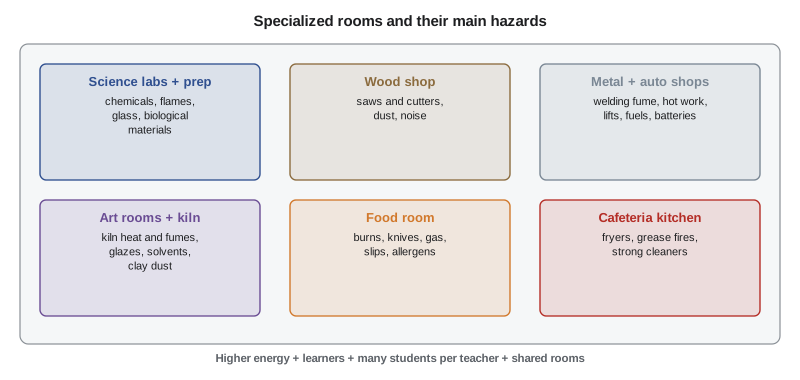
Most of a school is ordinary classroom space, where the main hazards are the ones covered in HSE-360: slips, lifting, chemicals used for cleaning, indoor air and the stresses of working with large groups of young people. A handful of rooms are different. Science labs, technology shops, art studios and food rooms put students in front of hot plates, open flames, acids, power saws, welders, kilns, deep fryers and sharp knives, often in groups of twenty-five or thirty, and often with one adult in charge. These rooms are where the most serious student injuries in schools happen, and they are also where some of the most valuable learning happens. This course is about keeping both of those things true at once: real hands-on work, with the hazards controlled.
The course follows staff at Pinecrest Secondary School in the invented Riverbend District School Board, the same setting as HSE-360. Pinecrest Secondary School is a 1968 building with additions from 1989 and 2011. It has six science labs with two shared prep rooms, a wood shop, a metal and welding shop, an automotive shop, a construction technology area, two art rooms with a kiln room, a food and nutrition room with eight kitchen stations, and a cafeteria kitchen run by contracted food service staff. Willow Park Elementary, a K-8 school in the same board, has a single science room used by the Grade 7 and Grade 8 classes and a small art room with a used kiln.
The people in this course
- Hannah Osei teaches chemistry, chairs the science department and is the worker co-chair of the school's joint health and safety committee.
- Kevin Park is the science technician who prepares materials for the science labs, keeps the chemical inventory and looks after the prep rooms.
- Greg Mahler teaches wood and construction technology and has run the wood shop for eleven years.
- Tom Brennan teaches automotive and metalwork, including welding.
- Lucia Ferraro teaches visual arts, including ceramics, printmaking and painting.
- Anita Desai teaches food and nutrition and runs the school's catering club.
- Marion Clarke is the principal, and Daniel Lefebvre is the board's health and safety officer.
- Victor Alvarez is the head custodian, whose crew cleans every one of these rooms and is often the first to find a problem.
Why these rooms are different
Four features set labs, shops, studios and food rooms apart from ordinary classrooms.
First, the energy involved is much higher. A table saw blade turns at several thousand revolutions per minute. A welding arc reaches thousands of degrees. A kiln firing stoneware climbs past 1,200 °C (2,200 °F). A deep fryer holds litres of oil at about 180 °C (350 °F). Concentrated acids and bases can burn skin in seconds. When something goes wrong in these rooms, the injuries are amputations, deep burns, eye injuries and poisonings, not bruises.
Second, the people doing the work are learners. Students are, by definition, still developing the skill and judgement to work safely. They are often enthusiastic, sometimes impatient, easily distracted by friends, and rarely aware of how quickly a machine or a chemical can hurt them. A professional cabinetmaker has thousands of hours at the saw; a Grade 10 student may have twenty minutes.
Third, the ratio of supervisors to workers is unusual. In an industrial shop, a supervisor might oversee a crew of six or eight trained adults. In a school shop, one teacher may be responsible for twenty-four students, all at different machines or benches, some of whom have never used the equipment before. That ratio shapes almost every control in this course: room layout, machine selection, the order in which students are trained, and the rules about which machines are used when.
Fourth, the rooms are shared and change hands. A science lab is used by several teachers through the day, by night-school classes, and by custodians in the evening. A shop may be used by a robotics club after school. An art room's kiln may be loaded on Friday and left firing overnight. Every handover is a chance for something to be left on, left out or left unlabelled.
Who is responsible
Ontario's Occupational Health and Safety Act protects the staff who work in these rooms. The board is the employer, the principal and department heads act as supervisors, and teachers and science technicians are workers. Students are not workers under the OHSA, but the Education Act and its regulations give teachers and principals a duty of care for students, including a duty to see that reasonable safety procedures are carried out in their courses and activities. In practice, the controls that protect staff and the controls that protect students are almost always the same: a guarded saw protects the teacher demonstrating it and the student using it.
This dual duty matters. When an inspector visits a school shop, the questions are about the staff: is the saw guarded, is the lockout procedure followed, is the welding exhaust working. When a parent or a court asks about a student injury, the questions are about supervision, instruction and whether the school did what a careful parent would do. A well-run room answers both.
Where to find guidance
School lab and shop safety draws on several sources, and staff do not need to memorize them, but they should know they exist:
- The OHSA and its regulations, including the WHMIS regulation (Regulation 860) and the machine-guarding and lockout provisions that apply to industrial workplaces, which school boards commonly use as the benchmark for school shops.
- The Education Act and its regulations, which set out teachers' and principals' duties for student safety.
- The Ontario curriculum documents for science, technological education and the arts, which include expectations that students learn and follow safe practices.
- The Science Teachers' Association of Ontario (STAO), which publishes safety guides for elementary and secondary science, including guidance on chemicals, facilities and demonstrations.
- The board's own procedures, which turn all of this into rules for its schools.
The four questions for every room
Every specialized room can be checked with the same four questions. They come up again and again in this course.
- Is the room right? Layout, ventilation, emergency equipment, storage, electrical supply, and enough space for the number of students.
- Is the equipment right? Machines guarded and maintained, fume hoods and dust collectors working, kilns and ranges vented, chemicals limited to what the curriculum needs.
- Are the people ready? Teachers trained and competent in the equipment they teach, students instructed and tested before they use a machine, and supervision planned for the size and age of the class.
- Are the procedures written and followed? Safety rules posted and taught, lockout and cleanup procedures, emergency procedures practised, and incidents reported.
A gap in any one of these can undo the others. A perfectly guarded saw is still dangerous in a room with thirty students and no clear walkways. A well-trained teacher still cannot supervise properly if the class has grown by ten students since September.
Class size and space
Room capacity is one of the most important and most overlooked controls. Science and technology teachers' associations commonly recommend limits on lab and shop class sizes and minimum floor areas per student, because crowding increases collisions, spills and the chance that a student is out of the teacher's sight. The exact figures vary by source and by room type, but the principle is consistent: a room designed for 24 students at lab stations should not routinely hold 32.
At Pinecrest Secondary School, the timetable once placed 31 students in a lab with 12 stations. Hannah raised it with Marion, citing the department's own procedure, which sets a maximum of 24 students in the senior labs. The class was split the following term. The program below shows a simple check a department head can run each term against the timetable.
# Check timetabled class sizes against each room's safe capacity.
rooms = {"Lab 204": 24, "Lab 206": 24, "Wood shop": 20, "Metal shop": 18, "Food room": 24, "Art 112": 28}
classes = [
    ("Chemistry, period 1", "Lab 204", 23),
    ("Chemistry, period 3", "Lab 204", 31),
    ("Wood tech, period 2", "Wood shop", 22),
    ("Welding, period 4", "Metal shop", 16),
    ("Food, period 2", "Food room", 24),
    ("Ceramics, period 3", "Art 112", 27),
]
for name, room, n in classes:
    cap = rooms[room]
    flag = "OVER by %d" % (n - cap) if n > cap else "ok"
print(f"{name:22} {room:10} {n:3d} / {cap:2d} {flag}")Chemistry, period 1 Lab 204 23 / 24 ok Chemistry, period 3 Lab 204 31 / 24 OVER by 7 Wood tech, period 2 Wood shop 22 / 20 OVER by 2 Welding, period 4 Metal shop 16 / 18 ok Food, period 2 Food room 24 / 24 ok Ceramics, period 3 Art 112 27 / 28 ok
Two classes are flagged. Neither is necessarily unsafe today, but both are worth a conversation with the principal before the term starts, not after an incident.
Specialized rooms in elementary schools
Willow Park shows that these hazards are not limited to secondary schools. Elementary teachers may run science activities with hot water, vinegar and baking soda, magnets, batteries and small amounts of household chemicals; Grade 7 and Grade 8 students may do more formal experiments in a science room. Art programs may use a kiln, often one donated or bought second-hand, sometimes installed in a storage closet without proper venting. Many elementary teachers have little formal training in lab safety, and there may be no science technician or department head to ask. This course flags the points where elementary schools need extra care, such as the kiln, the old chemical cupboard nobody has opened in years, and the classroom demonstration copied from a video online.
How this course is organized
Lessons 2 to 5 cover science labs: the room and its emergency equipment, chemical storage and inventory, demonstrations and experiments, and biological materials. Lessons 6 to 8 cover technology shops: machine guarding and lockout, wood dust, noise and digital fabrication, and welding, metalwork and automotive work. Lesson 9 covers art rooms and kilns, and Lesson 10 covers food rooms and school kitchens. Lesson 11 deals with chemical waste, spills and the response to an incident in any of these rooms, and Lesson 12 brings it all together: teaching students to work safely, supervising them, and building a yearly check of every specialized room in the school. Throughout, the aim is not to remove hands-on work from the curriculum but to make it safe enough that students can do it with confidence.
Worked problem
The first walk-through
Daniel joins Hannah, Greg, Tom, Lucia and Anita for a walk-through of the specialized rooms at Pinecrest Secondary School in late August, before students arrive. In the art room, the kiln vent hood is unplugged. In the wood shop, the dust collector bag is full. In Lab 206, the eyewash station has a box of glassware stacked in front of it. In the food and nutrition room, one range's oven door does not close properly. How should the team handle what it finds?
Show solution
- Record each item on the inspection form with the room, the hazard and a photo, so nothing depends on memory.
- Fix what can be fixed on the spot: plug in and test the kiln vent, move the glassware away from the eyewash and flush it to check it works.
- Rate the rest by risk: the dust collector and the range need work orders, and the range should not be used until it is repaired.
- Assign each item to a person with a date: Victor's crew empties the collector bag this week; the board's maintenance department repairs the range before classes start.
- Bring the list to the next joint health and safety committee meeting, so the committee can check that every item is closed.
Answer: Record everything, fix what can be fixed immediately, rate and assign the rest with dates, take unsafe equipment out of service, and track the list to closure through the committee.
Common mistakes
MistakeTreating a lab or shop like an ordinary classroom.
InsteadSpecialized rooms need their own layout, equipment checks, training and procedures.
MistakeAssuming student safety and staff safety are separate problems.
InsteadThe same controls usually protect both, and both duties apply.
MistakeLetting class sizes grow past the room's safe capacity.
InsteadCheck timetabled numbers against room capacity every term.
MistakeAssuming elementary schools have no lab or shop hazards.
InsteadKilns, old chemicals and classroom demonstrations need care in elementary schools too.
MistakeInspecting specialized rooms only when there is a complaint.
InsteadWalk through them before each school year and inspect them regularly.
Summary and key terms
- Labs, shops, art rooms and food rooms involve far more energy than ordinary classrooms, so injuries are more serious.
- Students are learners, and one teacher often supervises many of them at once.
- Shared rooms and handovers create chances for hazards to be left behind.
- Employers owe duties to staff under occupational health and safety law, and schools owe students a duty of care.
- Check every room with four questions: the room, the equipment, the people and the procedures.
- Class size and floor space are controls in their own right.
- Elementary schools have specialized-room hazards too, especially kilns and old chemicals.
- Specialized room
- A school space with hazards beyond an ordinary classroom, such as a lab, shop, art studio or food room.
- Duty of care
- The legal obligation of a school and its staff to take reasonable care for students' safety.
- Room capacity
- The maximum number of students a lab or shop can safely hold, based on stations and floor space.
- Prep room
- A room next to a science lab where chemicals and equipment are stored and prepared.
- Walk-through
- A planned inspection of rooms to find hazards before they cause harm.
Practice problems
Work each problem on paper first, then reveal the answer to check.
Name four features that set labs and shops apart from ordinary classrooms.
Show answer
Higher energy, learners doing the work, a high student-to-teacher ratio, and shared rooms that change hands.
Are students workers under occupational health and safety law?
Show answer
No, but schools owe them a duty of care, and the same controls usually protect both staff and students.
What are the four questions for every specialized room?
Show answer
Is the room right, is the equipment right, are the people ready, and are the procedures written and followed?
Why does class size matter in a lab or shop?
Show answer
Crowding increases collisions and spills and makes it harder for the teacher to see every student.
What specialized-room hazards are common in elementary schools?
Show answer
Kilns, old chemicals and classroom demonstrations.
Lesson quiz · 5 questions
Score 60% or more to complete this lesson.
Create a free account to save your progress, take quizzes and earn a certificate.