
HSE-361 · Lesson 10 of 12 · 20 min
Food rooms and school kitchens: burns, knives, gas, allergens and hygiene
Food rooms teach practical life skills: planning meals, handling food safely, cooking on a budget and, in culinary programs, working in a professional kitchen. They also contain hot ovens and ranges, boiling liquids, sharp knives, electrical appliances, gas, slippery floors and food allergens, all used by students who may never have cooked at home. School cafeteria kitchens, run by school or contracted staff, have the same hazards on a larger scale. Anita Desai teaches food and nutrition at Pinecrest Secondary School and runs a catering club that prepares lunches for school events. This lesson follows her room and the cafeteria kitchen down the hall.
Burns and scalds
Burns and scalds are the most common serious injuries in school food rooms. They come from:
- Hot liquids: boiling water, soup and sauces, especially when pots are carried across the room or knocked off the range.
- Hot oil: deep frying and shallow frying, where oil can splatter, overflow when wet food is added, or catch fire if overheated.
- Steam: from lifting pot lids, opening microwave containers and draining pasta.
- Hot surfaces: oven racks, pans, baking sheets and range elements.
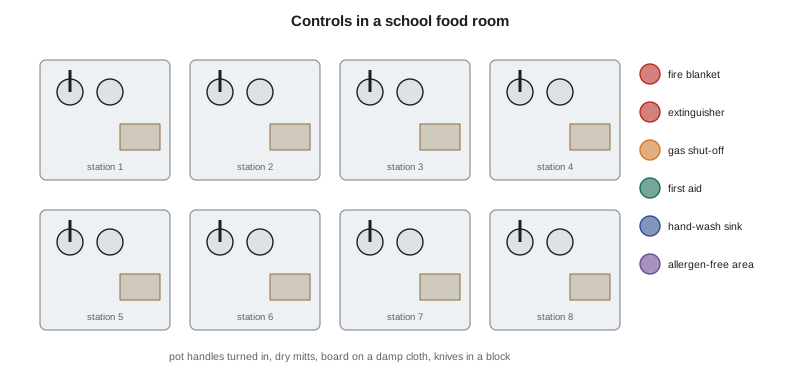
Controls include turning pot handles inward so they cannot be knocked, using back burners where possible, keeping the area around the range clear, using dry oven mitts (a wet mitt conducts heat and causes steam burns), lifting lids away from the face, and never carrying hot liquids through a crowded room. Students should know the immediate first aid for burns: cool the burn under cool running water for about 20 minutes, remove rings and tight items before swelling starts, and get medical help for anything larger than a small superficial burn. Ice, butter and creams should not be put on burns.
Deep fryers are a high-risk appliance in a classroom, and many school food programs do not use them with students. Where they are used, the fryer should have a thermostat and a high-temperature cut-off, be placed so it cannot be knocked, and be used only by trained students under direct supervision, with a lid nearby and a suitable extinguisher in the room.
Kitchen fires
Most kitchen fires start with cooking left unattended or with grease. A pan of oil on high heat can reach its ignition temperature within minutes. Water must never be used on a grease fire, because it turns to steam instantly and throws burning oil out of the pan. The safe response to a small pan fire is to turn off the heat, slide a lid or a baking sheet over the pan to smother it, and leave it covered until it cools. For larger fires, staff should use the right extinguisher or pull the fire alarm and leave.
Commercial kitchens with deep fryers and grills, such as the cafeteria, use Class K wet chemical extinguishers designed for cooking oils, and many have automatic fire suppression systems in the range hood. Food rooms with ordinary ranges usually have a multipurpose extinguisher and a fire blanket. Teachers should know which extinguisher is in the room and when to use it.
Knives and cutting
Knife cuts are the second most common injury in food rooms. Surprisingly, dull knives cause more injuries than sharp ones, because they slip and need more force. Controls include:
- Keeping knives sharp, and choosing the right knife for the task.
- Teaching the claw grip, with fingertips curled under and knuckles guiding the blade, and the bridge grip for cutting round items.
- Cutting on a stable board, with a damp cloth or non-slip mat underneath so it does not slide.
- Carrying knives point down, beside the leg, and announcing 'knife' or 'sharp' when walking behind others.
- Never trying to catch a falling knife.
- Washing knives separately, never leaving them in a sink of soapy water where someone could reach in and be cut.
- Storing knives in a block, magnetic strip or sheath, not loose in a drawer.
Mandolines, food processors, blenders and electric slicers have blades that cause severe cuts. Guards and food holders must be used, appliances are unplugged before cleaning or changing blades, and many school programs restrict slicers to the teacher or to senior culinary students.
Gas and electrical appliances
Many food rooms have gas ranges. Students should be taught to check that the burner lights immediately and to turn the gas off if it does not, rather than letting gas build up before trying again. A gas smell means turning off burners, ventilating, avoiding switches and flames, and reporting it; a strong smell means evacuating and calling for help. Rooms with gas should have an emergency gas shut-off, and the range hood should be on while cooking to remove heat, steam and combustion products.
Electrical appliances near sinks need GFCI-protected outlets. Cords should be kept away from hot surfaces and water, appliances with damaged cords taken out of service, and hands dry when plugging and unplugging. Microwave ovens can superheat water and cause sudden boiling when a cup is moved, and sealed containers and eggs in their shells can burst.
Slips, trips and lifting
Kitchen floors get wet and greasy. Spills should be cleaned immediately, wet floor signs used, and students should wear closed, non-slip shoes in food labs. Mats at sinks and ranges should lie flat. Lifting large pots, sacks of flour or cases of cans can strain backs; heavy items belong on lower shelves, carts should be used for moving loads, and large pots of liquid should be filled and emptied in place where possible, or carried by two people.
Food safety and hygiene
Food rooms must also keep the food itself safe to eat. Foodborne illness can affect a whole class or the guests at a catering event. The core practices are:
- Hand washing before handling food, after handling raw meat, eggs or poultry, after using the washroom, and after touching the face or hair, at a sink used only for hand washing.
- Keeping raw and ready-to-eat foods apart, with separate cutting boards and utensils.
- Cooking foods to safe internal temperatures, checked with a probe thermometer.
- Keeping cold foods cold and hot foods hot, and not leaving perishable food at room temperature for long periods.
- Cleaning and sanitizing surfaces and equipment.
- Excluding anyone with vomiting or diarrhea from food preparation.
Ontario's food premises regulation requires that food premises, such as a school cafeteria, have a certified food handler or supervisor on site during operating hours, and public health units inspect them. Food rooms used only for teaching may not be inspected in the same way, but the same practices apply, and many schools have food and nutrition students earn food handler certification as part of the course.
The program below checks cooked foods against safe internal temperatures, using commonly published guidance.
# Check probe readings against commonly published safe internal temperatures (degrees C).
safe = {"poultry": 74, "ground beef": 71, "pork": 71, "fish": 70, "leftovers reheated": 74}
readings = [
    ("chicken thighs, station 3", "poultry", 76),
    ("burgers, station 5", "ground beef", 66),
    ("salmon, station 1", "fish", 71),
    ("chili reheated, catering", "leftovers reheated", 69),
]
for item, kind, temp in readings:
    target = safe[kind]
    status = "safe" if temp >= target else f"keep cooking (needs {target} C)"
print(f"{item:28} {temp:3d} C {status}")chicken thighs, station 3 76 C safe burgers, station 5 66 C keep cooking (needs 71 C) salmon, station 1 71 C safe chili reheated, catering 69 C keep cooking (needs 74 C)
Two items need more cooking. The probe thermometer, inserted in the thickest part, is the only reliable test; colour and texture are not.
Allergens
Food allergies can cause anaphylaxis, a severe reaction that can be fatal within minutes. Food rooms handle many of the most common allergens, such as peanuts, tree nuts, milk, eggs, wheat, soy, fish, shellfish and sesame, and cross-contact can happen through shared utensils, surfaces and even airborne flour. Teachers must know which students have food allergies and their emergency plans, keep epinephrine auto-injectors accessible according to the student's plan, check ingredient labels every time, and plan recipes so that students with allergies can take part safely. Many schools avoid peanuts and tree nuts entirely in food rooms. Catering for events requires labelling dishes with their allergens.
Ontario's Sabrina's Law requires school boards to have anaphylaxis policies, including individual plans for students at risk and staff training. HSE-363 covers allergies and anaphylaxis in detail.
Worked problem
Smoke at station 6
During a food and nutrition class, a student at station 6 leaves a frying pan of oil on high heat to fetch ingredients. Anita sees smoke rising and then a flame in the pan. A student grabs a cup of water. What should Anita do?
Show solution
- Stop the student with the water: water on a grease fire throws burning oil out of the pan.
- Turn off the heat at the range.
- Slide the pan lid or a baking sheet over the pan to smother the flame, and leave it covered until it cools.
- If the fire spreads beyond the pan, get students out, pull the alarm and use the extinguisher only if it is safe and she is trained.
- Afterwards, report the incident, check that no one was burned, and use it to reteach the rules: never leave oil heating, keep lids nearby, and never use water on grease.
Answer: Stop the water, turn off the heat, smother the pan with a lid, evacuate if it spreads, and report and reteach.
The cafeteria kitchen and contracted staff
Many school cafeterias are run by a contracted food service company, whose staff work in the school but are employed by someone else. That creates a shared responsibility. The contractor is responsible for its own workers' training, procedures and protective equipment, while the school and the board are responsible for the building, the ventilation, the gas supply, the fire suppression system and the coordination between them. At Pinecrest Secondary School, the cafeteria manager and Marion meet at the start of each year to go over emergency procedures, who reports building problems to whom, and how the kitchen's fire suppression system and hood cleaning are scheduled and documented. Grease build-up in range hoods and ducts is a serious fire hazard, so commercial hood systems are cleaned by specialists on a regular schedule.
Cleaning chemicals in kitchens
Kitchens use strong cleaning chemicals: oven and grill cleaners that are often highly corrosive, degreasers, dishwasher detergents and sanitizers. They need the same care as lab chemicals: WHMIS labels and SDSs, gloves and eye protection when using concentrated products, dispensers or measuring cups for dilution, storage away from food and below food on shelving, and never mixing products. Sanitizer solutions should be checked with test strips so they are strong enough to work but not so strong that they leave harmful residues. Students in food and nutrition classes should use only the cleaning products the teacher provides, in the strengths the teacher has prepared, and should never use oven cleaner or other corrosive products.
Supervision in the food room
A food room with eight stations and twenty-four students is a busy, noisy place with eight ranges running at once. Anita circulates constantly, watching for pot handles sticking out, students leaving the range, knives on the edge of the counter and spills on the floor. She does not leave the room while ranges are on, and if she must step out, all heat is turned off first.
Common mistakes
MistakeThrowing water on a grease fire.
InsteadTurn off the heat and cover the pan with a lid.
MistakeUsing a wet oven mitt.
InsteadUse dry mitts; wet ones conduct heat and cause steam burns.
MistakeLeaving knives in a sink of soapy water.
InsteadWash knives separately and store them safely.
MistakePutting ice or butter on a burn.
InsteadCool it under cool running water for about 20 minutes.
MistakeJudging chicken as cooked by its colour.
InsteadCheck the internal temperature with a probe thermometer.
Summary and key terms
- Burns and scalds are the most common serious injuries in food rooms; control hot liquids, oil, steam and surfaces.
- Never use water on a grease fire; turn off the heat and smother it.
- Teach safe knife skills, keep knives sharp, and use guards on slicers and mandolines.
- Gas ranges need safe lighting, ventilation and an emergency shut-off; outlets near sinks need GFCIs.
- Prevent slips with prompt cleanup and non-slip shoes.
- Follow food safety practices, including hand washing, separation and checking temperatures.
- Know students' allergies and emergency plans, avoid cross-contact and label allergens.
- Scald
- A burn caused by hot liquid or steam.
- Class K extinguisher
- A wet chemical extinguisher designed for cooking oil and grease fires.
- Claw grip
- A knife technique with fingertips curled under, keeping them away from the blade.
- Cross-contact
- When an allergen is transferred to a food that should not contain it.
- Anaphylaxis
- A severe, rapid allergic reaction that can be fatal.
Practice problems
Work each problem on paper first, then reveal the answer to check.
How long should a burn be cooled under cool running water?
Show answer
About 20 minutes.
What should you do if oil catches fire in a pan?
Show answer
Turn off the heat and slide a lid or baking sheet over the pan.
Why are dull knives dangerous?
Show answer
They slip and need more force.
What is the only reliable way to tell if meat is cooked safely?
Show answer
Check the internal temperature with a probe thermometer.
What is cross-contact?
Show answer
When an allergen is transferred to a food that should not contain it.
Lesson quiz · 5 questions
Score 60% or more to complete this lesson.
Create a free account to save your progress, take quizzes and earn a certificate.