
HSE-342 · Lesson 9 of 12 · 25 min
Cardboard balers and compactors
A busy grocery store throws away several tonnes of corrugated cardboard a week. Balers crush it into dense bales that recyclers buy, and compactors crush garbage into containers that are hauled away. Both machines work by pushing a heavy steel plate, the platen or ram, down or across a chamber with many tonnes of force. That force is exactly what makes them useful and exactly what makes them among the most dangerous machines in a store. Workers have been killed and seriously injured in balers and compactors after reaching or climbing into the chamber, often while trying to clear a jam or with a safety interlock bypassed, and some of those killed were teenagers. Laws on young workers single these machines out for that reason.
This lesson covers how balers and compactors work, how people get hurt, the safeguards they must have, how to operate them safely, bale handling and the rules for young workers. Lesson 10 covers lockout for clearing jams, cleaning and maintenance.
Types of machine
- Vertical baler: the most common type in stores. Cardboard is loaded through a front gate into a chamber; when the gate is closed, a platen moves down to compress it. After several cycles the bale is tied with wire or strapping and ejected out the front, often by a chain or a tilting mechanism. Bales from a typical store vertical baler weigh several hundred kilograms.
- Horizontal baler: a larger machine used in big stores and distribution centres, fed by a conveyor or a hopper, with a ram that pushes horizontally and automatic tying. Workers do not load it by hand, but they clear jams and maintain it.
- Self-contained compactor: a compactor and sealed container in one unit, used for wet garbage. It is fed through a door or chute, often through the building wall, and the whole unit is hauled away when full.
- Stationary compactor: a compactor that pushes garbage into a separate roll-off container, which is hauled away while the compactor stays.
Northfield has a vertical baler near the dock and a self-contained compactor outside the back wall, fed through a chute with a door inside the backroom.
How people get hurt
The hazards fall into a few groups.
- Caught in the chamber: a worker reaches or climbs into the chamber to push down cardboard, straighten a box or clear a jam, and the platen comes down. This is the cause of most deaths. It happens when the gate interlock has been bypassed or is faulty, when another worker starts the machine without knowing someone is inside, or when the worker relies on the machine being switched off rather than locked out.
- Struck by the bale: during ejection, a bale weighing hundreds of kilograms can fall forward or roll. Workers standing in front of the baler, or trying to catch or steer the bale, can be crushed.
- Tie wire and strapping: baling wire under tension can whip when cut or when a bale bursts, and its ends cut hands.
- Falling into the compactor: workers have fallen into compactor hoppers and chutes while pushing garbage down or retrieving items.
- Fire: cardboard dust and fluff in and around a baler burn easily; a spark from a damaged electrical part or a discarded cigarette can start a fire.
- Slips, trips and strains around the machine from loose cardboard, wire and heavy lifting.
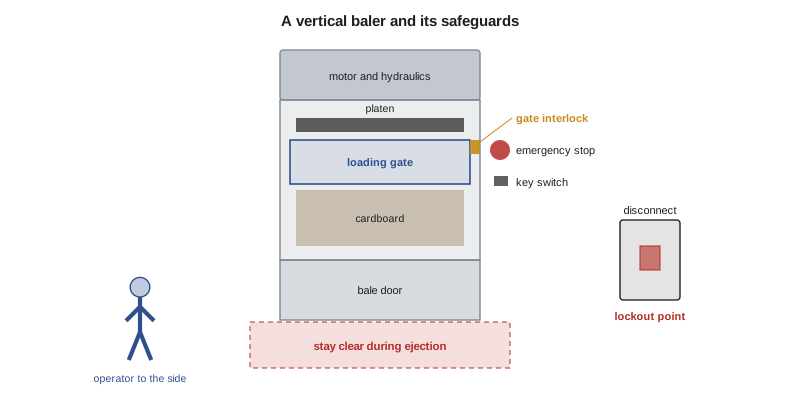
Safeguards balers and compactors must have
A modern baler or compactor has several layers of protection. Each one exists because people were killed without it.
- Interlocked loading gate or door: the machine cannot cycle while the gate is open, and opening it during a cycle stops the platen. The interlock must not be bypassed, taped, wedged or wired out of circuit.
- Key-switch or code control: a removable key or code means only authorized operators can start the machine. The key should stay with an authorized adult, not hang on a hook beside the machine.
- Emergency stop: a large red button within easy reach that stops all motion.
- Guards on moving parts and the chamber openings, so hands cannot reach the platen except through the interlocked gate.
- Hazard labels: clear labels showing the hazards, who may operate the machine and that minors may not operate it.
- A lockable energy isolating device: an electrical disconnect that can be locked in the off position for lockout (Lesson 10).
- Compactor chutes and doors: interlocked so the ram cannot cycle while the chute door is open, and designed so a person cannot fall or climb into the ram's path.
British Columbia's OHS Regulation requires safeguards on machinery that prevent workers from reaching dangerous parts and requires lockout before work inside a machine. The design standards that balers and compactors are built to in North America are the American National Standards Institute's ANSI Z245 series; Canadian buyers usually specify machines built to those standards and certified for electrical safety.
Operating a baler safely
Only trained, authorized adults operate the baler. A safe operating routine at Northfield looks like this:
- Check the machine at the start of the shift: gate interlock works (the machine will not start with the gate open), emergency stop works, guards and labels are in place, no hydraulic leaks, no damaged wire or strapping in the chamber, and the area around the machine is clear.
- Load cardboard through the gate only with the gate open and the platen fully up and stopped. Flatten boxes first. Never put your head, arms or body inside the chamber.
- Keep out materials that do not belong: plastic, wood, metal, glass and aerosol cans can jam the machine, damage it or burst. Many recyclers also reject bales with contamination.
- Close the gate fully and start the cycle with the key switch. Stand clear and watch the cycle. Never reach in while the platen is moving.
- If cardboard jams, bunches or a box needs straightening, stop. If it can be cleared from outside the chamber with a tool while the machine is stopped and the platen is up, do that. If anyone has to put any part of their body inside the chamber, lock the machine out first (Lesson 10).
- When the bale is full, follow the manufacturer's tying and ejection procedure. Stand to the side, never in front, during ejection. Do not try to catch or steer a falling bale.
- Remove the key when you leave the machine.
Bales and their weight
A finished bale is heavy, dense and hard to move. It must be handled with a pallet jack or hand truck designed for bales, never pushed or rolled by hand except for small adjustments with the bale on the floor. Bales should be stored on the floor or on a pallet, no more than two high unless the store has racking rated for them, and never stacked where they could fall onto a walkway. Cut tie wires only when the bale is secured, standing to the side and wearing gloves and eye protection.
The program below estimates the weight of Northfield's bales and how many it produces each week, so the store can plan handling and storage. Densities for baled cardboard vary with the baler and the material; the value used here is illustrative.
# Estimate bale weight and weekly bale count (illustrative density and volumes).
bale_l, bale_w, bale_h = 1.52, 0.76, 1.07     # m, typical vertical baler bale (about 60 x 30 x 42 in)
density = 320                                 # kg per m3 of baled cardboard (illustrative)
volume = bale_l * bale_w * bale_h
weight = volume * density
print(f"Bale volume {volume:.2f} m3, weight about {weight:.0f} kg ({weight * 2.2046:.0f} lb)")
cardboard_per_week = 4.2 * 1000               # kg of cardboard per week (store estimate)
bales = cardboard_per_week / weight
print(f"About {bales:.1f} bales per week, {bales / 7:.1f} per day")
# minutes of loading per bale if each load cycle adds about 18 kg of flattened cardboard
cycles = weight / 18
print(f"About {cycles:.0f} load cycles per bale")
for name, limit in (("one person by hand", 25), ("two people by hand", 50)):
print(f"{name}: limit about {limit} kg -> bale is {weight / limit:.0f} times too heavy")Bale volume 1.24 m3, weight about 396 kg (872 lb) About 10.6 bales per week, 1.5 per day About 22 load cycles per bale one person by hand: limit about 25 kg -> bale is 16 times too heavy two people by hand: limit about 50 kg -> bale is 8 times too heavy
Each bale weighs around 400 kg (870 lb), about eight times what two people should lift together, and the store makes about ten a week. That is roughly one and a half a day, so bale handling is a daily task, not an occasional one, and Northfield keeps a bale cart beside the baler. The roughly 22 load cycles per bale also explain why the baler is used so often and why shortcuts at the gate are so tempting: a worker who reaches in to straighten a box 22 times a bale is taking the same risk 22 times.
Compactors
Compactors handle garbage, which brings wet, heavy and sometimes sharp waste. Feed the compactor only through its chute or loading door with the ram stopped and the door interlock working. Never push garbage into the ram area with your body, a foot or a long pole while it can cycle. Never climb into the hopper or onto the container to retrieve something; if anything valuable goes in, such as keys or a wallet, stop and lock out before anyone reaches in, or wait for the hauler. Keep the area around the chute clean, because spills and broken glass make it slippery and sharp. Report full or overflowing containers rather than packing them by hand.
Young workers and balers
British Columbia restricts the hazardous work that workers under 19 may do, and WorkSafeBC's young worker guidance identifies balers and compactors as equipment that young and new workers should not operate without close supervision and training. Many employers, Northfield among them, go further and ban workers under 18 from operating balers and compactors at all. At Northfield, Jess, who is 17, may load flattened cardboard into the baler through the gate only when the platen is up, the machine is switched off with the key held by an adult operator, and that operator runs every cycle. She may not start, stop, tie or eject a bale, and Kai, who is 15, may not work near the baler.
For supervisors: the baler is a high-risk machine, every day
Because the baler is used so often, it is easy to forget how dangerous it is. Make it a daily habit to check that the gate interlock works and has not been tampered with; a bypassed interlock is a reason to take the machine out of service at once and to find out who did it and why. Keep the key with authorized adults, not on a hook. Watch for workers reaching in to push cardboard down, which usually means the chamber is being overfilled or boxes are not flattened. Make sure young workers never operate it, even when the crew is short. And keep the area around the baler clear of loose cardboard, which is both a trip hazard and fuel for a fire.
Worked problem
A bypassed interlock
On a busy Saturday, Marco finds a folded piece of cardboard wedged into the baler's gate switch, so the baler runs with the gate partly open. A worker explains that the crew does this to push down cardboard while the platen is cycling, because it saves time. What should Marco do?
Show solution
- Stop the baler, remove the key, switch off and lock the disconnect, and tag the machine out of service.
- Remove the wedge and have the interlock tested, and repaired if needed, before the baler is used again.
- Talk with the crew without blame for the moment: find out why they felt they needed to. Common reasons are overfilled chambers, unflattened boxes or pressure to keep up.
- Fix the cause: flatten boxes before loading, load smaller amounts, cycle more often and add a cardboard cart so loose boxes do not pile up.
- Retrain everyone on the baler, make clear that bypassing an interlock is a serious breach, and record the event as a high-potential near miss.
Answer: Take the baler out of service, restore and test the interlock, find and fix why the crew bypassed it, retrain them and record it as a serious near miss.
Common mistakes
MistakeWedging or taping the gate interlock to save time.
InsteadNever bypass an interlock; take the machine out of service if one is found bypassed.
MistakeReaching into the chamber to straighten a box while the machine is switched on.
InsteadStop, clear from outside with a tool if possible, and lock out before any body part goes in.
MistakeStanding in front of the baler during ejection.
InsteadStand to the side and never try to catch a falling bale.
MistakeLeaving the baler key on a hook beside the machine.
InsteadKeep the key with authorized adult operators.
MistakeLetting a 17-year-old run the baler when the crew is short.
InsteadYoung workers may at most load under strict conditions; an authorized adult always operates.
Summary and key terms
- Balers and compactors crush material with great force and have killed workers who reached or climbed inside.
- Main hazards: caught in the chamber, struck by bales, tie wire, falling into compactors, fire and slips.
- Safeguards include interlocked gates, key switches, emergency stops, guards, labels and a lockable disconnect.
- Only trained adults operate the baler; never bypass an interlock and lock out before any body part goes inside.
- Bales weigh hundreds of kilograms; move them with bale carts or jacks and stand clear during ejection.
- BC limits hazardous work for young workers; Northfield bars anyone under 18 from operating balers and compactors.
- Baler
- A machine that compresses cardboard or other recyclables into dense bales.
- Compactor
- A machine that compresses garbage into a container.
- Platen
- The steel plate that moves down or across a baler chamber to compress material.
- Interlock
- A switch that stops a machine or prevents it starting when a gate or guard is open.
- Ejection
- Pushing or tipping a finished bale out of the baler.
- Key switch
- A control that needs a removable key or code to start the machine.
Practice problems
Work each problem on paper first, then reveal the answer to check.
What is the most common cause of deaths in balers and compactors?
Show answer
Workers reaching or climbing into the chamber, often while clearing jams or with an interlock bypassed.
Name four safeguards a baler should have.
Show answer
Any four of: interlocked gate, key switch, emergency stop, guards, warning labels, lockable disconnect.
What should you do if cardboard jams in the baler?
Show answer
Stop the machine; clear from outside with a tool if possible; lock out before any body part goes inside.
Where should you stand during bale ejection?
Show answer
To the side, never in front of the baler.
About how much does one of Northfield's bales weigh?
Show answer
Around 400 kg (870 lb).
Why are shortcuts at the baler gate so tempting?
Show answer
The machine is loaded many times per bale, so each shortcut is repeated many times.
What may Jess, who is 17, do at Northfield's baler?
Show answer
Load flattened cardboard only when the baler is switched off and an adult holds the key and runs every cycle.
What should a supervisor do on finding a bypassed interlock?
Show answer
Take the baler out of service, restore and test the interlock, find the cause and retrain the crew.
Lesson quiz · 5 questions
Score 60% or more to complete this lesson.
Create a free account to save your progress, take quizzes and earn a certificate.