
HSE-342 · Lesson 11 of 12 · 24 min
Housekeeping, exits and fire safety in backrooms
Housekeeping sounds like the least serious topic in this course, but it ties all the others together. A cluttered backroom is where trips happen, where pallet jacks have to squeeze past obstacles and pin people, where cardboard piles up beside the baler waiting to burn, where exits are blocked and fire extinguishers hidden, and where nobody can tell whether a rack is damaged because there is stock leaning against it. Stores that keep their backrooms in order have fewer injuries, find stock faster and do better on fire inspections. This lesson covers aisles and exits, fire load and ignition sources, chemicals, waste, pests and sanitation, and a simple inspection score that tracks housekeeping over time.
HSE-106 covers slips, trips, falls and housekeeping in every kind of workplace, HSE-105 covers fire safety and emergency preparedness, and HSE-340 Lesson 11 covered store emergencies, including blocked exits and evacuation. This lesson focuses on what the backroom adds.
Aisles, exits and access
Every backroom needs clear routes: for people walking, for pallet jacks and carts, and for getting out in an emergency. The most important rules are these.
- Exit routes and exit doors are never blocked, even briefly, even by a pallet waiting to be worked. Exit doors must open from the inside without a key or special knowledge, and exit signs must be lit.
- Main aisles stay wide enough for pallet jacks and people to pass safely, and marked walkways (Lesson 6) stay clear.
- Fire extinguishers, fire alarm pull stations, hose cabinets, eyewash stations and first aid kits stay visible and reachable, with nothing stored in front of them.
- Electrical panels need clear working space in front of them, usually about 1 m (3 ft), so they can be reached quickly to shut off power.
- Sprinkler clearance below deflectors (Lesson 8) is kept.
Blocked exits are one of the most common findings in fire and safety inspections of stores. British Columbia's Fire Code and OHS Regulation require exits and exit routes to be kept clear and usable at all times, and local fire departments inspect stores and issue orders for blocked exits and storage problems.
Cardboard, pallets and fire load
A backroom holds a lot of fuel. Cardboard, paper products, plastic wrap, wooden and plastic pallets and many stocked goods burn readily, and loose, crumpled cardboard burns much faster than flat, baled cardboard. Fire load is the amount of combustible material in an area; the more there is, and the more loosely it is piled, the faster a fire grows and the harder it is for sprinklers to control.
- Bale cardboard as you go rather than letting it pile up. A cardboard cart or cage near each work area, emptied into the baler regularly, keeps loose cardboard off the floor.
- Store finished bales away from ignition sources, exits and the building's electrical equipment, and haul them away regularly.
- Limit empty pallets inside. Stacks of empty wooden and especially plastic pallets are a severe fire hazard; fire codes limit how high and how many can be stored indoors without extra protection. Many stores keep empty pallets outside, away from the building, and return them on each truck.
- Keep combustibles away from heaters, light fixtures, battery chargers (Lesson 6), the baler's motor and electrical panels.
- Ban smoking in the backroom and at the dock, and give smokers a designated area away from cardboard and pallets.
- Control hot work. Contractors welding, cutting or grinding in the store need a hot work permit, a fire watch and combustibles cleared or covered.
Fires in store backrooms most often start from electrical faults, discarded smoking materials, heaters, hot work and sometimes arson in outside cardboard and pallet piles. Keeping fuel away from these ignition sources removes most of the risk.
Chemicals in the backroom
Stores keep cleaning chemicals, aerosols, lighter fluid, propane cylinders, paint, fertilizers, pesticides and pool chemicals, both as stock and for their own use. Most are safe in normal use but can be dangerous if stored badly. HSE-102 covers WHMIS and hazard communication labels and safety data sheets.
- Keep products in their original, labelled containers, and keep safety data sheets available.
- Store incompatible products apart. Pool chlorine and other oxidizers can react violently with acids, fuels, oils and some organic materials, and fires and toxic gas releases have started in stores where pool chemicals were stored next to other products or got wet. Keep them in a cool, dry place away from flammables and acids.
- Store aerosols in a cage or a separate area, away from heat, because heated cans can burst and become projectiles in a fire.
- Store propane cylinders outside in a locked cage, never in the backroom (HSE-353 covers propane exchange).
- Clean up spills promptly with the right spill kit, and handle leaking containers with gloves and eye protection.
Northfield's chemical cage held pool chlorine on the shelf below a case of acid drain cleaner. After reading the safety data sheets, Marco moved the pool chemicals to a separate shelf unit at the other end of the backroom, away from the cage, and added a bin of absorbent and a spill kit at each location.
Waste, sharps and sanitation
Backroom waste includes cardboard, plastic wrap, broken glass, damaged and spoiled goods, used box cutter blades and sometimes needles found in returns, carts or garbage. Each needs its own place.
- Plastic wrap and strapping go straight into a bin, not onto the floor, where they trip people and wind around pallet jack wheels.
- Broken glass is swept up with a broom and dustpan and put into a sturdy box marked broken glass, never into a plastic bag that someone will carry against their leg.
- Used blades go into a blade disposal container.
- Needles are picked up only with tongs or a grabber, placed in a sharps container and reported. HSE-340 Lesson 6 covers this.
- Spoiled food and wet waste go into the compactor promptly, because rotting waste attracts pests and creates slippery floors.
Pests such as rodents and insects are attracted to food, cardboard and clutter. Rodent droppings and nesting material can carry diseases and should be cleaned up by trained people with gloves and disinfectant, not swept up dry. A clean, uncluttered backroom with sealed doors and a pest control contract is the best defence.
Lighting and floors
Burned-out lights in the backroom and at the dock make it harder to see obstacles, rack damage and spills. Report and replace them quickly. Keep floors dry and clean; wet cardboard, crushed produce and leaking cases are common slip hazards. Floor drains, damaged concrete and raised thresholds also affect pallet jacks (Lesson 5). Anti-fatigue mats at fixed workstations, such as the online order packing table, should lie flat with bevelled edges.
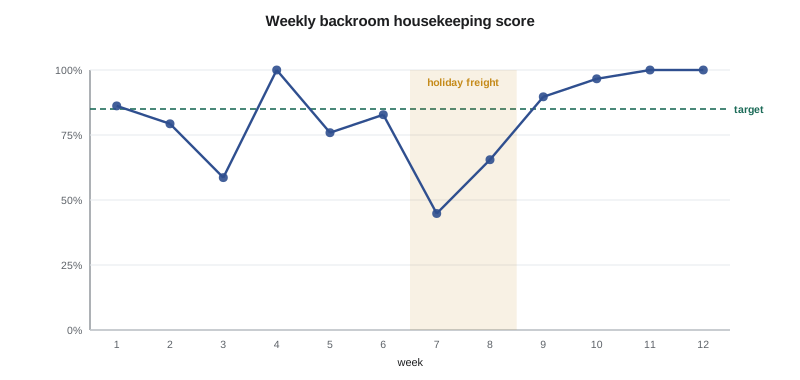
Scoring housekeeping
A housekeeping inspection with a short checklist, scored the same way each week, shows whether the backroom is improving and which items keep failing. Some items matter more than others, so the score is weighted, and a few items, such as a blocked exit, are treated as critical: they must be fixed immediately whatever the overall score. The program below calculates Northfield's weekly scores from its inspection records, fits a simple trend and lists the items that failed most often.
# Weekly backroom housekeeping scores (synthetic inspection results).
import random
random.seed(7)
items = {   # item: (weight, critical)
    "exits and exit routes clear": (5, True),
    "extinguishers and panels accessible": (4, True),
    "sprinkler clearance kept": (4, True),
    "main aisles clear": (3, False),
    "no loose cardboard on floor": (3, False),
    "empty pallets limited and stacked": (2, False),
    "wrap and strapping binned": (2, False),
    "chemicals stored correctly": (3, False),
    "lights working": (1, False),
    "floors dry and clean": (2, False),
}
total = sum(w for w, _ in items.values())
fails = {k: 0 for k in items}
scores = []
for week in range(1, 13):
    p_pass = 0.6 + 0.03 * week - (0.15 if week in (7, 8) else 0)   # improving, holiday dip
    got, critical = 0, []
    for name, (w, crit) in items.items():
        ok = random.random() < min(p_pass, 0.98)
        if ok:
            got += w
        else:
            fails[name] += 1
            if crit:
                critical.append(name)
    pct = 100 * got / total
    scores.append(pct)
    flag = " CRITICAL: " + ", ".join(critical) if critical else ""
    print(f"week {week:2d}: {pct:5.1f}%{flag}")
n = len(scores)
xbar, ybar = (n + 1) / 2, sum(scores) / n
slope = sum((i + 1 - xbar) * (s - ybar) for i, s in enumerate(scores)) / sum((i + 1 - xbar) ** 2 for i in range(n))
print(f"Trend: {slope:+.1f} points per week")
print("Most frequent failures:", ", ".join(f"{k} ({v})" for k, v in sorted(fails.items(), key=lambda x: -x[1])[:3]))week 1: 86.2% CRITICAL: sprinkler clearance kept week 2: 79.3% week 3: 58.6% CRITICAL: exits and exit routes clear, sprinkler clearance kept week 4: 100.0% week 5: 75.9% CRITICAL: sprinkler clearance kept week 6: 82.8% CRITICAL: exits and exit routes clear week 7: 44.8% CRITICAL: exits and exit routes clear, sprinkler clearance kept week 8: 65.5% CRITICAL: extinguishers and panels accessible week 9: 89.7% week 10: 96.6% week 11: 100.0% week 12: 100.0% Trend: +1.7 points per week Most frequent failures: chemicals stored correctly (5), sprinkler clearance kept (4), exits and exit routes clear (3)
The scores rise over the twelve weeks, with a dip during the holiday freight weeks, when the backroom was fullest and the crew busiest. The trend line shows the overall direction despite the week-to-week noise. The critical items are what matter most on any single day: in the weeks where an exit, an extinguisher or the sprinkler clearance failed, the problem was fixed on the spot, whatever the score. The list of most frequent failures tells Marco where to put effort next. In this sample, chemical storage failed most often, followed by sprinkler clearance and exits, all of them items that slip when the backroom fills up; the chemical findings are what led to the separate shelf for pool chemicals described above.
Housekeeping as a habit
Good backroom housekeeping is not a big clean-up once a week. It is a set of small habits done all the time: put it back when you finish, bin the wrap as you cut it, bale as you go, never set anything down in an exit or an aisle, report the light that is out. Some stores use the 5S approach from manufacturing: sort what is needed from what is not, set everything in its place, shine or clean, standardize with marked locations and checklists, and sustain with regular checks. Painted floor markings for pallet staging, carts and the baler area make it obvious when something is out of place.
Working alone in the backroom at night, which is common on overnight crews, adds a reason for good housekeeping: a worker who trips or is hurt in a cluttered corner may not be found quickly. HSE-352 covers working alone and late-night safety, including check-in systems.
For supervisors: walk it every shift
A quick walk through the backroom at the start and end of every shift, looking at exits, extinguishers, panels, sprinkler clearance, aisles, cardboard and chemicals, catches most problems before they become incidents. Fix the critical items on the spot. Give the crew the tools to keep the backroom in order: enough cardboard carts, bins for wrap and strapping, marked places for pallets and equipment, and time in the schedule to bale and tidy. Thank people who keep their areas clean, and follow up when an area keeps failing.
Worked problem
The holiday freight crunch
In the week before the holidays, Northfield receives twice its normal freight. By Thursday, pallets are staged in the main aisle and in front of the rear exit, cardboard is piled beside the baler up to shoulder height, the pool chemicals have been moved next to the aerosols to make room, and an extinguisher is hidden behind a pallet of drinks. What should the supervisor do, and what should change for next year?
Show solution
- Right now: clear the rear exit and the extinguisher at once; these are critical.
- Move pallets out of the main aisle into marked staging areas, or onto the floor and into the racking as space allows.
- Bale the cardboard pile and move bales outside or to the bale area.
- Move the pool chemicals back to their separate location away from the aerosols and flammables.
- For next year: plan holiday freight with the distribution centre to spread deliveries, add temporary storage such as a trailer at the dock, schedule extra baling time and keep the exit and extinguisher locations marked so they cannot be filled.
Answer: Fix the critical items immediately, restore aisles, bale the cardboard, separate the chemicals and plan holiday freight better next year.
Common mistakes
MistakeStaging a pallet in front of an exit just for a few minutes.
InsteadNever block exits, even briefly; use marked staging areas.
MistakeLetting cardboard pile up beside the baler until the end of the shift.
InsteadBale as you go and use cardboard carts.
MistakeStoring pool chemicals next to acids, fuels or aerosols.
InsteadStore oxidizers in a cool, dry place apart from incompatible products.
MistakeSweeping up broken glass into a plastic bag.
InsteadPut it in a sturdy box marked broken glass.
MistakeRelying on a weekly clean-up.
InsteadBuild small housekeeping habits into every task, with a quick walk every shift.
Summary and key terms
- Good housekeeping prevents trips, collisions, fires and blocked exits and makes other hazards visible.
- Exits, extinguishers, panels and eyewash stations must always be clear and reachable.
- Cardboard, wrap and pallets are a large fire load; bale as you go, limit empty pallets and keep fuel away from ignition sources.
- Store chemicals in labelled containers, keep incompatibles such as pool chemicals and acids apart, and keep propane outside.
- Give each kind of waste its place: wrap bins, glass boxes, blade containers and sharps containers.
- A weighted weekly inspection score shows trends; critical items are fixed immediately.
- Housekeeping is a set of small habits, supported by tools, markings and time in the schedule.
- Housekeeping
- Keeping a workplace clean, orderly and free of obstructions and waste.
- Exit route
- A continuous, unobstructed path from any point in a building to a safe place outside.
- Fire load
- The amount of combustible material in an area.
- Oxidizer
- A chemical, such as pool chlorine, that can make other materials burn more intensely or react violently.
- Hot work
- Welding, cutting, grinding or other work that produces sparks or flames.
- 5S
- A workplace organization method: sort, set in order, shine, standardize and sustain.
Practice problems
Work each problem on paper first, then reveal the answer to check.
Name four things that must never be blocked in a backroom.
Show answer
Any four of: exits and exit routes, fire extinguishers, pull stations, electrical panels, eyewash stations, first aid kits.
Why is loose cardboard more dangerous than baled cardboard?
Show answer
Loose, crumpled cardboard burns much faster.
Why limit empty pallets inside?
Show answer
Stacks of empty pallets, especially plastic ones, are a severe fire hazard.
What is the hazard of storing pool chlorine near acids or fuels?
Show answer
Oxidizers can react violently, causing fires or toxic gas.
How should broken glass be disposed of?
Show answer
Swept up with a broom and dustpan into a sturdy box marked broken glass.
What is a critical item in the housekeeping score?
Show answer
An item, such as a blocked exit, that must be fixed immediately whatever the overall score.
In the scoring program, why did the scores dip in weeks 7 and 8?
Show answer
Holiday freight made the backroom fuller and the crew busier.
Name the five steps of 5S.
Show answer
Sort, set in order, shine, standardize and sustain.
Lesson quiz · 5 questions
Score 60% or more to complete this lesson.
Create a free account to save your progress, take quizzes and earn a certificate.