
HSE-342 · Lesson 8 of 12 · 24 min
Storage up high, mezzanines and falling objects
When backroom space runs short, stores go up. Overstock is stacked to the ceiling on top-stock shelving, seasonal goods go onto a mezzanine, and anything flat, including the roof of a walk-in cooler, becomes a shelf. Height brings three hazards at once: people falling while reaching or climbing, stock falling onto people below, and storage that blocks fire sprinklers. This lesson covers all three, using Northfield's mezzanine, its top-stock shelving and the cooler roof as examples. HSE-212 covers fall protection in depth, and HSE-340 Lesson 5 covers step stools and ladders on the sales floor.
Falls while reaching and climbing
Most falls in a backroom are not from great heights. They happen when a worker stands on a pallet, a milk crate, a case, the forks of a pallet jack or the lower beam of a rack to reach something just out of reach, and the makeshift step shifts, breaks or slips. A fall of only a metre or so onto a concrete floor, especially backward or onto the edge of a pallet, can break a wrist, a hip or a skull. Falls from higher up, such as from the top of a cooler or a mezzanine edge, can kill.
The rules for reaching high are simple. Use a proper ladder, rolling ladder, step platform or work platform, never a makeshift step. Rolling warehouse ladders with handrails and wheels that lock under load are the standard tool in many backrooms; they let a worker climb with both hands and work from a platform with a rail. Face the ladder, keep three points of contact while climbing and carry stock up with a tool belt, a hoist or a second person handing it up, not in your hands. Do not lean out beyond the rails. And never climb the racking itself: racks are not ladders, and a worker standing on a beam can pull a pallet onto themselves or fall into the flue space.
Inventory counts are a common trigger for climbing. Counting stock on the top shelves of top-stock shelving or the upper levels of racking tempts workers to climb for a quick look. Plan counts so that the right ladder or platform is there, use scanners on a lanyard so both hands are free for climbing, and count high stock in pairs.
Storage on top of walk-in coolers
The flat roof of a walk-in cooler or freezer looks like free storage, and in many stores it has been used that way for years. It is a poor idea. Cooler roofs are insulated panels designed to keep cold in, not to carry weight; most manufacturers set a low load limit or none at all, and heavy storage can crack panels, damage the refrigeration equipment on top and in rare cases collapse a ceiling panel inward. Getting stock up and down means climbing a ladder with a load to an unguarded edge, often 2.5 to 3 m (8 to 10 ft) above the floor, close to refrigeration lines and electrical equipment. And stock stacked on top often comes within the sprinkler clearance zone.
Northfield's cooler roof held boxes of seasonal decorations and spare shelving parts. After a near miss in which a stocker slipped on the ladder while lowering a box, Marco checked the cooler manufacturer's data, which said the roof was not designed for storage. The store cleared it and moved the seasonal stock to the mezzanine, which is built for it.
Mezzanines
A mezzanine is a raised floor inside the building, usually over offices or part of the backroom. Northfield's is a steel platform over the office, reached by a staircase, used for seasonal stock, display fixtures and supplies. Mezzanines are designed for a rated floor load, and that load should be posted. The hazards are falls from open edges and from loading points, stock falling over the edge onto people below, overloading and the strain of carrying stock up and down stairs.
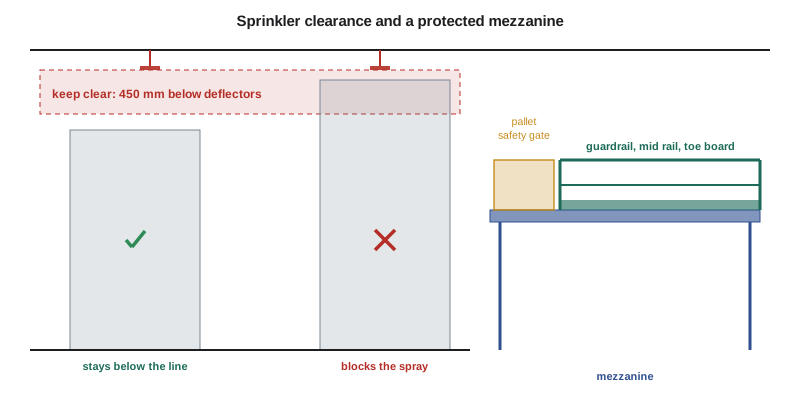
- Edges: every open edge needs a guardrail with a top rail at roughly waist to chest height, a mid rail, and a toe board to stop stock and feet sliding off. Rails must be strong enough to stop a person falling against them.
- Loading points: where stock is lifted onto the mezzanine, a gap in the guardrail is a fall hazard. A pallet safety gate, sometimes called a pivot gate or reciprocating gate, keeps one side closed at all times: when the side facing the drop is open for loading, the side facing the worker is closed, and vice versa. A simple chain or bar across the gap is not enough, because it is easily left open.
- Load: post the floor rating and keep a rough idea of what is up there. Heavy stock belongs on the ground floor.
- Stairs: stairs need handrails and should be kept clear. Carrying heavy or bulky cases up stairs is a lifting and fall hazard; use a stacker, a material lift or the loading gate instead.
- Below: people working under the mezzanine edge should be protected by toe boards and netting where items could fall.
In British Columbia, the OHS Regulation requires guardrails or other fall protection where a worker could fall 3 m (10 ft) or more, or where a fall from a lower height could cause unusual injury, such as onto equipment or a hard edge. Guardrails must meet height and strength requirements set out in the regulation. Northfield's mezzanine is about 3.2 m (10.5 ft) above the floor, so its guardrails are required, not optional.
Falling objects
Stock falling from height is one of the most serious hazards in stores that store goods high, and the people hit are sometimes customers rather than workers. Things fall when they are stacked loosely or unevenly, when cases are pushed back off the rear of a shelf or rack into the next aisle, when a pallet is placed or removed and nudges the stock beside it, when shelving or racking is overloaded or damaged, and when someone pulls a case from the bottom of a stack.
- Stack stably: square, interlocked, heaviest at the bottom, no case hanging over the edge, and within the stack-height limit.
- Use back stops, wire decking, netting or rails on the backs of shelves and racks that face an aisle or walkway, so pushed cases cannot fall through.
- Keep loose items in bins or totes rather than loose on high shelves.
- Clear the area below before putting stock up or taking it down from height, and keep people out until the work is done.
- Do not work below a mezzanine edge or an upper rack level while someone is loading it.
- Report leaning, crushed or bulging stacks and fix them before they fall.
In stores that keep top stock above the sales floor, the same rules apply with customers below. Many retailers ban stocking at height while customers are in the aisle, require the aisle to be closed with a barrier or chain and a spotter, and secure top stock with netting or restraint bars. HSE-340 Lesson 10 covers displays and falling merchandise on the sales floor.
Sprinkler clearance
Automatic sprinklers work by spraying water in a wide umbrella pattern from the deflector, the small plate below each head. Stock stacked close to the deflector blocks the spray, so a fire can grow underneath while the sprinkler wets only the top of the pile. Fire codes and the sprinkler installation standard, NFPA 13, which British Columbia's codes call up, require clear space below the deflectors. For most store storage, the practical rule is to keep stock at least 450 mm (18 in) below sprinkler deflectors, and more where the sprinkler design or the local fire department requires it, for example for high-piled storage. Fire codes have relaxed the rule in a few specific cases, such as shelving against a wall, but a store should keep to the simple rule unless its fire protection engineer says otherwise.
Clearance is easy to lose. Stock goes up a little higher during a busy season, a new shelf is added on top of an old unit, or cases are piled on the top shelf. A painted line or a strip of tape on the wall at the maximum storage height makes the limit visible. The program below checks the planned top-of-stock heights in several backroom locations against the sprinkler height and the clearance rule.
# Sprinkler clearance check for backroom storage (heights in m; illustrative locations).
clearance = 0.45                  # minimum clear space below sprinkler deflectors (about 18 in)
locations = {   # name: (deflector height above floor, top of stock height)
    "top-stock shelving, north wall": (4.30, 3.70),
    "top-stock shelving, east wall": (4.30, 4.05),
    "rack row 1, level 3 pallets": (5.80, 5.20),
    "rack row 2, level 3 pallets": (5.80, 5.45),
    "mezzanine storage": (6.40, 5.95),
    "seasonal pile beside the baler": (4.30, 3.95),
}
for name, (deflector, top) in locations.items():
    gap = deflector - top
    ok = gap >= clearance
    note = "OK" if ok else f"TOO HIGH by {clearance - gap:.2f} m"
print(f"{name:34} gap {gap:.2f} m ({gap / 0.0254:.0f} in) {note}")top-stock shelving, north wall gap 0.60 m (24 in) OK top-stock shelving, east wall gap 0.25 m (10 in) TOO HIGH by 0.20 m rack row 1, level 3 pallets gap 0.60 m (24 in) OK rack row 2, level 3 pallets gap 0.35 m (14 in) TOO HIGH by 0.10 m mezzanine storage gap 0.45 m (18 in) OK seasonal pile beside the baler gap 0.35 m (14 in) TOO HIGH by 0.10 m
Three locations fail: the east wall shelving, the third level of rack row 2 and the seasonal pile beside the baler. The rack is the most important, because pallets on the top level are hard to adjust quickly and the row is full of cardboard-packed goods. The fix there is to lower the top level's pallets or use shorter loads; on the shelving it is to take down the top layer of cases and mark the wall line. The pile beside the baler should not be there at all, for reasons Lesson 11 explains.
For supervisors: look up
Most backroom walk-throughs look at floors and aisles. Make a habit of looking up. Is anything stacked into the sprinkler zone? Is anything on top of the cooler? Is the mezzanine gate closed, and is stock kept back from the edge? Are the backs of shelves facing walkways protected? Is anyone working at height using a proper ladder or platform? Is the area below clear when stock goes up or comes down? Each of these takes seconds to check and each one heads off an injury or a fire.
Worked problem
Seasonal stock on the move
In late October, Hana's crew needs to bring holiday stock down from the mezzanine and send fall stock up. The mezzanine has a chain across its loading point, and the crew usually passes boxes up and down the stairs by hand. One of the crew has suggested standing a pallet on the forks of a powered pallet jack and handing boxes up from it. What should Hana plan?
Show solution
- Do not use the pallet jack as a platform: it lifts only a few centimetres, is not stable and is not designed for people.
- Replace the chain with a pallet safety gate so the drop side is never open while someone stands at the loading point.
- Use a rented stacker, operated by a trained operator, to lift pallets of light seasonal stock to the gate; or use the material lift if the store has one.
- Keep the area below the loading point clear and taped off while stock moves, and have one person in charge of signals.
- Pass only light boxes by hand on the stairs, keeping one hand free for the rail.
Answer: Use a stacker or lift with a proper safety gate at the loading point, keep the area below clear, and never use a pallet jack as a work platform.
Common mistakes
MistakeStanding on a pallet, crate or pallet jack to reach high stock.
InsteadUse a proper ladder, rolling ladder or work platform.
MistakeStoring stock on top of the walk-in cooler.
InsteadClear it and move the stock to storage designed for it.
MistakeLeaving a chain across the mezzanine loading point.
InsteadInstall a pallet safety gate that always keeps one side closed.
MistakeStacking stock right up to the ceiling.
InsteadKeep at least 450 mm (18 in) below sprinkler deflectors and mark the limit on the wall.
MistakePutting stock up or taking it down with people working below.
InsteadClear and tape off the area below until the work is done.
Summary and key terms
- Height brings falls, falling objects and blocked sprinklers.
- Use proper ladders and platforms, keep three points of contact, and never climb racking or stand on makeshift steps.
- Walk-in cooler roofs are not designed for storage; keep them clear.
- Mezzanines need posted load ratings, guardrails with midrails and toe boards, and safety gates at loading points; BC requires fall protection from 3 m (10 ft).
- Stack stably, protect the backs of shelves facing walkways and clear the area below when working at height.
- Keep stock at least 450 mm (18 in) below sprinkler deflectors; mark the limit on the wall.
- Top stock
- Overstock stored above shelving, either in the backroom or above sales fixtures.
- Mezzanine
- A raised floor inside a building, used for storage or offices.
- Toe board
- A low barrier at the bottom of a guardrail that stops objects and feet sliding off an edge.
- Pallet safety gate
- A gate at a mezzanine loading point that keeps one side closed at all times.
- Sprinkler deflector
- The plate on a sprinkler head that spreads the water spray.
- Sprinkler clearance
- The clear space required below sprinkler deflectors so the spray is not blocked.
Practice problems
Work each problem on paper first, then reveal the answer to check.
Name three makeshift steps workers should never stand on.
Show answer
Any three of: pallets, crates, cases, pallet jack forks, rack beams.
Why should cooler roofs not be used for storage?
Show answer
They are not designed to carry weight, access means climbing to an unguarded edge, and stock can block sprinklers.
What three parts should a mezzanine guardrail have?
Show answer
A top rail, a mid rail and a toe board.
Why is a chain across a mezzanine loading point not enough?
Show answer
It is easily left open; a pallet safety gate always keeps one side closed.
At what height does BC require fall protection?
Show answer
3 m (10 ft), or lower where a fall could cause unusual injury.
How much clear space should be kept below sprinkler deflectors?
Show answer
At least 450 mm (18 in), or more where the design or fire department requires.
In the clearance check, which three locations failed?
Show answer
The east wall shelving, rack row 2 level 3 and the seasonal pile beside the baler.
Name two ways to stop stock falling into a walkway behind a shelf.
Show answer
Any two of: back stops, wire decking, netting, rails.
Lesson quiz · 5 questions
Score 60% or more to complete this lesson.
Create a free account to save your progress, take quizzes and earn a certificate.