
HSE-342 · Lesson 2 of 12 · 23 min
Law and responsibilities behind the scenes
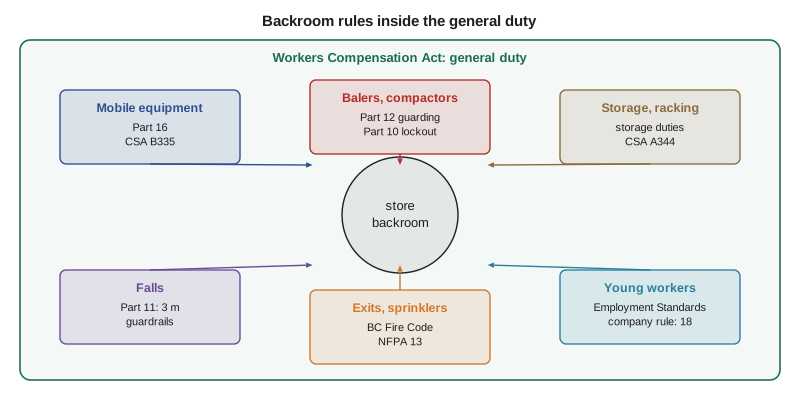
The backroom is covered by the same occupational health and safety law as the rest of the store, but several parts of that law matter more here than anywhere else: rules for powered equipment such as pallet jacks and forklifts, for machine guarding and lockout on balers and compactors, for storage and racking, for falls from height, for exits and fire protection, and for what young workers may do. This lesson maps those rules for a store, explains who is responsible for what when drivers, vendors and contractors share the space, and shows how a store can check that it has the basics in place.
The details vary by province and state. This lesson uses British Columbia and Washington, where the two versions of Northfield Market are located, and notes the national picture. HSE-102 covers rights and responsibilities in general, and HSE-340 Lesson 2 covered how they work in a store. This lesson does not repeat that material; it focuses on the rules that apply to backroom work.
The general duty still comes first
In every province, the employer has a general duty to ensure the health and safety of its workers, as far as is reasonably practicable. In British Columbia that duty is in the Workers Compensation Act, and the detailed rules are in the Occupational Health and Safety Regulation, which WorkSafeBC enforces. Supervisors must make sure workers under their direction know the hazards and follow the rules, and workers must work safely, use the equipment and protective gear provided and report hazards. Even where no specific rule covers a task, the general duty does. A store cannot argue that because no regulation mentions dock plates, an unsafe dock plate is acceptable.
Rules that matter most in the backroom
| Topic | What the rules require in general terms |
|---|---|
| Powered pallet jacks and forklifts | BC OHS Regulation Part 16 (mobile equipment): equipment fit for purpose and maintained, operators trained and competent, pre-use inspection, safe operation and traffic control. CSA B335 (now in a 2025 edition) is the national standard for lift truck safety and operator training. |
| Balers, compactors and conveyors | Part 12 (tools, machinery and equipment): safeguards on points of operation and moving parts; guards and interlocks kept in place. Part 10 (de-energization and lockout): lock out before clearing jams, cleaning or maintenance. |
| Storage and racking | General storage duties: materials stored so they cannot fall or collapse; racking installed, loaded and maintained to the manufacturer or an engineer. CSA A344 (2024 edition) covers steel storage racks. |
| Falls from height | Part 11 (fall protection): protection where a worker could fall 3 m (10 ft) or more, or where a fall from lower height carries unusual risk; guardrails on mezzanines and dock edges as needed. |
| Exits and fire safety | Exits kept clear and usable; storage kept below sprinkler deflectors as the BC Fire Code and NFPA 13 require; fire extinguishers accessible. |
| Young workers | Employment Standards Act and Regulation: general minimum age and hazardous work limits for workers under 19; Northfield adds a company rule that no one under 18 operates powered pallet jacks, the baler or the compactor. |
These rules are written in general terms because they apply to every workplace from a sawmill to a hospital. Stores rarely need to read them line by line. What they do need is to know which topics are regulated, to have a program that covers each one, and to know where to look when something changes, such as buying a new baler or adding a mezzanine.
Who is responsible when other employers are on site
A backroom is a shared workplace. On a normal weekday at Northfield, Tomás might deal with a distribution centre driver, two snack vendors, a soft drink merchandiser, a bread delivery driver, a contractor who services the refrigeration and, once a month, a technician who services the baler. Each of these people works for someone else. That does not mean the store can ignore them, and it does not mean they can ignore the store's rules.
In British Columbia, every employer is responsible for its own workers wherever they work, and the owner of the workplace must keep it in a safe condition and tell other employers about hazards they might not know. Where several employers work at one place, someone must coordinate safety; on a small retail site the store usually takes that role in practice even when it is not formally the prime contractor. A driver's employer must train the driver to work safely at customers' docks; the store must make sure its dock, leveller and restraints are safe and that the driver knows the store's rules.
In practice, Northfield handles shared work with a few simple tools: a one-page sheet of backroom rules that every driver and vendor gets on their first visit and signs, a sign-in book at the receiving door, a rule that vendors may use manual hand trucks and carts but not the store's powered pallet jacks or baler, and a requirement that contractors working on the baler, compactor or refrigeration check in with the manager on duty and follow the store's lockout procedure or their own if it is at least as strict.
Supervisors and young workers
The backroom is where many young people get their first job in a store, often on the overnight crew or in receiving. Young and new workers are injured at higher rates than experienced ones, mostly in their first months on the job. Two features of the law matter here. First, there are tasks young workers may not do at all, and in a backroom the most important are operating balers, compactors and powered lift equipment. Second, every new worker needs an orientation that covers the hazards of their actual job before they start it.
In British Columbia, the general minimum age for work was raised to 16 in 2021, with a list of light jobs that 14- and 15-year-olds may do with a parent's consent, and with limits on hazardous work for workers under 19. Rather than rely on each worker's age and the exact wording of the lists, Northfield sets a simple company rule: no one under 18 operates a powered pallet jack, the baler or the compactor, and no one under 16 works in receiving at all. Kai, who is 15, stocks shelves on the sales floor on weekend days. Jess, who is 17, may load cardboard into the baler only when an adult operator runs it, and may use manual pallet jacks and carts after training.
For supervisors: what the law expects of you
A supervisor in the backroom does not need to know regulation numbers. You do need to know which tasks require training or authorization before a worker does them, who on your crew is authorized for what, and that the equipment is safe to use. In practice that means checking that the person on the powered pallet jack has been trained and authorized, that the baler's gate interlock works and nobody bypasses it, that young workers are not given prohibited tasks when the crew is short, that racks are not overloaded or damaged, that exits are clear, and that drivers and vendors know the rules. When you see a hazard, you must fix it or report it, and you must not direct anyone to work in a way that is unsafe.
Checking the basics
A short self-check helps a store see whether it has the basic programs in place for its backroom. The program below scores Northfield against a list of required and recommended items. The list is an example drawn from the rules above and from common good practice; it is not a legal checklist, and each store should adapt it to its own jurisdiction.
# Backroom compliance self-check (illustrative list; adapt to your jurisdiction).
items = [
    ("written lockout procedure for baler and compactor", True, True),
    ("baler and compactor interlocks tested and logged", True, False),
    ("powered pallet jack operators trained and authorized", True, True),
    ("operator evaluations up to date", True, False),
    ("daily pre-use checks for powered jacks", True, True),
    ("rack load signs posted and racks inspected", True, False),
    ("storage kept below sprinkler clearance", True, True),
    ("exits and exit routes clear", True, True),
    ("young worker task restrictions written and known", True, True),
    ("driver and vendor rules sheet", False, True),
    ("vehicle restraint or chocks used every time", True, False),
    ("mezzanine guardrail and gate in place", True, True),
]
req = [i for i in items if i[1]]
done_req = [i for i in req if i[2]]
print(f"Required items in place: {len(done_req)} of {len(req)}")
for name, required, ok in items:
    if not ok:
print((" REQUIRED: " if required else " recommended: ") + name)Required items in place: 7 of 11 REQUIRED: baler and compactor interlocks tested and logged REQUIRED: operator evaluations up to date REQUIRED: rack load signs posted and racks inspected REQUIRED: vehicle restraint or chocks used every time
The check shows nine of twelve required items in place and four gaps: interlock testing is not being logged, operator evaluations have lapsed for some of the overnight crew, rack inspections are not happening on a schedule, and chocks are used most of the time but not every time. None of these is unusual. Each one is the subject of a later lesson, and Lesson 12 turns the list into an improvement plan.
Worked problem
Sorting out responsibilities for a vendor
A soft drink merchandiser arrives at 7 a.m. with a hand truck stacked six cases high and asks to borrow a powered pallet jack to move a full pallet of drinks that the distribution centre dropped off yesterday. Tomás is busy with the truck. What should happen?
Show solution
- The merchandiser works for the soft drink company, which is responsible for their training and their hand truck.
- The store controls its own equipment. Northfield's rule is that vendors do not use the store's powered pallet jacks, so Tomás says no.
- The pallet belongs in the store's workflow: a trained Northfield operator moves it when Tomás is free, or the merchandiser works from it where it sits.
- Six cases stacked high on a hand truck block the view and can tip on the dock plate. Tomás reminds the merchandiser of the store's rule of no more than chest height on a hand truck.
Answer: The vendor's employer is responsible for the vendor; the store is responsible for its equipment, dock and rules. Tomás applies the store rules politely and arranges for a trained worker to move the pallet.
Common mistakes
MistakeAssuming no rule applies because the regulation does not mention a specific item.
InsteadRemember that the general duty covers every hazard, and specific rules add detail.
MistakeLetting vendors and drivers use store equipment because it is quicker.
InsteadKeep store equipment for trained store workers, and give visitors clear written rules.
MistakeGiving a young worker a prohibited task when the crew is short.
InsteadKeep a written list of tasks each young worker may and may not do, and stick to it.
MistakeTraining an operator once and never evaluating them again.
InsteadRe-evaluate operators on the schedule your rules and standards set, and after any incident.
MistakeTreating contractors on the baler as someone else's problem.
InsteadMake them check in and follow a lockout procedure at least as strict as the store's.
Summary and key terms
- The general duty covers every backroom hazard; specific rules add detail for equipment, machines, storage, falls, exits and young workers.
- In BC, the key parts are mobile equipment, machinery, lockout and fall protection in the OHS Regulation, plus CSA B335 and CSA A344.
- Workplace owners must keep shared workplaces safe and coordinate with other employers.
- Drivers, vendors and contractors need clear written rules; store equipment is for trained store workers.
- BC limits hazardous work for young workers; Northfield bars anyone under 18 from powered jacks, the baler and the compactor.
- A short self-check shows which basic programs are in place and which need work.
- General duty
- The employer's overall legal duty to protect workers from hazards, whether or not a specific rule covers them.
- Powered industrial truck
- A powered vehicle used to carry, push, pull or lift materials, including forklifts and motorized pallet jacks.
- Lockout
- Isolating a machine from its energy sources and locking the isolating devices so it cannot start during work.
- Controlling employer
- Under OSHA policy, an employer with general control of a site who can be responsible for hazards there.
- Hazardous occupations order
- A federal rule listing jobs that workers under 18 may not do.
- Authorization
- Permission from the employer for a trained worker to use particular equipment.
Practice problems
Work each problem on paper first, then reveal the answer to check.
Name four backroom topics covered by specific rules.
Show answer
Any four of: powered equipment, machine guarding, lockout, storage and racking, falls from height, exits and fire safety, young workers.
What height triggers fall protection in BC?
Show answer
3 m (10 ft), or less where a fall carries unusual risk.
Why should vendors not use the store's powered pallet jacks?
Show answer
The store has not trained or authorized them, and it controls its own equipment.
What is one simple tool for managing drivers and vendors in the backroom?
Show answer
A one-page rules sheet they read and sign, or a sign-in book at the receiving door.
What does Northfield's company rule say about workers under 18?
Show answer
They may not operate powered pallet jacks, the baler or the compactor.
What should a supervisor check before letting someone use a powered pallet jack?
Show answer
That they have been trained and authorized and that the jack has passed its pre-use check.
In the self-check, which gap would you fix first and why?
Show answer
For example, chocks or restraints used every time, because trailer creep can kill; or interlock testing, because baler injuries are severe.
What must a contractor working on the baler do at Northfield?
Show answer
Check in with the manager on duty and follow a lockout procedure at least as strict as the store's.
Lesson quiz · 5 questions
Score 60% or more to complete this lesson.
Create a free account to save your progress, take quizzes and earn a certificate.