
HSE-342 · Lesson 5 of 12 · 24 min
Manual pallet jacks, hand trucks and carts
Almost everything that comes into a store moves at some point on wheels: a manual pallet jack, a two-wheeled hand truck, a flatbed cart, a U-boat or a roll cage. Wheeled equipment takes most of the lifting out of moving freight, but it replaces lifting with pushing and pulling, and a loaded pallet jack can weigh as much as a small car. The common injuries are strains from starting and stopping heavy loads, feet and ankles run over by wheels, hands pinched between a handle and a rack or wall, and loads that tip over on slopes or uneven floors. This lesson covers manual equipment. Lesson 6 covers powered pallet jacks and forklifts.
HSE-107 Lesson 11 covers the science of pushing and pulling, including how acceptable force limits are worked out. This lesson applies it to the equipment found in a store.
How a manual pallet jack works
A manual pallet jack, also called a pallet truck, has two forks that slide into the openings of a pallet, a steering handle and a small hydraulic pump. Pumping the handle lifts the forks a few centimetres, just enough to raise the pallet off the floor. A lever or trigger on the handle releases the hydraulics to lower the load. The steering wheels are under the handle; the load wheels are near the tips of the forks. A typical store jack is rated for about 2,500 kg (5,500 lb), far more than a person can comfortably move by hand, so in practice the limit is usually set by the force needed to move the load, not by the jack's rating.
Starting, moving and stopping
Moving a pallet jack takes three different kinds of force. The initial force overcomes inertia and gets the load rolling; it is usually the largest and the one that causes most strains. The sustained force keeps it rolling and depends on the weight, the wheels and the floor. The stopping force brings it to a halt and can be large if the load is heavy or going downhill, because a manual pallet jack has no brakes. Every push or pull adds to the load on the back and shoulders, and a shift of moving pallets adds up.
Several things increase the force needed:
- Weight: the force rises roughly in proportion to the load.
- Wheels: small, hard or worn wheels, wheels with flat spots, and wheels clogged with stretch wrap or strapping roll badly.
- Floors: cracks, expansion joints, dock plate lips, drains, rough concrete and debris all add resistance; even a small step can stop a heavy jack dead.
- Slopes: any upward slope adds force to climb, and any downward slope means the load wants to run away.
- Turning: turning a loaded jack in a tight space takes much more force than moving it in a straight line.
Push or pull?
Workers often ask whether to push or pull a pallet jack. Studies of pushing and pulling generally find that people can exert more force with less stress on the lower back when pushing, with the body behind the load and the arms close to the body, and that pushing lets the worker see where the load is going. Pulling a manual pallet jack from in front is common, because the handle is designed for it, but it puts the worker's heels in the path of the steering wheels and often means walking backward or twisting to look ahead.
Most guidance for stores comes down to a few practical points. Push when you can, especially to start a heavy load and on long straight runs. If you pull, walk forward beside or slightly ahead of the jack with the handle to one side, not walking backward, and keep your feet clear of the wheels. Never pull a heavy load down a slope. Use your legs and body weight to start the load rather than jerking with the arms, and start and stop gradually.
Estimating the force
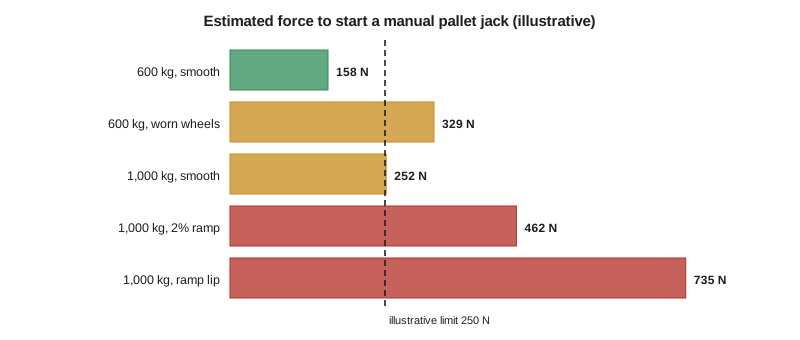
A rough estimate of the force needed helps decide when a load is too heavy for a manual jack and should go on a powered one. The sustained force on a level floor is about the load's weight multiplied by a rolling resistance coefficient that depends on the wheels and the floor. The starting force is higher, and a ramp adds the share of the weight acting down the slope. The program below makes these estimates for Northfield's common loads and compares them with an illustrative force limit. The coefficients and limit are examples for teaching; acceptable limits depend on the worker, the distance, how often the task is done and the handle height, and HSE-107 explains how they are set.
# Estimated forces to move a manual pallet jack (illustrative coefficients and limits).
import math
g = 9.81
jack_mass = 70                       # kg, the jack itself
cases = {   # name: (load kg, rolling coefficient, starting factor, slope %)
    "600 kg, smooth concrete":   (600, 0.012, 2.0, 0),
    "600 kg, worn wheels":       (600, 0.025, 2.0, 0),
    "1,000 kg, smooth concrete": (1000, 0.012, 2.0, 0),
    "1,000 kg, 2% ramp":         (1000, 0.012, 2.0, 2),
    "1,000 kg, dock plate lip":  (1000, 0.035, 2.0, 0),
}
limit_start = 250                    # N, illustrative acceptable starting force
for name, (load, crr, start, slope) in cases.items():
    m = load + jack_mass
    angle = math.atan(slope / 100)
    roll = crr * m * g * math.cos(angle)
    climb = m * g * math.sin(angle)
    sustained = roll + climb
    starting = start * roll + climb
    verdict = "use powered jack" if starting > limit_start else "manual OK"
print(f"{name:27} start {starting:5.0f} N keep moving {sustained:5.0f} N -> {verdict}")600 kg, smooth concrete start 158 N keep moving 79 N -> manual OK 600 kg, worn wheels start 329 N keep moving 164 N -> use powered jack 1,000 kg, smooth concrete start 252 N keep moving 126 N -> use powered jack 1,000 kg, 2% ramp start 462 N keep moving 336 N -> use powered jack 1,000 kg, dock plate lip start 735 N keep moving 367 N -> use powered jack
A 600 kg pallet on a smooth floor with good wheels needs a starting force of around 160 N, well within reach. The same load on worn wheels doubles that and goes well past the limit. A 1,000 kg pallet is right at the limit even on a smooth floor; on a ramp of only 2% or over a dock plate lip it needs far more, which is why Northfield moves full pallets of drinks, water and canned goods on powered jacks and keeps the manual jacks for lighter and shorter moves. The figures are rough: real forces depend on wheel condition, floor and speed, and a push-pull gauge measures them directly. Marco borrowed one from the company's safety office to check the store's worst routes.
Using a manual pallet jack safely
- Check it before use: forks straight, wheels round and free of wrap and strapping, the handle springs back upright, the jack lifts and holds the load and the release lowers it smoothly. Tag out a jack that leaks oil, will not hold a load or has damaged wheels.
- Centre the forks under the load, all the way in, and lift only enough to clear the floor.
- Know the weight. Do not move loads beyond the store's limit for manual jacks; use a powered jack or split the load.
- Look ahead. Keep loads low enough to see over, or have a second person guide you.
- Avoid slopes with heavy loads. If a slope cannot be avoided, keep the load downhill of you going up, and get help or use a powered jack going down.
- Keep feet clear. Wear safety footwear, keep heels away from the steering wheels and never put a foot under the load.
- Never ride on a pallet jack or let anyone ride on the load.
- Park it properly: forks fully lowered, handle upright, out of aisles and exits, not across doorways.
Hand trucks
Two-wheeled hand trucks, also called dollies, are used by vendors and store workers for stacks of cases, kegs and bags. The load should sit on the nose plate with the heaviest items at the bottom and against the frame, and the stack should be no higher than the worker's chest so they can see over it. Tip the truck back to its balance point, where the load rests over the wheels and the handle feels light, before moving. Go up stairs and curbs backward, pulling the truck up after you, and down them forward, with the truck ahead and below. Convertible hand trucks that become four-wheeled carts are easier on long runs.
Carts, U-boats and roll cages
Flatbed carts and U-boats, narrow carts with upright ends used for stocking cases, are pushed through the store all day. Roll cages, also called rolltainers, are wire cages on wheels that some distribution centres use instead of pallets. Each brings its own problems:
- Overloading and high stacking make carts tip and block the view.
- Roll cages are tall and top-heavy and can tip on a slope, on a dock plate or when turned sharply. Push them, do not pull them, and never try to catch one that is falling.
- Fingers get trapped between carts, between a cart and a doorframe, and in the folding parts of roll cages.
- Caster wheels that do not swivel freely make carts hard to steer and push.
- Carts left in aisles and in front of exits are trip and evacuation hazards.
HSE-340 Lesson 5 covers rolling ladders and step stools, which are often pushed around the backroom alongside carts.
Floors and routes
Many force problems are really floor problems. Marco walked Northfield's main freight routes with a push-pull gauge and found three places that needed a lot of extra force: the lip of the dock plate, a sunken drain cover in the backroom and the threshold strip at the doors to the sales floor. The drain cover and threshold were fixed for a few hundred dollars. The dock plate was replaced. Keeping floors swept and free of strapping and wrap also matters more than most people realize, because a single loop of wrap wound around a wheel can double the force needed.
For supervisors: maintain the equipment and the floors
Equipment that rolls badly turns every move into a strain. Set up a simple weekly check of manual pallet jacks, hand trucks and carts, and pull damaged ones out of service until they are fixed. Keep spare wheels on hand; they are cheap compared with an injury. Ask the crew which routes are hard work; they always know. Set a clear store rule for which loads go on manual jacks and which need a powered jack, and make sure powered jacks are actually available when they are needed, not tied up elsewhere or uncharged.
Worked problem
A sore shoulder on the drinks run
Omar reports a sore shoulder. He moves pallets of bottled drinks, about 900 kg each, from the backroom to the drinks aisle with a manual pallet jack several times a shift. The route crosses the threshold strip at the doors to the sales floor and has a slight slope down into the aisle. He pulls the jack and walks backward through the doors. What should change?
Show solution
- The load is near the limit for a manual jack even on a flat floor. The threshold and slope push it over.
- Use a powered pallet jack for full drinks pallets, or split them into half pallets.
- Fix the threshold strip so it is flush with the floor.
- On the slope, never let a heavy manual jack run downhill ahead of you without control; a powered jack has brakes.
- Coach Omar to push where possible and to walk forward beside the jack, not backward, when he has to pull. Refer the shoulder to first aid and follow the store's early reporting process.
Answer: Move full drinks pallets on a powered jack, fix the threshold, push rather than pull where possible and report the shoulder early.
Common mistakes
MistakeJerking a heavy pallet jack with the arms to get it moving.
InsteadUse your legs and body weight and start gradually, or use a powered jack for heavy loads.
MistakeWalking backward while pulling a jack through doors.
InsteadPush where possible; if you must pull, walk forward beside the jack with feet clear of the wheels.
MistakeUsing a jack with wrap wound around its wheels.
InsteadClean the wheels and check them before use; tag out damaged jacks.
MistakeLeaving a pallet jack in an aisle with its handle down.
InsteadLower the forks, put the handle upright and park it out of aisles and exits.
MistakeTrying to catch a roll cage that is tipping.
InsteadStep clear; push roll cages, never pull them, and avoid sharp turns on slopes.
Summary and key terms
- Wheeled equipment replaces lifting with pushing and pulling; starting forces cause most strains.
- Weight, wheels, floors, slopes and turning all increase the force needed.
- Pushing usually allows more force with less back stress and a better view; if pulling, walk forward with feet clear.
- Rough force estimates and push-pull gauges show when a load needs a powered jack.
- Check jacks before use, keep loads within limits, avoid slopes with heavy loads and park jacks properly.
- Hand trucks, carts and roll cages each need correct loading and handling.
- Fixing floors, thresholds and wheels removes many of the hardest pushes.
- Manual pallet jack
- A hand-operated truck with forks and a hydraulic pump used to lift and move pallets.
- Initial force
- The force needed to start a load moving.
- Sustained force
- The force needed to keep a load moving at a steady speed.
- Rolling resistance
- The resistance to motion caused by wheels deforming and the floor surface.
- Push-pull gauge
- A handheld meter that measures the force needed to push or pull a load.
- Roll cage
- A tall wire cage on wheels used to carry freight instead of a pallet.
Practice problems
Work each problem on paper first, then reveal the answer to check.
Name the three kinds of force involved in moving a pallet jack.
Show answer
Initial force to start, sustained force to keep moving, and stopping force.
Name four things that increase the force needed to move a pallet jack.
Show answer
Any four of: heavier load, poor wheels, rough or uneven floors, slopes, turning, wrap on wheels.
Why is pushing generally preferred to pulling?
Show answer
It allows more force with less back stress and lets the worker see ahead.
If you must pull a manual jack, how should you walk?
Show answer
Forward, beside or slightly ahead of the jack, with feet clear of the wheels, not backward.
In the force estimate, what happens to a 1,000 kg load on a 2% ramp?
Show answer
The starting force rises well past the illustrative limit, so it needs a powered jack.
How should a parked pallet jack be left?
Show answer
Forks lowered, handle upright, out of aisles, exits and doorways.
How high should a stack on a hand truck be?
Show answer
No higher than chest height, so the worker can see over it.
Name two floor problems that add force on freight routes.
Show answer
Any two of: dock plate lips, sunken drains, raised thresholds, cracks, debris, wrap and strapping on the floor.
Lesson quiz · 5 questions
Score 60% or more to complete this lesson.
Create a free account to save your progress, take quizzes and earn a certificate.