
HSE-322 · Lesson 7 of 12 · 26 min
Thermal runaway
Thermal runaway is the defining hazard of lithium-ion batteries. It is a chain of exothermic reactions inside a cell that, once started, generates heat faster than the cell can lose it, raising the temperature further and accelerating the reactions until the cell's stored chemical and electrical energy has been released. A cell in thermal runaway can reach several hundred degrees Celsius within seconds to minutes, vent large volumes of flammable and toxic gas, eject hot particles and burning electrolyte, and ignite neighbouring cells, which then go into runaway themselves. This lesson explains how thermal runaway starts, how it develops and spreads, why it is so hard to stop, and what it means for people working in and around battery rooms.
The purpose of this lesson is to help you recognize, prevent and respond to thermal runaway. Lead-acid batteries can also suffer a form of thermal runaway, described in Lesson 5, but it is slower and far less energetic.
What starts thermal runaway
Thermal runaway begins when something raises a cell's temperature to the point where its internal reactions become self-heating, or creates an internal short circuit that heats the cell from within. The triggers are commonly grouped into four kinds of abuse.
- Electrical abuse: overcharging beyond the cell's voltage limit, over-discharging followed by recharge, or external short circuits that drive very high currents. These are the conditions the BMS is designed to prevent.
- Thermal abuse: exposure to external heat, such as a fire nearby, a failed cooling system or a hot connection, that raises the cell above its safe temperature.
- Mechanical abuse: crushing, puncture, dropping or deformation that damages the separator and lets the electrodes touch. Damage during transport, installation, relocation or maintenance falls into this category.
- Internal defects: manufacturing defects such as metal particles, burrs or misaligned electrodes, or degradation such as lithium plating and dendrite growth, that create an internal short over time. These are the hardest to detect because the cell may operate normally until it fails.
In data centres, internal defects and installation or maintenance damage are among the most common causes of serious failures. Electrical abuse is usually prevented by the BMS and the UPS charger, but failures in those systems, or work that bypasses them, have contributed to incidents. Lesson 12 shows that the 2019 McMicken explosion began with an internal cell defect, and the 2025 Daejeon fire began during battery relocation work.
The stages of thermal runaway
Researchers describe thermal runaway as a sequence of reactions that begin at increasing temperatures. The exact temperatures depend on the chemistry, the cell design and the state of charge, so the values below are typical ranges for illustration only.
| Stage | Typical temperature range (illustrative) | What happens |
|---|---|---|
| Self-heating begins | About 80 to 120 °C | The SEI layer on the anode starts to decompose, releasing heat and gas |
| Electrolyte and anode reactions | About 100 to 150 °C | Exposed anode reacts with electrolyte; gas generation increases; cell swells |
| Separator melts | About 130 to 170 °C | Polyethylene or polypropylene separator shrinks and melts; widespread internal short |
| Venting | Often in the same range | Pressure opens the vent; flammable and toxic gas released, often as white or grey vapour |
| Cathode decomposition | About 200 °C or above for NMC; higher for LFP | Cathode breaks down; NMC releases oxygen; rapid heat release |
| Full runaway | Several hundred °C, peaks above 600 °C in some tests | Rapid temperature rise; possible flames, jets of gas and particles |
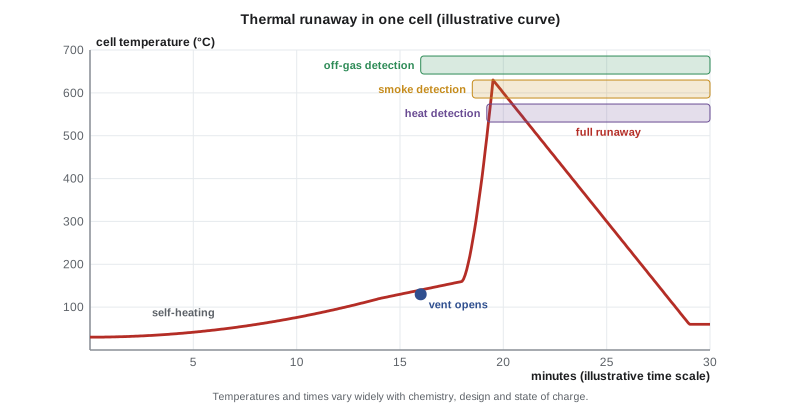
Two features of this sequence matter most for safety. First, there is often a window between the start of self-heating and full runaway, which can last minutes or longer, during which the cell vents gas before it ignites. Detection that responds to the vent gas, such as off-gas sensors, can give warning in this window, while smoke and heat detectors may respond only later. Second, once the cell passes the point where the separator fails and the cathode decomposes, the reactions are self-sustaining. Removing the electrical connection, stopping the charger or applying a clean agent will not stop that cell. The goal at that point is to stop the failure from spreading and to protect people from the gas, fire and explosion hazards.
Gas, fire or explosion
A cell in thermal runaway can produce three different kinds of event, and the difference matters greatly for the response.
If the vent gas ignites immediately as it is released, for example because hot particles or flames from the cell ignite it, the event is a fire. The gas burns as it escapes, producing a jet flame and heat that can spread runaway to neighbouring cells, but it does not accumulate.
If the vent gas does not ignite immediately, it can accumulate in the module, the cabinet or the room. When the accumulated gas reaches its flammable range and meets an ignition source, it can deflagrate, producing a pressure wave that can blow doors open, collapse walls and injure people nearby. This is the explosion hazard, and it is often greatest in the period after venting has begun but before any visible fire, which is exactly when people may be tempted to open a door to look.
If the gas neither ignites nor accumulates to a flammable concentration because ventilation removes it, the event may be limited to the venting of toxic gas. That is still dangerous for anyone exposed, but it is the least severe outcome and the one that exhaust ventilation and explosion prevention aim to achieve.
Propagation
A single cell failure in a large battery would be a minor event if it stayed in that cell. The serious incidents occur when runaway spreads from cell to cell, module to module and rack to rack. Propagation happens through heat conducted through cell cases and busbars, through hot gas and flames from venting cells, and through ignition of accumulated gas. Module designs use thermal barriers, spacing, venting paths and fuses to slow or stop propagation, and UL 9540A testing measures how well they work. The sixth edition of UL 9540A, introduced in Lesson 2, adds large-scale fire testing with pass and fail criteria for propagation between units.
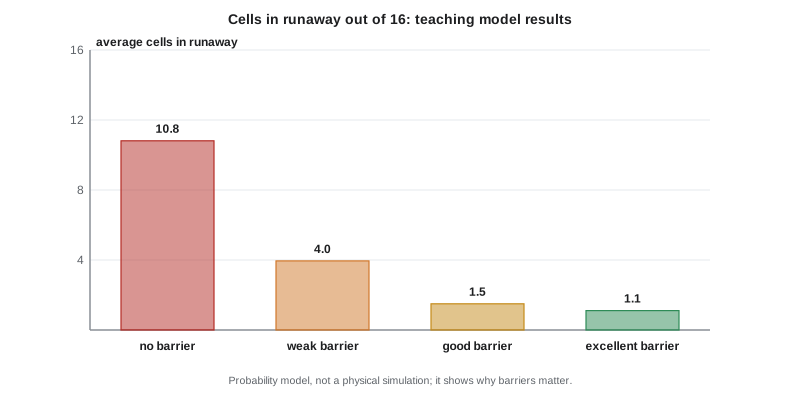
The program below is a teaching model of propagation along a row of cells. Each cell that is in runaway has a chance of driving each neighbour into runaway, and a thermal barrier reduces that chance. It is a deliberately simple probability model, not a physical simulation, intended only to show why barriers that reduce the per-step chance of spreading have a large effect on how many cells are lost.
import random

# Teaching model only: probability of runaway spreading along a module of cells.
# Not a physical simulation. Probabilities are illustrative.
def cells_lost(n_cells, p_spread, trials=20000, seed=7):
    rng = random.Random(seed)
    total = 0
    for _ in range(trials):
        failed = {n_cells // 2}            # one cell fails in the middle
        frontier = [n_cells // 2]
        while frontier:
            c = frontier.pop()
            for nb in (c - 1, c + 1):
                if 0 <= nb < n_cells and nb not in failed and rng.random() < p_spread:
                    failed.add(nb)
                    frontier.append(nb)
        total += len(failed)
    return total / trials

for label_text, p in [("no barrier", 0.9), ("weak barrier", 0.6), ("good barrier", 0.2), ("excellent barrier", 0.05)]:
print(f"{label_text:18s} p = {p:4.2f}: average cells in runaway {cells_lost(16, p):5.2f} of 16")no barrier p = 0.90: average cells in runaway 10.81 of 16 weak barrier p = 0.60: average cells in runaway 3.95 of 16 good barrier p = 0.20: average cells in runaway 1.50 of 16 excellent barrier p = 0.05: average cells in runaway 1.11 of 16
In the model, a module with no effective barrier usually loses most of its cells once one fails, while a good barrier usually limits the event to one or two cells. Real systems are more complex, but the lesson is the same: preventing propagation is the main way to keep a single cell failure from becoming a fire in a battery room.
Stranded energy and re-ignition
After a lithium-ion fire appears to be out, damaged cells may still contain stored energy. This stranded energy cannot be safely discharged by normal means because the cells and their connections are damaged. Damaged cells can go into thermal runaway hours or even days later, re-igniting the fire or releasing more gas. Battery fires at energy storage sites have rekindled after crews left, and fire services now commonly monitor damaged batteries for extended periods, sometimes using thermal imaging and gas monitoring for days. A damaged lithium-ion battery should be treated as a hazard until it has been removed, discharged or rendered safe by specialists, as Lesson 10 and Lesson 11 describe.
Why thermal runaway is hard to stop
Several properties of thermal runaway make it hard to fight. The reactions supply their own heat and, for oxide cathodes, some of their own oxygen, so smothering with a clean agent or inert gas may extinguish visible flames but does not stop the reactions inside the cells. The cells are sealed inside modules and cabinets, so water applied from outside reaches them poorly. Each cell carries its own stored energy, so even disconnecting the battery leaves the energy in place. And the gas produced can create an explosion hazard that makes it dangerous to open a cabinet or room to apply water.
Cooling is the only reliable way to slow runaway and stop propagation: removing heat faster than the reactions produce it, ideally before neighbouring cells reach their own runaway temperatures. Large volumes of water applied over long periods can do this for accessible batteries, which is why fire services increasingly cool battery installations rather than trying to extinguish them, and why some systems include integrated water or other cooling systems at the module or rack level. HSE-323 covers suppression systems; Lesson 9 covers the design limits.
Worked problem
Recognizing the precursors of thermal runaway
A security officer at Cedar Ridge patrolling the corridor outside the Hall 2 lithium-ion battery room notices a faint sweet chemical smell and a thin haze visible through the door's vision panel. No alarm has sounded. What does this mean, and what should the officer do?
Show solution
- The smell and haze suggest that a cell may be venting electrolyte vapour and gas, an early stage of thermal runaway, even though no detector has yet alarmed.
- The officer must not open the door. Opening it could admit air, disturb the gas and expose the officer to toxic and possibly flammable gas.
- The officer should move away from the door, raise the alarm by the site emergency procedure (including calling the fire service if the procedure requires it), and notify the operations centre.
- Operations can check the BMS and off-gas detection remotely, confirm the room exhaust is running and, if the procedure allows, isolate the affected racks.
- The officer should keep others out of the corridor and meet the fire service with information about the room, its battery chemistry and the site's emergency plan.
Answer: A smell and haze from a lithium-ion battery room may indicate venting before any fire. The officer should not open the door but should raise the alarm, keep people away and let detection, ventilation and trained responders deal with it.
Common mistakes
MistakeBelieving that disconnecting a battery in thermal runaway will stop it.
InsteadRecognize that runaway is self-sustaining inside the cell; disconnection may prevent further electrical abuse but does not stop a cell already in runaway.
MistakeOpening a battery room or cabinet door to check on a haze or smell.
InsteadKeep doors closed, leave the area and raise the alarm; accumulated gas can deflagrate when disturbed or ignited.
MistakeAssuming a clean agent discharge has stopped a lithium-ion fire because flames are out.
InsteadExpect continued runaway and re-ignition; cooling is needed to stop propagation.
MistakeTreating a damaged battery as safe once the fire is out.
InsteadTreat damaged batteries as hazards with stranded energy that can re-ignite hours or days later.
MistakeHandling or relocating lithium-ion modules without the manufacturer’s procedure.
InsteadFollow manufacturer procedures for handling and relocation, because mechanical damage can trigger runaway later.
Summary and key terms
- Thermal runaway is a self-sustaining chain of exothermic reactions that releases a cell’s stored energy as heat, gas and possibly fire.
- Triggers are electrical, thermal and mechanical abuse and internal defects; internal defects and handling damage are important in data centres.
- The stages run from SEI breakdown through separator failure and venting to cathode decomposition and full runaway.
- There is often a window when gas is vented before ignition; off-gas detection can respond in that window.
- A runaway event can be a fire, an explosion of accumulated gas or a toxic gas release; explosion risk is high when gas accumulates before ignition.
- Propagation from cell to cell is the main driver of serious incidents; barriers and spacing limit it.
- Damaged cells hold stranded energy and can re-ignite hours or days later; cooling is the only reliable way to stop propagation.
- Thermal runaway
- A self-accelerating chain of exothermic reactions inside a cell that releases its stored energy.
- Abuse condition
- An electrical, thermal or mechanical condition outside a cell’s safe operating limits that can trigger failure.
- Internal short circuit
- Contact between the anode and cathode inside a cell, often after separator damage or a defect.
- Venting
- The release of gas through a cell’s vent or case when internal pressure rises.
- Propagation
- The spread of thermal runaway from one cell to others.
- Thermal barrier
- Material or spacing between cells or modules designed to slow heat transfer and prevent propagation.
- Stranded energy
- Energy remaining in damaged cells that cannot be safely discharged by normal means.
- Deflagration
- A rapid combustion of a flammable gas mixture that produces a pressure wave, travelling slower than sound.
Practice problems
Work each problem on paper first, then reveal the answer to check.
Define thermal runaway in one sentence.
Show answer
A self-accelerating chain of exothermic reactions in a cell that generates heat faster than it can be lost, releasing the cell’s stored energy.
Name the four kinds of abuse that can trigger thermal runaway.
Show answer
Electrical, thermal and mechanical abuse, and internal defects.
What happens to the separator during thermal runaway, and why does it matter?
Show answer
It melts or shrinks, allowing widespread internal shorting that accelerates heating.
Why is there often a window for detection before fire?
Show answer
Cells often vent gas before igniting; off-gas detection can respond at venting.
Why can an explosion be more likely when there is no immediate flame?
Show answer
Unburned gas accumulates and can deflagrate when it reaches the flammable range and meets an ignition source.
What is propagation, and how is it limited?
Show answer
The spread of runaway to other cells; it is limited by thermal barriers, spacing, venting paths and cooling.
Why does a clean agent not stop thermal runaway?
Show answer
The reactions are self-heating and oxide cathodes can supply oxygen, so smothering does not remove the heat.
What is stranded energy?
Show answer
Energy left in damaged cells that cannot be safely discharged normally and can cause re-ignition.
In the teaching model, what effect does a good barrier have?
Show answer
It reduces the average cells lost from most of the module to about one or two.
What should someone do if they see haze and smell solvent outside a lithium-ion battery room?
Show answer
Not open the door; move away, raise the alarm and notify operations.
Lesson quiz · 5 questions
Score 60% or more to complete this lesson.
Create a free account to save your progress, take quizzes and earn a certificate.