
HSE-322 · Lesson 11 of 12 · 27 min
Responding to battery incidents
When a battery fails, the first minutes decide how bad the outcome will be, and the instincts that serve people well in other emergencies can be dangerous. Opening a door to see what is happening, rushing in with a fire extinguisher, or resetting an alarm to see whether it comes back can expose people to toxic gas, burns and explosion. This lesson covers the response to battery incidents in a data centre: the emergency response plan, the roles of site staff and the fire service, the decisions about entry and isolation, the response to acid and electrolyte exposures, and the long tail of monitoring and recovery after a lithium-ion event. HSE-105 and HSE-222 cover fire safety planning and evacuation in general, and HSE-320 Lesson 11 covered emergencies in data centres; this lesson focuses on what is specific to batteries.
The emergency response plan
NFPA 855 requires an emergency response plan for energy storage systems, and its 2026 edition adds a section setting minimum requirements for the plan and for training, covering mitigation, preparedness, response and recovery, with annual review and refresher training arranged with the authority having jurisdiction. Fire codes and OHS law add general requirements for emergency plans. For a data centre battery room, the plan should cover at least the following.
- A description of the battery systems: location, chemistry, energy, voltage, manufacturer, and the safety systems (detection, ventilation, explosion control, suppression).
- Procedures for each type of event: hydrogen alarm, off-gas alarm, smoke or fire, acid spill, electrolyte exposure, physical damage, and suspected thermal runaway with no visible fire.
- How to isolate the battery remotely and locally, and who is authorized to do it.
- Evacuation zones and assembly points, considering toxic gas and the discharge direction of any deflagration vents.
- Communication with the fire service, including who meets them and what information they receive.
- Contacts for the battery manufacturer's emergency support and a subject matter expert who can advise responders.
- Post-event monitoring, recovery, removal of damaged equipment and investigation.
- Training and drills for site staff, and pre-incident planning and site visits with the fire service.
First actions by site staff
Site staff are not firefighters, and the plan should not expect them to fight a battery fire. Their role is to detect, alert, isolate where safe, evacuate and inform. The decision chart below shows the typical first actions.
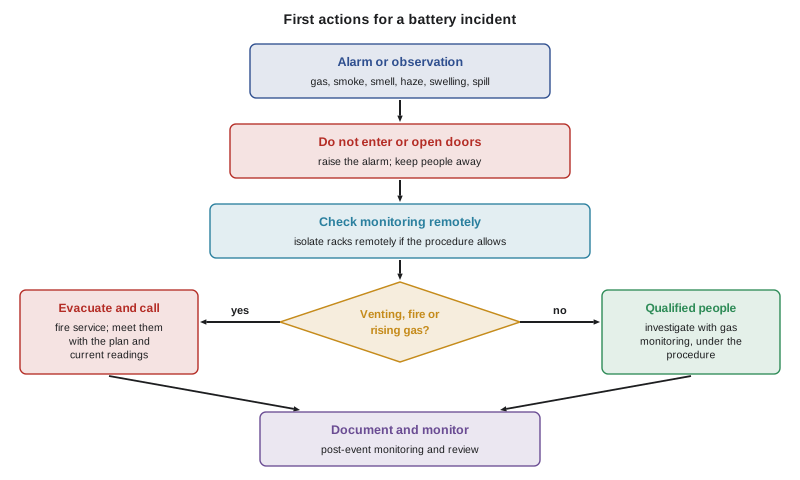
The most important rule is not to open the door of a battery room or cabinet where venting, smoke or gas accumulation is suspected. Opening a door can let in air, disturb a stratified gas layer, create an ignition path and put the person in the path of a deflagration that uses the open door as its vent. At McMicken in 2019, the explosion occurred minutes after firefighters opened the door of the battery container, hours after the event began. Entry decisions belong to the fire service, advised by people who understand the battery system.
Remote isolation, where the design allows it, is valuable: opening rack contactors or the battery breaker from the operations centre can stop charging current to a failing battery and prevent further electrical abuse. It will not stop a cell already in thermal runaway, as Lesson 7 explained, but it can limit the event. Isolation by hand inside the room during an event should not be attempted unless the procedure specifically allows it and gas monitoring shows it is safe.
Evacuation should consider the toxic gas hazard. Battery room vent gas and smoke can travel through corridors, ducts and cable pathways, and carbon monoxide and hydrogen fluoride are dangerous at low concentrations. The evacuation zone may need to be larger than for an ordinary fire alarm, and assembly points should be upwind and away from deflagration vent discharge areas and the exhaust outlet of the battery room.
Working with the fire service
Fire services across North America have learned a great deal about battery incidents since 2019, and many now have specific procedures for energy storage systems. They will still depend on the site for accurate information. A pre-incident plan prepared with the local fire service, and kept up to date, should give them the location and layout of each battery room, the chemistry and energy, the safety systems and their status indicators, the locations of disconnects and the emergency stop, the exhaust and deflagration vent locations, water supplies and access routes, and the contact details of the site's subject matter expert and the manufacturer's emergency line. Site visits and joint drills make the plan real.
| Information for the fire service | Why it matters |
|---|---|
| Battery chemistry, energy and voltage | Determines the hazards and the likely duration of the event |
| Status of detection, ventilation and suppression | Tells responders whether gas is being removed and whether a clean agent has discharged |
| Gas readings, if available from fixed detectors | Informs entry and evacuation decisions |
| Isolation status of the batteries | Whether charging current has been removed; which equipment remains energized |
| Locations of deflagration vents and exhaust outlets | Areas to keep clear of responders and the public |
| People unaccounted for | Determines whether a rescue is needed |
| Manufacturer and subject matter expert contacts | Technical advice on the specific product |
When the fire service arrives, the site representative should meet them at the agreed location with the pre-incident plan, the current alarm and detector readings from the monitoring system and someone who can operate remote controls. The fire service will decide on tactics, which for lithium-ion events increasingly emphasize defensive operations, protecting exposures and cooling with water rather than entering an enclosure that may contain explosive gas.
Acid spills and electrolyte exposure
Not every battery incident involves fire. Acid spills and electrolyte exposures are more common and are handled by trained site staff using the controls in Lesson 4: eyewash and showers for exposure, the right spill kit for the electrolyte, appropriate PPE and ventilation, and medical follow-up. For any exposure to a lithium-ion electrolyte leak or to residues after a lithium-ion event, the possibility of hydrogen fluoride exposure should be considered, with flushing, calcium gluconate under the site medical protocol and prompt medical assessment.
The long tail: monitoring after a lithium-ion event
A lithium-ion battery event does not end when flames are no longer visible. Damaged cells hold stranded energy and can go into runaway again hours or days later, releasing more gas or re-igniting. Fire services and site teams typically monitor a damaged battery for an extended period, using thermal imaging, fixed and portable gas detection and visual observation, before declaring it stable. The 2025 Daejeon fire took about 22 hours to extinguish fully, and large BESS fires have burned or smouldered for days.
The program below illustrates a simple post-event monitoring log. It records invented readings from a thermal camera and a CO detector at intervals after a lithium-ion event and applies a stability rule: the battery is considered stable only when the maximum surface temperature has stayed below a threshold and CO has stayed near background for a set number of consecutive readings. The rule and values are illustrative; the fire service and the manufacturer decide when a battery is stable.
import random

# Illustrative post-event monitoring log after a lithium-ion event (invented, seeded data).
random.seed(11)
TEMP_LIMIT_C = 40.0      # illustrative maximum surface temperature for "stable"
CO_LIMIT_PPM = 15.0      # illustrative near-background CO level
NEEDED = 6               # consecutive stable readings required (illustrative)

temp, co, stable_run = 95.0, 180.0, 0
for hour in range(0, 48, 2):
    temp = max(22.0, temp * 0.86 + random.uniform(-2, 2))
    co = max(2.0, co * 0.75 + random.uniform(-3, 3))
    if hour == 14:                       # a damaged cell re-heats
        temp, co = 78.0, 120.0
    ok = temp < TEMP_LIMIT_C and co < CO_LIMIT_PPM
    stable_run = stable_run + 1 if ok else 0
    status = "stable" if stable_run >= NEEDED else ("watch" if ok else "not stable")
    print(f"t+{hour:2d} h: max {temp:5.1f} C, CO {co:6.1f} ppm -> {status} ({stable_run})")
    if stable_run >= NEEDED:
breakt+ 0 h: max 81.5 C, CO 135.4 ppm -> not stable (0) t+ 2 h: max 71.8 C, CO 101.3 ppm -> not stable (0) t+ 4 h: max 61.8 C, CO 76.5 ppm -> not stable (0) t+ 6 h: max 51.9 C, CO 57.5 ppm -> not stable (0) t+ 8 h: max 45.1 C, CO 44.8 ppm -> not stable (0) t+10 h: max 37.2 C, CO 32.5 ppm -> not stable (0) t+12 h: max 30.3 C, CO 26.2 ppm -> not stable (0) t+14 h: max 78.0 C, CO 120.0 ppm -> not stable (0) t+16 h: max 69.0 C, CO 92.8 ppm -> not stable (0) t+18 h: max 60.0 C, CO 70.3 ppm -> not stable (0) t+20 h: max 50.2 C, CO 49.8 ppm -> not stable (0) t+22 h: max 43.3 C, CO 34.7 ppm -> not stable (0) t+24 h: max 36.0 C, CO 24.5 ppm -> not stable (0) t+26 h: max 29.1 C, CO 18.1 ppm -> not stable (0) t+28 h: max 24.8 C, CO 15.7 ppm -> not stable (0) t+30 h: max 22.0 C, CO 12.6 ppm -> watch (1) t+32 h: max 22.0 C, CO 10.4 ppm -> watch (2) t+34 h: max 22.0 C, CO 6.5 ppm -> watch (3) t+36 h: max 22.0 C, CO 7.8 ppm -> watch (4) t+38 h: max 22.0 C, CO 7.1 ppm -> watch (5) t+40 h: max 22.0 C, CO 3.7 ppm -> stable (6)
The log shows why a single good reading is not enough. A damaged cell re-heats part way through the period, resetting the count, and the battery is declared stable only after a sustained run of good readings. Throughout this period the area should remain controlled, with no one entering the enclosure without the fire service's agreement and appropriate protection.
| Phase | Key actions |
|---|---|
| Stabilization | Monitoring of temperature and gas; cooling as directed by the fire service; area controlled |
| Assessment | Manufacturer and specialists assess damage, stranded energy and safe removal methods |
| Removal | Damaged modules removed by specialists, placed in isolation containers, transported under damaged-battery rules |
| Decontamination | Cleaning of soot and residues, which may contain HF compounds, metals and other toxic substances, by trained contractors with PPE |
| Restoration | Repair of fire protection, ventilation and construction; recommissioning; review before re-energizing anything |
| Investigation | Root cause analysis, regulatory reporting, lessons learned and changes to design and procedures |
Reporting and investigation
Battery incidents may need to be reported to regulators. Provincial and federal OHS laws require employers to report serious injuries and certain dangerous occurrences, such as fires and explosions, to the OHS regulator, often immediately by phone followed by a written report, and to preserve the scene. Fire marshals or fire commissioners may also investigate. A thorough internal investigation, using root cause methods such as those in HSE-403, Incident Investigation and Root Cause Analysis, should look beyond the failed cell to the system of controls: monitoring, maintenance, work planning, contractor management, detection and response.
The investigations of the Pangyo and Daejeon fires both found failures far beyond the battery: monitoring that did not detect the problem, batteries in the same room as critical equipment, work carried out without plans by unqualified contractors, response manuals not available to those who needed them and disaster recovery that had not been tested. Lesson 12 examines these cases.
Worked problem
Responding to an off-gas alarm at night
At 03:40 the off-gas detector in cabinet 7 of the Hall 2 lithium-ion battery room at Cedar Ridge alarms. Thirty seconds later the BMS reports that rack 7 contactors have opened automatically, and the exhaust fan has started. The night shift has two facility technicians and a security officer. What should they do?
Show solution
- Do not enter the battery room or open its door. The security officer keeps people away from the Hall 2 battery room corridor and the exhaust outlet outside.
- One technician checks the monitoring system: is the off-gas reading rising or falling, are other cabinets alarming, has smoke detection activated, is the exhaust airflow proven, are hydrogen and CO detectors showing readings?
- If readings are rising, other cabinets are affected or smoke is detected, raise the fire alarm for the affected zone, evacuate the area and call the fire service as the plan requires. Some plans call the fire service for any confirmed off-gas alarm.
- Call the battery manufacturer's emergency line and the site's on-call manager, and prepare the pre-incident plan and current readings for the fire service.
- If readings fall to background and remain there, keep the room closed and monitored and wait for the manufacturer's guidance before anyone enters with gas monitoring and PPE under a plan.
Answer: The automatic layers have acted: detection, isolation and exhaust. The team's job is to keep people away, watch the trends remotely, escalate to the fire service if the event grows, and bring in expert help, not to enter the room.
Common mistakes
MistakeOpening the battery room door to check on an off-gas alarm.
InsteadKeep doors closed; assess remotely and leave entry decisions to the fire service with expert advice.
MistakeAttempting to fight a lithium-ion fire with a portable extinguisher.
InsteadEvacuate, isolate remotely if possible and call the fire service; portable extinguishers do not stop thermal runaway.
MistakeDeclaring a damaged battery safe after one cool reading.
InsteadRequire sustained stable readings over an extended period before declaring stability.
MistakeKeeping the emergency response manual on one manager’s computer.
InsteadMake the plan available to everyone who needs it, including the fire service, in print and electronically.
MistakeSending staff to clean up soot after a lithium-ion fire without protection.
InsteadUse trained decontamination contractors with appropriate PPE, since residues may contain HF compounds and metals.
Summary and key terms
- NFPA 855 requires an emergency response plan for energy storage systems; the 2026 edition sets minimum plan and training requirements with annual review.
- Site staff detect, alert, isolate where safe, evacuate and inform; they do not fight battery fires or enter rooms with suspected gas.
- Opening a door on accumulated gas can cause a deflagration; entry decisions belong to the fire service with expert advice.
- Evacuation zones should account for toxic gas and deflagration vent discharge.
- A pre-incident plan and joint drills with the fire service are essential.
- Damaged lithium-ion batteries need extended monitoring because they can re-ignite; stability requires sustained good readings.
- Recovery includes specialist removal, decontamination, restoration, reporting and investigation of the whole system of controls.
- Emergency response plan (ERP)
- A documented plan for responding to emergencies involving a facility or system, including roles, procedures and training.
- Pre-incident plan
- A plan prepared with the fire service describing a site’s hazards, systems, access and contacts for use during an emergency.
- Subject matter expert (SME)
- A person with detailed knowledge of the battery system who can advise responders.
- Remote isolation
- Disconnecting a battery from a safe location, for example by opening contactors from the operations centre.
- Defensive operations
- Firefighting tactics that protect exposures and cool from a safe position rather than entering the hazard area.
- Post-event monitoring
- Observation of a damaged battery over time with thermal imaging and gas detection to detect re-ignition.
- Decontamination
- Removal of hazardous residues from surfaces and equipment after a fire.
Practice problems
Work each problem on paper first, then reveal the answer to check.
What does the 2026 edition of NFPA 855 add for emergency response?
Show answer
Minimum requirements for emergency response plans and training covering mitigation, preparedness, response and recovery, with annual review and refresher training arranged with the AHJ.
What is the role of site staff in a battery fire?
Show answer
Detect, alert, isolate where safe, evacuate and inform; not to fight the fire or enter rooms with suspected gas.
Why should a battery room door not be opened when venting is suspected?
Show answer
It can admit air, disturb gas, create an ignition path and place the person in the path of a deflagration.
What can remote isolation achieve, and what can it not?
Show answer
It can remove charging current and prevent further electrical abuse but cannot stop a cell already in runaway.
List four items of information the fire service needs on arrival.
Show answer
Any four of chemistry, energy and voltage, safety system status, gas readings, isolation status, vent and exhaust locations, people unaccounted for and expert contacts.
Why do evacuation zones for battery incidents need special consideration?
Show answer
Because toxic gases can travel through the building and deflagration vents and exhaust outlets create hazard areas.
Why must post-event monitoring continue over an extended period?
Show answer
Damaged cells hold stranded energy and can re-ignite hours or days later.
Name the recovery phases after a lithium-ion event.
Show answer
Stabilization, assessment, removal, decontamination, restoration and investigation.
Why should soot from a lithium-ion fire be handled by trained contractors?
Show answer
It may contain HF compounds, metals and other toxic substances.
What should an investigation look at beyond the failed cell?
Show answer
The whole system of controls: monitoring, maintenance, work planning, contractor management, detection and response.
Lesson quiz · 5 questions
Score 60% or more to complete this lesson.
Create a free account to save your progress, take quizzes and earn a certificate.