
HSE-322 · Lesson 5 of 12 · 27 min
Lead-acid battery rooms: hydrogen and ventilation
Hydrogen is the oldest battery room hazard and still one of the most important. Every lead-acid battery produces some hydrogen when it is charged, because part of the charging current splits water in the electrolyte into hydrogen and oxygen. In normal float service the amount is small, and ventilation carries it away. When a battery is boost or equalize charged, when a charger fails and overcharges the battery, when a cell is shorted or when ventilation stops, hydrogen can build up. Hydrogen is lighter than air, colourless and odourless, burns with an almost invisible flame and ignites with very little energy. A spark from a tool, a static discharge or an arcing connection is enough to ignite a flammable mixture.
This lesson explains where battery hydrogen comes from, how much is produced, how ventilation keeps it below dangerous levels, how hydrogen is detected and what work practices prevent ignition. Lithium-ion batteries do not produce hydrogen in normal operation, but their vent gas during thermal runaway contains a large fraction of hydrogen; Lesson 8 covers ventilation and explosion control for that case.
Why hydrogen forms
During charging, the lead and lead dioxide plates are converted back from lead sulphate, storing energy. As a cell approaches full charge, an increasing share of the charging current goes into electrolysis instead: water is split into hydrogen at the negative plate and oxygen at the positive plate. In a flooded cell, both gases escape through the vent cap. In a VRLA cell, most of the oxygen migrates through the glass mat or gel to the negative plate and recombines, which suppresses hydrogen formation; recombination efficiencies are typically well above 90 percent in normal float conditions, so VRLA batteries release far less gas than flooded batteries. Under overcharge or high temperature, recombination cannot keep up, internal pressure rises and the valve opens to release hydrogen and oxygen.
The amount of hydrogen produced follows directly from Faraday's law of electrolysis. Each mole of hydrogen requires two moles of electrons, so one ampere-hour of electrolysis current produces about 0.0187 mol of hydrogen, or roughly 0.42 litres at 0 °C and 0.46 litres at 25 °C. In a series string, the same current passes through every cell, so the hydrogen production of the string is the electrolysis current times the number of cells. The current that goes into gassing at float is small, but in a large battery with hundreds of cells it adds up.
The rate of hydrogen generation can be written as \(G = n \, I_{g} \, k\), where \(n\) is the number of cells, \(I_g\) is the gassing current in amperes and \(k\) is the volume of hydrogen per ampere-hour per cell (about 0.46 L at 25 °C). IEEE 1635 / ASHRAE Guideline 21 gives the full calculation method for design, including how to estimate the gassing current for each battery type under float and boost charging, and the worst-case current under charger failure.
Flammable limits and the 1 percent target
Hydrogen is flammable in air between about 4 percent and 75 percent by volume. The lower flammable limit (LFL, also called the lower explosive limit, LEL) of 4 percent is the key number. Fire codes and standards set the design target at 25 percent of the LFL, which is 1 percent hydrogen by volume in the room, to provide a safety margin for uneven mixing and pockets near the ceiling. Some standards and designers use 2 percent in specific calculations, but 1 percent is the common design limit for occupied battery rooms, and many sites set detector alarms well below it.
| Hydrogen concentration | Meaning | Typical action |
|---|---|---|
| 0.4 percent (10 percent of LFL) | Early indication of abnormal gassing | First alarm; check charger and ventilation; investigate |
| 1 percent (25 percent of LFL) | Design limit for battery rooms | Second alarm; stop charging if possible; maximum ventilation; evacuate |
| 4 percent (LFL) | Lower flammable limit | Flammable mixture; any ignition source can cause a deflagration |
| 18 to 59 percent | Range where detonation is possible in confined spaces | Severe explosion hazard |
| 75 percent (UFL) | Upper flammable limit | Too rich to burn until diluted, which happens as it mixes |
Ventilation requirements
Ventilation is the primary control for battery hydrogen. The Canadian Electrical Code requires battery rooms and areas to be ventilated to prevent the accumulation of an explosive mixture, and fire codes, the building code and the referenced standards give methods for sizing it. The usual approaches are a continuous exhaust sized from a hydrogen generation calculation (using IEEE 1635 / ASHRAE Guideline 21) so that the room stays below 1 percent, or a fixed minimum exhaust rate per unit of floor area. Exhaust must be taken from the highest point of the room, where hydrogen collects, and discharged outdoors away from air intakes. The provincial fire code and the authority having jurisdiction may set additional requirements.
Ventilation must also be reliable. Codes and good practice call for supervision of the ventilation system, with an alarm if airflow fails, and many designs interlock the charger so that boost or equalize charging cannot start without proven airflow. Some sites provide redundant fans and connect them to standby power. A battery room whose exhaust fan has silently failed is one of the classic preconditions for a hydrogen explosion.
Calculating ventilation
The program below estimates hydrogen generation for the Hall 1 VRLA battery at Cedar Ridge in float, in boost charging and under a charger fault that forces a high overcharge current, and the exhaust needed to stay below 1 percent with a safety factor. The gassing currents are illustrative; a real design uses the manufacturer's data and the method in IEEE 1635 / ASHRAE Guideline 21.
# Hydrogen generation from Faraday's law and ventilation to stay below 1 percent.
# Gassing currents and the safety factor are illustrative; use manufacturer data for design.
F = 96485.0                     # coulombs per mole of electrons
MOLAR_VOLUME_25C = 24.47        # L per mole at 25 C, 1 atm
k = 3600 / (2 * F) * MOLAR_VOLUME_25C   # L of H2 per Ah per cell
print(f"Hydrogen per ampere-hour per cell: {k:.3f} L")

cells = 240 * 4                 # four strings of 240 cells
cases = {"float (VRLA)": 0.01, "boost charge": 0.1, "charger fault": 1.0}  # gassing amps (illustrative)
limit = 0.01                    # 1 percent by volume
safety_factor = 5.0

for name, amps in cases.items():
    g_lph = cells * amps * k                  # L of H2 per hour
    q_m3h = g_lph / 1000 / limit * safety_factor
    print(f"{name:15s}: {g_lph:8.1f} L/h of H2 -> exhaust {q_m3h:7.1f} m3/h "
f"({q_m3h * 0.5886:6.0f} cfm)")Hydrogen per ampere-hour per cell: 0.457 L float (VRLA) : 4.4 L/h of H2 -> exhaust 2.2 m3/h ( 1 cfm) boost charge : 43.8 L/h of H2 -> exhaust 21.9 m3/h ( 13 cfm) charger fault : 438.2 L/h of H2 -> exhaust 219.1 m3/h ( 129 cfm)
The output shows the large spread between normal and fault conditions. In float, VRLA batteries produce little hydrogen, and almost any mechanical ventilation will cope. A charger fault that forces high overcharge current can increase hydrogen production by a factor of a hundred, which is why charger supervision, voltage and current alarms and thermal monitoring are as important as the fan itself.
What happens when ventilation fails
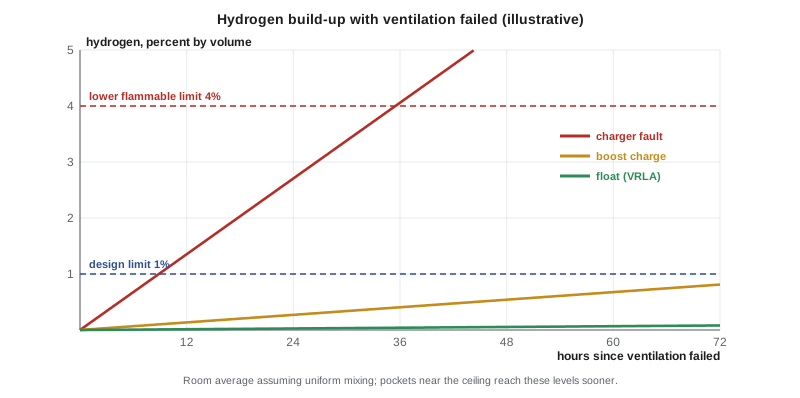
If ventilation stops, hydrogen accumulates at a rate that depends on the generation rate and the room volume. Because hydrogen rises, it collects first near the ceiling, in light fittings, cable trays and any pockets formed by beams or a dropped ceiling. The program below estimates how long it takes for the average concentration in the Hall 1 battery room to reach 1 percent and 4 percent with no ventilation, assuming the gas mixes uniformly, which understates the concentration near the ceiling.
# Time to reach hydrogen thresholds in a closed room (uniform mixing assumed).
# Same illustrative gassing currents as above; values are illustrative only.
k = 0.4566                     # L of H2 per Ah per cell at 25 C (Faraday's law)
cells = 960
room_m3 = 12.0 * 9.0 * 3.6     # Hall 1 VRLA battery room volume
for name, amps in {"float (VRLA)": 0.01, "boost charge": 0.1, "charger fault": 1.0}.items():
    g = cells * amps * k                # L of H2 per hour
    t1 = 0.01 * room_m3 * 1000 / g      # hours to 1 percent
    t4 = 0.04 * room_m3 * 1000 / g      # hours to 4 percent
    print(f"{name:15s}: {g:6.1f} L/h; 1% in {t1:7.1f} h ({t1/24:5.1f} days), "
f"4% in {t4:7.1f} h ({t4/24:5.1f} days)")float (VRLA) : 4.4 L/h; 1% in 887.0 h ( 37.0 days), 4% in 3548.0 h (147.8 days) boost charge : 43.8 L/h; 1% in 88.7 h ( 3.7 days), 4% in 354.8 h ( 14.8 days) charger fault : 438.3 L/h; 1% in 8.9 h ( 0.4 days), 4% in 35.5 h ( 1.5 days)
In float with VRLA batteries, a failed fan takes weeks to create a problem on average, although a pocket near the ceiling could get there sooner. Under a charger fault, the room average passes the 1 percent design limit within hours and can reach the lower flammable limit in a day or two, and much sooner near the ceiling. The lesson is that ventilation failure and charging faults together are what create dangerous conditions, and alarms on both must be acted on promptly.
Hydrogen detection
Hydrogen detectors provide a second line of defence. They are mounted at the ceiling, above the batteries and near the exhaust intake, where hydrogen collects first. Catalytic bead, electrochemical, thermal conductivity and newer solid-state sensors are all used; each has strengths and drift characteristics, and all need periodic calibration and bump testing as the manufacturer specifies. Detectors are typically connected to the building management system with two alarm levels: a low alarm that starts additional ventilation and notifies operations, and a high alarm that stops charging if possible, starts all fans, sounds a local alarm and may notify the fire alarm system. Lithium-ion battery rooms may also use hydrogen detection as an early indicator of off-gassing, as Lesson 8 describes.
Controlling ignition sources
Even with good ventilation, work practices in a lead-acid battery room must assume that hydrogen may be present near the cells, especially in flooded batteries and immediately after charging. The usual rules are:
- No smoking, open flames, hot work or spark-producing tools in the room without a hot work permit, gas testing and continuous ventilation.
- Before touching battery terminals, discharge static electricity by touching a grounded surface, and avoid synthetic clothing that builds static.
- Never make or break a live connection at a cell vent; break connections away from the cell or with the string isolated so that any spark occurs away from escaping gas.
- Keep vent caps and flame arrestors in place on flooded cells; they are designed to stop a flame outside the cell from igniting the gas inside.
- Use lighting and equipment suitable for the room's classification if the design requires it; most ventilated battery rooms are not hazardous locations, but some designs or codes classify the area near vents.
- Do not store combustible materials in the room.
Hydrogen sulphide and dry-out
When a VRLA battery suffers thermal runaway, a different process from lithium-ion thermal runaway but sharing the name, the battery heats, dries out and may produce hydrogen sulphide as well as hydrogen. Lead-acid thermal runaway happens when high temperature lowers the battery's internal resistance, which increases float current, which heats the battery further, in a feedback loop. It is slower than lithium-ion runaway and usually does not lead to fire, but it can swell and crack the cases, release acid and gas, and melt plastic. A rotten-egg smell in a lead-acid battery room is a sign of overheating that needs immediate investigation. Temperature-compensated charging, which lowers the float voltage as temperature rises, is the main design control.
Worked problem
Responding to a hydrogen alarm
At 02:10 the building management system at Cedar Ridge reports a low-level hydrogen alarm (0.4 percent) in the Hall 1 VRLA battery room, followed by a supply fan failure alarm for the same room's exhaust system. What should the operations team do?
Show solution
- Treat the two alarms together as a serious condition: rising hydrogen with failed ventilation.
- Do not send anyone into the room to investigate the battery. Check remotely: battery monitoring for string currents, voltages and temperatures, and the charger or UPS for boost or fault conditions.
- If a charger or UPS is in boost mode or shows abnormal current, stop the boost charge or transfer the charging function as the procedure allows.
- Start the standby exhaust fan if one exists, and open the room exhaust to maximum. If ventilation cannot be restored and hydrogen keeps rising toward 1 percent, follow the emergency procedure, which may include isolating the affected strings remotely and notifying the fire service.
- Once ventilation is restored and hydrogen is falling, a qualified person can enter with a portable gas detector to inspect the batteries and find the cause, typically a charger fault or a failing cell.
Answer: Restore ventilation and stop excess charging remotely before anyone enters. Rising hydrogen with failed ventilation is exactly the combination that leads to explosions.
Common mistakes
MistakeAssuming VRLA batteries never produce hydrogen because they are sealed.
InsteadRecognize that VRLA batteries vent hydrogen under overcharge, high temperature or fault conditions.
MistakePlacing the hydrogen detector near the floor.
InsteadMount detectors at the ceiling and near the exhaust intake, where hydrogen collects.
MistakeIgnoring a ventilation failure alarm because the batteries are only floating.
InsteadAct on ventilation failure promptly, because a charger fault can sharply increase hydrogen production.
MistakeBreaking a live connection at the cell vent.
InsteadBreak connections away from vents or with the string isolated, so sparks do not meet escaping gas.
MistakeUsing the room to store cardboard and spare parts.
InsteadKeep combustible materials out of battery rooms.
Summary and key terms
- Lead-acid batteries produce hydrogen and oxygen by electrolysis as they approach full charge; flooded batteries release much more than VRLA batteries.
- Hydrogen generation follows Faraday’s law: about 0.46 litres per ampere-hour per cell at 25 °C.
- The lower flammable limit of hydrogen is 4 percent; battery rooms are designed to stay below 1 percent (25 percent of the LFL).
- Ventilation, taken from the ceiling and discharged outdoors, is the primary control; it should be supervised and interlocked with boost charging.
- Charger faults and ventilation failure together create dangerous conditions; hydrogen can reach flammable levels within a day.
- Ceiling-mounted hydrogen detectors with staged alarms provide a second line of defence.
- Ignition control includes no hot work without a permit, static control and keeping vent caps in place.
- Electrolysis
- The splitting of water into hydrogen and oxygen by an electric current.
- Gassing current
- The portion of charging current that produces gas rather than charging the plates.
- Recombination
- The process in a VRLA cell by which oxygen reacts at the negative plate, suppressing hydrogen formation.
- Lower flammable limit (LFL)
- The lowest concentration of a gas in air that can burn; 4 percent for hydrogen.
- Boost charge
- A charge at a higher voltage than float, used to recharge a battery quickly or equalize cells, which increases gassing.
- Flame arrestor vent
- A vent cap on a flooded cell that allows gas to escape while preventing an external flame from entering.
- Temperature-compensated charging
- Charging that lowers the float voltage as battery temperature rises, reducing overcharge and gassing.
- Lead-acid thermal runaway
- A feedback loop in which heat lowers internal resistance, raising float current and producing more heat.
Practice problems
Work each problem on paper first, then reveal the answer to check.
Why does a lead-acid battery produce hydrogen?
Show answer
Because part of the charging current electrolyzes water in the electrolyte, especially near full charge.
What is the lower flammable limit of hydrogen in air?
Show answer
About 4 percent by volume.
What design limit is commonly used for hydrogen in battery rooms, and why?
Show answer
1 percent, which is 25 percent of the LFL, to give a safety margin for uneven mixing.
How many litres of hydrogen does one ampere-hour of gassing current produce per cell at 25 °C?
Show answer
About 0.46 litres.
A string of 240 cells has a gassing current of 0.5 A. How much hydrogen does it produce per hour?
Show answer
240 × 0.5 × 0.46 ≈ 55 litres per hour.
Where should battery room exhaust and hydrogen detectors be located?
Show answer
At the highest point of the room, where hydrogen collects.
Why are charger supervision and alarms as important as ventilation?
Show answer
A charger fault can increase hydrogen generation dramatically.
Why must vent caps be kept in place on flooded cells?
Show answer
They act as flame arrestors, preventing an outside flame from igniting gas inside the cell.
What smell indicates possible lead-acid overheating and dry-out?
Show answer
A rotten-egg smell from hydrogen sulphide.
What should operators do first when hydrogen rises and ventilation has failed?
Show answer
Restore ventilation and stop excess charging remotely before anyone enters the room.
Lesson quiz · 5 questions
Score 60% or more to complete this lesson.
Create a free account to save your progress, take quizzes and earn a certificate.