
HSE-322 · Lesson 12 of 12 · 28 min
Capstone: case studies and a battery room risk review
This final lesson brings the course together in two parts. The first examines four published battery incidents, two at battery energy storage sites and two in data centres, and draws out what they teach about the hazards and controls covered in Lessons 1 to 11. The second is a capstone exercise: a battery room risk review at the invented Cedar Ridge Colocation site, where you will apply the course to identify hazards, assess risks and recommend improvements. Facts about the incidents are taken from published investigation reports and news coverage available as of October 2026; investigations of the most recent events may still be producing findings.
Case 1: McMicken, Surprise, Arizona, 2019
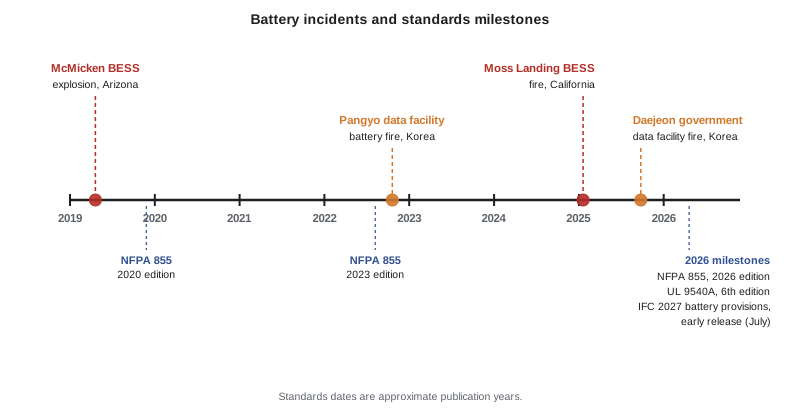
In April 2019, a 2 MW lithium-ion battery energy storage system at the McMicken site in Surprise, Arizona, owned by Arizona Public Service, suffered a thermal runaway event inside its walk-in container. Firefighters arrived and, after waiting for some time, opened a door to the container. About two minutes later, the accumulated gas exploded. Eight firefighters and a police officer were taken to hospital, several with serious injuries.
The technical analysis commissioned by the utility concluded that the event was an extensive cascading thermal runaway that began with an internal cell failure caused by an internal defect. The fire suppression system activated as designed, but it was designed for an ordinary fire, not for thermal runaway. Published analyses of the event also reported that runaway propagated from cell to cell and module to module, that flammable gases accumulated in the container without being ignited or vented, and that there was no emergency response plan for firefighters describing the hazards and safe tactics.
Lessons: an internal defect can start an event that no BMS can prevent; suppression that extinguishes or prevents flames can allow explosive gas to accumulate; opening a door on accumulated gas can trigger a deflagration; propagation barriers, explosion control and an emergency response plan shared with the fire service are essential. These lessons shaped later editions of NFPA 855 and UL 9540A and fire service guidance across North America.
Case 2: Pangyo data centre, South Korea, 2022
On October 15, 2022, a fire broke out in a battery room on the third basement level of SK C&C's data centre in Pangyo, near Seoul. Authorities said the fire likely started in lithium-ion UPS batteries. Power to the servers was cut, together with the backup power equipment, which was in the same room as the batteries. Kakao, whose popular messaging, payment and mobility services relied on the data centre, suffered disruption lasting about 127 hours. Kakao had backup systems in another data centre, but failover depended on systems located in the affected building, so it did not happen in time.
The government's investigation found that the battery monitoring system had not detected any abnormality before the fire, that the fire extinguishing system was not effective against a lithium-ion battery fire, and that the batteries were in the same space as other critical electrical equipment. It recommended strengthened battery monitoring, suppression suitable for lithium-ion fires and separation of batteries from other electrical equipment, together with redundancy and disaster recovery improvements by the service providers.
Lessons: monitoring can miss a failure; batteries located with the equipment they back up can take that equipment down with them; a basement battery room complicates firefighting; and resilience depends on separation and genuinely independent disaster recovery, not just on having a second site.
Case 3: Moss Landing, California, 2025
On January 16, 2025, a fire broke out at Vistra's battery storage facility at Moss Landing, California, one of the largest battery energy storage installations in the world. The fire affected the 300 MW Phase I installation, which used LG Energy Solution batteries and, as widely reported, was housed indoors in a large building rather than in separated outdoor containers. More than 1,500 people were evacuated, a nearby highway was closed and residents were advised to keep windows closed. The cause had not been determined at the time of the early reports. The site had experienced earlier incidents in 2021 and 2022 in which suppression system faults caused water to be released onto batteries, leading to short circuits and smoke.
Lessons: very large indoor installations can produce prolonged fires and community-scale impacts, including evacuations and concern about smoke and residues; the design choice between large indoor rooms and separated outdoor units has major consequences; and malfunctions of the protection systems themselves can create incidents. Investigation findings and regulatory responses, including in California, have continued to emerge since 2025.
Case 4: National Information Resources Service, Daejeon, South Korea, 2025
On the evening of September 26, 2025, a fire broke out in a computer room at the Daejeon centre of South Korea's National Information Resources Service, during work to relocate lithium-ion UPS batteries. The fire took about 22 hours to extinguish fully and halted 709 government information systems. The relocation project had been ordered after the 2022 Pangyo fire.
According to findings reported in September 2026 by the Board of Audit and Inspection and the National Forensic Service, sparks occurred between battery racks during the relocation because cable terminals had not been powered down and insulated: only one of eight battery racks had been powered down before dismantling. The work had been subcontracted to firms not registered as electrical construction businesses, no work plan had been required and manufacturer technical support had not been obtained. The audit also found that the fire response manual was kept only on one manager's computer, that firefighters were asked not to use water, delaying suppression, that a fire safety inspection had been declined, and that only a small fraction of the affected systems had separate disaster recovery platforms. The audit classified the fire as a man-made disaster caused by mismanagement.
Lessons: battery relocation and decommissioning are high-risk tasks needing a written method of procedure, full isolation and terminal insulation, qualified contractors and manufacturer support; emergency plans must be accessible and must support, not delay, effective firefighting; and the remedy for one incident can cause the next if the work itself is not controlled.
Common threads
The four cases differ in scale and setting, but they share patterns that map directly onto this course.
| Theme | Seen in | Course lesson |
|---|---|---|
| Internal defects or work-induced damage start the event | McMicken, Daejeon | Lessons 7 and 10 |
| Monitoring did not prevent the event | Pangyo, McMicken | Lessons 6 and 8 |
| Suppression not suited to thermal runaway, or malfunctioning | McMicken, Pangyo, Moss Landing | Lesson 9 |
| Gas accumulation and explosion on entry | McMicken | Lessons 7, 8 and 11 |
| Batteries co-located with critical equipment | Pangyo, Daejeon | Lessons 1 and 9 |
| Uncontrolled work, unqualified contractors, no plan | Daejeon | Lessons 3 and 10 |
| Emergency plans missing, inaccessible or not shared with responders | McMicken, Daejeon | Lesson 11 |
| Business and community impacts far beyond the battery room | All four | Lessons 1 and 11 |
Capstone: a battery room risk review at Cedar Ridge
You have been asked to lead a battery risk review at Cedar Ridge Colocation, the invented facility used throughout the data centre sites track. The site has a VRLA battery room serving Hall 1 (four strings, about 384 kWh), a lithium-ion battery room serving Hall 2 (eight racks of LFP modules, about 410 kWh, with off-gas detection, exhaust ventilation, aspirating smoke detection and pre-action sprinklers), generator starting batteries, rack-level battery shelves in two AI rows in Hall 2, and a small outdoor BESS container yard used for peak shaving. The review team includes the facility manager, the battery contractor, the UPS vendor, a fire protection engineer, the site safety advisor and a representative of the local fire service.
The walk-down and document review found the following conditions. They are invented for the exercise.
- The Hall 1 VRLA room's hydrogen detector was last calibrated 18 months ago; the manufacturer specifies 6 months.
- The Hall 1 room temperature has averaged 31 °C for the last summer because of a cooling unit fault that was deferred.
- In the Hall 2 lithium-ion room, eight spare modules are stored on a shelf against the wall.
- The Hall 2 exhaust fan's airflow proving switch is wired to the building management system, but its alarm is set to a low priority that does not notify the operations centre at night.
- The emergency response plan was last reviewed two years ago, before the rack-level battery shelves and the BESS yard were added.
- The fire service has never visited the site.
- A contractor's method of procedure for next month's replacement of a VRLA string does not mention sectioning the string or terminal covers.
- Staff e-bikes are charged in a corridor next to the Hall 2 battery room.
A simple risk matrix helps the team prioritize. Each finding is scored for likelihood and consequence on a scale of 1 to 5, and the product gives a risk score. The program below scores the findings with the team's illustrative ratings and sorts them.
# Illustrative risk ranking for the Cedar Ridge battery review (invented findings and scores).
findings = [
    ("Hydrogen detector calibration overdue (Hall 1)", 3, 4),
    ("Hall 1 battery room averaging 31 C", 4, 3),
    ("Spare Li-ion modules stored in Hall 2 room", 2, 4),
    ("Exhaust airflow alarm not reaching night operations", 3, 5),
    ("ERP out of date; rack BBUs and BESS not included", 3, 5),
    ("Fire service never visited the site", 3, 4),
    ("String replacement MOP lacks sectioning and covers", 3, 5),
    ("E-bikes charged next to Hall 2 battery room", 3, 3),
]
def band(score):
    return "high" if score >= 15 else "medium" if score >= 8 else "low"

ranked = sorted(findings, key=lambda f: f[1] * f[2], reverse=True)
for name, likelihood, consequence in ranked:
    s = likelihood * consequence
print(f"{s:2d} {band(s):6s} L{likelihood} C{consequence} {name}")15 high L3 C5 Exhaust airflow alarm not reaching night operations 15 high L3 C5 ERP out of date; rack BBUs and BESS not included 15 high L3 C5 String replacement MOP lacks sectioning and covers 12 medium L3 C4 Hydrogen detector calibration overdue (Hall 1) 12 medium L4 C3 Hall 1 battery room averaging 31 C 12 medium L3 C4 Fire service never visited the site 9 medium L3 C3 E-bikes charged next to Hall 2 battery room 8 medium L2 C4 Spare Li-ion modules stored in Hall 2 room
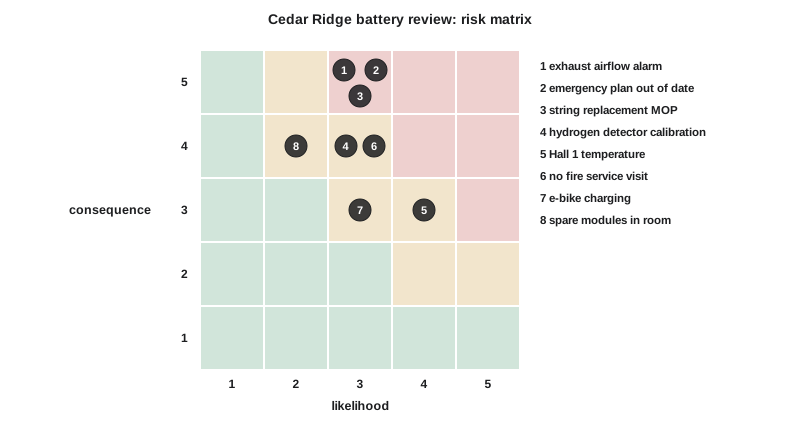
The ranking puts three findings at the top: the exhaust airflow alarm that would not reach night operations, the out-of-date emergency response plan and the string replacement procedure that lacks electrical controls. All three involve the failure of a layer of protection or of work control, the same themes seen in the case studies. The scores are judgements, and a different team might rate some findings differently; the value of the exercise lies in the discussion and in agreeing actions.
Recommendations
| Finding | Recommended action | Lesson |
|---|---|---|
| Exhaust airflow alarm priority | Raise to a priority that notifies operations at all times; test end to end; add to impairment procedure | 8 |
| Emergency response plan out of date | Revise to include rack battery shelves and BESS; review annually; train staff | 11 |
| String replacement MOP | Require sectioning, terminal covers, insulated tools, PPE and kept-in-service ventilation; manufacturer review | 3, 10 |
| Hydrogen detector calibration | Calibrate now; add to the maintenance system with alerts for overdue tasks | 5 |
| Hall 1 temperature | Repair cooling as a priority; assess battery condition and remaining life; review temperature alarms | 10 |
| Fire service never visited | Arrange a site visit and pre-incident planning session; share the updated plan | 11 |
| Spare modules in battery room | Move to designated storage meeting the fire code and manufacturer requirements | 9, 10 |
| E-bike charging | Move charging to a designated area away from battery rooms, exits and data halls; adopt a device policy | 10 |
The review should end with owners and dates for each action, a plan to verify that actions are complete, and a date for the next review. The findings should also be shared across the organization, because the same weaknesses, such as alarms set to the wrong priority or plans that lag behind changes, are likely to exist at other sites.
Worked problem
Writing a one-page summary for management
The facility manager asks you to summarize the Cedar Ridge battery review in a few points for the regional director, who is not a battery specialist. What should the summary say?
Show solution
- Purpose and scope: a review of all battery systems at the site, prompted by industry incidents and the addition of rack batteries and the BESS.
- Overall finding: the battery systems are well designed, but some layers of protection and work controls have weakened, which is how serious incidents elsewhere began.
- Top three risks: the exhaust airflow alarm would not reach night operations; the emergency plan does not cover the newest battery systems and has not been shared with the fire service; and next month's battery replacement procedure lacks key electrical controls.
- Actions and timing: all three high-priority items to be corrected before the replacement work begins, with the remaining items within 60 days, owners named and verification by the safety advisor.
- Request: support for a fire service site visit and for repairing the Hall 1 cooling unit as a priority rather than deferring it.
Answer: A short summary should state the purpose, the overall finding in plain terms, the top risks and why they matter, the actions with owners and dates, and any decisions or resources needed from management.
Closing the track
This course completes the battery part of the data centre sites track. HSE-320 introduced the data centre workplace, HSE-321 covered electrical safety in critical facilities, and HSE-322 has covered the electrical, chemical, thermal and explosion hazards of battery systems. HSE-323, Fire Suppression and Liquid Cooling Hazards, completes the track with clean agent and sprinkler systems, oxygen and pressure hazards, and the coolant hazards of liquid-cooled AI racks. Together, the four courses prepare you to work safely in the spaces that keep critical facilities running, and to recognize when the systems that protect you are not working as they should.
Common mistakes
MistakeReading case studies as stories about other people’s failures.
InsteadUse them to test your own site: would the same conditions exist here?
MistakeTreating a risk matrix score as an objective measurement.
InsteadUse scores to structure discussion and prioritize, recognizing they are judgements.
MistakeEnding a review with a list of findings but no owners or dates.
InsteadAssign owners, dates and verification for every action.
MistakeDeferring repairs to battery room cooling as a low priority.
InsteadRecognize that heat shortens battery life and raises failure risk.
MistakeUpdating the emergency plan only after an incident.
InsteadReview it whenever systems change and at least annually, and share it with the fire service.
Summary and key terms
- McMicken (2019) showed the danger of cascading runaway, suppression unsuited to runaway, gas accumulation and opening doors on accumulated gas.
- Pangyo (2022) showed that monitoring can miss failures and that co-locating batteries with critical equipment can take down services.
- Moss Landing (2025) showed the community-scale impacts of very large indoor installations and the risk of protection system malfunctions.
- Daejeon (2025) showed the dangers of uncontrolled battery relocation work, unqualified contractors and inaccessible emergency plans.
- Common threads include failed layers of protection, uncontrolled work and plans not shared with responders.
- A battery risk review identifies hazards, scores and prioritizes risks and assigns actions with owners, dates and verification.
- Case study
- An analysis of a real event used to draw lessons for practice.
- Risk matrix
- A grid that combines likelihood and consequence ratings to prioritize risks.
- Likelihood
- An estimate of how probable it is that a hazardous event will occur.
- Consequence
- An estimate of how severe the outcome of a hazardous event would be.
- Risk review
- A structured examination of hazards, controls and risks, ending with agreed actions.
- Corrective action
- An action taken to remove the cause of a finding and prevent recurrence.
- Verification
- Confirmation that an action has been completed and is effective.
Practice problems
Work each problem on paper first, then reveal the answer to check.
What started the McMicken event, according to the utility’s technical analysis?
Show answer
An internal cell failure caused by an internal defect, leading to cascading thermal runaway.
What happened shortly after firefighters opened the McMicken container door?
Show answer
The accumulated gas exploded, injuring firefighters and a police officer.
Name two findings of the Pangyo investigation.
Show answer
Any two of: monitoring did not detect an abnormality, suppression was not effective for lithium-ion, and batteries shared space with other critical equipment.
What work was under way when the Daejeon fire started?
Show answer
Relocation of lithium-ion UPS batteries.
Name three work control failures found at Daejeon.
Show answer
Any three of: only one of eight racks powered down, terminals not insulated, unregistered subcontractors, no work plan and no manufacturer support.
What community impacts did the Moss Landing fire have?
Show answer
Evacuation of more than 1,500 people, a highway closure and advice to keep windows closed.
Why were the exhaust alarm, the ERP and the string replacement MOP ranked highest at Cedar Ridge?
Show answer
Each represents a failed layer of protection or work control with high potential consequence.
What should every recommendation from a risk review have?
Show answer
An owner, a date and a plan for verification.
Why should review findings be shared with other sites?
Show answer
Because the same weaknesses are likely to exist elsewhere.
Which course completes the data centre sites track?
Show answer
HSE-323, Fire Suppression and Liquid Cooling Hazards.
Lesson quiz · 5 questions
Score 60% or more to complete this lesson.
Create a free account to save your progress, take quizzes and earn a certificate.