
HSE-322 · Lesson 1 of 12 · 30 min
Battery systems in data centres
Every critical facility depends on stored energy. When the utility fails, there is a gap of several seconds to a minute or more before standby generators start, synchronize and pick up the load. Uninterruptible power supplies bridge that gap with batteries, and in most data centres the batteries are the largest store of chemical energy in the building after the generator fuel. Unlike fuel in a tank, battery energy is stored as electricity ready to be released, and it cannot be switched off. A battery string disconnected from its UPS is still a source of hundreds of volts and thousands of amperes; a damaged lithium-ion cell can release its stored energy as heat, flammable gas and fire even when nothing is connected to it at all.
This course is the third in the data centre sites track. HSE-320, Data Centre Safety Essentials, introduced battery rooms as one of the special spaces in a data centre, and HSE-321, Electrical Safety in Critical Facilities, treated the battery as a DC source to be identified and isolated when working on a UPS. HSE-322 goes into the battery itself: the electrical, chemical, thermal and explosion hazards of the battery systems used in data centres, the codes and standards that govern them, how they are detected and controlled, and how to respond when something goes wrong. HSE-323, Fire Suppression and Liquid Cooling Hazards, follows and covers the clean agent and sprinkler systems that protect battery rooms in more detail.
The engineering of battery systems, including sizing, chemistry selection and UPS integration, is covered in DCE-340, Backup Power Systems, especially Lesson 3 on batteries and Lesson 6 on battery energy storage. Electrochemistry itself belongs to the chemistry courses. This course takes the view of the people who work in, near and around battery systems: facility technicians, electricians, battery service contractors, security officers, safety professionals, emergency responders and the managers who make decisions about them.
Why batteries are a special hazard
Most hazards in a data centre can be removed before work begins. Electrical equipment can be de-energized and locked out, moving machinery can be stopped, and a hot aisle can be cooled. Batteries are different in four ways that run through this whole course.
- First, a battery cannot be fully de-energized. Opening a battery disconnect isolates the battery from the UPS, but every cell remains charged. The terminals of each tier, shelf and module stay live. Work on a battery is always work near energized parts unless the battery has been discharged and taken apart, which is rarely practical.
- Second, a battery combines several hazards in one place. It is an electrical source, a container of corrosive or flammable chemicals, a possible source of flammable and toxic gas, and, for lithium-ion, a possible source of self-sustaining fire.
- Third, a battery failure can escalate without any outside help. A single lithium-ion cell that enters thermal runaway can heat its neighbours until they fail too, and a lead-acid battery that is overcharged can produce hydrogen until a room becomes explosive.
- Fourth, the consequences of a battery incident reach well beyond the battery room. Data centre battery fires have taken down national government services and popular consumer platforms for days, and explosions at battery energy storage sites have injured firefighters who arrived to help.
Where batteries are found in a data centre
Batteries in a data centre come in several sizes and forms, and each has its own hazards. The largest and most important are the central UPS batteries, but they are not the only ones.
| Location | Typical chemistry | Typical voltage | Main hazards |
|---|---|---|---|
| Central UPS battery room | VRLA or flooded lead-acid; lithium-ion (LFP or NMC) | About 400 to 600 V DC per string | Shock, DC arc flash, acid, hydrogen, thermal runaway |
| UPS battery cabinets beside the UPS | VRLA or lithium-ion | About 400 to 600 V DC | Shock, DC arc flash, thermal runaway in the UPS room |
| Battery energy storage system (BESS) yard | Lithium-ion, usually LFP, in containers | About 1,000 to 1,500 V DC | Fire, explosion, toxic gas, very high energy |
| Rack-level battery backup units (BBUs) | Lithium-ion | About 48 to 54 V DC | Thermal runaway in the data hall; large numbers of cells |
| Generator starting batteries | Flooded or VRLA lead-acid | 12 or 24 V DC | Acid, hydrogen, burns from short circuits |
| Telecom and network DC plants | VRLA lead-acid or lithium-ion | 48 V DC | High current, burns, acid |
| Fire alarm, access control and emergency lighting | Small sealed lead-acid or lithium | 12 or 24 V DC | Mostly low; ageing batteries can swell |
| Tools, laptops, radios and micromobility devices | Lithium-ion | Up to about 60 V DC | Fire from damaged or charging packs |
Central UPS batteries are the focus of most of this course. They are installed either in dedicated battery rooms, separated from other spaces by fire-rated construction, or in cabinets placed next to the UPS modules in the UPS room. Battery rooms are common for large lead-acid installations because of their weight, floor area and hydrogen ventilation needs. Lithium-ion batteries take up far less space and are usually supplied in factory-built cabinets, which has made cabinet installations more common. Each arrangement has advantages and drawbacks, discussed below.
Rack-level battery backup units have become common in hyperscale and AI facilities, where some designs place lithium-ion battery shelves inside each rack instead of using a large central UPS. HSE-321 Lesson 1 noted the move to higher-voltage DC distribution in AI racks; distributed batteries follow the same trend. They spread the energy across the data hall, which reduces the size of any one battery but means thousands of cells sit among the servers, where a failure affects the space people work in every day.
Battery chemistries at a glance
Lesson 4 and Lesson 6 describe the chemistries in more detail. For now, three families matter.
Lead-acid batteries have been the standard UPS battery for decades. Each cell has lead and lead dioxide plates in sulphuric acid electrolyte and a nominal voltage of 2 V. Flooded (vented) lead-acid batteries have free liquid electrolyte, need topping up with water and release hydrogen and oxygen during charging, especially at the end of charge. Valve-regulated lead-acid (VRLA) batteries hold the electrolyte in an absorbent glass mat or gel and recombine most of the gas internally, releasing it through a valve only under abnormal conditions. VRLA batteries are cheaper and easier to install, but they are sensitive to heat and typically need replacement every four to six years in UPS service.
Lithium-ion batteries store energy by moving lithium ions between a graphite anode and a metal oxide or phosphate cathode through a flammable organic electrolyte. The two chemistries most common in data centres are lithium iron phosphate (LFP), with a nominal cell voltage of about 3.2 V, and lithium nickel manganese cobalt oxide (NMC), with about 3.6 to 3.7 V. Lithium-ion batteries are lighter, smaller and longer-lived than lead-acid, tolerate higher temperatures and can be monitored cell by cell. Their chief safety concern is thermal runaway, a self-sustaining reaction that releases heat, flammable and toxic gas and sometimes fire. LFP is generally more resistant to thermal runaway than NMC, but neither is immune.
Nickel-cadmium batteries are found in some older sites and in generator starting and switchgear control systems. Sodium-ion batteries, which avoid lithium and use a non-flammable or less flammable chemistry in some designs, are emerging as an option for data centre backup; as of 2026 a few suppliers are marketing them for UPS and rack use, but installed numbers remain small compared with lead-acid and lithium-ion.
Battery rooms and battery cabinets
A battery room is a dedicated enclosed space for batteries, usually with fire-rated walls, a controlled door, dedicated ventilation, spill containment for flooded batteries, an eyewash station, and signs warning of the hazards. Racks hold rows of cells or monoblocs (multi-cell blocks), connected in series into strings by intercell connectors and cables. The room may serve one UPS or several.
A battery cabinet is a steel enclosure, often the same size as a UPS module, holding shelves or trays of monoblocs or lithium-ion modules, with an integral DC breaker or disconnect. Cabinets are usually placed in the UPS room, beside the modules they serve, which shortens the DC cables.
| Feature | Battery room | Battery cabinets in a UPS room |
|---|---|---|
| Separation from other equipment | Good, by fire-rated construction | Limited; a battery fire affects the UPS room |
| Ventilation for hydrogen | Dedicated room exhaust is straightforward | Depends on room ventilation and cabinet venting |
| Access for maintenance | Open racks, good access, but exposed terminals | Shelves behind doors; terminals partly shielded |
| Fire suppression and detection | Can be designed specifically for the room | Shared with the UPS room unless cabinets have their own |
| Explosion control for lithium-ion off-gas | Room-level exhaust or deflagration venting can be added | Cabinet-level venting and detection needed |
| Footprint and weight | Large floor area; heavy floor loads for lead-acid | Compact, especially for lithium-ion |
Neither option is always better. What matters for the people who work there is that each space is designed, signed and managed for the battery hazards it actually contains, and that workers know which hazards to expect before they open the door.
Strings, cells and the DC bus
A UPS needs a DC voltage of several hundred volts, so cells are connected in series into a string. The string voltage is the number of cells times the voltage per cell, and it changes with state of charge: a lead-acid cell floats at about 2.25 to 2.27 V when fully charged and falls to about 1.75 V at the end of a discharge. Several strings may be connected in parallel to provide more runtime or redundancy, each with its own disconnect. HSE-321 Lesson 7 explained how the battery connects to the UPS DC bus and why opening the battery breaker does not make the battery safe.
The energy stored in a string is roughly the string voltage times its capacity in ampere-hours. A string of 240 lead-acid cells (40 monoblocs of 12 V) with a capacity of 200 Ah stores about \(480 \times 200 = 96{,}000\) Wh, or 96 kWh, at nominal voltage. Only part of this can be used at the high discharge rates of UPS service, but all of it is present as a hazard. The short program below compares the strings at Cedar Ridge.
# Illustrative battery strings at the invented Cedar Ridge Colocation site.
# Nominal cell voltages: lead-acid 2.0 V, LFP 3.2 V, NMC 3.65 V (typical values).
strings = [
    ("Hall 1 VRLA string", 240, 2.0, 2.27, 200),
    ("Hall 2 LFP rack", 160, 3.2, 3.45, 100),
    ("Comparison NMC rack", 136, 3.65, 4.1, 100),
]
print(f"{'String':22s} {'cells':>5s} {'nominal V':>9s} {'float V':>8s} {'kWh':>6s}")
for name, cells, v_nom, v_float, ah in strings:
    nominal = cells * v_nom
    floating = cells * v_float
    kwh = nominal * ah / 1000
    print(f"{name:22s} {cells:5d} {nominal:9.0f} {floating:8.0f} {kwh:6.1f}")

hall1_strings = 4
print(f"Hall 1 has {hall1_strings} parallel strings: "
f"{hall1_strings * 240 * 2.0 * 200 / 1000:.0f} kWh stored in one room")String cells nominal V float V kWh Hall 1 VRLA string 240 480 545 96.0 Hall 2 LFP rack 160 512 552 51.2 Comparison NMC rack 136 496 558 49.6 Hall 1 has 4 parallel strings: 384 kWh stored in one room
The numbers show two things. String voltages for every chemistry fall in the same range, so the shock and DC arc flash hazards are similar whatever the chemistry. And a single battery room can store hundreds of kilowatt-hours, more than enough to injure workers and destroy the room if released suddenly.
Worked problem
Recognizing the hazards of each battery space
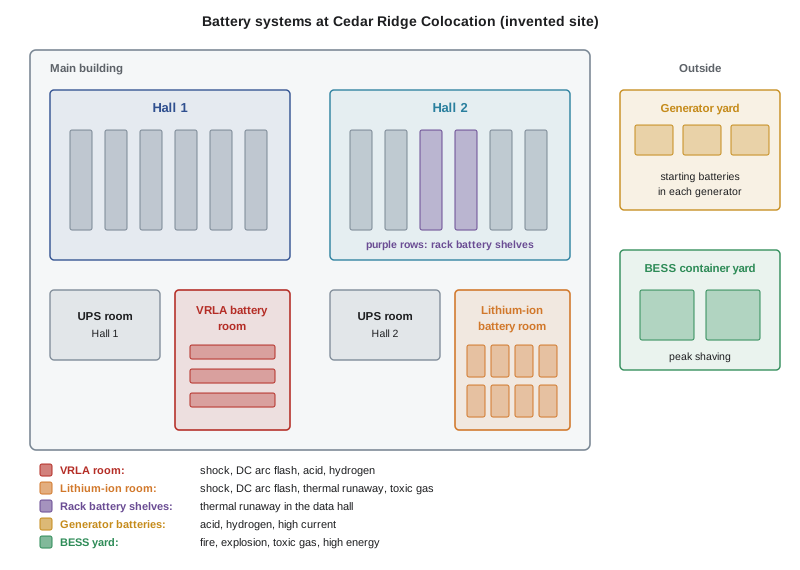
A new facility technician at Cedar Ridge is given a walk-through of the site's battery spaces: the VRLA battery room serving Hall 1, the lithium-ion battery room serving Hall 2, the lead-acid starting batteries in the generator enclosures and the rack-level battery shelves in two AI rows in Hall 2. For each, list the two most important hazards the technician should expect.
Show solution
- VRLA battery room: shock and DC arc flash from string terminals at around 480 to 545 V DC, and hydrogen if ventilation fails or a cell is overcharged; acid is a lesser concern with VRLA but possible with a damaged jar.
- Lithium-ion battery room: shock and DC arc flash, and thermal runaway with flammable, toxic off-gas and fire.
- Generator starting batteries: acid splash and hydrogen near the terminals, and burns from short circuits with tools; the voltage is low, but the current is high.
- Rack-level battery shelves: thermal runaway inside the data hall among servers and people, and high-current burns from the DC busbar.
Answer: Each space has a different mix. The technician should treat every battery as energized and know whether the main additional hazard is hydrogen, acid or thermal runaway before entering.
Who works on batteries
Several groups of people come into contact with data centre batteries. Facility technicians perform daily and weekly inspections, record readings and respond to alarms. Battery service contractors, often from the battery or UPS manufacturer, perform quarterly and annual maintenance, impedance testing and replacements. Electricians install and remove battery systems and their DC cabling. Security officers patrol battery rooms and are often first to notice a smell, a sound or an alarm. Fire services respond to battery incidents and need accurate information quickly. Each group needs training matched to its tasks, as Lesson 2 and Lesson 3 explain.
Battery energy storage systems on site
A growing number of data centres install battery energy storage systems (BESS) outside the building, in containers or prefabricated enclosures, to take part in grid services, shave peak demand, support on-site renewable generation or reduce generator runtime. DCE-340 Lesson 6 covers the engineering case. A BESS can store tens or hundreds of megawatt-hours, far more than a UPS battery, and usually operates at higher DC voltages. It is governed by the same core standards as indoor batteries, particularly NFPA 855 and UL 9540, and the large-scale incidents studied in Lesson 12 were mostly BESS events. Where a data centre has a BESS, the emergency plan, the fire service pre-incident plan and the training of site staff must include it.
A course roadmap
Lesson 2 maps the law, codes and standards that govern battery systems in your country. Lesson 3 covers electrical hazards, Lesson 4 chemical hazards and Lesson 5 hydrogen and ventilation in lead-acid rooms. Lessons 6 and 7 cover lithium-ion batteries, their management systems and thermal runaway. Lessons 8 and 9 cover detection, ventilation, explosion control, suppression and separation. Lesson 10 covers maintenance, handling, transport and disposal. Lesson 11 covers emergency response, and Lesson 12 brings everything together with published case studies and a battery room risk review at Cedar Ridge.
Common mistakes
MistakeTreating an isolated battery as de-energized because its breaker is open.
InsteadTreat every battery as energized; opening the disconnect isolates it from the UPS but every cell and terminal remains live.
MistakeAssuming lithium-ion batteries are safe because they are sealed and monitored.
InsteadRecognize that lithium-ion cells can enter thermal runaway, release flammable and toxic gas and burn, and that monitoring reduces but does not remove the risk.
MistakeIgnoring small batteries such as generator starting batteries, rack battery shelves and tool packs.
InsteadInclude every battery in the site inventory and hazard assessment, with controls matched to its size and location.
MistakePlacing batteries in the same room as the equipment they back up without considering what a battery fire would do to that equipment.
InsteadWeigh separation, detection and suppression when choosing between battery rooms and cabinets.
MistakeLeaving the outdoor BESS out of the data centre emergency plan.
InsteadInclude the BESS in emergency planning, fire service pre-incident plans and staff training.
Summary and key terms
- Batteries store energy that cannot be switched off; a disconnected string is still a source of high voltage and fault current.
- Data centre batteries include central UPS batteries, BESS containers, rack-level battery units, generator starting batteries, DC plants and small batteries in tools and devices.
- Lead-acid (flooded and VRLA) and lithium-ion (LFP and NMC) are the main chemistries; sodium-ion is emerging.
- Battery rooms offer separation and dedicated ventilation; cabinets save space but share the UPS room.
- String voltages of about 400 to 600 V DC are common to all chemistries, so shock and DC arc flash hazards are similar.
- A single battery room can store hundreds of kilowatt-hours, enough to cause severe injury and serious damage.
- Uninterruptible power supply (UPS)
- Equipment that supplies the critical load from a battery when the normal supply fails, until generators take over or the supply returns.
- Battery string
- Cells or monoblocs connected in series to provide the DC voltage the UPS needs.
- Monobloc
- A battery block containing several cells in one case, such as a 12 V lead-acid block of six cells.
- VRLA battery
- A valve-regulated lead-acid battery that recombines most of its gas internally and vents only under abnormal conditions.
- Flooded lead-acid battery
- A vented lead-acid battery with free liquid electrolyte that releases hydrogen and oxygen during charging.
- LFP
- Lithium iron phosphate, a lithium-ion chemistry with a nominal cell voltage of about 3.2 V and relatively high thermal stability.
- NMC
- Lithium nickel manganese cobalt oxide, a lithium-ion chemistry with higher energy density and lower thermal stability than LFP.
- Battery energy storage system (BESS)
- A large battery installation, often in containers, used for grid services, peak shaving or backup.
- Battery backup unit (BBU)
- A battery module installed at rack level to provide ride-through power to the equipment in that rack.
Practice problems
Work each problem on paper first, then reveal the answer to check.
Why can a battery not be fully de-energized by opening its disconnect?
Show answer
Because every cell remains charged; opening the disconnect only separates the battery from the UPS.
Name four places in a data centre where batteries are found.
Show answer
Any four of the central UPS battery room, UPS battery cabinets, a BESS yard, rack-level battery units, generator starting batteries, telecom DC plants, fire alarm and access control panels, tools and devices.
What is the main difference between flooded and VRLA lead-acid batteries?
Show answer
Flooded batteries have free electrolyte and vent hydrogen and oxygen during charging; VRLA batteries recombine most gas internally and vent only under abnormal conditions.
What is the chief safety concern with lithium-ion batteries?
Show answer
Thermal runaway, which releases heat, flammable and toxic gas and sometimes fire.
Calculate the nominal energy of a string of 160 LFP cells at 3.2 V with a capacity of 100 Ah.
Show answer
160 × 3.2 = 512 V; 512 × 100 = 51,200 Wh, about 51 kWh.
Give one advantage and one drawback of battery cabinets in a UPS room.
Show answer
Advantage: compact, short DC cables. Drawback: a battery fire directly affects the UPS room and the equipment in it.
Why do rack-level battery units change the hazard profile of a data hall?
Show answer
They place many lithium-ion cells among servers and people, so a failure happens in an occupied work area.
Which course covers battery engineering such as sizing and chemistry selection?
Show answer
DCE-340, Backup Power Systems.
Why should a BESS be included in the data centre emergency plan?
Show answer
Because it stores very large amounts of energy and can cause fire, explosion and toxic gas that affect the whole site and responders.
What are the four ways batteries differ from most other data centre hazards?
Show answer
They cannot be fully de-energized, they combine several hazards, a failure can escalate on its own, and the consequences reach beyond the battery room.
Lesson quiz · 5 questions
Score 60% or more to complete this lesson.
Create a free account to save your progress, take quizzes and earn a certificate.