
HSE-322 · Lesson 10 of 12 · 27 min
Maintenance, handling, transport and disposal
Most battery incidents in data centres do not start during normal operation. They start when something is done to the battery: a maintenance task, a replacement, a relocation, a delivery, a removal. Work on batteries brings people into direct contact with energized terminals and electrolyte, and moving batteries exposes cells to mechanical damage that may only show itself weeks later. The 2025 Daejeon fire began while lithium-ion batteries were being dismantled for relocation. This lesson covers the safe maintenance, inspection, handling, storage, transport and disposal of data centre batteries, building on the electrical controls in Lesson 3 and the chemical controls in Lesson 4.
Maintenance programs
Battery maintenance keeps batteries reliable and finds failing cells before they cause outages or incidents. For lead-acid batteries, IEEE 450 (vented) and IEEE 1188 (VRLA) recommend maintenance and testing practices, and IEEE 1657 describes qualifications for battery maintenance personnel. Lithium-ion battery maintenance is defined largely by the manufacturer, supported by the BMS. NFPA 855 requires energy storage systems to be maintained in accordance with the manufacturer's instructions and requires records of inspections, tests and maintenance.
| Task | Lead-acid (typical) | Lithium-ion (typical) |
|---|---|---|
| Visual inspection: leaks, swelling, corrosion, damage, cleanliness | Monthly or more often | Monthly or per manufacturer |
| String and float voltage and current; room temperature | Monthly, or continuous by monitoring | Continuous by BMS; review trends |
| Individual cell or block voltages | Quarterly, or continuous by monitoring | Continuous by BMS |
| Internal ohmic measurements (impedance, conductance or resistance) | Quarterly to semi-annually | Per manufacturer; BMS may estimate |
| Connection resistance and torque check | Annually, and after installation | Per manufacturer |
| Infrared thermography of connections | Annually or more often | Annually or per manufacturer |
| Electrolyte level and specific gravity (flooded only) | Monthly to quarterly | Not applicable |
| Capacity (discharge) test | At acceptance and periodically per IEEE 450/1188 | At acceptance and per manufacturer |
| Detection, ventilation and suppression interface tests | Per fire code and design | Per fire code, NFPA 855 and design |
Several of these tasks involve exposure to energized terminals: measuring cell voltages and ohmic values, checking torque and opening covers for thermography. Lesson 3 described the controls: a risk assessment, sectioning the string where practical, exposing one tier at a time, insulated tools and test leads, removal of jewellery and the right PPE. Infrared thermography is best done with covers that have IR windows or with the battery under a modest load, so that loose connections show as hot spots without removing more covers than necessary.
Temperature and battery life
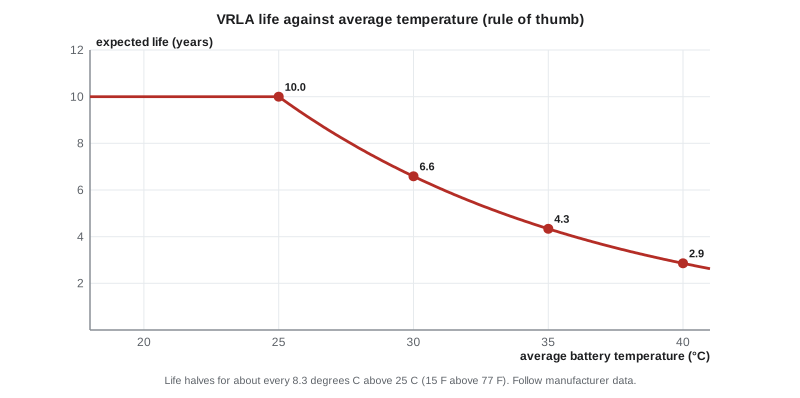
Temperature is the single most important factor in lead-acid battery life. Battery life ratings are usually given at 25 °C (77 °F), and a widely used rule of thumb, based on the Arrhenius relationship for chemical reaction rates, is that life is roughly halved for every 8 to 10 °C (about 15 to 18 °F) of sustained operation above that temperature. Lithium-ion batteries tolerate warmer conditions better, but high temperature also shortens their life and reduces the margin to thermal runaway. Keeping battery rooms within the manufacturer's temperature range is therefore both a reliability and a safety measure. The program below applies the rule of thumb to a VRLA battery with a design life of ten years at 25 °C.
# Rule-of-thumb VRLA life versus average temperature (illustrative, Arrhenius-based).
# Life halves for every 8.3 C above 25 C; real results depend on the product.
DESIGN_LIFE_Y = 10.0
HALVING_C = 8.3
for t_c in (20, 25, 30, 35, 40):
    factor = 2 ** (-(t_c - 25) / HALVING_C) if t_c > 25 else 1.0
    t_f = t_c * 9 / 5 + 32
print(f"{t_c:2d} C ({t_f:5.1f} F): expected life about {DESIGN_LIFE_Y * factor:4.1f} years")20 C ( 68.0 F): expected life about 10.0 years 25 C ( 77.0 F): expected life about 10.0 years 30 C ( 86.0 F): expected life about 6.6 years 35 C ( 95.0 F): expected life about 4.3 years 40 C (104.0 F): expected life about 2.9 years
The results show why a battery room cooling failure that persists for weeks, or a room design that runs batteries at 35 °C, can more than halve the life of a lead-acid battery and lead to unexpected failures. The rule is approximate, and below 25 °C life does not increase in proportion; the manufacturer's data governs. For safety, the key point is that hot batteries fail sooner and, in the case of VRLA, are more prone to dry-out and lead-acid thermal runaway.
Handling and installing batteries
Batteries are heavy. A 12 V, 200 Ah VRLA monobloc can weigh about 60 kg, and a lithium-ion module about 30 to 60 kg. Manual handling injuries are a real risk during installation and replacement. Mechanical aids such as battery lifts, hoists and carts designed for batteries should be used, and team lifts planned where aids cannot be used; HSE-320 Lesson 8 covered lifting and moving equipment in data centres.
Lithium-ion modules need particular care because mechanical damage can cause internal shorts that do not show immediately. Modules must not be dropped, struck, crushed or punctured, and any module that is dropped or visibly damaged must be set aside for inspection by the manufacturer rather than installed. Terminals must be protected from short circuit during handling, typically with caps or covers provided by the manufacturer, and modules must not be placed on conductive surfaces where terminals could contact metal. Installation must follow the manufacturer's sequence, including connecting communications to the BMS before the battery is energized, so that protection is active from the start.
Relocation and decommissioning
Moving or dismantling an energized battery system is among the highest-risk battery tasks, as the Daejeon fire showed. The investigation found that only one of eight battery racks had been powered down before dismantling, that cable terminals were not insulated during the work, that the work was carried out by firms not registered for electrical work, that no work plan had been required and that the manufacturer's technical support had not been obtained. Each of these is a familiar failure of work control.
A safe relocation or decommissioning plan for a lithium-ion battery includes:
- A written method of procedure reviewed by the manufacturer, with the site's change control approval (HSE-320 Lesson 9 covered methods of procedure).
- Qualified personnel from registered or licensed contractors, with the manufacturer's technical support where required.
- Shutting down and isolating every rack, verifying isolation at each, and opening contactors and breakers under lockout.
- Reducing state of charge to the level the manufacturer specifies for transport or storage before dismantling, where practical.
- Insulating every cable end and terminal as it is disconnected, using covers or caps provided for the purpose.
- Keeping detection, ventilation and suppression in service throughout, or providing compensating measures and a fire watch if any is impaired.
- Inspecting each module for damage, packaging it for transport in accordance with dangerous goods rules and labelling damaged modules separately.
Storage of batteries and spares
Spare batteries and modules, and batteries awaiting installation or disposal, should be stored in a dedicated area designed for them, not in the battery room or the data hall. For lithium-ion, the manufacturer typically specifies a storage state of charge, often around 30 to 50 percent, a temperature range and limits on stacking. The fire code may limit the quantity stored and require separation and detection, and the early release of battery provisions for the 2027 International Fire Code, published in July 2026, includes new requirements for battery storage and handling. Lead-acid batteries in storage need periodic recharging to prevent hard lead sulphate crystals from forming on the plates, and should be stored upright in a ventilated area with spill containment for flooded types.
Damaged and defective batteries
Batteries that are damaged, swollen, leaking, overheated or recalled need special handling. For lithium-ion, a damaged module can enter thermal runaway later, so it should be removed to a safe isolation location away from buildings and combustibles, ideally outdoors or in a container designed for damaged batteries, and monitored. Transport of damaged or defective lithium-ion batteries is subject to stricter packaging rules and in some cases is prohibited by certain modes, such as passenger aircraft. The manufacturer and a specialist recycler should be involved in the decision about how to handle and move them.
Transport
When batteries are shipped to or from a site, the Transportation of Dangerous Goods Regulations apply. Lithium-ion batteries are Class 9 dangerous goods: UN 3480 for batteries shipped alone and UN 3481 for batteries packed with or contained in equipment. Wet lead-acid batteries are Class 8 corrosives (UN 2794), and non-spillable VRLA batteries are UN 2800, with exemptions in some conditions. Requirements include training of those who prepare and offer shipments, packaging, marking, labels and shipping documents. Damaged or defective lithium-ion batteries need special packaging and may need approval. Air transport follows the ICAO Technical Instructions and IATA regulations, which add state-of-charge limits for lithium-ion batteries shipped alone. HSE-250 covers dangerous goods transport in more depth. For a data centre, the key points are that only trained people prepare battery shipments and that damaged batteries are never shipped as ordinary goods.
End of life and recycling
Lead-acid batteries are among the most recycled products in North America, with well-established collection and smelting systems; the lead, plastic and acid are recovered. Lithium-ion recycling is growing rapidly. In Canada, end-of-life batteries are managed under provincial waste and extended producer responsibility programs, which vary by province, and under federal rules for interprovincial and international movement of hazardous waste and recyclables. Data centre batteries are usually returned to the supplier or sent to an approved recycler, with documentation of the chain of custody.
Batteries awaiting recycling remain hazardous. Lithium-ion modules should have their terminals protected and be stored and transported as described above, and lead-acid batteries should be kept upright with spill containment. Fires at battery recycling facilities and in waste trucks, often caused by damaged or unprotected lithium-ion batteries, are a recognized problem across the industry.
Micromobility devices and tool batteries
Data centres also contain smaller lithium-ion batteries in tools, laptops, radios, phones and sometimes personal e-bikes and e-scooters brought by staff. Fires from charging micromobility devices have caused deaths in residential buildings, and fire codes increasingly address them. A site policy should cover where such devices may be charged (not in data halls, battery rooms, electrical rooms or exit routes), the use of manufacturer chargers and certified devices, inspection for damage, and the removal of damaged or swollen packs. Tool batteries used by contractors should be charged in designated areas, not on top of racks or in the data hall.
Worked problem
Planning a lead-acid to lithium-ion replacement
Cedar Ridge will replace one of the four VRLA strings serving Hall 1 with lithium-ion cabinets, as a first step toward converting the room. The old string must be removed while the other three remain in service, and the new cabinets installed and commissioned. Outline the key safety steps for the removal and the installation.
Show solution
- Prepare a method of procedure with the UPS and battery manufacturers, approved under change control, covering the UPS configuration with three strings, the removal sequence and the installation and commissioning sequence.
- For removal: isolate and lock out the string breaker, section the string at the inter-tier links, cover each terminal as connections are removed, lift blocks with a battery lift, check each for damage or leaks, and package them for recycling under dangerous goods rules.
- Keep the room's hydrogen ventilation and detection in service throughout, since the remaining strings are still floating.
- For installation: confirm the fire protection review of the new lithium-ion cabinets (stored energy, detection, ventilation, suppression), inspect each module on delivery, install with terminal covers in place, connect BMS communications before energizing and follow the manufacturer's commissioning tests.
- Update the battery inventory, emergency response information and fire service pre-incident plan to show that the room now contains both chemistries.
Answer: The work combines live electrical work, heavy lifting, chemical handling and a change in hazard. A manufacturer-approved method of procedure, isolation and sectioning, terminal protection, kept-in-service ventilation and detection, inspection of modules and updated emergency information are all essential.
Common mistakes
MistakeInstalling a lithium-ion module that was dropped but shows no visible damage.
InsteadSet aside any dropped or impacted module for the manufacturer’s inspection.
MistakeDismantling a battery system with only some racks powered down and cable ends uninsulated.
InsteadIsolate and verify every rack and insulate each terminal and cable end as it is disconnected.
MistakeUsing an unregistered subcontractor without a work plan for battery relocation.
InsteadUse qualified, licensed contractors with a manufacturer-reviewed method of procedure.
MistakeStoring spare modules and old batteries in the battery room.
InsteadUse a designated storage area that meets the fire code and manufacturer requirements.
MistakeShipping damaged lithium-ion batteries as ordinary freight.
InsteadFollow dangerous goods rules for damaged or defective batteries and involve the manufacturer and a specialist recycler.
Summary and key terms
- Many battery incidents start during maintenance, replacement, relocation or delivery.
- Lead-acid maintenance follows IEEE 450 and IEEE 1188; lithium-ion maintenance follows the manufacturer with BMS support; NFPA 855 requires records.
- Temperature strongly affects battery life; a rule of thumb is that lead-acid life roughly halves for every 8 to 10 °C above 25 °C.
- Lithium-ion modules must be protected from mechanical damage and short circuit during handling; dropped modules must be inspected.
- Relocation and decommissioning need a manufacturer-reviewed procedure, full isolation, terminal insulation and kept-in-service protection.
- Spares and damaged batteries need designated storage away from battery rooms and data halls.
- Transport of batteries is regulated as Class 9 (lithium-ion) or Class 8 (wet lead-acid) dangerous goods, with stricter rules for damaged batteries.
- End-of-life batteries remain hazardous until recycled.
- Ohmic measurement
- A measurement of a cell’s internal impedance, conductance or resistance used to detect degradation.
- Capacity test
- A controlled discharge test that measures the actual capacity of a battery compared with its rating.
- Arrhenius relationship
- The relationship between temperature and chemical reaction rate, underlying the rule that battery life falls as temperature rises.
- State of charge (SOC)
- The fraction of a battery’s capacity that is currently stored.
- UN 3480
- The UN number for lithium-ion batteries shipped on their own.
- UN 2794
- The UN number for wet, spillable lead-acid batteries.
- Universal waste
- A US category for common hazardous wastes such as batteries, with simplified management rules.
- Float charge
- A constant charging voltage that keeps a fully charged battery topped up in standby service.
Practice problems
Work each problem on paper first, then reveal the answer to check.
Which IEEE standards address maintenance of vented and VRLA lead-acid batteries?
Show answer
IEEE 450 for vented and IEEE 1188 for VRLA.
What does NFPA 855 require for maintenance of energy storage systems?
Show answer
Maintenance in accordance with the manufacturer’s instructions and records of inspections, tests and maintenance.
Using the rule of thumb, what is the expected life of a 10-year VRLA battery operated at about 33 °C?
Show answer
About 5 years, since life halves for about every 8 °C above 25 °C.
Why must a dropped lithium-ion module not be installed without inspection?
Show answer
Mechanical damage can cause an internal short that leads to thermal runaway later.
Name four failures of work control found in the Daejeon fire investigation.
Show answer
Only one of eight racks powered down, cable terminals not insulated, unregistered subcontractors, no work plan required and no manufacturer technical support.
Why should BMS communications be connected before energizing a new lithium-ion battery?
Show answer
So that protection is active from the start.
What UN numbers apply to lithium-ion batteries shipped alone and in equipment?
Show answer
UN 3480 alone; UN 3481 packed with or contained in equipment.
Where should damaged lithium-ion modules be kept?
Show answer
In a safe isolation location away from buildings and combustibles, ideally outdoors or in a container for damaged batteries, and monitored.
Why do lead-acid batteries in storage need periodic recharging?
Show answer
Because self-discharge lets hard lead sulphate crystals form on the plates, permanently reducing capacity.
Where should staff not charge micromobility devices in a data centre?
Show answer
In data halls, battery rooms, electrical rooms or exit routes.
Lesson quiz · 5 questions
Score 60% or more to complete this lesson.
Create a free account to save your progress, take quizzes and earn a certificate.