
HSE-320 · Lesson 8 of 12 · 27 min
Lifting, moving and installing equipment
Equipment is always arriving at a data centre. Servers, switches, storage arrays, complete integrated racks, UPS modules, battery cabinets, cooling distribution units and spare parts come in through the loading dock, are unpacked in the staging room, travel along corridors and up ramps or freight lifts, cross the data hall floor and are lifted into racks. Every step involves weight, and the weights are rising quickly. A rack of AI servers delivered fully integrated can weigh 1,400 kg (3,100 lb) or more. A single eight-accelerator server can weigh more than 100 kg (220 lb). Material handling injuries, from strained backs to crushed feet and hands, are among the most common injuries in data centre work, and a toppling rack can kill.
This lesson covers the weights you will meet, manual handling of servers and components, moving racks and heavy equipment through the building, installing equipment in racks, and the special hazards of the loading dock. Forklifts and powered mobile equipment are covered in HSE-218, cranes, hoisting and rigging in HSE-219, and the principles of manual handling in HSE-107.
How heavy is it?
| Item | Typical weight (illustrative) | Handling notes |
|---|---|---|
| 1U or 2U server | 10 to 35 kg (22 to 77 lb) | Two people or a lift for heavier units or high positions |
| 8-accelerator AI server | 60 to 130 kg (130 to 290 lb) | Mechanical lift required; never lift manually into a rack |
| Modular network chassis | 50 to 200 kg (110 to 440 lb) | Install empty, then add line cards and power supplies |
| Empty rack or cabinet | 100 to 200 kg (220 to 440 lb) | Top-heavy when doors and panels are fitted |
| Integrated AI rack, liquid-cooled | 1,300 to 1,600 kg (2,900 to 3,500 lb) | Powered mover, trained crew, route survey and floor check |
| Battery cabinet | 500 to 1,500 kg (1,100 to 3,300 lb) | Specialist movers; see HSE-322 |
| UPS module or cooling distribution unit | 300 to 2,000 kg (660 to 4,400 lb) | Specialist movers or rigging; see HSE-219 |
Always find the actual weight before handling anything heavy. It is on the shipping label, the packing list or the manufacturer's data sheet. Remember that weights on data sheets may be for the bare unit, not including rails, cables, drives, packaging or, for liquid-cooled equipment, coolant.
Manual handling of servers and components
Lifting servers into racks is awkward manual handling. The load is often bulky, has handles in poor positions, must be held at arm's length while rails are aligned, and has to be lifted to positions from the floor to above shoulder height. Most manufacturers state that servers above a certain weight require two people or a mechanical lift; follow those instructions and the site's rules, which may be stricter.
A useful reference point is the NIOSH lifting equation, developed by the US National Institute for Occupational Safety and Health, which starts from a load constant of 23 kg (51 lb) under ideal conditions and reduces it for factors such as reach distance, height, twisting, frequency and poor grip. Lifting a server into a rack involves several of those factors, so the recommended weight limit for a real rack lift is often far below 23 kg. In Canada, provincial regulations require employers to assess and control manual handling risks, and many use the NIOSH equation or similar tools to do so.
Good practice for server handling includes using a server lift for heavy units and for high positions, removing power supplies, drives and other removable parts to reduce weight where the manufacturer allows, planning the rack layout so that heavy equipment goes low, working in pairs with clear communication about who lifts and who aligns the rails, and keeping fingers clear of rails and slides as the unit slides home. Cage nuts and rail clips cause many cut and pinched fingers; use the proper insertion tool. Gloves with good grip and cut resistance help when handling sheet metal edges, but must not reduce dexterity so much that you drop things.
Moving racks and heavy equipment
Moving an integrated rack from the dock to its final position is a planned operation, not a job for whoever happens to be free. A good plan starts with a route survey: measuring door widths and heights, checking thresholds, ramps and gradients, freight lift capacity and dimensions, corners and turning space, floor ratings along the way (Lesson 4), and obstacles such as low cable trays or sprinkler pipes. The plan names the crew, the equipment to be used, the person in charge and the signals they will use, and it identifies points where the load must stop, such as ramp tops and lift thresholds.
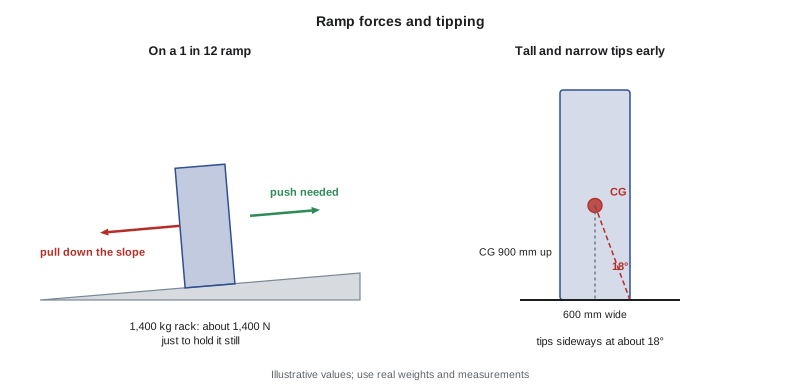
Two kinds of physics dominate a rack move. The first is the force needed to move or hold the load. On a level, smooth floor, a rack on good casters may need only a small push to keep it rolling, though getting it started takes more. On a ramp, gravity pulls the load downhill with a force equal to its weight times the sine of the ramp angle, and that force can far exceed what a person can safely push or hold. The second is stability. A loaded rack is tall and narrow with its centre of gravity high above its casters, so it can tip over at a surprisingly small angle, especially toward its narrow side, when a caster drops into a gap, hits a threshold or meets a ramp at an angle.
import math

G = 9.81
N_TO_LBF = 0.2248

def push_force(mass_kg, ramp_rise_over_run, rolling=0.02):
    """Force to hold or push a load up a ramp, N (illustrative rolling coefficient)."""
    a = math.atan(ramp_rise_over_run)
    return mass_kg * G * (math.sin(a) + rolling * math.cos(a))

for label_text, ratio in [("level floor", 0.0), ("1 in 12 ramp", 1 / 12), ("1 in 8 ramp", 1 / 8)]:
    f = push_force(1400, ratio)
    print(f"1400 kg rack, {label_text:12s}: {f:5.0f} N ({f * N_TO_LBF:4.0f} lbf)")

def tip_angle(half_base_m, cg_height_m):
    """Tilt angle at which the balance point passes over the base edge, degrees."""
    return math.degrees(math.atan(half_base_m / cg_height_m))

for width, depth, cg in [(0.6, 1.2, 0.9), (0.6, 1.2, 1.1), (0.8, 1.2, 0.9)]:
    print(f"rack {width} x {depth} m, CG {cg} m: tips sideways at {tip_angle(width / 2, cg):4.1f} deg,"
f" front-to-back at {tip_angle(depth / 2, cg):4.1f} deg")1400 kg rack, level floor : 275 N ( 62 lbf) 1400 kg rack, 1 in 12 ramp: 1414 N ( 318 lbf) 1400 kg rack, 1 in 8 ramp : 1976 N ( 444 lbf) rack 0.6 x 1.2 m, CG 0.9 m: tips sideways at 18.4 deg, front-to-back at 33.7 deg rack 0.6 x 1.2 m, CG 1.1 m: tips sideways at 15.3 deg, front-to-back at 28.6 deg rack 0.8 x 1.2 m, CG 0.9 m: tips sideways at 24.0 deg, front-to-back at 33.7 deg
The figures are illustrative; real rolling resistance depends on casters, floor and load, and real centres of gravity depend on what is in the rack. Still, the pattern is clear. On a level floor a 1,400 kg (3,100 lb) rack may need only a few hundred newtons to keep it rolling, but on a 1 in 12 ramp it needs about 1,400 N (320 lbf) just to hold it still, far more than a few people can safely control. A rack 600 mm (24 in) wide with its centre of gravity 900 mm (36 in) up tips sideways at about 18 degrees, and raising the centre of gravity makes it tip sooner. That is why heavy rack moves use powered movers or tugs with brakes, winches on ramps, and crews positioned beside, never downhill of, the load.
Practical rules for moving racks and heavy equipment:
- Use equipment designed for the load: powered rack movers or tugs, pallet jacks rated for the weight, air skates or dollies for very heavy items.
- Never stand downhill of a load on a ramp or in its path, and never try to stop a runaway load with your body.
- Move slowly, especially over thresholds, joints, lift entrances and ramp transitions, and approach ramps straight on.
- Keep the narrow side protected; move racks along their long axis where possible and avoid sideways movement on slopes.
- Assign one person to give signals and stop the move, and agree on clear stop and go signals before starting.
- Check the freight lift capacity, including the weight of the crew and moving equipment, and never ride in a lift with a load that could shift if the lift is not rated for it.
- Leave stabilizers or anti-tip feet in place until the rack is in its final position and secured.
Worked problem
Planning a rack move up the dock ramp
Four integrated AI racks, each 1,450 kg, must be moved from the loading dock into a data hall. The route includes a 1 in 12 ramp from the dock level to the hall level, a freight lift rated for 2,500 kg, a raised floor rated for rolling loads of 4.5 kN per wheel over a heavy-duty path, and doorways 2.4 m high. The crew proposes to push each rack up the ramp by hand with four people. What should the plan include?
Show solution
- Estimate the ramp force: about 1,460 N to hold each rack on the ramp, far more than four people can safely control. Use a powered mover or a winch with a brake instead of a manual push.
- Check the freight lift: one rack at 1,450 kg plus a powered mover and two crew is within 2,500 kg, but only one rack at a time.
- Check the rolling load: 1,450 kg on four casters is about 3.6 kN per caster if shared equally, below 4.5 kN, but uneven sharing could approach the limit; keep to the heavy-duty path and lay load-spreading plates at transitions.
- Check clearances: confirm the rack height on its mover is below the 2.4 m doorways and any low cable trays.
- Name a person in charge, agree signals, position crew beside the load and keep everyone out of the downhill path.
Answer: The manual push should be rejected. The plan should use powered or winched movement on the ramp, move one rack per lift trip, keep to the heavy-duty floor path with plates at transitions, confirm clearances and set up a crew with a person in charge and clear signals.
Installing equipment in racks
Racks themselves can tip during installation. An empty rack, or one loaded only at the top, is unstable, and extending a heavy server on its rails moves the centre of gravity forward, out over the front feet. Most rack tip-overs during installation happen when someone pulls out a heavy unit, or two units at once, from a rack that is not bolted down or ganged to its neighbours.
- Load racks from the bottom up, so the heaviest equipment is lowest.
- Lower the levelling feet and fit the stabilizer or anti-tip foot before installing or extending equipment, and bolt or gang racks together as the site requires.
- Extend only one unit at a time on its rails.
- Follow seismic anchoring requirements in seismic regions, such as coastal British Columbia and much of the western United States.
- Keep cables from snagging when units slide in and out, and keep fingers clear of slides.
The loading dock and staging room
The loading dock is where the data centre meets the road, and it carries the hazards of any warehouse dock. Trucks can pull away while a pallet jack is on the trailer, so trailers must be secured with vehicle restraints or wheel chocks before anyone enters. Dock edges are a fall hazard when doors are open and no trailer is present. Forklifts, where used, must be operated only by trained and authorized operators; HSE-218 covers them. Pallets and crates may need to be lifted by forklift or crane; HSE-219 covers rigging.
Unpacking brings its own injuries. Knives and box cutters cause cuts; use safety knives and cut away from your body. Steel and plastic strapping can spring back when cut; hold it and stand to the side. Wooden crates have nails and splinters. Large crated racks are often removed from their pallets down a supplied ramp, a step where racks have tipped and rolled; follow the manufacturer's uncrating instructions exactly. Packaging must be removed and disposed of promptly to keep the dock and staging room clear and to keep combustibles out of the hall.
Common mistakes
MistakeLifting a heavy GPU server into an upper rack position by hand with one helper.
InsteadUse a server lift, reduce weight where allowed and plan heavy equipment low.
MistakePushing a loaded rack up a ramp by hand with a few people.
InsteadUse a powered mover or a winch with a brake, and keep crew out of the downhill path.
MistakePulling out two heavy servers at once from a rack that is not secured.
InsteadFit stabilizers, secure the rack and extend only one unit at a time.
MistakeEntering a trailer before checking that it is restrained or chocked.
InsteadConfirm the vehicle restraint or chocks are in place first.
MistakeUsing the data sheet weight without checking what it includes.
InsteadCheck whether the weight includes rails, drives, packaging and coolant.
Summary and key terms
- Data centre equipment is heavy and getting heavier; integrated AI racks can weigh 1,400 kg (3,100 lb) or more.
- Always find the actual weight and what it includes before handling.
- Use server lifts, team lifts and good rack planning for manual handling; the NIOSH equation shows why real rack lifts have low limits.
- Rack moves need a route survey, the right equipment, a person in charge and clear signals.
- Ramp forces can far exceed what people can hold; never stand downhill of a load.
- Tall, narrow racks tip at small angles; protect the narrow side and move slowly over transitions.
- Install from the bottom up, use stabilizers, extend one unit at a time and anchor racks as required.
- The loading dock needs vehicle restraints, edge protection and safe unpacking practices.
- Integrated rack
- A rack delivered with its servers, cabling and often cooling already installed.
- Server lift
- A mechanical device that raises servers to rack height and supports them during installation.
- Route survey
- A check of every door, ramp, lift, floor and obstacle along the path of a heavy move.
- Centre of gravity
- The point at which the weight of an object can be considered to act.
- Tipping angle
- The tilt at which the centre of gravity passes over the edge of the base and the object falls.
- Stabilizer foot
- A foot or bracket that extends from the base of a rack to prevent tipping.
- Powered mover
- A motorized device for moving heavy loads with controlled speed and braking.
- NIOSH lifting equation
- A method for calculating a recommended weight limit for a lifting task.
- Vehicle restraint
- A device at a loading dock that holds a trailer in place.
Practice problems
Work each problem on paper first, then reveal the answer to check.
What is the typical weight range of an integrated liquid-cooled AI rack?
Show answer
About 1,300 to 1,600 kg.
What is the load constant in the NIOSH lifting equation?
Show answer
23 kg.
Estimate the force to hold a 1,000 kg rack on a 1 in 12 ramp, ignoring rolling resistance.
Show answer
About 815 N (1,000 × 9.81 × sin of about 4.8 degrees).
A rack 0.6 m wide has its centre of gravity 1.0 m up. At what sideways tilt does it tip?
Show answer
About 16.7 degrees.
Why should crew never stand downhill of a load on a ramp?
Show answer
If control is lost, the load will roll toward them.
In what order should a rack be loaded?
Show answer
From the bottom up, heaviest equipment lowest.
What should be fitted before extending a server on its rails?
Show answer
The stabilizer or anti-tip foot, with the rack levelled and secured.
What must be done before entering a trailer at the dock?
Show answer
Confirm a vehicle restraint or wheel chocks are in place.
Name three things a route survey checks.
Show answer
Any three of door sizes, thresholds, ramps, lift capacity, floor ratings, turning space, overhead obstacles.
Why can a data sheet weight be misleading?
Show answer
It may exclude rails, drives, packaging or coolant.
Lesson quiz · 5 questions
Score 60% or more to complete this lesson.
Create a free account to save your progress, take quizzes and earn a certificate.