
HSE-320 · Lesson 12 of 12 · 25 min
Capstone: site orientation and MOP review for an invented colocation facility
This capstone brings the course together. You will work with an invented colocation facility, Cedar Ridge Colocation, and complete two tasks that safety professionals, operations leads and experienced technicians do all the time. First, you will outline a site orientation for contractors and customer technicians, drawing on Lessons 1 to 11. Second, you will review a draft method of procedure for installing a new liquid-cooled AI rack, find its weaknesses and recommend changes. A model answer follows each task, but you will learn far more if you attempt each task before reading it.
Cedar Ridge and everyone in it are invented. The values in this lesson are illustrative and chosen to make the exercise realistic, not to describe any real site, product or standard requirement.
The facility
Cedar Ridge Colocation is a two-hall facility on a suburban industrial lot. Hall 1, built in 2014, has a 600 mm raised floor, air cooling with cold aisle containment and racks of up to about 15 kW, leased to enterprise customers in caged and open areas. Hall 2, completed in 2025, is slab on grade with overhead busway, hot aisle containment and rear-door and direct-to-chip liquid cooling, built for AI racks of 40 to 130 kW; it is about half occupied, and new racks arrive every week. The facility has two utility feeds, medium-voltage switchgear, four transformers, six diesel generators in a yard on the north side, UPS rooms for each hall, a lithium-ion battery room serving Hall 2 and a valve-regulated lead-acid battery room serving Hall 1. The meet-me room and a network room are protected by a clean agent system; the data halls have pre-action sprinklers and aspirating smoke detection. Equipment arrives at a two-bay loading dock and travels up a 1 in 12 ramp to the hall level. The building is about 9,000 m² in total.
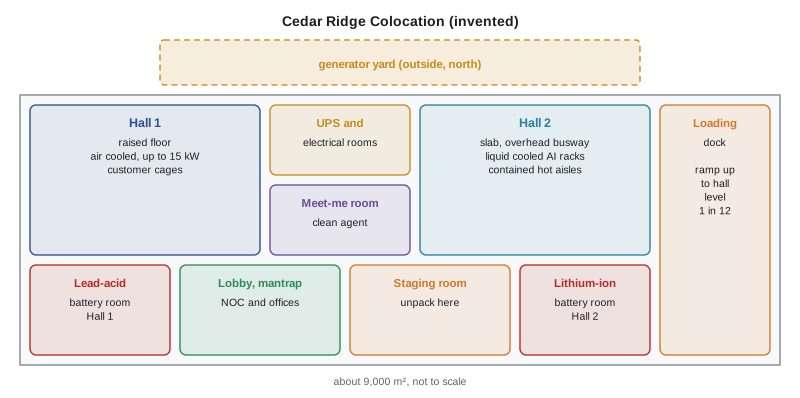
The operator, Cedar Ridge Operations, employs about 30 people across operations, security and facilities, and uses contractors for electrical and mechanical maintenance, cleaning and security guarding. On a typical weekday there are 40 to 80 contractors and customer technicians on site, rising to more than 150 when a large customer is installing. Cedar Ridge is in a Canadian province and is provincially regulated. Its corporate electrical safety program is based on CSA Z462, and its fire protection follows the provincial building and fire codes, with NFPA 75 required by its insurer.
Task 1: outline a site orientation
Cedar Ridge wants a 45-minute orientation for every contractor and customer technician before their first unescorted visit. Using what you learned in this course, outline what it should cover. For each topic, write the key messages and note which hazards at Cedar Ridge make them important. Try to keep it to the ten or so topics that matter most; an orientation that tries to cover everything teaches nothing.
Before reading the model answer, attempt the task. Think about who will attend, what they are likely to know already, and which mistakes at Cedar Ridge would be most serious.
Model answer: orientation outline
| Topic | Key messages | Why it matters at Cedar Ridge |
|---|---|---|
| Welcome and why rules exist | A live, mission-critical, dense facility; safety and uptime usually agree; when they conflict, safety wins; anyone can stop work | Mixed workforce, many new to data centres (Lesson 1) |
| Roles and reporting | Who the operator, your employer and the customer are; who to call; report every incident, near miss and hazard | Several parties share duties (Lesson 2) |
| Access, badges and escorts | Badge individually, no tailgating, escort rules, restricted rooms, sign in and out | Headcount depends on accurate badging (Lesson 3) |
| Site rules | No food, drink, packaging or photography in halls; unpack in staging; no hot work without permit; keep aisles and exits clear | Aspirating detection, combustibles, crowded installs (Lessons 3 and 5) |
| Floors and loads | Hall 1 raised floor: guard open tiles, replace like for like, check tile ratings; Hall 2 slab: rack paths and limits | Mixed floor types and heavy AI racks (Lesson 4) |
| Noise, heat and the environment | Hearing protection areas; hot aisle time limits and breaks; drinks outside the hall; lights on sensors | Contained hot aisles in Hall 2; generator yard (Lessons 5 and 6) |
| Electrical awareness | Do not open or operate electrical equipment unless authorized and qualified; keep working space clear; EPO for emergencies only; power tools on convenience receptacles | Busway and high-density power in Hall 2 (Lesson 7) |
| Moving and installing equipment | Route plans, powered movers on the ramp, never downhill of a load, stabilizers, one unit out at a time | 1 in 12 dock ramp and 1,400 kg racks (Lesson 8) |
| Change control | No work without an approved change, MOP or work order; follow steps exactly; stop if anything is unexpected | Customer loads on redundant paths (Lesson 9) |
| Permits and contractors | Permits for hot work, energized work, heights and impairments; check in with operations daily | Ongoing installs and retrofits (Lesson 10) |
| Emergencies | Alarms and strobes, pre-discharge alarm means leave now and close doors, exits and assembly point, AEDs, call security | Clean agent rooms, lithium-ion batteries, isolated halls at night (Lesson 11) |
Good answers vary, but strong ones share some features. They put the reasons before the rules, because people follow rules they understand. They are specific to Cedar Ridge: the two floor types, the dock ramp, the clean agent rooms and the lithium-ion battery room. They make stop-work authority and reporting explicit. They leave detailed technical content, such as arc flash boundaries or noise calculations, to the specialist training required for specific jobs, and instead tell people what they must not do and whom to ask. Many sites end orientation with a short quiz and a walk-through of the route from the entrance to the work area, pointing out exits, EPOs, AEDs and restricted rooms.
Task 2: review a draft MOP
A customer's vendor has submitted the following draft MOP to install a new liquid-cooled AI rack in Hall 2. Read it carefully and list every weakness you can find, then recommend changes. Use the review checklist from Lesson 9: equipment identifiers, redundancy, energy sources, safety controls, sequence, expected results and hold points, backout, timing and communication.
| Step | Draft MOP: install rack R2-14-07 in Cage 2-14, Hall 2 |
|---|---|
| Scope | Deliver and install one integrated AI rack, connect power and coolant, power on. |
| Window | Tuesday 13:00 to 17:00. |
| Crew | Vendor technicians A, B and C. |
| 1 | Unload the rack from the truck at the dock. |
| 2 | Push the rack up the ramp and into Hall 2. |
| 3 | Position the rack in Cage 2-14, position 7, and level it. |
| 4 | Install the busway tap-off box at position 7 on busway 2B. |
| 5 | Connect the rack power strips to the tap-off boxes. |
| 6 | Connect the coolant hoses to the row manifold and open the valves. |
| 7 | Power on the rack and check that the servers boot. |
| 8 | Remove packaging and leave site. |
Useful facts for your review: the rack weighs 1,450 kg including coolant; Hall 2 busway is fed on A and B paths from separate UPS systems; installing a tap-off box on live busway is an energized task that Cedar Ridge restricts to qualified electricians under its electrical safety program; the row manifold serves eight other racks already in operation; Hall 2 has hot aisle containment and aspirating smoke detection; and Tuesday afternoon is the busiest period at the loading dock.
Model answer: MOP review findings
| Area | Weakness in the draft | Recommended change |
|---|---|---|
| Scope and approvals | No change reference, approvals, customer and operator contacts or risk assessment | Add the change record, approvers, MOP lead, operator contact and a risk assessment covering people and the load |
| Equipment identifiers | Tap-off position and busway named loosely; only busway 2B mentioned although the rack needs A and B feeds | Use exact identifiers matching field labels for busway 2A and 2B, tap-off positions, manifold and valves |
| Moving the rack | Pushing a 1,450 kg (3,200 lb) rack up a 1 in 12 ramp by hand; no route survey, person in charge or floor path | Use a powered mover or winch, route survey, person in charge, signals, crew beside the load, schedule outside peak dock time |
| Stability | No stabilizers or anchoring step | Keep stabilizers on during moves; anchor or gang the rack as Hall 2 requires before connecting services |
| Electrical work | Vendor technicians installing tap-off boxes on live busway, with no qualification, permit, PPE or boundaries | Assign Cedar Ridge qualified electricians; follow the electrical safety program, with de-energized installation preferred or a justified energized work permit, arc flash PPE and barriers |
| Redundancy | No check that both A and B paths are healthy, or of busway loading before adding the rack | Add hold points to confirm A and B path status and busway and UPS capacity before connection |
| Coolant connection | Opening valves on a shared manifold with no leak check, pressure check or effect on other racks considered | Add a pre-connection inspection, controlled valve opening with leak checks, monitoring of manifold pressure and temperatures, and spill kit and leak detection checks; see HSE-323 |
| Expected results | No expected results or verification for any step | State expected readings and conditions for each step, with performer and verifier sign-off |
| Backout | No backout plan | Add backout steps for a failed lift, an electrical problem and a coolant leak, with decision points |
| Housekeeping and detection | Packaging removed at the end; no consideration of dust and detection | Uncrate in the staging room; bring no packaging into Hall 2; coordinate with operations on detection |
| Timing | Four hours at the busiest dock time, with no allowance for verification or backout | Move to a quieter period, sequence the move, electrical and coolant work as separate stages with decision points |
| Communication | No briefing, NOC notification or close-out | Add a pre-task briefing, NOC and security notifications, post-checks and handover to operations |
The most serious weaknesses are the manual push up the ramp, unqualified workers doing energized busway work without a permit, and the uncontrolled coolant connection to a manifold serving live racks. Each could cause a serious injury, and the last two could also cause an outage for other customers. A reviewer should return the MOP for rework rather than approve it with comments.
# A simple MOP "lint": flag steps that lack expected results, verification or qualified roles
steps = [
    {"n": 1, "text": "Unload rack at dock", "expected": "", "verify": False, "energized": False, "role": "vendor"},
    {"n": 2, "text": "Push rack up ramp", "expected": "", "verify": False, "energized": False, "role": "vendor"},
    {"n": 4, "text": "Install tap-off box on busway 2B", "expected": "", "verify": False, "energized": True, "role": "vendor"},
    {"n": 6, "text": "Open coolant valves to manifold", "expected": "", "verify": False, "energized": False, "role": "vendor"},
    {"n": 7, "text": "Power on rack", "expected": "servers boot", "verify": False, "energized": True, "role": "vendor"},
]
heavy_words = ("push", "ramp")
findings = 0
for s in steps:
    issues = []
    if not s["expected"]:
        issues.append("no expected result")
    if s["energized"] and s["role"] != "qualified electrician":
        issues.append("energized task without qualified person")
    if s["energized"] and not s["verify"]:
        issues.append("no peer verification")
    if any(w in s["text"].lower() for w in heavy_words):
        issues.append("check move plan and mechanical aid")
    if "coolant" in s["text"].lower():
        issues.append("needs leak check and shared-manifold hold point")
    findings += len(issues)
    print(f"step {s['n']}: {s['text']}: " + ("; ".join(issues) if issues else "OK"))
print("Total findings:", findings)step 1: Unload rack at dock: no expected result step 2: Push rack up ramp: no expected result; check move plan and mechanical aid step 4: Install tap-off box on busway 2B: no expected result; energized task without qualified person; no peer verification step 6: Open coolant valves to manifold: no expected result; needs leak check and shared-manifold hold point step 7: Power on rack: energized task without qualified person; no peer verification Total findings: 10
An automated check like this cannot replace a human reviewer, who understands the facility and the work, but it shows how review criteria can be made explicit and applied the same way every time. Some operators build such checks into their change management tools.
Reflecting on the course
The orientation and the MOP review together cover most of what makes data centre safety distinctive. The orientation sets the expectations for everyone who walks in the door; the MOP review applies them to a specific job, where the hazards of the floor, the power system, the cooling system, heavy equipment and the live facility meet. In both, the same habits matter: understand why each rule exists, plan the work before doing it, verify instead of assuming, communicate clearly, and stop when something is not as expected.
From here, the data centre sites track continues with HSE-321, Electrical Safety in Critical Facilities, which takes the electrical awareness of Lesson 7 into the practice of arc flash risk assessment, energized work and UPS and switchgear hazards; HSE-322, Battery Rooms and Lithium-Ion Hazards, which covers the stored energy and thermal runaway hazards behind the Cedar Ridge battery rooms; and HSE-323, Fire Suppression and Liquid Cooling Hazards, which covers the clean agent and pre-action systems and the coolant hazards that featured in the MOP review.
Common mistakes
MistakeWriting an orientation that lists every rule without explaining why.
InsteadGive the reasons first and keep to the topics that matter most at the site.
MistakeMaking the orientation generic rather than site-specific.
InsteadPoint out the site's own floors, ramps, protected rooms, battery rooms and exits.
MistakeApproving a flawed MOP with comments to save time.
InsteadReturn it for rework when serious hazards are uncontrolled.
MistakeReviewing only the electrical steps of a MOP.
InsteadReview the whole task, including moves, coolant, housekeeping, timing and communication.
MistakeRelying on an automated check alone.
InsteadUse tools to support, not replace, a knowledgeable human reviewer.
Summary and key terms
- Cedar Ridge Colocation is an invented two-hall facility with mixed floors, AI racks, liquid cooling, clean agent rooms and lithium-ion batteries.
- A good orientation is short, site-specific, explains the reasons for rules and makes stop-work authority and reporting explicit.
- The draft MOP had uncontrolled manual handling, unqualified energized work and an unsafe coolant connection.
- A MOP review checks identifiers, redundancy, energy sources, safety controls, sequence, expected results, backout, timing and communication.
- Serious uncontrolled hazards mean the MOP goes back for rework.
- HSE-321, HSE-322 and HSE-323 continue the data centre sites track.
- Site orientation
- Training given to people before they work at a site, covering its rules, hazards and emergency procedures.
- MOP review
- A structured check of a method of procedure by people who did not write it.
- Tap-off box
- A plug-in unit that connects equipment to busway.
- Row manifold
- Piping that distributes coolant to several racks in a row.
- Rework
- Returning a document for substantial changes before approval.
- Stop-work authority
- The right and duty of any worker to stop work they believe is unsafe.
Practice problems
Work each problem on paper first, then reveal the answer to check.
Name four features of Cedar Ridge that should shape its orientation.
Show answer
Any four of the two floor types, the dock ramp, heavy AI racks, clean agent rooms, the lithium-ion battery room, aspirating detection, contained hot aisles, the generator yard.
Why should an orientation explain the reasons for rules?
Show answer
People follow rules they understand.
What is wrong with step 2 of the draft MOP?
Show answer
It pushes a heavy rack up a 1 in 12 ramp by hand with no plan, mechanical aid or person in charge.
Who should install the busway tap-off boxes at Cedar Ridge?
Show answer
Qualified electricians under the electrical safety program, with permits and PPE as required.
Why does the coolant connection need a hold point?
Show answer
The manifold serves eight live racks, so a leak or pressure change could affect them.
What redundancy check should be added before connecting power?
Show answer
Confirm both A and B paths are healthy and there is capacity on the busway and UPS.
Why should the work be moved away from Tuesday afternoon?
Show answer
It is the busiest dock period, adding traffic and time pressure.
What should a reviewer do with a MOP that has serious uncontrolled hazards?
Show answer
Return it for rework rather than approving it with comments.
What can an automated MOP check do and not do?
Show answer
It can apply criteria consistently but cannot replace a knowledgeable human reviewer.
Which course covers the coolant hazards raised in the MOP review?
Show answer
HSE-323, Fire Suppression and Liquid Cooling Hazards.
Lesson quiz · 5 questions
Score 60% or more to complete this lesson.
Create a free account to save your progress, take quizzes and earn a certificate.