
HSE-320 · Lesson 11 of 12 · 27 min
Emergencies in data centres
Data centres are designed to keep running through failures, and their operators plan in great detail for equipment emergencies: utility outages, UPS faults, chiller trips, generator failures. People emergencies need the same care. A fire, a clean agent discharge, an electrical injury, a cardiac arrest in a remote corner of a data hall, a water leak near energized equipment or a lithium-ion battery going into thermal runaway each call for fast, correct action by people who may have only a few seconds to decide. The security, layout and noise of a data centre can make those decisions harder: locked doors and mantraps slow paramedics, loud halls mask alarms, and large windowless buildings are easy to get lost in.
This lesson covers the emergency plan, the alarms you will hear and what they mean, how to respond to the most likely emergencies, and how drills keep the plan alive. Fire wardens and evacuation leaders are covered in HSE-222, first aid and CPR in HSE-110 and HSE-111, the suppression systems themselves in HSE-323, battery emergencies in HSE-322 and electrical incident response in HSE-224 and HSE-321.
Life safety comes first
The first principle of emergency response in a data centre is the same as anywhere else: people come first. A facility that has spent millions on redundancy can tolerate the loss of a hall; it cannot undo the loss of a life. In an emergency, nobody should stay behind to save equipment, finish a step in a MOP, shut down servers gracefully or collect their laptop. Operations staff with specific emergency roles may carry out actions in the emergency operating procedures, such as isolating a fuel supply or confirming that a suppression system has operated, but only where the procedure says so and it is safe.
The emergency plan
Every data centre should have a written emergency response plan, required in one form or another by OHS law in both countries and by fire codes. In the United States, OSHA's emergency action plan requirements in 29 CFR 1910.38 set out minimum contents; Canadian provinces have similar requirements in their OHS regulations and fire codes. A good plan for a data centre covers the following:
- The types of emergency that could occur at the site and the response to each.
- Alarm signals and what each means, including fire alarms, suppression pre-discharge alarms, refrigerant and gas alarms and any site-specific signals.
- Roles: who takes charge, who calls emergency services, who meets them, who leads evacuation and who accounts for people.
- Evacuation routes, refuge areas and assembly points, with plans for people with disabilities.
- How headcount is done, including visitors, contractors and customer technicians.
- How emergency services get through security quickly, including keys, codes, escorts and site plans for firefighters.
- Locations of first aid kits, automated external defibrillators (AEDs), eyewash stations, spill kits and EPO buttons.
- Communication with customers, management and authorities after the immediate emergency.
Security is a special consideration. Mantraps, biometric readers and locked doors that keep intruders out also keep paramedics and firefighters out unless the plan provides for them. Security staff must know that their job in a medical emergency or fire is to get responders to the scene as fast as possible, with escorts and override access ready, and to keep the headcount. Many sites agree pre-incident plans with the local fire department, including building layout, hazards such as battery rooms and fuel storage, suppression systems and the location of EPOs and shutoffs.
Alarms and what they mean
Data centres can have more kinds of alarm than most buildings, and in a loud hall they can be hard to hear. Learn the alarms at your site during orientation, and look for strobes as well as listening for horns.
| Alarm or signal | Typical meaning | What you should do |
|---|---|---|
| General fire alarm | Fire detected or manual pull station operated somewhere in the building | Stop work, make equipment safe only if it takes seconds, and evacuate by the nearest safe exit to the assembly point |
| Clean agent pre-discharge alarm | Detection has confirmed a fire condition in a protected room and agent will discharge after a short delay | Leave the protected room immediately and close the doors behind you; do not wait to see whether it is real |
| Agent discharge signal | Agent has been released | Stay out; do not re-enter until the room is ventilated and authorized persons declare it safe |
| Pre-action sprinkler alarm | Detection has operated and the pre-action system is charging with water | Follow the evacuation procedure; water may discharge if heat opens sprinkler heads |
| Refrigerant or gas detector alarm | Refrigerant, hydrogen or another gas has reached an alarm level in a room | Leave the room, do not re-enter, and report it |
| Leak detection alarm | Water detected under the floor or near equipment | Report to operations; do not investigate water near energized equipment yourself |
| Evacuation announcement | Voice instructions from the emergency communication system | Follow the instructions given |
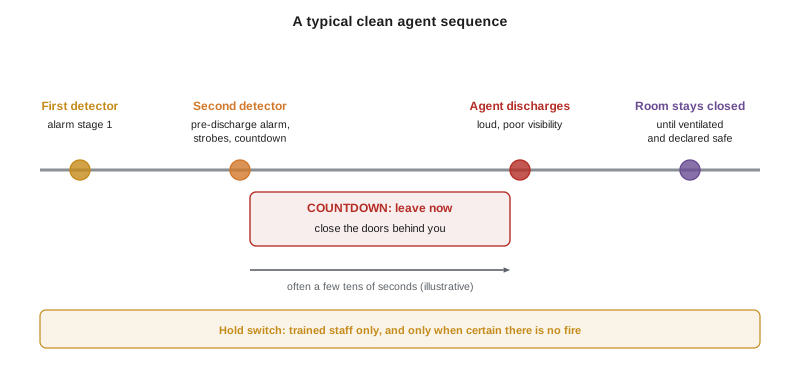
Clean agent systems deserve particular care. When detection confirms a fire condition in a room protected by a clean agent or inert gas system, a pre-discharge alarm sounds and a short countdown begins, often a few tens of seconds, before the agent is released. The countdown exists so that people can get out. Some systems have a hold switch, sometimes called an abort switch, that pauses the countdown while it is held; it is for use only by trained people who are certain there is no fire, for example during an accidental activation by a contractor's dust, and must never be used as a way to keep working. Halocarbon agents are designed for occupied spaces at their design concentrations, but their decomposition products from a fire can be harmful, and inert gas systems reduce oxygen. The discharge itself is loud, can be forceful near nozzles and can drop visibility. Nobody should be in a protected room during a discharge, and nobody should re-enter until the room has been ventilated and authorized persons say it is safe. HSE-323 explains the agents and their hazards.
import random

# Can everyone leave a protected room during the pre-discharge countdown? (illustrative)
random.seed(11)
countdown_s = 30
walking_speed = 1.0          # m/s, slowed by aisles, doors and reaction time
reaction_s = 5               # time to recognize the alarm and start moving
workers = {f"worker {i}": random.uniform(5, 40) for i in range(1, 7)}   # path length to exit, m
for name, path_m in sorted(workers.items(), key=lambda kv: kv[1]):
    t = reaction_s + path_m / walking_speed
    margin = countdown_s - t
    flag = "OK" if margin >= 5 else "AT RISK"
    print(f"{name}: {path_m:4.1f} m ({path_m * 3.281:5.1f} ft) to exit, out in {t:4.1f} s,"
f" margin {margin:5.1f} s {flag}")worker 1: 20.8 m ( 68.4 ft) to exit, out in 25.8 s, margin 4.2 s AT RISK worker 4: 21.3 m ( 69.9 ft) to exit, out in 26.3 s, margin 3.7 s AT RISK worker 5: 22.8 m ( 74.7 ft) to exit, out in 27.8 s, margin 2.2 s AT RISK worker 2: 24.6 m ( 80.7 ft) to exit, out in 29.6 s, margin 0.4 s AT RISK worker 6: 25.6 m ( 83.9 ft) to exit, out in 30.6 s, margin -0.6 s AT RISK worker 3: 37.3 m (122.5 ft) to exit, out in 42.3 s, margin -12.3 s AT RISK
The numbers are illustrative, but they show why people working deep in a large protected room must react to the pre-discharge alarm at once and why they should know their nearest exit before work starts. Hesitating for even ten seconds to see whether the alarm is real can turn a comfortable margin into none. Planning work in protected rooms includes checking the exit routes, keeping them clear and, for long tasks in very large rooms, discussing with operations whether the system's operating mode should be changed under a formal impairment.
Responding to common emergencies
Fire or smoke. If you see smoke or fire, raise the alarm using the nearest manual pull station and by telling operations, and evacuate. Use a portable extinguisher only if you are trained, the fire is small and in its early stage, you have a clear exit behind you and the site procedure allows it; fires in electrical equipment and batteries can reignite and produce toxic smoke. Do not open cabinets or rooms where you suspect fire. Close doors behind you to contain smoke and protect any suppression system's agent concentration.
Electrical injury. If someone is in contact with an energized conductor, do not touch them. Have the power removed by the fastest safe means, such as opening the supply breaker or, if the plan says so, operating the EPO, then call emergency services and give first aid. Start CPR and use an AED if the person is not breathing normally. Cool arc flash burns with cool running water and treat for shock. Everyone who has received an electric shock should be medically assessed, even if they feel fine, because effects on the heart can be delayed. Secure the scene for investigation; HSE-224 and HSE-321 cover electrical incident response in detail.
Medical emergencies. Data centres can be large, isolated and sparsely staffed, so a cardiac arrest in a data hall at 3 a.m. may not be noticed quickly. Call emergency services and site security, start CPR, send someone for the nearest AED and have security meet the paramedics at the entrance with access and an escort. Lone work check-in systems, described in Lesson 3, exist partly for this reason.
Water leaks. Water near energized equipment is both an electrical hazard and a slip hazard. Do not step into pooled water near electrical equipment or under raised floors with power cabling. Report the leak to operations, who will follow the emergency operating procedure to isolate the source and, if necessary, the affected electrical equipment. Leak detection cables under floors and around cooling equipment help find leaks early; HSE-323 covers leaks from liquid cooling systems.
Battery and refrigerant emergencies. Unusual smells, hissing, smoke or swelling from battery cabinets, or a battery room gas alarm, may signal thermal runaway or off-gassing. Leave the area, raise the alarm and do not try to deal with it yourself unless you are trained and the procedure says so; HSE-322 covers battery emergencies. Refrigerant alarms in machinery rooms mean leave and stay out, as Lesson 6 explained.
Power outages. A utility outage should be invisible to the IT load, but people in the building may notice lights going out briefly, generators starting and alarms. Emergency lighting should light exit routes. Stop work, stay where you are if it is safe, avoid moving around open floor tiles in poor light and follow instructions from operations. Electrical work in progress should be stopped and made safe, because system configurations may change during the outage.
Worked problem
Pre-discharge alarm during cable work
Two contractors are pulling cable in a clean agent protected network room. The pre-discharge alarm sounds and the strobes start flashing. One says, 'It's probably our dust again; let's finish this pull.' What should they do?
Show solution
- Leave immediately by the nearest exit, without finishing the pull or collecting tools.
- Close the room doors behind them.
- Report to operations or security that they were in the room and what they were doing, including any dust.
- Do not use the hold switch unless trained and authorized and certain there is no fire.
- Stay out until operations declares the room safe, whether or not the agent discharged.
Answer: They must leave at once and close the doors. Deciding that an alarm is false is not their call during the countdown; operations will investigate, and work resumes only when the room is declared safe.
Drills and exercises
Plans that are never practised fail when they are needed. Data centres should run evacuation drills, including at night and with contractors on site, at the frequency required by the fire code and the site's plan. Operations teams also run tabletop exercises and walk-throughs of emergency operating procedures, for example a utility outage combined with a generator failure, and some practise live responses during planned tests. Drills should test the things most likely to go wrong in a data centre: whether alarms can be heard and seen in every part of the hall, whether security can get responders through the mantraps quickly, whether the headcount includes visitors and contractors, and whether people working in protected rooms react to pre-discharge alarms at once. After each drill and each real event, record lessons and fix what did not work.
Common mistakes
MistakeWaiting to see whether a pre-discharge alarm is real before leaving the room.
InsteadLeave immediately and close the doors; the countdown is short.
MistakeStaying behind to shut down servers or finish a MOP step during an evacuation.
InsteadLeave; life safety comes before equipment and uptime.
MistakePulling a person away from an energized conductor with your hands.
InsteadHave the power removed first by the fastest safe means, then give first aid.
MistakeExpecting paramedics to find their own way through the security layers.
InsteadHave security meet them with access and an escort.
MistakeUsing the clean agent hold switch to keep working.
InsteadLeave the switch to trained staff who are certain there is no fire.
Summary and key terms
- Life safety comes before equipment and uptime in every emergency.
- The emergency plan covers emergency types, alarms, roles, evacuation, headcount, responder access and equipment locations.
- Security must get emergency responders through mantraps and locked doors quickly.
- Learn the site's alarms; look for strobes in loud halls.
- Leave a clean agent protected room immediately on the pre-discharge alarm, close the doors and stay out until declared safe.
- For electrical injuries, remove power before touching the victim, then call for help and give first aid.
- Report water leaks, battery warning signs and gas alarms and stay clear rather than investigating.
- Drills should test audibility, responder access, headcount and reactions in protected rooms.
- Emergency response plan
- The written plan for how a site responds to emergencies.
- Pre-discharge alarm
- The warning that a clean agent or gas suppression system is about to discharge.
- Hold switch
- A switch that pauses a suppression countdown while held, for use by trained staff only.
- Clean agent
- A gaseous fire suppression agent that leaves no residue, used to protect IT equipment.
- Pre-action sprinkler system
- A sprinkler system whose pipes fill with water only after detection operates.
- AED
- Automated external defibrillator, a device that can restore a normal heart rhythm.
- Assembly point
- A designated place where people gather after evacuation to be counted.
- Pre-incident plan
- Information prepared with the fire department about a building's layout, hazards and systems.
- Tabletop exercise
- A discussion-based rehearsal of the response to an emergency scenario.
Practice problems
Work each problem on paper first, then reveal the answer to check.
What is the first principle of emergency response in a data centre?
Show answer
Life safety comes before equipment and uptime.
Which OSHA standard sets minimum contents for emergency action plans?
Show answer
29 CFR 1910.38.
Why must security be part of the emergency plan?
Show answer
Mantraps and locked doors can delay responders unless security provides access and escorts.
What should you do when a clean agent pre-discharge alarm sounds?
Show answer
Leave the protected room immediately and close the doors.
Who may use a hold switch?
Show answer
Only trained staff who are certain there is no fire.
What is the first step when someone is in contact with an energized conductor?
Show answer
Have the power removed by the fastest safe means without touching them.
Why should everyone who receives an electric shock be medically assessed?
Show answer
Effects on the heart can be delayed.
What should you do if you find water under a raised floor near power cables?
Show answer
Stay out of it and report it to operations.
Name three warning signs of a battery problem.
Show answer
Any three of unusual smell, hissing, smoke, swelling, a gas alarm.
Name two things a data centre drill should test.
Show answer
Any two of alarm audibility, responder access, headcount completeness, reactions in protected rooms.
Lesson quiz · 5 questions
Score 60% or more to complete this lesson.
Create a free account to save your progress, take quizzes and earn a certificate.