
HSE-320 · Lesson 6 of 12 · 24 min
Heat, cold and the work environment
Data centres are built for machines. Temperature, humidity, lighting and air movement are set to suit the equipment and the energy budget, not the people who work among it. For most of the hall most of the time that is not a problem: the cold aisles are cool, the lighting is bright and the air is clean. But workers spend long periods in hot aisles that can be much hotter than any office, in cold, breezy aisles, in plant rooms and on roofs exposed to the weather, often at night during maintenance windows and sometimes alone. This lesson covers heat and cold, humidity and static, lighting, air quality, fatigue and the physical demands of the work.
Temperatures set for equipment, not people
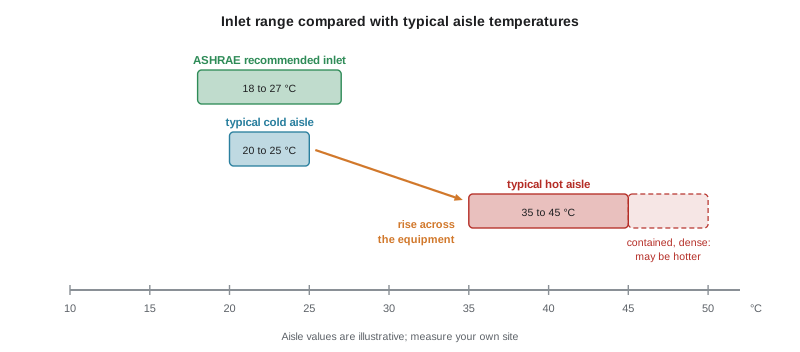
Most operators set their hall temperatures using the thermal guidelines published by ASHRAE Technical Committee 9.9. The fifth edition of those guidelines, published in 2021 and still the current reference as of 2026, recommends equipment inlet air temperatures of 18 to 27 °C (64.4 to 80.6 °F) for most classes of air-cooled IT equipment, with wider allowable ranges for short periods, and a narrower recommended range of 18 to 22 °C (64.4 to 71.6 °F) for a newer class of high-density equipment. These figures describe the air entering the front of the equipment, which is what a cold aisle is designed to supply. They say nothing directly about the air behind the equipment.
Behind the equipment, the air is much hotter, because it has just carried away the heat produced by the servers. The temperature rise across the equipment depends on its power and airflow, and is commonly 10 to 20 °C (18 to 36 °F). So a cold aisle at 24 °C (75 °F) can sit next to a hot aisle at 35 to 45 °C (95 to 113 °F), and contained hot aisles behind high-density racks can be hotter still. Operators raise inlet temperatures to save energy, which pushes hot aisle temperatures up too. These are illustrative figures; actual temperatures vary widely, and only measurement tells you what a given aisle is like.
Heat stress in hot aisles
Heat stress happens when the body cannot shed heat as fast as it gains it, from the environment and from physical work. In a hot aisle the main sources are high air temperature and fast-moving hot air; radiant heat is usually modest and humidity is usually low, which helps sweat evaporate. Hot aisle work is often physical: lifting servers, pulling cables, kneeling and reaching into the backs of racks, sometimes while wearing protective clothing. A worker who spends an hour recabling in a contained hot aisle at 40 °C (104 °F) can begin to suffer heat strain, and heat stroke can follow if warning signs are ignored.
The symptoms progress from heat rash and cramps, through heat exhaustion with heavy sweating, weakness, dizziness, headache and nausea, to heat stroke, a medical emergency in which the body's temperature control fails and the person may become confused, stop sweating, collapse or lose consciousness. Heat also affects judgment and dexterity, raising the chance of mistakes in delicate work on live equipment.
Controls for hot aisle work follow the hierarchy of controls. Plan work so that it is done from the cold aisle where possible, which is easier with front-access equipment. Schedule long hot aisle tasks when the load is lower, or arrange temporary cooling such as portable spot coolers if the site allows. Limit continuous time in the hot aisle with planned breaks in the cold aisle or a cooler room, and provide cool drinking water outside the hall, since drinks are not allowed inside. Train workers to recognize the signs in themselves and others, use a buddy system for long hot aisle tasks, and allow new and returning workers to acclimatize. Some sites leave containment doors open during extended work, but only with operations approval, because it affects cooling for the whole row.
Most Canadian provinces base heat stress limits or guidance on the threshold limit values for heat stress published by the American Conference of Governmental Industrial Hygienists (ACGIH), which use the wet bulb globe temperature (WBGT), workload and work-rest cycles. In the United States there is no federal OSHA heat standard as of 2026; a proposed heat injury and illness prevention rule has not been finalized, and OSHA continues to address heat through the General Duty Clause, while several states, including California, Washington, Oregon and Maryland, have their own heat rules. HSE-243, Heat and Cold Stress, covers WBGT, work-rest planning and medical response in detail.
# Exhaust temperature for air-cooled racks: rise = power / (density * cp * airflow)
RHO, CP = 1.2, 1005          # air density kg/m3, heat capacity J/(kg K)

def c_to_f(c):
    return c * 9 / 5 + 32

inlet_c = 24.0
for kw, airflow_m3s in [(8, 0.6), (15, 1.0), (30, 1.8), (45, 2.4)]:
    rise = kw * 1000 / (RHO * CP * airflow_m3s)
    out = inlet_c + rise
    print(f"{kw:3d} kW rack, {airflow_m3s:.1f} m3/s: rise {rise:4.1f} K, "
          f"exhaust {out:4.1f} C ({c_to_f(out):5.1f} F)")

# Raising the inlet setpoint raises every exhaust temperature by the same amount
for inlet in (22.0, 24.0, 27.0):
    print(f"inlet {inlet:.0f} C ({c_to_f(inlet):.1f} F) -> 30 kW rack exhaust "
f"{inlet + 30000 / (RHO * CP * 1.8):.1f} C")8 kW rack, 0.6 m3/s: rise 11.1 K, exhaust 35.1 C ( 95.1 F) 15 kW rack, 1.0 m3/s: rise 12.4 K, exhaust 36.4 C ( 97.6 F) 30 kW rack, 1.8 m3/s: rise 13.8 K, exhaust 37.8 C (100.1 F) 45 kW rack, 2.4 m3/s: rise 15.5 K, exhaust 39.5 C (103.2 F) inlet 22 C (71.6 F) -> 30 kW rack exhaust 35.8 C inlet 24 C (75.2 F) -> 30 kW rack exhaust 37.8 C inlet 27 C (80.6 F) -> 30 kW rack exhaust 40.8 C
The figures are illustrative, with airflow chosen to represent typical equipment, but they show the pattern: higher rack power means hotter exhaust unless airflow rises to match, and every degree added to the inlet setpoint is added to the hot aisle as well. Liquid-cooled racks remove most of their heat through coolant rather than air, which can make the aisles behind them cooler, but they bring the coolant hazards covered in HSE-323.
Cold, wind and weather
Cold is less of a problem inside the hall, but it is not absent. A cold aisle supplied from perforated tiles can be cool and breezy; a technician who spends hours kneeling in front of racks in the airflow can become chilled and stiff, which affects dexterity and comfort. Layers of clothing, warm breaks and rotating tasks help.
Outside, the hazards are greater. Heat rejection equipment, dry coolers and condensers on roofs and in yards, generator enclosures and fuel systems all need inspection and maintenance in every season. In much of Canada and the northern United States that means work in extreme cold, wind, snow and ice, with the added hazards of slippery roofs and walkways and falls from height near roof edges. In summer the same areas can be very hot, with hot exhaust air from condensers and generators adding to the heat. Plan outdoor work for the weather, provide warm or cool shelter as appropriate, keep walkways clear of snow and ice, and follow fall protection rules near roof edges and openings; HSE-212 and HSE-243 apply.
Humidity and static
Data halls are kept within humidity limits to protect equipment: too humid and condensation or corrosion becomes a risk, too dry and electrostatic discharge can damage components. ASHRAE gives recommended and allowable humidity ranges in terms of dew point and relative humidity. In practice many halls run fairly dry, especially in winter in cold climates. Dry air can cause dry eyes, skin and throats for people who work long shifts there.
Electrostatic discharge is mainly an equipment hazard, not a personal one. When you handle circuit boards, memory or drives, use the site's static controls, such as wrist straps connected to the equipment frame or a static mat. The small shock you sometimes feel when touching a rack in dry conditions is uncomfortable but not dangerous in itself, though it can make you drop something or pull your hand back into a sharp edge.
Lighting
Many data halls use occupancy sensors that switch lights off in unoccupied areas, and some facilities run lights-out most of the time. Lights that switch off while you are working in a quiet corner, kneeling behind a rack where the sensor cannot see you, can leave you in sudden darkness next to open tiles and energized equipment. Know how the lighting works, carry a torch or head lamp as the site allows, and never move in darkness near open tiles. Emergency lighting must cover exit routes; report any emergency light that is out. Rack interiors and underfloor spaces are often poorly lit, so task lighting is needed for detailed work.
Air quality and oxygen
Data hall air is normally filtered and clean. A few situations can change that. Refrigerant leaks from cooling equipment in a small, enclosed machinery room can displace oxygen; many refrigerants are heavier than air and collect in low areas. Machinery rooms with large refrigerant charges are required by refrigeration safety codes to have refrigerant detectors and ventilation; know the alarms and evacuate when they sound. Clean agent fire suppression discharges and inert gas systems change the atmosphere of a room on purpose, and some facilities use oxygen reduction systems that keep oxygen permanently below normal levels to prevent fire. Entry into such spaces needs specific training and controls; HSE-323 covers them. Diesel exhaust from generators during testing can enter buildings through air intakes if the exhaust and intake are poorly placed or the wind is wrong.
Fatigue, shifts and ergonomics
Data centres run around the clock. Operations staff often work 12-hour shifts, including nights, and planned maintenance on critical systems is usually scheduled for overnight windows when the business impact is lowest. That combination means that some of the riskiest work, such as switching power or isolating cooling, is done when people are least alert. Fatigue affects attention, memory and judgment in much the same way as alcohol. Good practice includes limits on consecutive shifts and total hours, enough rest before overnight windows, scheduling the most critical steps early in a window rather than at four in the morning, peer checks and the freedom to stop work if someone is too tired to continue safely. Lesson 9 returns to this when it discusses maintenance windows.
Much data centre work is awkward. Servers at the bottom of a rack require kneeling or squatting; those at the top require reaching over the head. Technicians use crash carts or laptops balanced on rack shelves, and spend long periods standing on hard floors. Server lifts and rack-mounted lift assists, anti-fatigue mats in staging rooms, knee pads, rotating tasks and good planning of rack layouts so that the heaviest equipment sits at waist height all help. HSE-107, Manual Handling and Ergonomics, covers the principles, and Lesson 8 covers lifting and moving equipment.
| Condition | Where it occurs | Main controls |
|---|---|---|
| High air temperature | Hot aisles, contained aisles, UPS rooms, condenser and generator areas in summer | Plan work from the cold aisle, limit exposure time, breaks, water, buddy system, training |
| Cold and wind | Cold aisles, roofs and yards in winter | Layers, warm breaks, task rotation, weather planning, clear walkways |
| Low humidity | Halls in winter, especially in cold climates | Static controls for equipment, breaks, drinking water outside the hall |
| Sudden darkness | Halls with occupancy sensors or lights-out operation | Know the lighting, carry a torch, guard open tiles |
| Low oxygen or contaminated air | Refrigerant machinery rooms, suppression discharges, oxygen reduction areas, generator exhaust | Detectors, ventilation, alarms, entry controls, training |
| Fatigue | Night shifts and overnight maintenance windows | Hours limits, rest, schedule critical steps early, peer checks, stop-work authority |
Common mistakes
MistakeAssuming the hall is comfortable because the ASHRAE inlet range is comfortable.
InsteadRecognize that hot aisles are 10 to 20 °C (18 to 36 °F) or more hotter than the inlet air.
MistakeWorking continuously in a contained hot aisle for hours to finish a task.
InsteadPlan breaks in cooler areas, drink water outside the hall and work in pairs.
MistakePropping containment doors open without approval to cool down.
InsteadAsk operations, who can approve it or arrange other cooling.
MistakeScheduling the most critical switching step at the end of an overnight window.
InsteadPut critical steps early, when people are most alert, with peer checks.
MistakeIgnoring a refrigerant alarm in a machinery room because the air looks clear.
InsteadEvacuate; many refrigerants are invisible and displace oxygen.
Summary and key terms
- Hall conditions are set for equipment; ASHRAE recommends inlet air of about 18 to 27 °C (64.4 to 80.6 °F) for most equipment.
- Hot aisles are commonly 10 to 20 °C (18 to 36 °F) hotter than the inlet, and contained hot aisles can be hotter still.
- Heat stress controls include planning work from the cold aisle, limiting exposure, breaks, water, buddy systems and training.
- Canada generally uses ACGIH heat stress values; there is no federal OSHA heat standard as of 2026, but several states have rules.
- Cold, wind, snow and ice affect roof and yard work; cold aisles can also be chilly over long periods.
- Low humidity, sudden darkness, refrigerant leaks and altered atmospheres need specific controls.
- Night shifts and overnight windows bring fatigue; schedule critical steps early and keep stop-work authority.
- ASHRAE TC 9.9
- The ASHRAE technical committee that publishes thermal guidelines for data processing environments.
- Recommended inlet range
- The range of air temperatures entering IT equipment that ASHRAE recommends for normal operation.
- Temperature rise
- The increase in air temperature as it passes through equipment.
- Heat stress
- The total heat load on the body from the environment and physical work.
- Heat stroke
- A medical emergency in which the body's temperature control fails.
- WBGT
- Wet bulb globe temperature, an index combining air temperature, humidity, air movement and radiant heat.
- Acclimatization
- The body's gradual adaptation to working in heat.
- Electrostatic discharge
- A sudden flow of static electricity that can damage electronic components.
- Oxygen reduction system
- A fire prevention system that keeps oxygen levels below normal in a protected space.
- Fatigue
- Reduced mental and physical capacity caused by lack of sleep, long hours or night work.
Practice problems
Work each problem on paper first, then reveal the answer to check.
What inlet temperature range does ASHRAE recommend for most air-cooled IT equipment?
Show answer
About 18 to 27 °C.
A cold aisle is at 23 °C and the equipment adds a 15 °C rise. What is the exhaust temperature?
Show answer
38 °C.
Convert 40 °C to Fahrenheit.
Show answer
104 °F.
Name three signs of heat exhaustion.
Show answer
Any three of heavy sweating, weakness, dizziness, headache, nausea.
Which heat stress index do most Canadian provinces use through the ACGIH values?
Show answer
The wet bulb globe temperature (WBGT).
Why are drinks provided outside the hall rather than inside?
Show answer
Food and drink are not allowed in data halls because of spill and equipment risks.
Why do occupancy-sensor lights create a hazard?
Show answer
They can switch off while someone is working out of the sensor's view, near open tiles or live equipment.
Why are refrigerant leaks dangerous in machinery rooms?
Show answer
Many refrigerants are heavier than air, invisible and can displace oxygen.
How should critical steps be scheduled in an overnight maintenance window?
Show answer
Early in the window, when people are most alert, with peer checks.
Name two ergonomic controls for rack work.
Show answer
Any two of server lifts, knee pads, rotating tasks, placing heavy equipment at waist height, anti-fatigue mats.
Lesson quiz · 5 questions
Score 60% or more to complete this lesson.
Create a free account to save your progress, take quizzes and earn a certificate.