
HSE-313 · Lesson 9 of 12 · 28 min
Ignition sources and static electricity
Even with good dust collection and housekeeping, explosible clouds exist inside equipment during normal operation, and accidents can release dust into rooms. Controlling ignition sources is therefore a core defence. This lesson surveys the main ignition sources in dust-handling facilities, explains how each is controlled, and gives particular attention to static electricity, which is less obvious than a flame or a spark from a grinder but can ignite many dusts. Electrical equipment in hazardous locations is covered separately in Lesson 10.
HSE-216 covers hot work safety and HSE-221 covers permit-to-work systems. HSE-312 covered bonding and grounding for flammable liquid transfers. This lesson builds on those courses and focuses on what is different when the fuel is a dust.
The main ignition sources
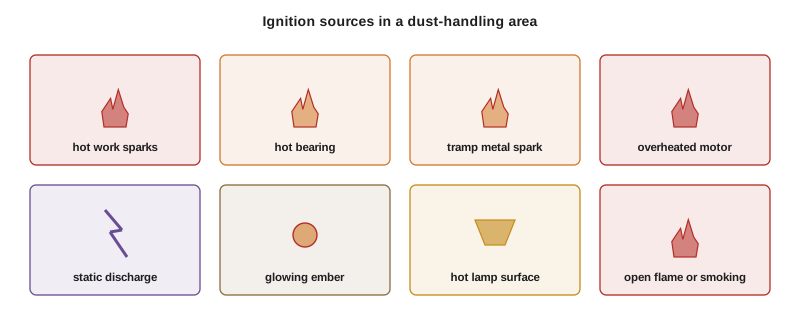
| Ignition source | Examples | Typical controls |
|---|---|---|
| Hot work | Welding, cutting, grinding, brazing | Hot work permits, cleaning of dust, shutting down dust-producing equipment, fire watch |
| Hot surfaces | Dryers, steam lines, motors, lights, heaters | Keep surfaces below ignition temperatures; keep dust off hot surfaces |
| Mechanical sparks and friction | Tramp metal in mills, belt slip, misaligned elevator buckets, failed bearings | Magnets and metal detectors, bearing and belt monitoring, maintenance |
| Electrical | Arcs from switches, motors, faulty wiring, unsuitable lights | Equipment suitable for the hazardous location (Lesson 10) |
| Static electricity | Ungrounded conductors, people, plastic containers, pneumatic conveying | Bonding and grounding, conductive materials, suitable bulk bags |
| Smouldering material | Embers from dryers or machines carried into collectors or silos | Spark detection and extinguishing, temperature monitoring, inspection after shutdown |
| Self-heating | Piles, silos and dryers of reactive or biological material | Temperature and gas monitoring, stock rotation, limited storage time |
| Open flames and smoking | Heaters, torches, cigarettes | Prohibit in dust areas; control portable heaters |
Hot work
Welding, cutting, brazing and grinding produce sparks and molten particles that can travel many metres and ignite settled dust or a cloud. Hot work has been a factor in many dust fires and explosions. In a combustible dust area, hot work should be avoided where practical, for example by moving the work to a safe location. When it must be done, a hot work permit should require that dust be cleaned from the area, including elevated surfaces within the spark travel range, that dust-producing equipment be shut down, that openings to ducts and equipment be covered, that the work be watched by a trained fire watch during the work and for a period afterward, and that suitable extinguishers be at hand. NFPA 51B provides the general requirements for hot work, and NFPA 660 adds requirements specific to dust.
Hot surfaces and smouldering
Lesson 3 explained that dust layers can ignite on hot surfaces at temperatures lower than those needed to ignite a cloud. Motors, bearings, lights, dryers, steam pipes, heaters and process equipment can all reach such temperatures, especially if covered by an insulating layer of dust. A smouldering layer can then become an ignition source for a cloud. Controls include keeping surfaces below the temperatures set by the DHA and by equipment marking requirements, keeping dust off hot surfaces through housekeeping, and inspecting dryers and ovens for residue after shutdowns.
Mechanical sparks and friction
Pieces of metal such as bolts, nuts, wire and tools, known as tramp metal, can enter process streams and cause sparks or hot spots in mills, grinders and fans. Magnets, magnetic separators and metal detectors upstream of size-reduction equipment remove much of this metal, and they must be cleaned and checked regularly. Bucket elevators and conveyors can create friction heat if belts slip, buckets rub against the casing or bearings fail. Monitoring for bearing temperature, vibration, belt alignment and speed, with alarms or automatic shutdown, helps detect problems early. The OSHA grain handling standard, 29 CFR 1910.272, includes requirements for such monitoring and maintenance at grain facilities.
Static electricity
Static electricity builds up when materials move against each other and are separated. Powder sliding down a chute, flowing through a pneumatic conveying pipe or pouring from a bag can generate large amounts of charge. If the charge collects on an isolated conductor, such as an ungrounded metal drum, a funnel, a section of duct isolated by a rubber gasket, or a person wearing insulating footwear, the voltage rises until it discharges as a spark. If the energy in that spark is greater than the minimum ignition energy of the dust, the cloud can ignite.
The energy stored in a charged conductor can be estimated with a simple formula:
E = ½ C V²
where E is the energy in joules, C is the capacitance of the conductor in farads and V is its voltage in volts. Capacitance depends on the size of the object and how close it is to ground. A person might have a capacitance of a few hundred picofarads, and a metal drum or a section of duct a few tens to a few hundred picofarads. Voltages of 10,000 volts or more are common on isolated conductors in powder handling. The values in the example below are illustrative.
Worked problem
Comparing spark energy with MIE
An ungrounded metal funnel used to pour a powder has a capacitance of about 50 pF (50 × 10⁻¹² F) and charges to 15 kV. A worker on an insulating floor might have a capacitance of about 200 pF and charge to 10 kV. The powder has an MIE of 20 mJ. Could either discharge ignite a cloud?
Show solution
- Funnel: E = ½ × 50 × 10⁻¹² × 15,000² = ½ × 50 × 10⁻¹² × 2.25 × 10⁸ ≈ 5.6 × 10⁻³ J = 5.6 mJ.
- Worker: E = ½ × 200 × 10⁻¹² × 10,000² = ½ × 200 × 10⁻¹² × 10⁸ = 10 × 10⁻³ J = 10 mJ.
- Both values are below the 20 mJ MIE, but not by a large margin.
- A larger drum, higher voltage, finer powder or a solvent vapour could push the energy above the MIE, or lower the MIE below it.
Answer: Neither spark is above the MIE in this case, but the margin is small. Bond and ground the funnel and use static-dissipative footwear and flooring rather than relying on the margin.
def spark_energy_mj(capacitance_pf, voltage_kv):
    """E = 1/2 C V^2, returned in millijoules (illustrative)."""
    c = capacitance_pf * 1e-12
    v = voltage_kv * 1e3
    return 0.5 * c * v * v * 1e3

conductors = [
    ("Small funnel", 50, 15),
    ("Person on insulating floor", 200, 10),
    ("Metal drum, ungrounded", 100, 20),
    ("Isolated duct section", 300, 25),
]
mie_mj = 20
for name, c_pf, v_kv in conductors:
    e = spark_energy_mj(c_pf, v_kv)
    flag = "ABOVE MIE" if e >= mie_mj else "below MIE"
print(f"{name:28s} C={c_pf:3d} pF V={v_kv:2d} kV -> {e:6.1f} mJ ({flag} of {mie_mj} mJ)")Small funnel C= 50 pF V=15 kV -> 5.6 mJ (below MIE of 20 mJ) Person on insulating floor C=200 pF V=10 kV -> 10.0 mJ (below MIE of 20 mJ) Metal drum, ungrounded C=100 pF V=20 kV -> 20.0 mJ (ABOVE MIE of 20 mJ) Isolated duct section C=300 pF V=25 kV -> 93.8 mJ (ABOVE MIE of 20 mJ)
Bonding and grounding
The main control for static on conductors is bonding and grounding. Bonding connects conductive objects together so they stay at the same voltage. Grounding connects them to earth so charge drains away. Every conductive part of a powder handling system, including ducts, flanges isolated by gaskets, hoppers, funnels, drums, scoops, hoses and the frames of equipment, should be bonded and grounded. Grounding clamps for portable containers should be of a type that bites through paint and coatings, and some systems include a monitor that confirms the ground connection before transfer can start. People can be grounded through static-dissipative footwear and flooring. HSE-312 covers bonding and grounding for flammable liquids; the same principles apply to powders.
Insulating materials and discharge types
Plastics and other insulating materials cannot be grounded, because charge does not flow through them. Charged insulators can produce brush discharges, which can ignite flammable vapours and gases and some very sensitive dusts. A more dangerous type, the propagating brush discharge, can occur when a thin insulating layer, such as a plastic liner or coating, sits on a conductive backing and becomes highly charged. Propagating brush discharges can release energy high enough to ignite most combustible dusts. Large silos being filled with highly charged, insulating powders can also produce cone discharges, sometimes called bulking brush discharges, on the surface of the heap. For these reasons, plastic pipes, liners, containers and bags should be avoided in combustible dust service unless they are specifically designed for it. NFPA 77 gives detailed guidance on static electricity.
Flexible intermediate bulk containers
Flexible intermediate bulk containers (FIBCs), often called bulk bags or super sacks, are woven plastic bags that hold up to a tonne or more of powder. Filling and emptying them generates static, and an unsuitable bag can produce an ignition source. FIBCs are classified into four types, according to international standard IEC 61340-4-4.
| FIBC type | Construction | Grounding | Typical use (summary) |
|---|---|---|---|
| Type A | Plain woven plastic with no static protection | Not applicable | Only non-flammable products in areas with no flammable dust or vapour |
| Type B | Fabric with a low breakdown voltage that prevents propagating brush discharges | Not grounded | Combustible dusts with MIE above about 3 mJ, where no flammable vapour is present |
| Type C | Conductive threads woven into the fabric | Must be grounded during filling and emptying | Flammable dusts and flammable atmospheres, provided the ground connection is made |
| Type D | Static-dissipative fabric that safely dissipates charge | No ground connection needed | Flammable dusts and many flammable atmospheres, within the limits of the bag certification |
Worked problem
Choosing a bulk bag
A plant fills bulk bags with a powder that has an MIE of 8 mJ. In one area the powder is handled near a solvent mixing operation where flammable vapour may be present. Which FIBC types could be considered for the general area and for the area near the solvent?
Show solution
- General area: the dust is combustible with an MIE above about 3 mJ and no flammable vapour, so Type B could be considered, as could Type C or D.
- Type A is unsuitable because the dust is combustible.
- Solvent area: flammable vapour may be present, so Type B is no longer suitable.
- Type C (grounded every time) or Type D (within its certification) should be used near the solvent.
- Confirm the choice in the DHA and train operators to connect Type C ground straps.
Answer: Type B, C or D in the general area; Type C or D near the solvent. Never Type A for a combustible dust.
Self-heating
Some materials heat up on their own through slow oxidation or biological activity. Wood pellets, grain, coal, some oily or chemically reactive powders and residues in dryers can self-heat in storage. If heat is generated faster than it can escape, the temperature rises until the material smoulders. A smouldering pocket inside a silo can ignite a dust cloud when the silo is emptied or disturbed. Temperature probes, carbon monoxide monitoring, limits on storage time and careful procedures for dealing with a smouldering silo are important. Responding to silo fires is a specialist task; Lesson 11 discusses emergency response.
Common mistakes
MistakeAllowing hot work in a dusty area without cleaning elevated surfaces.
InsteadClean the area within spark range, shut down dust equipment, cover openings and keep a fire watch.
MistakeBonding equipment frames but leaving duct sections isolated by gaskets.
InsteadBond across gaskets and flanges so every conductive part is grounded.
MistakeUsing a plain Type A bulk bag for a combustible powder.
InsteadSelect a Type B, C or D bag appropriate to the MIE and the presence of flammable vapour.
MistakeFilling a Type C bag without connecting its ground strap.
InsteadAlways connect and verify the ground on Type C bags during filling and emptying.
MistakeIgnoring magnets and metal detectors once installed.
InsteadClean, inspect and test tramp metal protection on a schedule.
Summary and key terms
- Ignition sources include hot work, hot surfaces, mechanical sparks and friction, electrical equipment, static, smouldering material, self-heating and open flames.
- Hot work in dust areas needs strict permits, cleaning, shutdown of dust equipment and a fire watch.
- Tramp metal protection and bearing and belt monitoring prevent mechanical ignition.
- The energy in a spark from a charged conductor is E = ½CV²; compare it with the dust MIE, with a good margin.
- Bond and ground every conductive part; avoid insulating plastics in dust service.
- Propagating brush discharges from insulating layers on conductive backings can ignite most dusts.
- FIBC Type A is for non-combustible products only; Types B, C and D are chosen according to MIE and flammable vapour.
- Tramp metal
- Stray pieces of metal that enter a process stream and can cause sparks.
- Static electricity
- Electric charge that builds up when materials are separated or rubbed together.
- Capacitance
- The ability of an object to store electric charge, measured in farads.
- Bonding
- Connecting conductive objects together so they remain at the same voltage.
- Grounding
- Connecting conductive objects to earth so that charge drains away.
- Brush discharge
- A discharge from a charged insulating surface that can ignite gases and sensitive dusts.
- Propagating brush discharge
- A high-energy discharge from a charged insulating layer on a conductive backing.
- Cone discharge
- A discharge on the surface of a heap of charged powder in a large silo.
- FIBC
- A flexible intermediate bulk container, or bulk bag.
- Fire watch
- A trained person who watches for fire during and after hot work.
Practice problems
Work each problem on paper first, then reveal the answer to check.
List five ignition sources found in dust facilities.
Show answer
Hot work, hot surfaces, tramp metal sparks, friction, electrical arcs, static, smouldering embers, self-heating.
Calculate the spark energy from a 100 pF drum charged to 20 kV.
Show answer
E = ½ × 100 × 10⁻¹² × (2 × 10⁴)² = 0.02 J = 20 mJ.
What is the difference between bonding and grounding?
Show answer
Bonding connects conductors together; grounding connects them to earth.
Why are plastic pipes a static hazard?
Show answer
They are insulators that cannot be grounded and can produce brush or propagating brush discharges.
What is a propagating brush discharge?
Show answer
A high-energy discharge from a thin charged insulating layer on a conductive backing.
When can a Type B FIBC be used?
Show answer
For combustible dusts with MIE above about 3 mJ where no flammable vapour is present.
What must be done every time a Type C FIBC is filled or emptied?
Show answer
Its ground strap must be connected to a verified ground.
Why are magnets installed upstream of mills?
Show answer
To remove tramp metal that could cause sparks.
What should a hot work permit in a dust area require?
Show answer
Cleaning within spark range, shutting down dust equipment, covering openings, a fire watch and extinguishers.
How can self-heating in silos be detected?
Show answer
Temperature probes and carbon monoxide monitoring.
Lesson quiz · 5 questions
Score 60% or more to complete this lesson.
Create a free account to save your progress, take quizzes and earn a certificate.