
HSE-313 · Lesson 1 of 12 · 26 min
Why dust explodes: lessons from major incidents
Most people do not think of flour, sugar, sawdust or plastic powder as explosives. In a bag, a bin or a thin film on a shelf, they look harmless. Yet when finely divided combustible solids are lifted into the air as a cloud and meet an ignition source inside an enclosed space, they can burn so fast that the pressure rise wrecks equipment and buildings. Combustible dust explosions have killed hundreds of workers in North America over the past few decades, and most of them happened in workplaces where people did not believe dust was a serious hazard. This course explains how dust explosions happen, which industries and materials are at risk, what the law and the consensus codes expect, and how housekeeping, dust collection, ignition control and explosion protection keep people safe.
HSE-310 introduced industrial plant safety: permits, hot work, plant traffic and contractor control. HSE-311 covered process safety for flammable liquids, gases and toxic releases, including hazard analysis methods such as HAZOP and layer of protection analysis. HSE-312 covered chemical storage and the bonding and grounding of flammable liquid transfers. This course builds on all three but focuses on one hazard that those courses only touch: combustible particulate solids. The health effects of breathing dust, such as silicosis from crystalline silica, are a separate topic covered in HSE-242, and respiratory protection is covered in HSE-240. Here the concern is fire and explosion.
What makes dust different from a pile of the same material
A block of wood burns slowly because only its surface touches the air. Cut the same block into sawdust and the surface area rises enormously. Lift that sawdust into a cloud and every particle is surrounded by oxygen. Heat moves from a burning particle to its neighbours in a fraction of a second, and the flame front races through the cloud. In the open, this produces a flash fire. Inside a duct, a dust collector, a silo or a room, the hot gases cannot escape fast enough and the pressure rises sharply. That pressure rise is the explosion.
The materials involved are ordinary. Grain, flour, starch, sugar, milk powder, cocoa, spices, wood, paper, coal, many plastics and resins, pharmaceuticals, pigments, rubber, textiles and many metals such as aluminum and magnesium can all form explosible dust clouds. If a material can burn as a solid, it is wise to assume that its fine dust can explode until testing shows otherwise. A common misconception is that only a few exotic industries face this hazard. In fact a woodworking shop, a bakery, a feed mill, a recycling plant and a 3D printing operation using metal powders can all have it.
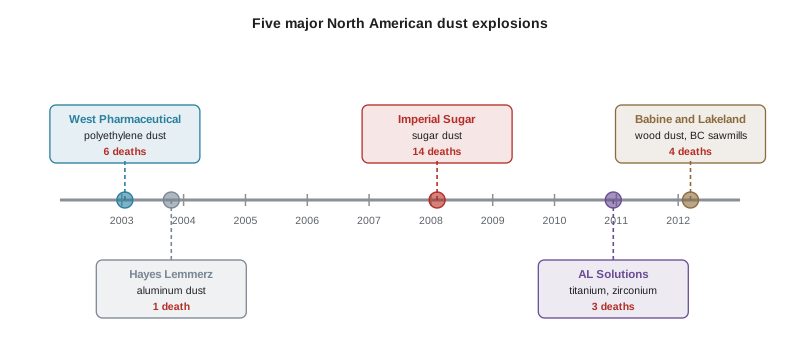
Five incidents that shaped the field
The United States Chemical Safety and Hazard Investigation Board (CSB) has investigated many dust explosions, and its reports are among the most useful free learning resources in safety. In British Columbia, WorkSafeBC investigated two sawmill explosions in 2012 that changed how the Canadian wood products industry treats dust. The summaries below are written in our own words from the public record.
In January 2003, an explosion at West Pharmaceutical Services in Kinston, North Carolina, killed six workers and injured dozens. The plant made rubber products. A fine polyethylene powder used as an anti-tack agent had settled above a suspended ceiling over a production area for years. Something disturbed the hidden layer, a cloud formed, and it ignited. The lesson was that dust you cannot see is still dust. Concealed spaces above ceilings and on top of ducts and beams must be inspected and cleaned.
In October 2003, an explosion at Hayes Lemmerz International in Huntington, Indiana, killed one worker and injured others. The plant made aluminum wheels. Aluminum chips were remelted, and the fine aluminum dust from the chip-processing system was collected in a dust collector. A fire inside the collector spread through the ductwork, and accumulated aluminum dust in the building fed a secondary explosion. The lesson was that metal dusts are especially energetic and that dust collectors and ducts can carry an explosion into the building.
In February 2008, the Imperial Sugar refinery in Port Wentworth, Georgia, suffered the deadliest of these events. Fourteen workers died and dozens more were badly burned. Sugar dust had escaped from conveyors and accumulated on floors, equipment and elevated surfaces throughout the packing buildings. An initial explosion inside an enclosed steel belt conveyor below the sugar silos dislodged settled dust, and a chain of secondary explosions tore through the buildings. The CSB found that the company had known about dust accumulations for years and that housekeeping and equipment design had not controlled them.
In December 2010, an explosion at AL Solutions in New Cumberland, West Virginia, killed three workers. The plant processed titanium and zirconium scrap into compacts for the metals industry. Metal dust ignited in a blender, and the explosion and fire killed the workers nearby. The CSB noted that the facility had experienced earlier fires and that the hazards of these reactive metal dusts were not adequately controlled.
In January 2012, an explosion and fire destroyed the Babine Forest Products sawmill near Burns Lake, British Columbia. Two workers died and about twenty were injured. In April 2012, a similar explosion at the Lakeland Mills sawmill in Prince George killed two more workers and injured over twenty. Both mills were processing timber killed by the mountain pine beetle. The dry beetle-killed wood produced large volumes of fine, dry dust. Investigations pointed to dust accumulations in the mills and ignition at equipment in lower-level conveyor areas. WorkSafeBC issued a directive order to sawmill employers in April 2012 requiring them to assess and control combustible dust, and it inspected every sawmill and wood processing operation in the province that year.
| Incident | Year | Material | What the investigation emphasized |
|---|---|---|---|
| West Pharmaceutical, Kinston | 2003 | Polyethylene powder | Hidden dust above a suspended ceiling |
| Hayes Lemmerz, Huntington | 2003 | Aluminum dust | Collector fire spreading through ducts into the building |
| Imperial Sugar, Port Wentworth | 2008 | Sugar dust | Long-standing accumulations and secondary explosions |
| AL Solutions, New Cumberland | 2010 | Titanium and zirconium | Reactive metal dust and repeated earlier fires |
| Babine and Lakeland, BC | 2012 | Wood dust from dry, beetle-killed timber | Accumulations in mills and changed raw material |
Common threads
When you read these investigations side by side, the same themes keep appearing. First, dust accumulated in places where it should not have been, often for months or years. Second, people in the workplace had become used to the dust and did not see it as an explosion hazard. Third, an initial event, often small and inside equipment, disturbed settled dust and turned it into a cloud. Fourth, the secondary explosion caused most of the damage and most of the deaths, because it involved far more dust spread over a far larger area than the first event. Fifth, warnings in the form of earlier fires, near misses or consultant reports were not acted on. Sixth, a change in the raw material, the process or the equipment changed the dust hazard without anyone reassessing it.
These themes point directly to the controls covered in the rest of this course. Keep dust inside the equipment. Clean up what escapes before it accumulates. Control ignition sources. Design equipment so that an explosion inside it is contained, vented safely or suppressed, and isolated so it cannot travel. Analyze the hazard systematically and reanalyze it when something changes. Train workers so they recognize dust as a fuel, not as dirt.
Worked problem
Reading an incident for lessons
A furniture plant has a small flash fire in a dust collector hopper. Nobody is hurt, the fire is put out, and production resumes the same day. A supervisor notes that the floor around the sanders is covered with fine dust and that the roof trusses above the finishing room have a visible grey coating. What should the plant learn from this event, using the common threads above?
Show solution
- Treat the collector fire as a warning: the collector contained a fuel and an ignition source at the same time.
- Ask what ignited it, such as a spark from a sander or a tramp metal strike, and fix the cause rather than only the damage.
- Recognize that the dust on the floor and trusses is the fuel for a possible secondary explosion that could involve the whole building.
- Check whether the collector is protected by venting, isolation or suppression and whether ducts could carry flame back into the plant.
- Record the event, investigate it and update the dust hazard analysis rather than closing it as a minor fire.
Answer: The fire is a near miss for a building-wide secondary explosion. Investigate the ignition source, clean the accumulations and confirm the collector is protected and isolated.
Why near misses matter so much
Dust hazards are unusual because the worst outcome often follows years of apparently safe operation. A plant can run for a long time with dust on the beams and never have a problem, because a large enough disturbance and an ignition source have never coincided. Every small fire, every smouldering hot spot in a collector and every spark found in a duct is evidence that one half of the combination is present. Organizations that learn from small events, investigate them properly and fix the underlying conditions are the ones that avoid the large event. HSE-403 covers incident investigation and root cause analysis in depth.
# Deaths and injuries in the five incidents summarized above
incidents = [
    ("West Pharmaceutical 2003", 6, 38),
    ("Hayes Lemmerz 2003", 1, 6),
    ("Imperial Sugar 2008", 14, 36),
    ("AL Solutions 2010", 3, 1),
    ("Babine and Lakeland 2012", 4, 41),
]
deaths = sum(d for _, d, _ in incidents)
injured = sum(i for _, _, i in incidents)
print("Total deaths:", deaths)
print("Total injured (approximate):", injured)
worst = max(incidents, key=lambda r: r[1])
print("Deadliest:", worst[0], "with", worst[1], "deaths")Total deaths: 28 Total injured (approximate): 122 Deadliest: Imperial Sugar 2008 with 14 deaths
Injury counts in the code above are approximate and drawn from public summaries; investigations report slightly different numbers depending on how serious injuries were defined. The point is not the exact count but the scale. These were not isolated accidents in unusual plants. They happened in ordinary manufacturing workplaces.
How this course is organized
Lesson 2 explains the dust explosion pentagon and why secondary explosions are so destructive. Lesson 3 covers the laboratory tests that measure how explosible a dust is and what the numbers mean. Lesson 4 surveys the industries and materials at risk. Lesson 5 maps the law, fire codes and consensus standards in Canada and the United States, including the 2025 consolidation of the NFPA dust standards into NFPA 660. Lesson 6 explains the dust hazard analysis. Lessons 7 to 11 cover the controls: housekeeping, dust collection and isolation, ignition control and static electricity, hazardous location classification for electrical equipment, and explosion protection and emergency response. Lesson 12 brings everything together in a combustible dust management plan for an invented facility.
Common mistakes
MistakeAssuming dust is only a housekeeping or cosmetic problem.
InsteadTreat fine combustible dust as a fuel that can produce a flash fire or explosion.
MistakeBelieving that only grain elevators and coal mines have dust explosion hazards.
InsteadAssume any finely divided combustible solid can explode until testing shows otherwise.
MistakeCleaning only the dust that is visible from the floor.
InsteadInspect and clean hidden and elevated surfaces such as ceiling spaces, beams and duct tops.
MistakeClosing out a small collector fire as a minor event once it is extinguished.
InsteadInvestigate small fires and near misses as warnings of a possible larger explosion.
MistakeKeeping the same controls after the raw material or process changes.
InsteadReassess the dust hazard whenever materials, equipment or production rates change.
Summary and key terms
- Finely divided combustible solids can form dust clouds that burn fast enough to cause explosions.
- Many ordinary materials, including flour, sugar, wood, plastics and metals, can produce explosible dust.
- Major incidents at West Pharmaceutical, Hayes Lemmerz, Imperial Sugar, AL Solutions and two BC sawmills killed workers and destroyed facilities.
- Secondary explosions fuelled by accumulated dust caused most of the damage in these events.
- Common threads include long-standing accumulations, normalization of dust, ignored warnings and unassessed changes.
- Small fires and near misses are warnings that one part of the explosion combination is already present.
- Health effects of dust and respiratory protection are covered in HSE-242 and HSE-240; this course focuses on fire and explosion.
- Combustible dust
- Finely divided solid particles that can burn and form an explosible cloud when suspended in air.
- Dust cloud
- Dust suspended in air at a concentration high enough to propagate a flame.
- Flash fire
- A fire that sweeps rapidly through a dust or vapour cloud without causing damaging pressure.
- Dust explosion
- A rapid combustion of a dust cloud in a confined space that produces a damaging pressure rise.
- Primary explosion
- The initial explosion, often inside a piece of equipment.
- Secondary explosion
- An explosion fuelled by settled dust lifted into the air by a primary event.
- Accumulation
- Dust that has settled on surfaces over time.
- Normalization
- The process by which a hazard becomes so familiar that people stop seeing it as dangerous.
- CSB
- The United States Chemical Safety and Hazard Investigation Board, which investigates chemical incidents.
- Directive order
- An order issued by WorkSafeBC requiring a class of employers to take specified action.
Practice problems
Work each problem on paper first, then reveal the answer to check.
Why does sawdust burn so much faster than a block of wood?
Show answer
Its surface area is far larger, so far more of the material is in contact with oxygen at once.
Name four ordinary materials that can form explosible dust.
Show answer
Examples include flour, sugar, wood, plastics, coal, milk powder, aluminum and magnesium.
What was the key lesson from the West Pharmaceutical explosion?
Show answer
Dust hidden above a suspended ceiling can fuel a deadly explosion; concealed spaces must be inspected and cleaned.
Why were so many people killed at Imperial Sugar?
Show answer
An initial explosion lifted long-standing sugar dust accumulations, causing secondary explosions through the buildings.
What changed in the raw material before the 2012 BC sawmill explosions?
Show answer
The mills were processing dry, beetle-killed timber that produced much more fine, dry dust.
What did WorkSafeBC require of sawmills after the 2012 explosions?
Show answer
A directive order required them to assess and control combustible dust, followed by inspections of every mill.
List three common threads in major dust explosions.
Show answer
Long-standing accumulations, normalization of dust, small initial events lifting settled dust, ignored warnings and unassessed changes.
Why should a small collector fire be investigated?
Show answer
It shows that fuel and an ignition source were present together, which could lead to a larger explosion.
Which course covers the health effects of silica dust?
Show answer
HSE-242.
What is the difference between a flash fire and an explosion?
Show answer
A flash fire burns through a cloud without damaging pressure; an explosion occurs when confinement lets pressure build.
Lesson quiz · 5 questions
Score 60% or more to complete this lesson.
Create a free account to save your progress, take quizzes and earn a certificate.