
HSE-313 · Lesson 3 of 12 · 28 min
Explosibility properties and dust testing
Lesson 2 explained that many dusts can explode. This lesson explains how we find out whether a particular dust is explosible and how severe an explosion would be. Laboratory tests produce a small set of numbers that engineers use to design dust collectors, vents, suppression systems and electrical equipment, and that safety professionals use to decide how strict housekeeping and ignition controls need to be. You do not need to run these tests yourself, but you do need to know what each number means, which way is safer, and why published values for a material are only a starting point.
Why test your own dust
Tables of explosibility data exist for hundreds of materials, and they are useful for a first screening. But the same named material can behave very differently depending on particle size, moisture content, shape, chemical composition and contamination. Sugar from one refinery and sugar from another, or wood dust from a planer and wood dust from a sander, can give quite different results. NFPA standards allow published data to be used in some situations but generally expect facilities to test representative samples of their own dust when the results will be used for design, or when the material is not well characterized. A sample should be taken from the places where dust actually accumulates or is collected, because the finest, driest dust usually ends up in collectors and on high surfaces.
The main explosibility properties
| Property | What it measures | Lower is safer or higher is safer? |
|---|---|---|
| Explosible or not (go/no-go screening) | Whether the dust can propagate an explosion at all under test conditions | Not explosible is safer |
| Kst (deflagration index) | How fast pressure rises, normalized to vessel volume; a measure of violence | Lower is safer |
| Pmax (maximum explosion pressure) | The highest pressure reached in a closed test vessel | Lower is safer |
| MEC (minimum explosible concentration) | The lowest dust concentration in air that can explode | Higher is safer |
| MIE (minimum ignition energy) | The smallest spark energy that can ignite a cloud | Higher is safer |
| MIT cloud (minimum ignition temperature) | The lowest hot surface temperature that ignites a cloud | Higher is safer |
| Layer ignition temperature | The lowest hot surface temperature that ignites a layer of given thickness | Higher is safer |
| LOC (limiting oxygen concentration) | The oxygen level below which the dust cannot explode | Higher is safer for inerting |
Screening: is the dust explosible?
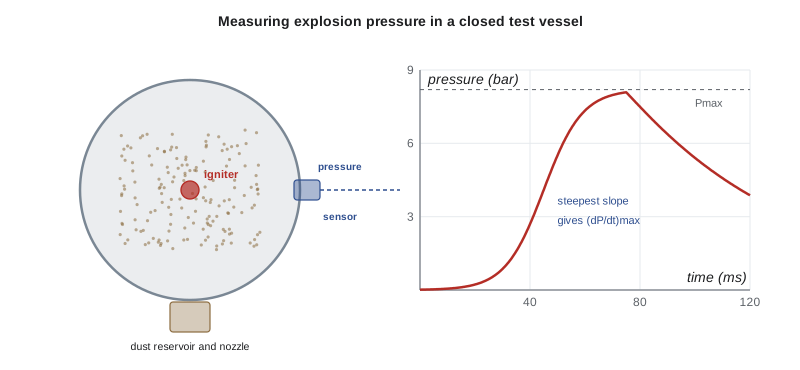
The first question is simply whether the dust can explode. A screening test, often called a go/no-go test, disperses the dust in a closed laboratory vessel at several concentrations and fires a strong igniter. If pressure rises above a defined threshold, the dust is explosible. In North America this testing is commonly done to ASTM E1226, which uses a 20-litre sphere or a larger 1 cubic metre vessel. A dust that does not explode in screening may still pose a flash fire or smouldering hazard, and NFPA standards may require further testing in some cases, so a negative result is not the end of the story.
Pmax and Kst: how violent is it?
If the dust is explosible, the same type of test is run over a range of concentrations to find the highest explosion pressure (Pmax) and the highest rate of pressure rise, written (dP/dt)max. Pmax for many organic dusts is in the range of roughly 7 to 10 bar gauge in a closed vessel, which is far higher than any ordinary building or dust collector housing can withstand. The rate of pressure rise depends on the size of the vessel, so it is normalized using the cubic law to give a number that can be compared between vessels and used for design:
Kst = (dP/dt)max × V^(1/3)
Here (dP/dt)max is in bar per second, V is the test vessel volume in cubic metres, and Kst comes out in bar·m/s. The higher the Kst, the faster and more violent the explosion. Kst is used directly in explosion venting and suppression design, which must be done by qualified specialists using the current edition of the relevant standard.
| Dust class | Kst range (bar·m/s) | Description |
|---|---|---|
| St 0 | 0 | Not explosible under test conditions |
| St 1 | Above 0 up to 200 | Weak to moderate explosion |
| St 2 | Above 200 up to 300 | Strong explosion |
| St 3 | Above 300 | Very strong explosion |
Many agricultural and wood dusts fall in the St 1 class, many plastics and some fine organic powders reach St 2, and fine metal dusts such as aluminum often reach St 3. These are general tendencies only. A St 1 dust can still destroy a building; the class affects how fast the explosion develops and how protection is designed, not whether it is dangerous.
Worked problem
Calculating Kst with the cubic law
A dust is tested in a 20-litre sphere (0.020 cubic metres). The highest rate of pressure rise measured is 550 bar/s. Calculate Kst and assign the dust class.
Show solution
- Apply the cubic law: Kst = (dP/dt)max × V^(1/3).
- V^(1/3) = 0.020^(1/3) ≈ 0.271 m.
- Kst ≈ 550 × 0.271 ≈ 149 bar·m/s.
- 149 is above 0 and not more than 200, so the dust is class St 1.
Answer: Kst is about 149 bar·m/s, class St 1. It is explosible and needs full protection, but it is not in the most violent class.
def kst(dpdt_max, volume_m3):
    """Cubic law: Kst = (dP/dt)max * V^(1/3), bar*m/s."""
    return dpdt_max * volume_m3 ** (1.0 / 3.0)

def st_class(k):
    if k <= 0:
        return "St 0"
    if k <= 200:
        return "St 1"
    if k <= 300:
        return "St 2"
    return "St 3"

tests = [("Sample A", 550, 0.020), ("Sample B", 900, 0.020),
         ("Sample C", 1300, 0.020), ("Sample D", 160, 1.0)]
for name, rate, vol in tests:
    k = kst(rate, vol)
print(f"{name}: (dP/dt)max = {rate} bar/s in {vol} m3 -> Kst = {k:.0f} bar*m/s, {st_class(k)}")Sample A: (dP/dt)max = 550 bar/s in 0.02 m3 -> Kst = 149 bar*m/s, St 1 Sample B: (dP/dt)max = 900 bar/s in 0.02 m3 -> Kst = 244 bar*m/s, St 2 Sample C: (dP/dt)max = 1300 bar/s in 0.02 m3 -> Kst = 353 bar*m/s, St 3 Sample D: (dP/dt)max = 160 bar/s in 1.0 m3 -> Kst = 160 bar*m/s, St 1
Look at Sample D in the code. The same dust gives a much lower rate of pressure rise in a 1 cubic metre vessel than in a 20-litre sphere, but the cubic law brings the result back to a comparable Kst. This is exactly why the rate of pressure rise is normalized: without it, numbers from different laboratories could not be compared.
MEC: how much dust does it take?
The minimum explosible concentration is the lowest concentration of dust suspended in air that can propagate an explosion. For many organic dusts it is in the range of a few tens of grams per cubic metre (often quoted as roughly 30 to 60 g/m³, but treat any such figure as illustrative). That sounds like a lot, and it is: a cloud at the MEC is so dense that you would struggle to see your hand at arm's length. This is why the inside of equipment is where clouds above the MEC normally exist, and why a room with clear air is unlikely to contain an explosible cloud during normal operation. The danger is that a thin layer on surfaces, once disturbed, can create a cloud above the MEC in a large volume. Lesson 7 shows how this leads to housekeeping criteria. MEC testing in North America is commonly done to ASTM E1515.
MIE: how easily does it ignite?
The minimum ignition energy is the smallest electrical spark energy that can ignite the most easily ignited concentration of a dust cloud. It is measured in millijoules (mJ), commonly to ASTM E2019. Dusts with an MIE of a few millijoules or less are very sensitive and can be ignited by static discharges from people, ungrounded metal parts or some types of bulk bags. Dusts with an MIE of hundreds of millijoules are much harder to ignite by static but can still be ignited by flames, hot surfaces and mechanical sparks. MIE falls sharply with finer particle size and with the presence of flammable vapour. Lesson 9 compares MIE with the energy stored in a charged conductor.
MIT: how hot is too hot?
Two temperature properties matter. The minimum ignition temperature of a cloud is the lowest temperature of a hot surface, such as the wall of a furnace, that ignites a dust cloud blown against it. It is commonly measured to ASTM E1491. The layer ignition temperature is the lowest temperature of a hot surface that ignites a layer of dust of a specified thickness, often 5 mm, resting on it. It is commonly measured to ASTM E2021. The layer temperature is usually much lower than the cloud temperature, because the layer insulates itself and traps heat, and thicker layers ignite at lower temperatures still. These numbers set the maximum surface temperature allowed for electrical equipment, motors, lights and process equipment in dusty areas. Lesson 10 explains how equipment temperature markings are matched to them.
Worked problem
Using temperature data to set a surface limit
A dust has a cloud minimum ignition temperature of 430 °C and a 5 mm layer ignition temperature of 290 °C. A simplified rule often applied (check the current standard for your jurisdiction) is to keep surfaces below two-thirds of the cloud temperature and at least 75 °C below the 5 mm layer temperature, and to use the lower of the two. What is the maximum allowable surface temperature?
Show solution
- Two-thirds of the cloud temperature: 430 × 2/3 ≈ 287 °C.
- Layer limit: 290 − 75 = 215 °C.
- Take the lower of the two values.
Answer: About 215 °C. The layer value governs, which is common because settled layers ignite at lower temperatures than clouds.
LOC: when inerting is used
The limiting oxygen concentration is the oxygen level below which a dust cloud cannot propagate a flame. It is used to design inerting systems, which add nitrogen, carbon dioxide or another inert gas to keep oxygen below the LOC with a safety margin. LOC values vary with the inert gas used. Inerting is a specialist design topic and, as Lesson 2 noted, creates a serious asphyxiation hazard for anyone entering the equipment.
Other properties
Some other tests support specific decisions. Electrical volume resistivity and charge relaxation tests show how readily a powder holds static charge. Thermal stability or self-heating tests show whether a material in a pile, silo or dryer can heat up and ignite on its own, which is important for materials such as some agricultural products, coal, wood pellets and oily or chemically reactive powders. Burning behaviour tests show how a layer burns. Moisture content and particle size distribution should be reported with every test so that results can be compared with conditions in the plant.
Reading a test report
A good test report identifies the sample, where it was taken, its moisture content and particle size distribution, any sample preparation such as drying or sieving, the test method and vessel, and the results with units. Laboratories often test a dried, sieved fraction because that is the worst credible case. That is appropriate for design, but you should know about it when comparing results with plant conditions. If a process changes in a way that could make dust finer, drier or more reactive, the samples should be retested.
Common mistakes
MistakeRelying on a generic table value for a design calculation.
InsteadTest representative samples of your own dust when values will be used for design.
MistakeAssuming a St 1 dust is safe because it is in the lowest explosible class.
InsteadTreat any explosible dust as capable of destroying equipment and buildings.
MistakeUsing the cloud ignition temperature alone to set surface temperature limits.
InsteadCheck the layer ignition temperature too; it is usually lower and often governs.
MistakeTaking samples from the floor near the door because it is convenient.
InsteadSample where the finest, driest dust collects, such as collectors and high surfaces.
MistakeTreating a negative screening result as proof that there is no hazard at all.
InsteadConsider flash fire, smouldering and self-heating hazards, and retest if the material changes.
Summary and key terms
- Explosibility tests tell you whether a dust can explode and how severe and easy to ignite it is.
- Kst = (dP/dt)max × V^(1/3) normalizes the rate of pressure rise so results from different vessels can be compared.
- Dust classes are St 0 (0), St 1 (above 0 to 200), St 2 (above 200 to 300) and St 3 (above 300 bar·m/s).
- Lower Kst and Pmax are safer; higher MEC, MIE, MIT and layer ignition temperatures are safer.
- Layer ignition temperatures are usually lower than cloud temperatures and often set surface temperature limits.
- Published data are a starting point only; particle size, moisture and composition change the results.
- Retest when a process change could make dust finer, drier or more reactive.
- Kst
- The deflagration index, the normalized maximum rate of pressure rise of a dust explosion, in bar·m/s.
- Pmax
- The maximum explosion pressure measured in a closed test vessel.
- Cubic law
- The relationship Kst = (dP/dt)max × V^(1/3) used to normalize test results.
- St class
- A classification of dust explosion severity based on Kst.
- MEC
- Minimum explosible concentration, the lowest dust concentration in air that can explode.
- MIE
- Minimum ignition energy, the smallest spark energy that can ignite a dust cloud.
- MIT
- Minimum ignition temperature, the lowest hot surface temperature that ignites a dust cloud.
- Layer ignition temperature
- The lowest hot surface temperature that ignites a dust layer of specified thickness.
- LOC
- Limiting oxygen concentration, the oxygen level below which a dust cannot explode.
- Go/no-go test
- A screening test that shows whether a dust is explosible.
Practice problems
Work each problem on paper first, then reveal the answer to check.
What does Kst measure?
Show answer
The violence of a dust explosion, as the normalized maximum rate of pressure rise.
A dust gives (dP/dt)max of 1,200 bar/s in a 20-litre sphere. Find Kst and the class.
Show answer
Kst ≈ 1,200 × 0.271 ≈ 326 bar·m/s, class St 3.
Is a higher MIE safer or more dangerous?
Show answer
Safer, because more energy is needed to ignite the cloud.
Why is the layer ignition temperature usually lower than the cloud temperature?
Show answer
A layer insulates itself and traps heat, so it can self-heat to ignition at a lower surface temperature.
What does MEC tell you?
Show answer
The lowest concentration of dust in air that can propagate an explosion.
Why should you test your own dust instead of using a table value?
Show answer
Particle size, moisture, shape and composition can change the results greatly.
Where should samples be taken?
Show answer
Where the finest, driest dust accumulates or is collected, such as collectors and elevated surfaces.
What is the purpose of the cubic law?
Show answer
To normalize the rate of pressure rise for vessel volume so results can be compared and used in design.
Which property is used to design inerting systems?
Show answer
The limiting oxygen concentration.
A process change makes the dust finer. What should happen to the test data?
Show answer
Representative samples should be retested because finer dust is usually more hazardous.
Lesson quiz · 5 questions
Score 60% or more to complete this lesson.
Create a free account to save your progress, take quizzes and earn a certificate.