
HSE-313 · Lesson 12 of 12 · 27 min
Capstone: a combustible dust management plan
This final lesson brings the course together by building a combustible dust management plan for an invented facility. A management plan is the written program that ties the dust hazard analysis to day-to-day practice: who is responsible, what is cleaned and how often, how equipment is protected and maintained, how ignition sources are controlled, how changes are managed, how workers are trained and how the facility responds to an emergency. NFPA 660 expects many of these elements, and regulators and insurers look for them. The facility, its people and its numbers are fictional and are used only to show how the pieces fit.
The facility
Northbrook Cabinet Works is an invented cabinet and millwork plant in a single-storey building of about 4,000 m². It employs 85 people on two shifts. The plant cuts and machines kiln-dried hardwood, plywood and medium-density fibreboard (MDF), then sands and finishes the parts. Equipment includes eight table and panel saws, two CNC routers, a planer, three wide-belt sanders, a row of hand-sanding stations and a lacquer spray booth. A single baghouse dust collector sits outside the north wall and is connected by a main duct and branches to the machines. Sawdust from the collector discharges through a rotary valve into a trailer. The building has open steel roof trusses, cable trays and overhead heaters.
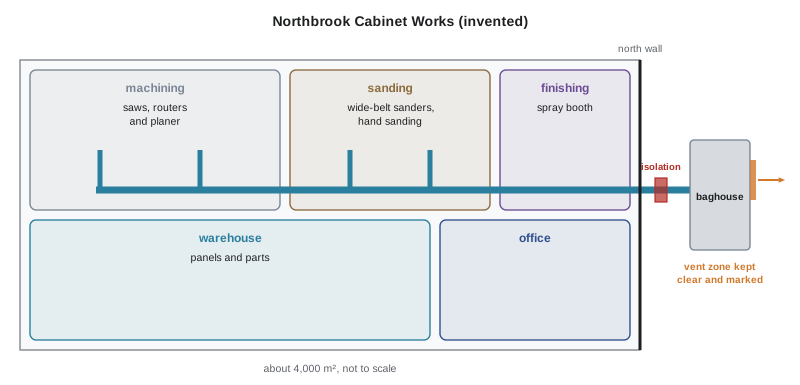
Starting point: what the DHA found
A qualified consultant led the DHA with the plant manager, the maintenance lead, two machine operators and the joint health and safety committee co-chair. Samples of dust were taken from the baghouse hopper, the top of the main duct and the roof trusses above the sanders. Test results showed that all samples were explosible. The finest sample, from the trusses, had a Kst of 160 bar·m/s (St 1), an MIE of 30 mJ, a cloud ignition temperature of 430 °C and a 5 mm layer ignition temperature of 290 °C. The DHA identified the following main findings.
| Area | Finding | Recommendation |
|---|---|---|
| Baghouse | Explosion vent present but discharge zone includes a walkway; no inlet isolation | Restrict and mark the discharge zone; install inlet isolation designed to NFPA 69 |
| Ducts | Two branches below transport velocity after a router was added; dust found settled in them | Rebalance the system; add cleanouts; verify velocities annually and after changes |
| Sanding area | Dust on trusses, cable trays and heater tops above the action level | Clean now; set a schedule from measured rates; enclose or slope ledges where practical |
| Ignition | No spark detection on sander branches; hot work permits did not require truss cleaning | Install spark detection and extinguishing; revise the hot work permit |
| Electrical | No hazardous location classification drawing; ordinary lights near sanders | Have a qualified person classify the area; replace equipment as needed |
| Spray booth | Booth exhaust and wood dust ducts could interconnect during maintenance | Keep booth exhaust fully separate from wood dust collection |
| Management | No written housekeeping program, no MOC procedure for the dust system, no dust-specific training | Write the programs below and train all workers |
Element 1: Policy, roles and responsibilities
The plan starts with a short statement from the plant manager committing to control combustible dust hazards and naming who is responsible for what. The plant manager owns the plan and approves resources. The maintenance lead owns the dust collection system, protection devices and electrical equipment in classified areas. Area supervisors own housekeeping in their areas and verify completion each shift. The health and safety coordinator maintains the DHA, tracks recommendations, coordinates training and audits the plan. Workers are responsible for following procedures, reporting leaks and accumulations, and stopping work when they see an uncontrolled hazard. The joint health and safety committee reviews progress quarterly.
Element 2: Material inventory and data
The plan lists each combustible material, where it is handled and its test data, with the date and location of sampling. It states that samples will be retested when the material mix changes significantly, for example if the proportion of MDF increases, since MDF sanding dust is very fine. Safety data sheets for the finishing materials are linked so that the hybrid hazard near the spray booth is visible.
Element 3: Housekeeping program
The housekeeping program sets an action level at half of the facility's accumulation criterion and calculates cleaning frequencies from measured accumulation rates. Cleaning is by approved vacuum equipment. Compressed air is prohibited except under a written procedure as a last resort, with the area shut down and ignition sources controlled. Hidden and elevated surfaces are cleaned on a schedule by a contractor using a lift, under a permit.
Worked problem
Building the cleaning schedule
Measured accumulation rates at Northbrook are: sanding area trusses 0.06 mm/day, machining area trusses 0.02 mm/day, sanding area floor 0.30 mm/day, and warehouse racking 0.005 mm/day. Using an action level of 0.4 mm (half of 0.8 mm), set a cleaning frequency for each area.
Show solution
- Sanding trusses: 0.4 ÷ 0.06 ≈ 6.7 days, so weekly cleaning would be too late; clean twice a week and fix the source.
- Machining trusses: 0.4 ÷ 0.02 = 20 days, so clean every two weeks.
- Sanding floor: 0.4 ÷ 0.30 ≈ 1.3 days, so clean at least daily; in practice the plant cleans every shift.
- Warehouse racking: 0.4 ÷ 0.005 = 80 days, so clean monthly with inspection.
Answer: Every shift for the sanding floor, twice a week for sanding trusses, every two weeks for machining trusses and monthly for the warehouse, each verified by inspection.
# Cleaning schedule from measured accumulation rates (invented values)
action_mm = 0.4
rates = {
    "Sanding area trusses": 0.06,
    "Machining area trusses": 0.02,
    "Sanding area floor": 0.30,
    "Warehouse racking": 0.005,
}
standard_intervals = [("every shift", 0.5), ("daily", 1), ("twice a week", 3.5), ("weekly", 7),
                      ("every two weeks", 14), ("monthly", 30)]
for area, rate in rates.items():
    days = action_mm / rate
    choice = [name for name, d in standard_intervals if d <= days][-1]
print(f"{area:24s} reaches action level in {days:5.1f} days -> clean {choice}")Sanding area trusses reaches action level in 6.7 days -> clean twice a week Machining area trusses reaches action level in 20.0 days -> clean every two weeks Sanding area floor reaches action level in 1.3 days -> clean daily Warehouse racking reaches action level in 80.0 days -> clean monthly
Element 4: Dust collection and explosion protection
The plan describes the dust collection system, its design airflows and velocities, and the protection on each piece of equipment. It commits to the DHA recommendations: rebalancing the system, adding cleanouts, installing inlet isolation on the baghouse, installing spark detection and extinguishing on the sander branches, and restricting the vent discharge zone. It sets an inspection, testing and maintenance schedule for each protection device, following the manufacturer's instructions and NFPA 68 and NFPA 69. It also prohibits connecting the spray booth exhaust to the wood dust system.
| Item | Check | Frequency (example) |
|---|---|---|
| Baghouse differential pressure | Record and compare with normal range | Each shift |
| Hopper and rotary valve | Confirm hopper is emptying; check valve seals | Daily |
| Branch velocities | Measure static pressure or velocity at each branch | Annually and after any change |
| Explosion vent panel | Inspect for damage, corrosion, obstruction and discharge zone clearance | Quarterly and after any event |
| Inlet isolation valve | Inspect and function test as specified by the manufacturer | As specified, at least annually |
| Spark detection system | Test detectors and extinguishing function | As specified by the manufacturer |
| Magnets and separators | Clean and check | Weekly |
| Bonding and grounding | Visual check of straps and continuity test | Quarterly |
Element 5: Ignition control
The plan covers hot work, electrical equipment, static, mechanical sparks and smoking. The hot work permit is revised so that in dust areas it requires cleaning of floors and elevated surfaces within spark range, shutdown of dust collection branches nearby, covering of duct openings, a fire watch during work and for at least the time set in the permit afterward, and sign-off by the area supervisor. Smoking and open flames are prohibited in production areas. A qualified electrical professional prepares a hazardous location classification drawing for the sanding area and collector, and non-compliant equipment is replaced on a schedule. Ducts are bonded across all flexible connections and gaskets. Overhead heaters are checked to confirm their surface temperatures are below the limit calculated from the dust data, about 215 °C in this case, and dust is kept off them.
Element 6: Management of change
Any change that could affect dust generation, collection, protection or ignition must go through the plant's management of change procedure before it is made. Examples include adding or moving machines, changing duct layouts, changing the wood or panel products used, increasing production rates, changing filters, and modifying the building. The MOC form includes a question asking whether the change affects the DHA, and if so the health and safety coordinator arranges a review. HSE-311 covers management of change in detail.
Element 7: Training
All workers receive combustible dust awareness training on hire and refresher training annually. It covers the pentagon, secondary explosions, how to recognize accumulations and leaks, the housekeeping program, the prohibition on compressed air and on opening burning equipment, how to report hazards and what to do in an emergency. Maintenance staff receive additional training on the dust collection system, isolation and venting devices, bonding and grounding, and hazardous location equipment. Supervisors receive training on verifying housekeeping and issuing hot work permits. Contractors working in production areas receive a site-specific briefing, as covered in HSE-406.
Element 8: Emergency response
The emergency plan covers dust fires in machines, ducts and the collector, and explosions. It states that workers must not open the collector or ducts during a fire, describes how to shut down the system and evacuate, and identifies the vent discharge zone as a no-go area. The plant shares a pre-incident plan with the local fire service and holds a joint walk-through each year.
Element 9: Inspection, audit and improvement
The plan sets leading indicators that show whether controls are working, not just whether incidents have happened. HSE-407 covers safety metrics and leading indicators. Examples for Northbrook include the percentage of scheduled cleaning tasks completed on time, the number of open DHA recommendations and their age, the number of leaks reported and repaired, inspection and testing completion for protection devices, and training completion. The health and safety coordinator audits the plan annually, and the DHA is reviewed at least every five years or sooner after significant changes.
Worked problem
Prioritizing the action plan
Northbrook has a limited budget this year and seven DHA recommendations. How should it decide what to do first?
Show solution
- Immediately do the low-cost, high-value actions: clean the trusses now, restrict the vent discharge zone, revise the hot work permit, prohibit compressed air and begin training.
- Next, address the items that could turn a collector event into a building disaster: inlet isolation on the baghouse and rebalancing the ducts.
- Then install spark detection and extinguishing to reduce the likelihood of collector fires.
- Commission the hazardous location classification and plan electrical replacements over a defined period.
- Track each action with an owner and date and report progress to the joint committee.
Answer: Act at once on housekeeping, the vent zone, permits and training; fund isolation and duct rebalancing next; then spark detection and electrical upgrades, all tracked to completion.
Common mistakes
MistakeWriting a plan that repeats the DHA but assigns no owners or dates.
InsteadAssign responsibilities, frequencies and deadlines for every element.
MistakeMeasuring success only by the absence of explosions.
InsteadTrack leading indicators such as cleaning completion and open recommendations.
MistakeLeaving contractors out of the dust program.
InsteadBrief contractors on dust hazards and include them in permits and training.
MistakePostponing all actions until the budget allows major upgrades.
InsteadDo low-cost, high-value actions immediately and schedule capital projects.
MistakeTreating the plan as finished once written.
InsteadAudit it annually and update it with the DHA after changes.
Summary and key terms
- A combustible dust management plan turns the DHA into daily practice.
- It assigns roles and responsibilities from the plant manager to every worker.
- It sets housekeeping frequencies from measured accumulation rates and an action level.
- It defines inspection, testing and maintenance of dust collection and protection devices.
- It controls ignition through hot work permits, electrical classification, bonding and other measures.
- It links to management of change, training, contractor control and emergency response.
- It uses leading indicators and regular audits to keep improving.
- Management plan
- A written program that turns hazard analysis into responsibilities, procedures and schedules.
- Action plan
- A list of corrective actions with owners and target dates.
- Leading indicator
- A measure that shows whether controls are working before an incident occurs.
- Inspection, testing and maintenance
- Scheduled checks that keep safety devices working.
- Pre-incident plan
- Information shared with the fire service before an emergency.
- Joint health and safety committee
- A committee of worker and employer representatives that helps oversee safety.
- Hot work permit
- A written authorization that sets precautions for work that produces sparks or flames.
- Management of change
- A procedure for reviewing the hazards of changes before they are made.
- Classification drawing
- A drawing showing hazardous location zones or divisions in a facility.
- Audit
- A systematic check of whether a program is in place and working.
Practice problems
Work each problem on paper first, then reveal the answer to check.
What is the purpose of a combustible dust management plan?
Show answer
To turn the DHA into responsibilities, procedures and schedules that control dust hazards day to day.
Who owns the dust collection system at Northbrook?
Show answer
The maintenance lead.
Dust accumulates at 0.08 mm/day and the action level is 0.4 mm. How often should you clean?
Show answer
At least every 5 days.
Why should the spray booth exhaust be separate from the wood dust system?
Show answer
To avoid a hybrid mixture of lacquer vapour and wood dust in ducts or the collector.
Name three leading indicators for a dust program.
Show answer
Cleaning completion, open DHA recommendations, leaks reported and repaired, ITM completion, training completion.
What should the revised hot work permit require in dust areas?
Show answer
Cleaning within spark range including elevated surfaces, shutting down nearby collection, covering openings and a fire watch.
What changes should trigger a DHA review?
Show answer
New or moved machines, duct changes, material changes, higher production rates, building modifications.
Which actions can be taken immediately at low cost?
Show answer
Cleaning, restricting the vent zone, revising permits, prohibiting compressed air and training.
Why include contractors in the plan?
Show answer
They may perform hot work or work near dust equipment and need to know the hazards and controls.
How often should the plan be audited and the DHA reviewed?
Show answer
Audit annually; review the DHA at least every five years and after significant changes.
Lesson quiz · 5 questions
Score 60% or more to complete this lesson.
Create a free account to save your progress, take quizzes and earn a certificate.