
HSE-313 · Lesson 5 of 12 · 25 min
Law, codes and standards for combustible dust
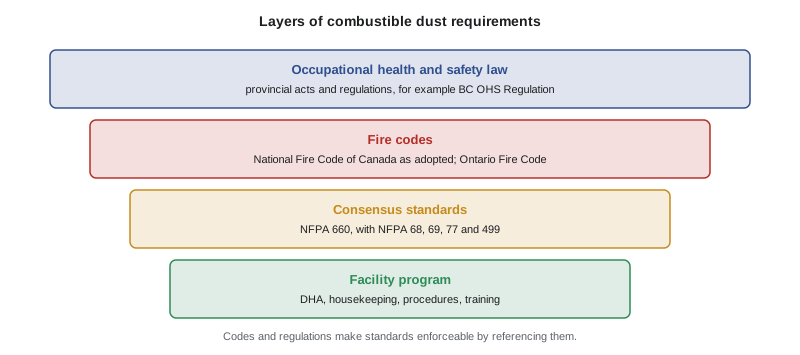
Combustible dust is regulated through a layered system. At the top are occupational health and safety laws, which make employers responsible for protecting workers from hazards. Fire codes, adopted by provinces, states and municipalities, set requirements for buildings and processes. Consensus standards, especially those published by the National Fire Protection Association (NFPA), contain the detailed engineering requirements, and they become legally enforceable when a code or regulation references them. Even where they are not referenced, regulators and courts often treat them as the recognized standard of good practice. This lesson maps that system for Canada and the United States and explains the 2024 consolidation of the NFPA dust standards into a single document, NFPA 660. The facts are current as of 2026; codes and standards change, so always check the edition in force in your jurisdiction.
Because this course is offered in Canada, the Canadian framework is described first, followed by the United States for comparison. Many Canadian facilities belong to companies with plants in both countries, and many Canadian codes reference the same NFPA standards used south of the border.
The NFPA dust standards and the move to NFPA 660
For many years, NFPA published six separate standards on combustible dust. NFPA 652, Fundamentals of Combustible Dust, set the general requirements that apply to all industries, including the requirement for a dust hazard analysis. Five commodity-specific standards gave more detailed requirements: NFPA 61 for agricultural and food processing facilities, NFPA 484 for combustible metals, NFPA 654 for the general manufacturing, processing and handling of combustible particulate solids, NFPA 655 for sulfur, and NFPA 664 for wood processing and woodworking facilities. Users had to read NFPA 652 together with whichever commodity standard applied, and the documents did not always agree.
To fix this, NFPA consolidated all six into a single standard, NFPA 660, Standard for Combustible Dusts and Particulate Solids. The 2025 edition of NFPA 660 was issued in late 2024 and replaced the six earlier standards. It keeps a set of fundamental chapters that apply to everyone, followed by chapters for the specific commodity groups that were previously in separate standards. If you see a reference to NFPA 61, 484, 652, 654, 655 or 664 in a code, a regulation, an insurance requirement or an older company procedure, the corresponding requirements now live in NFPA 660. Codes that reference the older standards by edition may continue to point at those editions until they are updated, so you need to check which edition is actually enforceable where you work.
| Former standard | Scope | Where it now lives |
|---|---|---|
| NFPA 652 | Fundamentals for all combustible dusts, including the dust hazard analysis | NFPA 660 fundamental chapters |
| NFPA 61 | Agricultural and food processing facilities | NFPA 660 agricultural and food chapter |
| NFPA 484 | Combustible metals | NFPA 660 combustible metals chapter |
| NFPA 654 | General manufacturing, processing and handling | NFPA 660 chapter for other particulate solids |
| NFPA 655 | Sulfur | NFPA 660 sulfur chapter |
| NFPA 664 | Wood processing and woodworking | NFPA 660 wood chapter |
Other NFPA standards remain separate and are often used alongside NFPA 660. NFPA 68 covers explosion protection by deflagration venting. NFPA 69 covers explosion prevention systems such as suppression, isolation, inerting and containment. NFPA 70, the National Electrical Code, covers electrical installations in hazardous locations in the United States. NFPA 77 covers static electricity. NFPA 499 gives recommended practice for classifying combustible dust locations for electrical installations. NFPA 51B covers fire prevention during hot work, which HSE-216 discusses.
The dust hazard analysis requirement
The most important single requirement to come out of the NFPA dust standards in recent years is the dust hazard analysis (DHA). NFPA 652 introduced a requirement for owners and operators of facilities with combustible dust to complete a DHA. For existing facilities, the 2016 and 2019 editions set a deadline of 7 September 2020 to complete it. New processes and facility modifications need a DHA as part of the design. NFPA 660 carries this requirement forward, and it also expects the DHA to be reviewed and updated periodically, generally every five years, and whenever significant changes occur. Lesson 6 explains how to carry out a DHA.
Worked problem
Mapping an old reference to the new standard
A company procedure written in 2018 says, 'Wood dust collectors shall be protected in accordance with NFPA 664, and a dust hazard analysis shall be completed in accordance with NFPA 652.' The procedure is being revised in 2026. How should the references be updated?
Show solution
- Recognize that NFPA 664 and NFPA 652 were both consolidated into NFPA 660.
- Replace both references with NFPA 660, noting the edition used (the 2025 edition at the time of writing).
- Check whether the local fire code or regulation still references the older standards by edition, and record that in the procedure.
- Keep separate references to NFPA 68 and NFPA 69 for venting and isolation design, since those remain separate standards.
Answer: Reference NFPA 660 (2025 edition) for the wood dust and dust hazard analysis requirements, keep NFPA 68 and 69 for protection design, and note any older edition still referenced by the enforceable code.
from datetime import date

# Map older NFPA dust references in company documents to NFPA 660
consolidated = {"NFPA 61", "NFPA 484", "NFPA 652", "NFPA 654", "NFPA 655", "NFPA 664"}
still_separate = {"NFPA 68", "NFPA 69", "NFPA 70", "NFPA 77", "NFPA 499", "NFPA 51B"}
documents = {
    "Collector procedure (2018)": ["NFPA 664", "NFPA 68"],
    "Hot work procedure (2019)": ["NFPA 51B", "NFPA 652"],
    "Electrical standard (2021)": ["NFPA 70", "NFPA 499"],
}
for doc, refs in documents.items():
    old = [r for r in refs if r in consolidated]
    keep = [r for r in refs if r in still_separate]
    action = "update to NFPA 660" if old else "no consolidation change"
    print(f"{doc}: old {old or '-'}; keep {keep}; {action}")

# Five-year DHA review dates (illustrative)
last_dha = date(2020, 9, 1)
for cycle in range(1, 3):
    due = date(last_dha.year + 5 * cycle, last_dha.month, last_dha.day)
print("DHA review due by", due.isoformat())Collector procedure (2018): old ['NFPA 664']; keep ['NFPA 68']; update to NFPA 660 Hot work procedure (2019): old ['NFPA 652']; keep ['NFPA 51B']; update to NFPA 660 Electrical standard (2021): old -; keep ['NFPA 70', 'NFPA 499']; no consolidation change DHA review due by 2025-09-01 DHA review due by 2030-09-01
Canada
In Canada, occupational health and safety is mainly a provincial and territorial responsibility, with federal rules for federally regulated workplaces. Every jurisdiction has a general duty requiring employers to protect workers from hazards, and some have specific provisions on combustible dust. British Columbia is the clearest example because of the 2012 sawmill explosions.
In British Columbia, the Occupational Health and Safety Regulation addresses combustible dust directly. Section 5.81 deals with combustible dust and requires employers to control the hazard, including by preventing hazardous accumulations. Section 5.71 sets requirements for dust collectors, including those with a volume greater than 0.6 cubic metres (20 cubic feet), covering where they may be located and how they must be protected against explosion. After the 2012 explosions, WorkSafeBC issued a directive order to sawmills and other wood product manufacturers, carried out province-wide inspections, and published guidance on combustible dust hazard assessment. The BC Fire Code, which is based on the National Fire Code of Canada, also applies.
Across Canada, the National Fire Code of Canada (NFC), published by the National Research Council and adopted with or without changes by the provinces and territories, contains requirements for dust-producing processes and references NFPA dust standards. At the time of writing, the references in the editions most widely in force were written to the individual NFPA standards that existed before NFPA 660, such as NFPA 61, 484, 654 and 664, so users need to check how their authority having jurisdiction treats the consolidated standard. Ontario has its own Fire Code, a regulation under the Fire Protection and Prevention Act, which is closely aligned with the NFC. Ontario's Occupational Health and Safety Act general duty also applies.
United States
In the United States, OSHA does not have a general combustible dust standard. It relies on the grain handling standard (29 CFR 1910.272), the walking-working surfaces housekeeping requirement (29 CFR 1910.22), the hazardous locations electrical standard (29 CFR 1910.307), the Hazard Communication Standard (29 CFR 1910.1200) and the General Duty Clause, section 5(a)(1) of the OSH Act. OSHA's Combustible Dust National Emphasis Program, CPL 03-00-008, revised on 30 January 2023, targets inspections in listed industries. Fire codes adopted by states and cities, mainly the International Fire Code and NFPA 1, reference NFPA dust standards.
The stalled US federal standard
After the Imperial Sugar explosion and a CSB recommendation, OSHA began work on a general combustible dust standard in 2009. Progress was slow, and the rulemaking was removed from the regulatory agenda in 2017. OSHA returned to the topic in 2023 with a stakeholder meeting, but as of 2026 there is still no final federal combustible dust standard, and its future is uncertain. Employers should not wait for one. The General Duty Clause, existing standards and the NFPA consensus standards already set clear expectations.
| Layer | Canada | United States |
|---|---|---|
| General duty | Provincial OHS acts, for example the BC Workers Compensation Act and Ontario OHSA | OSH Act section 5(a)(1), the General Duty Clause |
| Specific dust rules | BC OHS Regulation sections 5.81 (combustible dust) and 5.71 (dust collectors) | 29 CFR 1910.272 (grain handling); no general dust standard |
| Housekeeping | BC section 5.81 and general duties | 29 CFR 1910.22 walking-working surfaces |
| Hazard communication | WHMIS and the Hazardous Products Regulations | Hazard Communication Standard, 29 CFR 1910.1200 |
| Fire code | National Fire Code of Canada as adopted provincially; Ontario Fire Code | International Fire Code or NFPA 1 as adopted by states and cities |
| Electrical code | Canadian Electrical Code, Part I (CSA C22.1) | National Electrical Code (NFPA 70); 29 CFR 1910.307 |
| Enforcement focus | Provincial inspections; WorkSafeBC directive order to sawmills (2012) | OSHA National Emphasis Program CPL 03-00-008 (revised 2023) |
| Consensus standard | NFPA 660 where referenced or used as good practice | NFPA 660 where referenced or used as good practice |
Hazard communication
Safety data sheets and labels are often the first place a worker or a new safety professional learns that a material can form combustible dust. In the United States, the Hazard Communication Standard as revised in 2012 and updated in 2024 requires chemical manufacturers and importers to address combustible dust on labels and safety data sheets where it applies. In Canada, the Hazardous Products Regulations under WHMIS include a hazard class for combustible dusts, with a required hazard statement on labels and safety data sheets. Not every product that can form combustible dust in the workplace comes with such a label, especially when the dust is generated on site by sanding, grinding or cutting, so the absence of a label does not mean there is no hazard.
Insurers and corporate standards
Property insurers are another powerful influence. Many large insurers have their own loss prevention data sheets on combustible dust and expect insured facilities to follow them or NFPA 660. A corporate engineering standard may also set requirements stricter than local law. When several sources apply, the facility should follow the most protective requirement unless a qualified engineer has documented why a different approach provides equivalent safety.
Common mistakes
MistakeAssuming there is no legal requirement because there is no specific combustible dust regulation.
InsteadRecognize that general duty clauses, fire codes and referenced NFPA standards still apply.
MistakeContinuing to cite NFPA 652, 654 or 664 in new procedures without comment.
InsteadCite NFPA 660 and note any older edition that the local code still references.
MistakeWaiting for a federal OSHA dust standard before acting.
InsteadAct now using the General Duty Clause, existing standards and NFPA 660.
MistakeTreating a missing combustible dust statement on a label as proof there is no hazard.
InsteadEvaluate dust generated on site by sanding, grinding or cutting regardless of labels.
MistakeFollowing only the minimum legal requirement when insurers or corporate standards are stricter.
InsteadFollow the most protective applicable requirement unless equivalence is documented.
Summary and key terms
- Combustible dust is regulated by OHS law, fire codes and consensus standards that codes reference.
- NFPA 660 (2025 edition) consolidated NFPA 61, 484, 652, 654, 655 and 664 into one standard.
- NFPA 68, 69, 70, 77 and 499 remain separate standards used alongside NFPA 660.
- The dust hazard analysis requirement began in NFPA 652 with a 7 September 2020 deadline for existing facilities and continues in NFPA 660.
- British Columbia regulates combustible dust directly in OHS Regulation sections 5.81 and 5.71.
- In the United States, OSHA uses 1910.272, 1910.22, 1910.307, HazCom, the General Duty Clause and the National Emphasis Program CPL 03-00-008.
- There is no final federal US combustible dust standard as of 2026.
- NFPA 660
- The NFPA Standard for Combustible Dusts and Particulate Solids, which consolidated six earlier dust standards.
- NFPA 652
- The former NFPA standard on the fundamentals of combustible dust, now part of NFPA 660.
- Authority having jurisdiction
- The organization or official responsible for enforcing a code or standard in a given area.
- General Duty Clause
- Section 5(a)(1) of the US OSH Act, requiring employers to keep workplaces free of recognized serious hazards.
- National Emphasis Program
- An OSHA inspection program focused on a particular hazard; the combustible dust program is CPL 03-00-008.
- National Fire Code of Canada
- The model fire code published by the National Research Council and adopted by provinces and territories.
- Directive order
- A WorkSafeBC order requiring a class of employers to take specified action.
- Consensus standard
- A standard developed by a committee representing many interests, such as NFPA standards.
- Incorporation by reference
- Making a standard legally enforceable by referring to it in a code or regulation.
- Safety data sheet
- A document describing the hazards of a product and how to handle it safely.
Practice problems
Work each problem on paper first, then reveal the answer to check.
Which six NFPA standards were consolidated into NFPA 660?
Show answer
NFPA 61, 484, 652, 654, 655 and 664.
Which NFPA standards on explosion protection remain separate from NFPA 660?
Show answer
NFPA 68 for venting and NFPA 69 for prevention systems such as suppression and isolation.
What deadline did NFPA 652 set for completing a DHA at existing facilities?
Show answer
7 September 2020.
Which sections of the BC OHS Regulation address combustible dust and dust collectors?
Show answer
Section 5.81 for combustible dust and section 5.71 for dust collectors.
What is the OSHA Combustible Dust National Emphasis Program directive number?
Show answer
CPL 03-00-008, revised on 30 January 2023.
Which OSHA standard covers grain handling facilities?
Show answer
29 CFR 1910.272.
How does OSHA cite combustible dust hazards where no specific standard applies?
Show answer
Under the General Duty Clause, often using NFPA standards as evidence of recognized hazards.
Is there a final federal US combustible dust standard?
Show answer
No; the rulemaking stalled and no final standard exists as of 2026.
Why must you check which NFPA edition your local code references?
Show answer
Codes may still reference older individual standards by edition, which remain enforceable until updated.
Does the absence of a combustible dust label mean there is no hazard?
Show answer
No; dust generated on site may not be labelled and must still be evaluated.
Lesson quiz · 5 questions
Score 60% or more to complete this lesson.
Create a free account to save your progress, take quizzes and earn a certificate.