
HSE-313 · Lesson 11 of 12 · 26 min
Explosion protection and emergency response
Prevention comes first: keep dust inside equipment, keep it off surfaces and control ignition sources. But clouds exist inside equipment during normal operation, and no ignition control is perfect. Explosion protection accepts that an explosion may occur inside equipment and makes sure that it does not injure people, destroy the building or spread to other equipment. This lesson introduces the four main protection methods, venting, suppression, containment and isolation, at a conceptual level, then covers protection of buildings and emergency response to dust fires and explosions. The design of these systems is a specialist engineering task governed by NFPA 68, NFPA 69 and NFPA 660. Nothing here is a substitute for qualified design.
Two key pressures
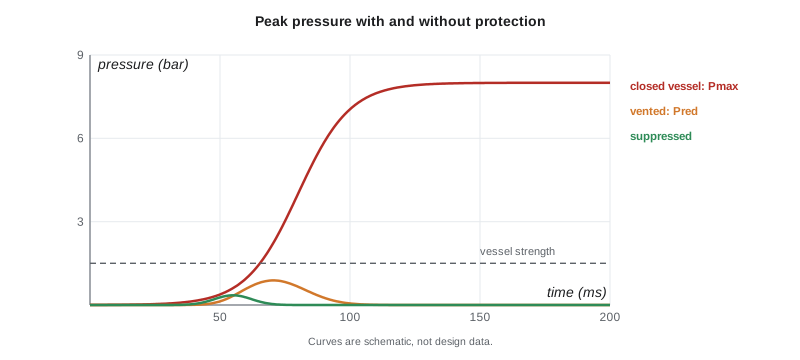
Two pressures appear throughout explosion protection. The maximum explosion pressure, Pmax, from Lesson 3, is the pressure a dust would reach if it exploded in a completely closed vessel, typically several bar. The reduced explosion pressure, Pred, is the lower peak pressure reached when an explosion is relieved by venting or controlled by suppression. Protection systems are designed so that Pred stays below the pressure the protected equipment can withstand without bursting, with a margin. Most dust collectors, silos and ducts can withstand only a fraction of Pmax, so without protection they would rupture.
| Method | How it works | Main considerations |
|---|---|---|
| Venting | A weak panel or door opens early and releases burning dust and gas to a safe place | Needs a safe discharge area; fireball and pressure outside the vent; not usually suitable for toxic dusts |
| Flameless venting | A vent fitted with a device that cools and retains the flame and burning dust | Allows venting indoors in some cases; reduces efficiency; manufacturer limits apply |
| Suppression | Detectors sense the start of an explosion and inject extinguishing agent within milliseconds | Suitable indoors and for toxic dusts; needs inspection, testing and maintenance |
| Containment | Equipment is built strong enough to withstand the explosion pressure | Practical for small vessels; connected equipment still needs isolation |
| Isolation | Valves or barriers stop flame travelling through connections (Lesson 8) | Used with the other methods; location and maintenance are critical |
| Inerting | Oxygen is kept below the limiting oxygen concentration | Prevents explosion rather than mitigating it; asphyxiation hazard |
Venting
Explosion venting is the most common protection for dust collectors, silos, bins and some other equipment. A vent panel, made of a thin membrane or a hinged door designed to open at a low pressure, is fitted to the equipment. When an explosion begins, the panel opens and the burning dust and hot gases escape before pressure inside rises to a damaging level. The vent does not stop the explosion; it redirects it. Outside the vent there will be a large fireball and a pressure wave, so the vent must discharge to a location where nobody can be and where the fireball cannot ignite other materials or enter buildings.
The vent area needed depends on several factors. In general terms, a larger vessel, a more violent dust (higher Kst and Pmax) and a weaker vessel (lower Pred allowed) all require more vent area. Ducting the vent to the outside reduces its effectiveness, so a ducted vent needs more area than one that discharges directly. NFPA 68 sets out the method for sizing vents, and it should be applied only by qualified designers using tested dust data. The illustrative table below shows only the direction of each effect, not values.
| If this increases... | Required vent area (all else equal) |
|---|---|
| Vessel volume | Increases |
| Kst of the dust | Increases |
| Pmax of the dust | Increases |
| Allowed reduced pressure (stronger vessel) | Decreases |
| Length of vent duct | Increases |
| Static opening pressure of the panel | Increases |
Worked problem
Reviewing a vent installation
During a walk-through, you see a dust collector just outside a plant wall. Its explosion vent panel faces a parking lot where employees park and walk to the side door, about 6 metres (20 feet) away. Material is stored on pallets beside the collector. What concerns should you raise?
Show solution
- The vent discharges toward an area where people walk and park, so they could be caught in the fireball and pressure wave.
- Stored material beside the collector could be ignited by the fireball.
- The nearby side door could let flame or pressure into the building.
- Ask for the vent discharge zone to be determined under NFPA 68 and for it to be kept clear, marked and restricted, or for the vent to be redirected or replaced by another method.
- Check whether the inlet duct has isolation, so the explosion does not travel back inside.
Answer: The vent discharge area is not safe. Have a qualified person define the hazard zone, restrict access, move stored material and consider redirection, flameless venting or suppression, and confirm inlet isolation.
Flameless venting
Where equipment is indoors and cannot be vented safely to the outside, a flameless venting device may be used. These devices are mounted over a vent opening and contain a mesh or other structure that absorbs heat and traps burning particles, so that only cooled gases escape into the room. They allow venting in places where conventional vents would be impossible, but they reduce vent efficiency, have limits on dust type and volume, and still release some pressure and hot gas into the surrounding area. Their use must follow the manufacturer's certification and NFPA 68.
Suppression
Explosion suppression systems use fast pressure or optical detectors to sense the very start of an explosion, within a few milliseconds, and then discharge an extinguishing agent from pressurized containers into the equipment. The agent quenches the flame before pressure rises significantly. Suppression is useful when equipment is indoors, when the dust is toxic and must not be released, or when venting would discharge into an unsafe area. Suppression systems need regular inspection and servicing by trained technicians, and the equipment must be locked out from the suppression system during maintenance so it does not discharge on workers. NFPA 69 governs their design.
Containment
For small equipment, it can be practical to build the vessel strong enough to withstand the full explosion pressure. Containment is common for small mills, some mixers and rotary valves. Explosion-resistant or explosion-pressure-resistant designs are distinguished by whether the vessel may deform permanently. Containment protects the vessel but not anything connected to it, so isolation is still needed on inlets and outlets.
Protecting buildings
If an explosion can occur within a room, for example from a cloud formed during an upset, the building itself needs consideration. Measures include keeping hazardous operations in separate, detached buildings or rooms, separating them by distance or by walls designed to withstand or direct pressure, and providing damage-limiting construction, such as lightweight wall or roof panels that relieve pressure in a predictable direction. These measures are part of the design of new facilities and major modifications and are addressed in NFPA 660 and the building and fire codes. The most effective way to protect a building remains keeping accumulations below the criteria described in Lesson 7.
# Illustrative check: is the protected vessel's peak pressure below its strength?
cases = [
    ("Unprotected collector", 8.0, 0.4),
    ("Vented collector", 0.3, 0.4),
    ("Suppressed collector", 0.2, 0.4),
    ("Contained small mill", 8.0, 10.0),
]
for name, peak_bar, strength_bar in cases:
    status = "holds" if peak_bar < strength_bar else "ruptures"
    margin = strength_bar - peak_bar
print(f"{name:24s} peak {peak_bar:4.1f} bar vs strength {strength_bar:4.1f} bar -> {status} (margin {margin:+.1f})")Unprotected collector peak 8.0 bar vs strength 0.4 bar -> ruptures (margin -7.6) Vented collector peak 0.3 bar vs strength 0.4 bar -> holds (margin +0.1) Suppressed collector peak 0.2 bar vs strength 0.4 bar -> holds (margin +0.2) Contained small mill peak 8.0 bar vs strength 10.0 bar -> holds (margin +2.0)
The numbers in the code above are invented to illustrate the idea that protection succeeds when the peak pressure stays below what the equipment can withstand. Real values come from the vessel manufacturer, the dust tests and the protection design.
Emergency response to dust fires
Dust fires need careful handling, because the wrong response can create a cloud and turn a fire into an explosion. Common rules, which must be adapted to each facility in its emergency plan and agreed with the local fire service, include the following. Do not open the doors or access panels of a dust collector, dryer or silo that is on fire, because the inrush of air and the disturbance of dust can cause an explosion. Do not use a solid stream of water or a strong jet from an extinguisher on a dust layer or pile, because it can raise a cloud; use a gentle spray or fog where water is appropriate. Shut down conveying and dust collection to stop feeding air and dust to the fire, unless the emergency plan says otherwise. Evacuate people from the area, including the vent discharge zone, and call the fire service.
Metal dust fires need special attention. Water, and some common extinguishing agents, can react violently with burning metals such as aluminum, magnesium and titanium, and some metal dust fires can produce hydrogen. Class D extinguishing agents or dry sand applied gently, or isolation and allowing the fire to burn out under control, may be specified in the emergency plan. Only trained people should attempt to fight metal fires.
Silo fires, often caused by self-heating, are complex and dangerous incidents. Emptying a burning silo or opening it can lead to an explosion, and specialists may use inert gas injection and carefully planned discharge. The emergency plan should identify when outside specialist help is needed.
| Do | Do not |
|---|---|
| Raise the alarm, evacuate and call the fire service | Open collector, dryer or silo doors during a fire |
| Shut down conveying and dust collection as the plan specifies | Hit dust layers or piles with a solid water stream or strong extinguisher jet |
| Use gentle spray or fog where water is suitable | Use water on water-reactive metal dust fires |
| Keep people out of vent discharge zones | Re-enter a damaged area before it is declared safe |
| Share the plan and site information with the fire service in advance | Assume firefighters know the dust hazards of your site |
Pre-incident planning and training
The fire service should know about combustible dust hazards before an emergency. Pre-incident planning involves sharing site plans, the location of dust collectors, silos, vents, isolation and suppression systems, the dust types and test data, the location of water-reactive metals, and shutoff points. Joint walk-throughs and exercises help both sides understand what to expect. Workers need training to recognize a developing fire, raise the alarm, shut down equipment safely and evacuate, and they need to understand why they must not open burning equipment. HSE-105 and HSE-222 cover general fire safety and evacuation.
Flame-resistant clothing
Where workers may be exposed to flash fires, flame-resistant (FR) clothing reduces the severity of burns. NFPA 660 requires a hazard assessment to decide when FR clothing is needed, and NFPA 2112 and 2113 cover the clothing and its selection and use. FR clothing is the last line of defence: it does not protect against overpressure, flying debris or building collapse, and it does not replace preventing clouds and ignition.
Common mistakes
MistakeOpening a dust collector door to look at a fire inside.
InsteadKeep it closed, shut down as planned, evacuate and call the fire service.
MistakeLetting people park or walk in front of an explosion vent.
InsteadDefine, mark and restrict the vent discharge zone.
MistakeFitting a vent and forgetting the inlet duct.
InsteadAdd isolation so the explosion cannot travel back into the building.
MistakeSpraying a dust pile with a strong water jet.
InsteadUse a gentle spray or fog where water is suitable, to avoid raising a cloud.
MistakeServicing a vessel with a suppression system without isolating the system.
InsteadLock out the suppression system before entry or maintenance.
Summary and key terms
- Explosion protection limits the effects of explosions inside equipment: venting, suppression, containment and isolation.
- Protection keeps the reduced pressure Pred below the strength of the equipment.
- Vent area increases with vessel volume, Kst and Pmax, and decreases with stronger vessels; sizing follows NFPA 68.
- Vents must discharge to a safe area; flameless venting or suppression may be used indoors.
- Containment suits small equipment; connected equipment still needs isolation.
- In a dust fire, do not open burning equipment or raise a cloud; evacuate and call the fire service.
- Pre-incident planning with the fire service and training of workers are essential.
- Pred
- The reduced explosion pressure reached when an explosion is vented or suppressed.
- Explosion vent
- A panel or door that opens at low pressure to release an explosion to a safe area.
- Flameless venting
- A device that allows venting while retaining flame and burning particles.
- Suppression
- Detecting an incipient explosion and injecting extinguishing agent to stop it.
- Containment
- Designing equipment strong enough to withstand an internal explosion.
- Vent discharge zone
- The area outside a vent affected by the fireball and pressure wave.
- Damage-limiting construction
- Building elements designed to relieve explosion pressure in a controlled way.
- Pre-incident plan
- Information prepared with the fire service in advance of an emergency.
- Class D agent
- An extinguishing agent for combustible metal fires.
- FR clothing
- Flame-resistant clothing that reduces burn injury in a flash fire.
Practice problems
Work each problem on paper first, then reveal the answer to check.
Name the four main explosion protection methods.
Show answer
Venting, suppression, containment and isolation.
What is Pred?
Show answer
The reduced peak pressure reached when an explosion is vented or suppressed.
Why must vent discharge areas be kept clear?
Show answer
A fireball and pressure wave come out of the vent.
How does a higher Kst affect vent area?
Show answer
It increases the required vent area, all else equal.
When might suppression be preferred to venting?
Show answer
Indoors, with toxic dusts, or where there is no safe vent discharge area.
Why should a burning collector not be opened?
Show answer
The inrush of air and disturbed dust can cause an explosion.
Why avoid a solid water stream on dust?
Show answer
It can raise a dust cloud that could explode.
What extinguishing approach is used for metal dust fires?
Show answer
Class D agents or dry sand applied gently, or controlled burnout, as the plan specifies; not water.
What should a pre-incident plan share with the fire service?
Show answer
Site plans, locations of collectors, silos, vents and protection, dust types, metals and shutoffs.
Does FR clothing protect against overpressure?
Show answer
No; it only reduces burn injury from flash fires.
Lesson quiz · 5 questions
Score 60% or more to complete this lesson.
Create a free account to save your progress, take quizzes and earn a certificate.