
HSE-313 · Lesson 4 of 12 · 25 min
Industries and materials at risk
Combustible dust is not confined to one industry. It appears wherever combustible solids are ground, cut, sanded, conveyed, dried, mixed, bagged or collected. This lesson surveys the industries and materials where dust hazards are most common, explains the process equipment where explosions most often begin, and gives you a structured way to recognize a dust hazard in a workplace you have never seen before. The goal is not to memorize a list but to develop the habit of asking, wherever you see fine solid material, whether it could burn and whether it could become a cloud.
How regulators and investigators group dust industries
When the United States Chemical Safety and Hazard Investigation Board studied combustible dust incidents in its 2006 hazard investigation, it found incidents in a wide range of industries, with food products, wood products, chemical manufacturing, metals, plastics and rubber among the most frequently involved. The OSHA National Emphasis Program on combustible dust uses lists of industry classification codes to target inspections, and those lists cover agriculture and food, wood and paper, chemicals and pharmaceuticals, plastics and rubber, primary and fabricated metals, textiles, recycling and power generation. In Canada, the 2012 sawmill explosions focused attention on the wood products sector, but provincial regulators and fire officials apply the same principles to other industries.
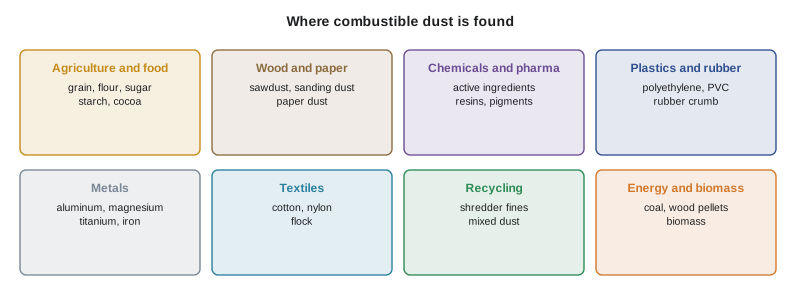
| Industry group | Typical dusts | Typical high-risk equipment |
|---|---|---|
| Agriculture and food | Grain, flour, sugar, starch, cocoa, milk powder, spices | Bucket elevators, mills, spray dryers, silos, sifters |
| Wood and paper | Sawdust, sanding dust, wood flour, paper fibre | Sanders, chippers, cyclones, dust collectors, dryers, pellet mills |
| Chemicals and pharmaceuticals | Active ingredients, resins, pigments, excipients | Fluid bed dryers, mills, blenders, tablet presses |
| Plastics and rubber | Polyethylene, polypropylene, PVC, rubber crumb | Pneumatic conveying, silos, grinders, anti-tack systems |
| Metals | Aluminum, magnesium, titanium, zirconium, iron, zinc | Grinding and polishing, collectors, powder handling, additive manufacturing |
| Textiles | Cotton, nylon, polyester, flock | Carding, cutting, flocking lines, filter systems |
| Recycling | Shredder fines, plastic and paper dust, mixed fines | Shredders, granulators, air separators |
| Energy and biomass | Coal, wood pellets, biomass | Pulverizers, storage silos, conveyors, pellet handling |
Agriculture and food
Grain handling has a long history of dust explosions, and the United States has a specific OSHA standard for grain handling facilities, 29 CFR 1910.272, which covers housekeeping, hot work, bucket elevators and other controls in grain elevators, feed mills, flour mills and similar sites. Flour, sugar, starch, cocoa, milk powder and spices are all explosible in fine form. Spray dryers, which turn liquids such as milk into powder, combine a hot gas stream with a fine dust cloud and are a classic explosion risk. Bucket elevators are another frequent starting point because the buckets keep dust suspended inside a tall enclosed casing, and a misaligned belt or a failed bearing can create friction heat. Bakeries, confectioners and snack food plants may not think of themselves as dust operations, but their ingredient handling areas often are.
Wood and paper
Sawmills, panel plants, furniture and cabinet shops, millwork plants and pellet plants all generate wood dust. Sanding produces the finest and most hazardous dust, while sawing and planing produce larger particles mixed with fines. Dry wood produces more fine dust than green wood, which is one reason the dry, beetle-killed timber processed in British Columbia in 2012 changed the hazard. Paper and tissue mills generate fine paper fibre that accumulates on structures. Wood pellet plants and pellet storage also face self-heating and off-gassing hazards: wood pellets in storage can heat up and give off carbon monoxide, which is a separate hazard that must be considered alongside dust.
Chemicals and pharmaceuticals
Chemical and pharmaceutical plants handle many fine organic powders, some with very low minimum ignition energies. Fluid bed dryers, mills, micronizers, blenders, granulators and tablet presses are common equipment. Many of these processes also use solvents, which can create hybrid mixtures. Some powders are also toxic, which means that dust control serves both explosion prevention and worker health. Lesson 9 covers the static electricity hazards that are particularly important in these plants.
Plastics and rubber
Plastic resins are often delivered as pellets, which are not themselves explosible, but pneumatic conveying wears the pellets and produces fine streamers, angel hair and dust that collect in silos, filters and transfer points. Grinding and recycling scrap plastic produces much more dust. Rubber plants use powders as fillers and anti-tack agents. The West Pharmaceutical explosion described in Lesson 1 involved a polyethylene anti-tack powder.
Metals
Metal dusts deserve special attention. Fine aluminum, magnesium, titanium, zirconium and some other metals can be ignited easily, burn at very high temperatures and often reach the St 3 class. Some react with water to produce hydrogen, so ordinary water-based firefighting can make a metal dust fire worse. Some metal dust fires cannot be extinguished with common extinguishers and need special Class D agents. Metal grinding, polishing, deburring and buffing operations generate fine dust that is often collected in wet or dry collectors. Additive manufacturing (3D printing) with metal powders is a newer source of risk, because fine reactive powders are handled in small workshops and laboratories that may have little experience with combustible dust. NFPA 484, the standard for combustible metals, has been consolidated into NFPA 660 along with the other dust standards, and its metal-specific requirements continue there.
Textiles, recycling and energy
Textile plants generate cotton and synthetic fibre dust, and flocking operations spray fine fibres onto adhesives. Recycling facilities shred and separate mixed materials and generate fines that can include plastics, paper, wood and metal. Coal-fired and biomass-fired power plants, as well as wood pellet export terminals, handle large quantities of combustible solid fuel. Coal dust explosions in underground mines are covered by mining legislation and are outside the scope of this course, but the principles are the same.
Where explosions start: high-risk equipment
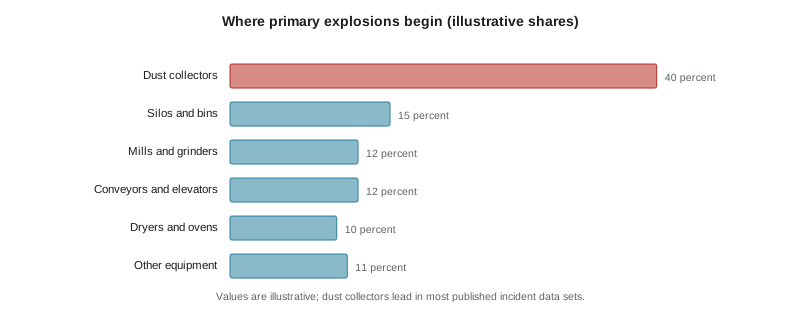
In most incident studies, primary explosions begin inside process equipment rather than in open rooms, because that is where clouds above the minimum explosible concentration exist during normal operation. Dust collectors are the most frequently involved piece of equipment in many incident data sets, followed by equipment such as silos and bins, mills and grinders, dryers, conveyors and bucket elevators. Ducts are a frequent path for flame to travel from one piece of equipment to another, and ultimately into the building. This pattern drives the protection approach in Lessons 8 and 11.
Worked problem
Spotting dust hazards on a walk-through
You visit a small cabinet shop for the first time. It has three table saws, a wide-belt sander, a CNC router, a spray booth for lacquer, and a single dust collector outside the back wall connected by ducts to each machine. You notice fine dust on the window sills and on top of the overhead lights. List the dust hazards you would note and the questions you would ask.
Show solution
- Fuel: wood dust, especially fine sanding dust from the wide-belt sander, is likely explosible.
- Accumulations: dust on window sills and light fixtures shows that dust is escaping and settling on elevated surfaces.
- Equipment: the dust collector and ducts will contain clouds; ask whether the collector has explosion venting and isolation.
- Ignition: ask about sparks from tramp metal in the sander or router, hot work, and electrical equipment near accumulations.
- Hybrid hazard: the spray booth uses flammable lacquer; ask whether wood dust and lacquer overspray can mix in any duct or collector.
- Management: ask whether a dust hazard analysis has been done and how often cleaning happens.
Answer: The shop has fuel, likely clouds in the collector and ducts, settled dust on high surfaces, and possible ignition and hybrid hazards. A dust hazard analysis and a cleaning program are needed.
A recognition checklist
A simple set of questions helps you recognize a combustible dust hazard in any workplace. Does the facility handle any solid material that can burn, including food products, wood, plastics, chemicals or metals? Is any of that material handled in a way that creates fine particles, such as grinding, sanding, cutting, polishing, drying or pneumatic conveying? Is there dust collection, a cyclone, a silo, a dryer or a mill? Does dust escape from equipment and settle on floors, ledges, beams, ducts, light fixtures or above ceilings? Has the dust ever been tested? Have there been any fires in collectors, dryers or ducts? If the answer to the first two questions is yes, the facility should assume it has a combustible dust hazard until a dust hazard analysis shows otherwise.
# A simple screening score for a walk-through (illustrative, not a substitute for a DHA)
questions = {
    "combustible solid handled": True,
    "fines generated (grinding, sanding, drying, conveying)": True,
    "dust collector, cyclone, silo, dryer or mill present": True,
    "visible accumulations on elevated surfaces": True,
    "dust has been tested": False,
    "history of fires in equipment": False,
}
flags = [q for q, yes in questions.items() if yes and q != "dust has been tested"]
print("Indicators present:")
for q in flags:
    print(" -", q)
if questions["combustible solid handled"] and questions["fines generated (grinding, sanding, drying, conveying)"]:
    print("Result: assume a combustible dust hazard exists; a dust hazard analysis is needed.")
if not questions["dust has been tested"]:
print("Action: arrange testing of representative samples.")Indicators present: - combustible solid handled - fines generated (grinding, sanding, drying, conveying) - dust collector, cyclone, silo, dryer or mill present - visible accumulations on elevated surfaces Result: assume a combustible dust hazard exists; a dust hazard analysis is needed. Action: arrange testing of representative samples.
Small operations
Many people assume that only large plants have dust explosions. In fact small shops, bakeries, farms, laboratories and makerspaces can all have the hazard. They often lack the engineering resources and the explosion protection found in larger plants, and the people working in them may never have heard of combustible dust. A small collector connected to a single sander can still produce a fireball, and a small building can be badly damaged. The principles in this course apply regardless of size, although the methods used, such as the depth of the dust hazard analysis, can be scaled.
Questions to ask about a new material
When a facility introduces a new raw material, additive or product, a few questions help decide whether it changes the dust hazard. Is the material combustible, and what does its safety data sheet say about combustible dust? Will it be ground, sanded, dried or conveyed in a way that creates fines? Is it finer, drier or more reactive than the material it replaces? Will it be handled with solvents, creating a possible hybrid mixture? Does it need testing before it is used at full scale? Asking these questions through the management of change process prevents the kind of unassessed change that preceded several of the incidents in Lesson 1.
Common mistakes
MistakeAssuming that plastic pellets cannot cause a dust hazard because pellets are not explosible.
InsteadCheck silos, filters and transfer points for fines and streamers produced by conveying.
MistakeFighting a metal dust fire with water.
InsteadUse agents and procedures suited to the metal; some metal dusts react with water to form hydrogen.
MistakeBelieving only large plants have dust explosion risks.
InsteadApply the same recognition questions to small shops, bakeries, labs and makerspaces.
MistakeFocusing only on the open workroom when looking for hazards.
InsteadLook first at collectors, silos, mills, dryers, conveyors and ducts, where clouds exist during operation.
MistakeOverlooking hybrid hazards where powders and solvents meet.
InsteadIdentify any duct, dryer or collector where dust and flammable vapour can mix.
Summary and key terms
- Combustible dust appears in food, wood, chemicals, plastics, metals, textiles, recycling and energy industries.
- Grain handling in the United States is covered by a specific OSHA standard, 29 CFR 1910.272.
- Dry wood and sanding produce the finest and most hazardous wood dust.
- Metal dusts are often St 3, burn very hot, and some react with water.
- Primary explosions most often begin inside equipment, with dust collectors leading in many data sets.
- Ducts carry flame between equipment and into buildings.
- If a facility handles a combustible solid and generates fines, assume a hazard until a dust hazard analysis shows otherwise.
- Fines
- The smallest particles produced by handling or processing.
- Streamers
- Thin plastic strands produced when pellets rub against pipe walls during conveying.
- Bucket elevator
- An enclosed vertical conveyor that lifts bulk solids in buckets on a belt or chain.
- Spray dryer
- Equipment that dries a liquid into powder by spraying it into a hot gas stream.
- Class D agent
- A fire extinguishing agent designed for combustible metal fires.
- Additive manufacturing
- Building parts layer by layer, sometimes from fine metal or plastic powders.
- Self-heating
- A rise in temperature within a material caused by its own slow oxidation or biological activity.
- Off-gassing
- The release of gases, such as carbon monoxide, from stored materials.
- National Emphasis Program
- An OSHA inspection program that targets a specific hazard across listed industries.
- Pneumatic conveying
- Moving bulk solids through pipes using air or another gas.
Practice problems
Work each problem on paper first, then reveal the answer to check.
Name five industries where combustible dust is common.
Show answer
Food and agriculture, wood and paper, chemicals and pharmaceuticals, plastics and rubber, metals, textiles, recycling, energy.
Which OSHA standard specifically covers grain handling facilities?
Show answer
29 CFR 1910.272.
Why do plastic pellet systems still have dust hazards?
Show answer
Conveying wears pellets and produces fines and streamers that collect in silos and filters.
Why should water not be used on some metal dust fires?
Show answer
Some metals react with water to produce hydrogen, which can make the fire or explosion worse.
Which equipment is most often involved in primary dust explosions?
Show answer
Dust collectors, followed by silos, mills, dryers, conveyors and elevators.
Why are bucket elevators a common starting point?
Show answer
They keep dust suspended inside an enclosed casing, and belt misalignment or bearing failure can cause friction heat.
What extra hazard do wood pellet storage areas have?
Show answer
Self-heating and off-gassing of carbon monoxide.
What two questions show that a facility probably has a dust hazard?
Show answer
Does it handle a combustible solid, and does it generate fines?
Why is metal additive manufacturing a concern?
Show answer
Fine reactive metal powders are handled in small facilities that may lack dust hazard experience.
Where was NFPA 484 consolidated?
Show answer
Into NFPA 660, along with the other combustible dust standards.
Lesson quiz · 5 questions
Score 60% or more to complete this lesson.
Create a free account to save your progress, take quizzes and earn a certificate.