
HSE-312 · Lesson 8 of 12 · 28 min
Compressed gases and cryogenic liquids
Compressed gas cylinders are found in almost every workplace that welds, cuts, heats, brazes, runs a laboratory, serves carbonated drinks, inflates balloons or treats patients. A standard industrial cylinder holds gas at pressures of about 15,000 to 20,000 kPa (about 2,200 to 3,000 psi). If the valve is knocked off, the escaping gas can turn the cylinder into a projectile capable of going through a concrete block wall. Cryogenic liquids such as liquid nitrogen add other hazards: extreme cold and a huge expansion into gas that can displace the oxygen in a room. This lesson covers how to store, secure, segregate and monitor these products. The welding-specific hazards of oxy-fuel equipment are covered in HSE-240.
Hazards of compressed gases
Compressed gases carry two kinds of hazard. The first is the hazard of the gas itself, which appears on the label and SDS: flammable (acetylene, propane, hydrogen, methane), oxidizing (oxygen, nitrous oxide), toxic or corrosive (chlorine, ammonia, carbon monoxide, hydrogen sulfide), or inert but asphyxiating (nitrogen, argon, helium, carbon dioxide). The second is the pressure hazard common to all of them: the cylinder can rupture if heated or damaged, the valve can be sheared off, and a sudden release can whip hoses and regulators around. Under the GHS, gases under pressure have their own hazard class and pictogram, the gas cylinder.
| Gas | Main hazard besides pressure | Storage notes |
|---|---|---|
| Acetylene | Extremely flammable; unstable at high pressure | Store and use upright; keep away from oxygen and heat |
| Propane | Flammable; heavier than air | Store outdoors where possible; never below grade or near drains |
| Hydrogen | Extremely flammable; invisible flame; lighter than air | Ventilate high points; keep away from oxidizers |
| Oxygen | Oxidizer; makes materials burn violently | Keep away from fuel gases, oil and grease |
| Nitrogen, argon, helium | Asphyxiant; displaces oxygen | Ventilate; monitor oxygen in small rooms |
| Carbon dioxide | Asphyxiant and toxic at high concentration; heavier than air | Monitor in cellars and drink dispensing rooms |
| Chlorine, ammonia | Toxic and corrosive | Ventilated gas cabinet or dedicated room; leak detection |
Securing and handling cylinders
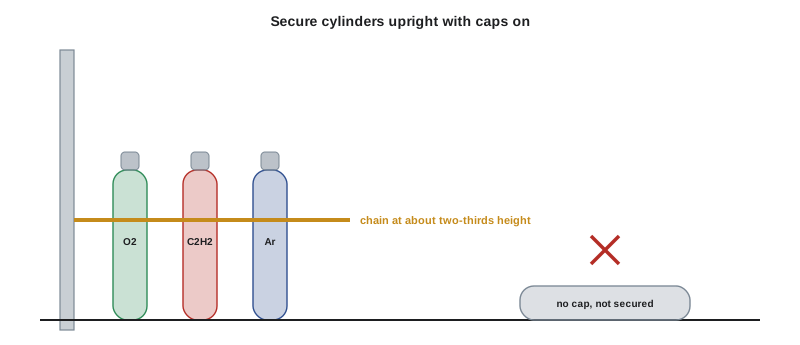
Every cylinder, full or empty, must be secured upright so it cannot fall. The usual method is a chain or strap at about two-thirds of the cylinder height, fastened to a wall, a bench or a purpose-built rack, with no more than a few cylinders per chain so that each is held firmly. Floor stands and cylinder carts with restraints are also acceptable. Valve protection caps must be in place whenever a cylinder is not connected for use, including when it is stored or moved. Move cylinders only on a proper cylinder cart with the cylinder chained; never roll them on their sides, drag them, or lift them by the cap.
Store cylinders in a well-ventilated, dry area away from heat sources, direct sunlight, electrical circuits, and areas where they could be struck by vehicles or falling objects. Many suppliers and the Compressed Gas Association advise that cylinders should not be exposed to temperatures above about 52 °C (125 °F). Keep full and empty cylinders in separate, clearly marked areas, and mark empty cylinders as empty. Close valves on empty cylinders to keep out moisture and contamination.
Segregating gas cylinders
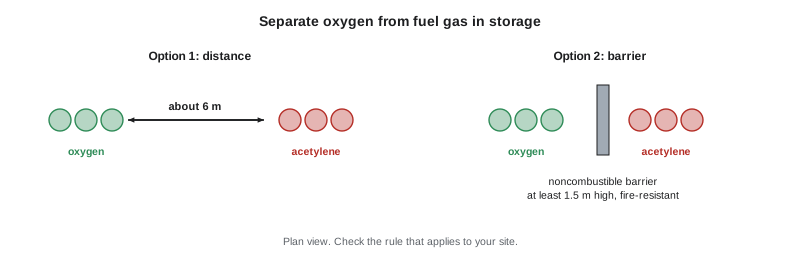
Gas cylinders follow the same compatibility logic as other chemicals. Oxidizing gases, especially oxygen, must be separated from flammable gases. Toxic and corrosive gases should be stored apart from both, ideally in ventilated gas cabinets. Inert gases can generally be stored with any group, but they still need ventilation.
In Canada, provincial occupational health and safety regulations, the fire codes based on the National Fire Code, and CSA W117.2, Safety in welding, cutting and allied processes, set requirements for separating oxygen from fuel gas cylinders in storage. These are typically a separation distance of about 6 m or a non-combustible barrier at least 1.5 m high with a fire-resistance rating, similar to the US rule. Check the edition of CSA W117.2 and the provincial regulation that apply to your site for exact wording.
Acetylene cylinders contain acetylene dissolved in acetone inside a porous filler. They must always be stored and used upright, because acetone can be drawn out through the valve if the cylinder lies on its side. Hydrogen and other lighter-than-air gases rise and collect at ceilings; propane, carbon dioxide and many other gases are heavier than air and collect in basements, pits and trenches. Ventilation and gas detection must be placed accordingly.
Cryogenic liquids
Cryogenic liquids are gases cooled until they become liquid, at temperatures below about −150 °C (−238 °F). Liquid nitrogen boils at −196 °C (−321 °F), liquid oxygen at −183 °C (−297 °F), liquid argon at −186 °C (−303 °F) and liquid helium at −269 °C (−452 °F). They are stored in insulated containers called dewars or cryogenic cylinders, which are designed to vent gas continuously as the liquid slowly boils. Workplaces use them for freezing biological samples, cooling equipment such as MRI magnets, food processing, and in welding and metal fabrication supply.
The hazards of cryogenic liquids are: severe cold burns and frostbite on contact with skin or eyes; embrittlement of materials such as carbon steel, rubber and plastics, which can shatter; pressure build-up if the venting system is blocked or a container is sealed; and oxygen deficiency as the liquid boils into a large volume of gas. Liquid nitrogen expands about 694 times when it vaporizes and warms to room temperature. Liquid oxygen adds a fire hazard because it can saturate clothing and materials, making them highly flammable.
Oxygen deficiency
Normal air contains about 20.9 per cent oxygen by volume. Many Canadian provincial regulations, and CSA Z1006 for confined spaces, treat an atmosphere with less than 19.5 per cent oxygen as oxygen deficient and hazardous. Below about 16 per cent, people suffer impaired judgement and coordination; below about 10 per cent, they can lose consciousness in seconds without warning. Nitrogen, argon and helium have no smell, so people cannot sense the danger.
# Estimate worst-case oxygen after a liquid nitrogen release into a closed room.
# Assumes the gas mixes evenly and displaces air; no ventilation. Illustrative only.
EXPANSION = 694           # approximate LN2 liquid-to-gas ratio at room temperature
room = (4.0, 3.0, 2.5)    # length, width, height in m
room_vol = room[0] * room[1] * room[2]
for liquid_L in (5, 10, 25, 50):
    gas_m3 = liquid_L / 1000 * EXPANSION
    o2 = 20.9 * max(room_vol - gas_m3, 0) / room_vol
    flag = "DANGER" if o2 < 19.5 else "ok"
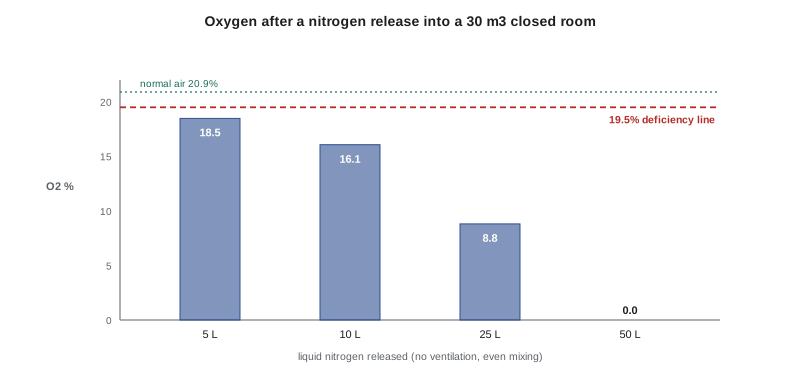
print(f"{liquid_L:3d} L LN2 -> {gas_m3:5.1f} m3 gas -> O2 about {o2:4.1f}% {flag}")5 L LN2 -> 3.5 m3 gas -> O2 about 18.5% DANGER 10 L LN2 -> 6.9 m3 gas -> O2 about 16.1% DANGER 25 L LN2 -> 17.4 m3 gas -> O2 about 8.8% DANGER 50 L LN2 -> 34.7 m3 gas -> O2 about 0.0% DANGER
The estimate shows how quickly a small room becomes dangerous. In a 30 m³ room (about 1,060 ft³), releasing only 5 L (about 1.3 gal) of liquid nitrogen could lower the oxygen level below 19.5 per cent if there were no ventilation, and a 50 L dewar emptying completely would leave a lethal atmosphere. Real rooms have some ventilation and gas does not mix perfectly, so the actual result could be better or worse, especially near the floor where cold nitrogen pools. This is why rooms that store or fill cryogenic liquids or large inert gas supplies need adequate ventilation and fixed oxygen monitors with alarms outside the door.
Storing and moving cryogenic containers
Store dewars and cryogenic cylinders upright in well-ventilated areas, never in closets, small offices, walk-in coolers or freezers. Do not seal them or block relief valves. Move larger containers with carts designed for them. Never travel in an elevator with a dewar of liquid nitrogen: if the elevator stops between floors, the gas released can make the air in the car deadly. Instead, send the dewar unaccompanied with a sign, and have someone meet it at the destination floor. Wear a face shield, safety glasses, loose cryogenic gloves and a long-sleeved lab coat or apron when filling or pouring cryogenic liquids.
Worked problem
A sample freezer room
A research centre has a 20 m³ room (about 700 ft³) with no windows, containing four liquid nitrogen freezers and two 180 L supply dewars. Staff fill small dewars there. What controls are needed?
Show solution
- Estimate the potential release: one 180 L dewar holds about 125 m³ of gas when vaporized, far more than the room volume. A large leak could make the room lethal.
- Install mechanical ventilation sized for the hazard, with exhaust near the floor where cold nitrogen collects.
- Install a fixed oxygen monitor with audible and visual alarms inside and outside the door, set to alarm at 19.5 per cent.
- Post signs at the door warning of oxygen deficiency and showing the alarm meaning.
- Train staff to leave immediately on alarm and never enter to rescue someone without proper equipment.
- Consider moving the large supply dewars to a ventilated area or outside wall, or using a bulk tank outside the building.
Answer: Ventilation, a fixed oxygen monitor with alarms, signs, training and, if possible, relocating the supply dewars.
Inspecting cylinders and gas storage areas
A short monthly inspection of cylinder storage catches most problems before they cause harm. Check that every cylinder is secured, that valve caps are on stored cylinders, that labels and contents markings are legible, and that cylinders show no dents, bulges, corrosion, fire damage or arc burns from welding leads. Do not accept or use a cylinder whose contents cannot be identified; colour alone is not a reliable identifier, because colour codes vary between suppliers and countries. Return damaged or unidentified cylinders to the supplier. Check that full and empty cylinders are separated and marked, that oxygen and fuel gases are separated, that the area is free of oil, grease and combustibles, and that signs and ventilation are in place.
Leaking cylinders need a calm, planned response. For a small leak of an inert gas in a well-ventilated area, closing the valve may be enough. For a leak of a flammable, toxic or corrosive gas, or any leak that cannot be stopped by closing the valve, evacuate the area, remove ignition sources if it is safe to do so, and call the emergency number and the supplier. Never try to repair a cylinder valve yourself. Toxic gas cylinders, such as chlorine or ammonia, should be stored where leak detection and alarms give early warning, and only trained responders with the right equipment should approach a leak.
Worked problem
Lowering the risk in a small welding shop
A small welding shop keeps two oxygen and two acetylene cylinders on a cart beside the bench, plus six spare cylinders free-standing against the back wall near a parts washer. What should change?
Show solution
- Chain the spare cylinders upright to a wall rack with caps on.
- Separate spare oxygen from spare acetylene by the required distance or a fire-resistant barrier.
- Move the parts washer and any oily rags away from the oxygen cylinders.
- Mark full and empty cylinders and keep them in separate areas.
- Keep the cart cylinders secured and close valves at the end of each shift.
Answer: Secure and cap the spares, separate oxygen from acetylene, remove combustibles and mark full and empty cylinders.
Common mistakes
MistakeLeaving cylinders free-standing because they are only there for a short time.
InsteadSecure every cylinder upright with a chain or strap at all times.
MistakeStoring oxygen next to acetylene on the same cart for convenience.
InsteadSeparate by the required distance or barrier when in storage; carts for use must be designed for both.
MistakeRiding in an elevator with a dewar of liquid nitrogen.
InsteadSend the dewar unaccompanied with a sign and meet it at the destination.
MistakeKeeping a dewar in a closet or small office.
InsteadStore cryogenic containers in ventilated areas with oxygen monitoring if needed.
MistakeRemoving valve caps from stored cylinders.
InsteadKeep caps on whenever cylinders are not connected for use.
Summary and key terms
- Compressed gas cylinders have both the hazard of the gas and the hazard of high pressure.
- Secure cylinders upright with chains or straps, keep caps on, and move them only on proper carts.
- Separate oxygen from fuel gases by distance or a fire-resistant barrier as required by provincial rules, the fire code and CSA W117.2.
- Acetylene must be stored and used upright.
- Cryogenic liquids cause cold burns, embrittlement, pressure build-up and oxygen deficiency; liquid nitrogen expands about 694 times.
- Oxygen-deficient atmospheres have less than 19.5 per cent oxygen; inert gases give no warning.
- Rooms storing cryogens or large inert gas supplies need ventilation and oxygen monitors.
- Compressed gas
- A gas stored under pressure in a cylinder.
- Valve protection cap
- A cap that protects the cylinder valve from damage.
- Fuel gas
- A flammable gas used for heating or cutting, such as acetylene or propane.
- Cryogenic liquid
- A gas cooled to a liquid below about −150 °C (−238 °F).
- Dewar
- An insulated container for cryogenic liquids.
- Expansion ratio
- The volume of gas produced by a unit volume of liquid.
- Asphyxiant
- A gas that displaces oxygen and causes suffocation.
- Oxygen-deficient atmosphere
- Air containing less than 19.5 per cent oxygen.
- Embrittlement
- Loss of toughness in materials at very low temperatures.
- Gas cabinet
- A ventilated enclosure for toxic or reactive gas cylinders.
Practice problems
Work each problem on paper first, then reveal the answer to check.
What are the two kinds of hazard of a compressed gas cylinder?
Show answer
The hazard of the gas itself and the pressure hazard.
Where should a securing chain be placed on a cylinder?
Show answer
At about two-thirds of the cylinder height.
Why must acetylene be stored upright?
Show answer
Acetone can be drawn out through the valve if it lies on its side.
What separation is typical between oxygen and fuel gas cylinders in Canada?
Show answer
About 6 m, or a non-combustible barrier at least 1.5 m high with a fire-resistance rating; check CSA W117.2 and provincial rules.
What is the boiling point of liquid nitrogen?
Show answer
About −196 °C (−321 °F).
About how many times does liquid nitrogen expand when it vaporizes?
Show answer
About 694 times.
Below what oxygen level is air considered oxygen deficient?
Show answer
19.5 per cent.
Why should you not ride in an elevator with a dewar of liquid nitrogen?
Show answer
If the elevator stops, released nitrogen could create a deadly atmosphere.
Where should exhaust be placed in a liquid nitrogen room?
Show answer
Near the floor, where cold nitrogen collects.
What protective equipment is needed when pouring cryogenic liquids?
Show answer
Face shield, safety glasses, loose cryogenic gloves and a long-sleeved coat or apron.
Lesson quiz · 5 questions
Score 60% or more to complete this lesson.
Create a free account to save your progress, take quizzes and earn a certificate.