
HSE-312 · Lesson 10 of 12 · 27 min
Eyewashes, showers and first response
Even with good storage and careful transfers, chemicals will sometimes reach people's eyes or skin. When that happens, the first 10 to 15 seconds matter more than anything that follows. Corrosives can cause permanent eye damage within seconds, and the single most effective first aid is immediate, prolonged flushing with large amounts of clean, tepid water. This lesson covers emergency eyewash and shower equipment, where to put it, how to test and maintain it, how to choose protective gloves for chemical handling, and the first steps after a chemical exposure. General first aid training is outside the scope of this course; spill response is covered in HSE-104.
Why immediate flushing matters
Acids coagulate the proteins of the eye surface, which can limit how deep they penetrate. Alkalis such as sodium hydroxide and ammonia dissolve fats and proteins and keep penetrating, so an alkali splash can cause deeper and more lasting injury, even if it hurts less at first. In both cases, the aim of flushing is to dilute and wash the chemical away as fast as possible. Delays of even a minute while someone looks for water, takes off safety glasses or walks to a distant washroom can be the difference between a full recovery and permanent damage.
Do not try to neutralize a chemical on the skin or in the eyes with another chemical. The heat of neutralization adds injury, and finding the right neutralizer wastes time. Water is the right answer for nearly every chemical splash. The exceptions are rare and product-specific: for example, hydrofluoric acid needs calcium gluconate gel after flushing, and a few reactive metals such as sodium should be brushed off before flushing. These exceptions appear in SDS section 4 and must be part of the training for anyone working with those products.
Standards for emergency eyewash and shower equipment
In Canada, provincial occupational health and safety regulations require emergency washing facilities where workers may be exposed to substances that can injure the eyes or skin; Ontario's regulation for industrial establishments (Regulation 851) is one example. Most provinces and employers use ANSI/ISEA Z358.1, American National Standard for Emergency Eyewash and Shower Equipment, as the technical standard for design, installation and testing. The current edition is Z358.1-2014, reaffirmed in 2020 (checked October 2026).
ANSI/ISEA Z358.1 sets requirements for several types of equipment: plumbed and self-contained eyewashes, eye/face washes, drench showers, combination units that provide both, and supplemental equipment such as drench hoses and personal wash bottles. Personal wash bottles can support but never replace a plumbed or self-contained unit, because they cannot deliver the required flow for the full flushing period.
| Requirement | Eyewash | Drench shower |
|---|---|---|
| Minimum flow | 1.5 L/min (0.4 gpm) | 75.7 L/min (20 gpm) |
| Duration | 15 minutes | 15 minutes |
| Flushing fluid temperature | Tepid: 16 °C to 38 °C | Tepid: 16 °C to 38 °C |
| Activation | One motion, on in 1 second or less, stays on hands-free | One motion, on in 1 second or less, stays on |
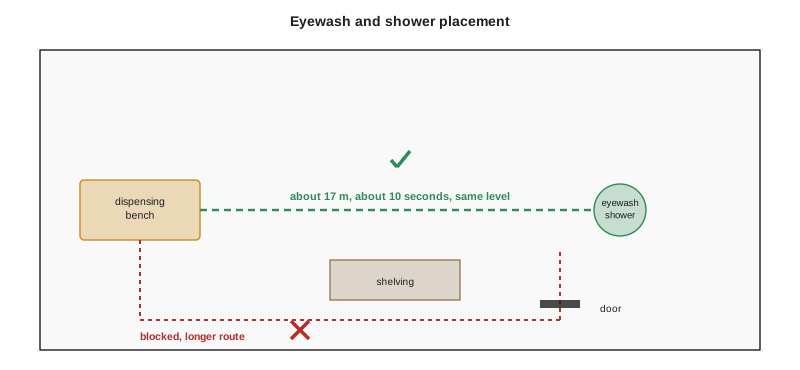
| Location | Reachable in about 10 seconds, on the same level, unobstructed path | Reachable in about 10 seconds, on the same level, unobstructed path |
| Testing | Activate weekly; inspect annually | Activate weekly; inspect annually |
The 10-second reach requirement is often translated into a distance of about 17 m (55 ft), based on a normal walking speed, but the standard is written in time, not distance. Someone who has just been splashed in the eyes cannot see well and may be in pain, so the path must be straight, clear of obstacles and doors where possible, and on the same level, with no stairs or ramps to negotiate. Where workers handle strong acids or caustics, the standard's appendix advises placing the equipment immediately adjacent to the hazard. The unit should be marked with a highly visible sign and the area around it well lit.
# Check eyewash reach time and flushing water needs for a planned layout.
WALK_M_PER_S = 1.7          # typical brisk walking speed, illustrative
paths_m = {"dispensing bench": 9.0, "battery charging bay": 16.0, "far storeroom shelf": 24.0}
for spot, d in paths_m.items():
    t = d / WALK_M_PER_S
    print(f"{spot:22s} {d:5.1f} m  about {t:4.1f} s  {'OK' if t <= 10 else 'TOO FAR - add a unit'}")

# Water needed for one full 15-minute activation (ANSI/ISEA Z358.1 minimum flows).
eyewash_L = 1.5 * 15
shower_L = 75.7 * 15
print(f"Eyewash, 15 min: {eyewash_L:.1f} L")
print(f"Shower, 15 min: {shower_L:.0f} L")dispensing bench 9.0 m about 5.3 s OK battery charging bay 16.0 m about 9.4 s OK far storeroom shelf 24.0 m about 14.1 s TOO FAR - add a unit Eyewash, 15 min: 22.5 L Shower, 15 min: 1136 L
The check shows that the far storeroom shelf is too far from the planned unit, so a second unit, or a better location, is needed. It also shows why tepid water supply matters: a drench shower uses more than 1,100 L (about 300 gal) in 15 minutes, which can drain a small water heater or deliver dangerously cold water from an outdoor line in winter. Many sites use a thermostatic mixing valve to keep the water tepid. Self-contained eyewash stations must hold enough fluid for the full 15 minutes and must have their fluid replaced on the manufacturer's schedule.
Testing and maintenance
Plumbed units should be activated weekly long enough to verify that flushing fluid is supplied and to clear sediment and bacteria from the supply line. Annual inspections should confirm that the unit meets all of the standard's requirements, including flow, temperature, height, location and signage. Keep a tag or log at each unit showing who tested it and when. During weekly tests, also check that caps on eyewash heads are in place, that the area is clear, and that nothing has been stored in front of the unit.
Chemical-protective gloves
Gloves are the most common protective equipment for chemical handling, and also the most commonly chosen badly. No single glove material resists every chemical. Chemicals can pass through glove material by permeation, a molecular process that can happen without any visible damage, as well as by degradation, where the glove swells, softens or cracks, and by penetration through holes or seams. Manufacturers publish breakthrough times, the time it takes a chemical to be detected on the inside of the glove under test conditions. Always check the manufacturer's chart for the specific chemical and glove model, because glove thickness and formulation vary.
| Chemical family | Generally good | Generally poor |
|---|---|---|
| Ketones (acetone, MEK) | Butyl rubber | Nitrile, natural rubber, PVC |
| Aromatic solvents (toluene, xylene) | Viton (fluoroelastomer), laminate film | Natural rubber, nitrile for long contact, butyl |
| Aliphatic solvents (mineral spirits, gasoline) | Nitrile, Viton | Natural rubber, butyl |
| Alcohols (ethanol, isopropyl) | Nitrile, butyl, neoprene | Natural rubber for long contact |
| Inorganic acids (dilute) | Nitrile, neoprene, butyl | Thin disposable gloves for long contact |
| Bases (sodium hydroxide) | Nitrile, neoprene, butyl | Thin disposable gloves for long contact |
| Hydrofluoric acid | Thick neoprene or nitrile rated for HF | Thin disposable gloves |
Thin disposable nitrile gloves are good for incidental splash protection with many chemicals but are not suitable for immersion or prolonged contact with solvents such as acetone, which can break through in less than a minute. When a disposable glove is splashed, remove it and replace it promptly. For heavier work, choose a thicker glove of the right material, and inspect it for damage before each use. PPE selection in general is covered in HSE-102.
First steps after an exposure
When someone is splashed, the first responders are usually co-workers. Training everyone who works near chemicals to act quickly is more important than any equipment specification. The steps below follow common first aid guidance; the product SDS section 4 gives the specific measures for each chemical.
- Get the person to the eyewash or shower immediately and help them use it; they may not be able to see.
- Hold the eyelids open and roll the eyes so water reaches all surfaces. Remove contact lenses if they come out easily, but do not delay flushing to do so.
- Remove contaminated clothing, shoes and jewellery while under the shower.
- Flush for at least 15 minutes, or longer if the SDS or a medical adviser says so, which is common for alkalis.
- Call for medical help or the poison centre and have the SDS ready to send with the person.
- Report the incident and investigate why the exposure happened.
Worked problem
A battery acid splash
A forklift technician topping up a lead-acid battery is splashed in the face with sulfuric acid. The nearest eyewash is a wall-mounted bottle station; the plumbed eyewash is in a washroom 40 m (about 130 ft) away through two doors. What should happen now, and what should change?
Show solution
- Now: use the bottle station only to start flushing immediately, while a co-worker guides the technician to the nearest plumbed eyewash or shower.
- Flush for at least 15 minutes, holding the eyelids open, and call for medical help with the SDS.
- After: install a plumbed or self-contained eyewash meeting ANSI/ISEA Z358.1 within 10 seconds of the battery charging area, on the same level with a clear path.
- Add face shields and splash goggles to the battery charging procedure, and use a battery watering system to avoid open pouring.
- Set up weekly activation and an annual inspection for the new unit.
Answer: Start flushing at once and get to proper equipment; then install a compliant unit at the battery bay and improve the procedure.
Other emergency equipment near storage
Eyewashes and showers are the most important emergency equipment for chemical splashes, but storage areas usually need a few other items close by. A spill kit matched to the products stored, with absorbents, neutralizers where appropriate, bags, a scoop and protective equipment, lets trained workers contain small spills before they spread. Portable fire extinguishers of the right class, typically Class B for flammable liquids and often multipurpose ABC units, must be mounted where people can reach them without passing the hazard. A phone or radio and a posted list of emergency numbers, including the poison centre, make it possible to call for help quickly. Many sites also keep a printed or offline copy of SDSs near the storage area, so responders can find first aid and firefighting information even if the network is down.
All of this equipment must be inspected on a schedule. Extinguishers are typically checked monthly and serviced annually, spill kits restocked after use and checked during regular inspections, and emergency contact lists updated when people or numbers change. A simple combined checklist for each storage area keeps these checks together with the weekly eyewash activation, so that nothing is missed.
Worked problem
Planning emergency equipment for a new dispensing room
A plant is building a small room where operators will dispense concentrated sodium hydroxide and sulfuric acid from totes into smaller containers. What emergency equipment should be planned?
Show solution
- A combination eyewash and drench shower meeting ANSI/ISEA Z358.1, placed immediately adjacent to the dispensing point because strong corrosives are handled.
- A tepid water supply with a thermostatic mixing valve, and a floor drain or containment designed so shower water does not spread spilled chemicals.
- A spill kit with absorbents and neutralizers suitable for acids and bases, kept outside the immediate splash zone.
- Chemical splash goggles, face shields, gloves and aprons rated for both chemicals, stored at the entrance.
- Posted SDSs, emergency numbers and weekly test tags for the eyewash and shower.
Answer: An adjacent combination unit with tepid water, containment, a suitable spill kit, rated PPE and posted information.
Common mistakes
MistakeRelying on wall-mounted bottle stations as the only eyewash.
InsteadUse plumbed or self-contained units meeting ANSI/ISEA Z358.1; bottles are supplemental.
MistakeTrying to neutralize an acid splash with a base.
InsteadFlush with plenty of tepid water; follow SDS section 4 for exceptions.
MistakePlacing the eyewash behind a door or up a short flight of stairs.
InsteadPlace it on the same level, reachable in about 10 seconds with an unobstructed path.
MistakeUsing thin nitrile gloves for long contact with acetone.
InsteadChoose a glove material such as butyl with a suitable breakthrough time.
MistakeNever testing the eyewash.
InsteadActivate plumbed units weekly and inspect annually.
Summary and key terms
- Immediate flushing with large amounts of tepid water is the most important first aid for chemical splashes.
- Alkalis penetrate deeper than acids; do not try to neutralize chemicals on skin or eyes.
- Provincial regulations require emergency washing facilities; ANSI/ISEA Z358.1-2014 (R2020) is the technical standard.
- Eyewashes need at least 1.5 L/min (0.4 gpm) and showers 75.7 L/min (20 gpm) of tepid water for 15 minutes.
- Units must be reachable in about 10 seconds on an unobstructed path, activated weekly and inspected annually.
- Choose gloves by chemical using manufacturer breakthrough data; thin disposables are for splashes only.
- Train everyone to act fast: flush, remove clothing, call for help and bring the SDS.
- Eyewash
- A device that flushes both eyes with a controlled flow of water.
- Drench shower
- An overhead shower that drenches the whole body.
- Tepid
- Flushing fluid between 16 °C and 38 °C (60 °F and 100 °F).
- ANSI/ISEA Z358.1
- The American National Standard for emergency eyewash and shower equipment.
- Self-contained unit
- An eyewash with its own fluid supply, not connected to plumbing.
- Supplemental equipment
- Personal wash bottles or drench hoses that support but do not replace primary units.
- Permeation
- Movement of a chemical through glove material at the molecular level.
- Breakthrough time
- The time for a chemical to be detected inside a glove under test.
- Degradation
- Physical damage to glove material caused by a chemical.
- Thermostatic mixing valve
- A valve that blends hot and cold water to keep flushing fluid tepid.
Practice problems
Work each problem on paper first, then reveal the answer to check.
Why are alkali splashes often worse than acid splashes?
Show answer
Alkalis keep penetrating tissue, while acids tend to coagulate proteins at the surface.
What is the minimum flushing time under ANSI/ISEA Z358.1?
Show answer
15 minutes.
What is the minimum eyewash flow?
Show answer
1.5 L/min (0.4 gpm).
What is the minimum drench shower flow?
Show answer
75.7 L/min (20 gpm).
What temperature range is tepid?
Show answer
16 °C to 38 °C (60 °F to 100 °F).
How quickly must an eyewash be reachable?
Show answer
In about 10 seconds, on the same level with an unobstructed path.
How often should plumbed units be activated?
Show answer
Weekly.
Why can a personal wash bottle not replace a plumbed eyewash?
Show answer
It cannot deliver the required flow for 15 minutes.
Which glove material is generally good for acetone?
Show answer
Butyl rubber.
What extra first aid does hydrofluoric acid need?
Show answer
Calcium gluconate gel after flushing, and urgent medical care.
Lesson quiz · 5 questions
Score 60% or more to complete this lesson.
Create a free account to save your progress, take quizzes and earn a certificate.