
HSE-312 · Lesson 7 of 12 · 27 min
Corrosives, oxidizers, reactives and peroxide formers
Flammable liquids get most of the attention in fire codes, but many serious chemical storage incidents involve other groups: corrosives that eat through containers and shelving, oxidizers that turn ordinary combustibles into fierce fires, reactive chemicals that decompose or explode, and peroxide-forming chemicals that become shock-sensitive as they age. This lesson covers how to store each of these groups safely. The chemistry behind them is covered in CHEM-101 and CHEM-102; here the focus is on containers, locations, inspection and time limits.
Corrosives
Corrosives are acids and bases that damage skin, eyes and metals. In storage, their main hazards are container failure, fumes that corrode shelving, cabinets and nearby equipment, and violent reactions with incompatible chemicals. Common workplace corrosives include sulfuric acid (battery acid, drain openers), hydrochloric acid (muriatic acid, concrete etch), phosphoric acid (rust removers), sodium hydroxide (caustic soda, oven and drain cleaners), potassium hydroxide, and ammonia solutions.
Store corrosives in their original containers or in containers made of a compatible material. Most acids and bases are stored in polyethylene; hydrofluoric acid must never be stored in glass because it dissolves silica. Keep them in corrosion-resistant cabinets or on low shelves in trays, with acids separated from bases. Keep oxidizing acids (nitric, perchloric, chromic) apart from organic acids and from all organics. Inspect containers regularly for bulging, cracking, crystal build-up around caps, and discoloured labels, which are signs of slow leaks or fumes.
| Corrosive | Storage notes | Keep away from |
|---|---|---|
| Sulfuric acid (concentrated) | Absorbs moisture; reacts with water releasing heat | Bases, water-reactives, organics, metals |
| Hydrochloric acid | Fumes corrode metal shelving and equipment | Bases, oxidizers, hypochlorite, cyanides, sulfides, active metals |
| Nitric acid | Strong oxidizer; yellows with age | Organic acids, solvents, metals powders, bases |
| Hydrofluoric acid | Plastic containers only; special first aid | Glass, bases, metals; keep calcium gluconate nearby |
| Glacial acetic acid | Flammable (flash point about 39 °C or 102 °F) and corrosive | Oxidizing acids, oxidizers, bases |
| Sodium hydroxide | Absorbs moisture and carbon dioxide; solutions attack aluminum | Acids, aluminum, zinc, organic halogen compounds |
| Ammonia solution | Releases ammonia gas when warm | Hypochlorite, acids, halogens, oxidizers |
Oxidizers
Oxidizers supply oxygen or accept electrons, so they make other materials burn more intensely and can start fires on their own when they contact combustibles. They are not usually flammable themselves, which leads people to underestimate them. Common workplace oxidizers include hydrogen peroxide solutions, calcium and sodium hypochlorite, nitrates (ammonium nitrate, potassium nitrate), chlorates and perchlorates, permanganates, dichromates, and pool shock products.
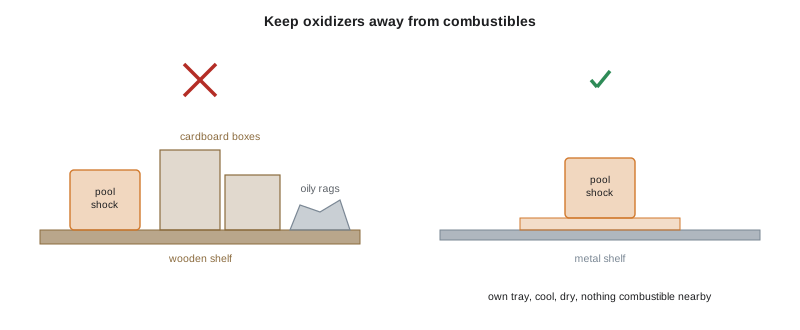
Store oxidizers in a cool, dry place away from flammables, combustibles, reducing agents, organic materials and anything that might fuel a fire. That includes wooden shelves, cardboard boxes, paper, oily rags and sawdust. Oxidizer spills absorbed with sawdust or paper towels can ignite. Use inert absorbents such as sand or vermiculite listed on the SDS. Keep large quantities of oxidizers, especially solid ones such as ammonium nitrate and calcium hypochlorite, in dedicated areas and limit the amount on hand.
Fire codes classify oxidizers by how strongly they promote combustion, using classes 1 to 4 in NFPA 400 and the fire codes based on it, and by GHS categories 1 to 3 for oxidizing solids and liquids in hazard communication. Higher classes have tighter quantity limits and stricter separation requirements. The 2020 port explosion in Beirut, where about 2,750 metric tons of ammonium nitrate stored for years in a warehouse alongside other goods detonated after a fire, and the 2015 Tianjin port explosions, which killed 173 people, are extreme reminders of what happens when large quantities of oxidizers and reactive chemicals are stored without proper segregation and control.
Reactive and unstable chemicals
Reactive chemicals are those that can undergo violent reactions on their own or with common triggers. The GHS covers several such hazard classes: self-reactive substances, organic peroxides, pyrophoric liquids and solids that ignite in air, self-heating substances, substances that release flammable gas in contact with water, and explosives. In workplaces outside chemical manufacturing, the most common reactives are organic peroxides (resin hardeners), water-reactive metals (sodium, potassium, lithium), metal hydrides, calcium carbide, and pyrophoric reagents in research laboratories.
Storage rules for reactives are strict and product-specific. Keep quantities to the minimum. Follow the temperature range in SDS section 7; some organic peroxides must be kept refrigerated in a spark-free refrigerator. Keep water-reactive and pyrophoric materials in sealed containers under inert gas or oil as supplied, away from water sources and sprinklers where possible, and inform the fire department. Store them in a dedicated cabinet with a sign. Never return unused material to the original container, because contamination can trigger decomposition.
The 2008 death of Sheri Sangji, a research assistant at the University of California, Los Angeles, followed a fire when the pyrophoric reagent tert-butyllithium ignited as she transferred it with a syringe. She was not wearing a lab coat. The case led to criminal charges and to major changes in laboratory safety programs in the United States, and it shows that the transfer of reactive materials is as important as their storage. Transfers are covered in lesson 9 and laboratory practices in lesson 11.
Peroxide-forming chemicals
Some common solvents and reagents react slowly with oxygen in air to form organic peroxides, which can accumulate as crystals around the cap or in the liquid, especially if the solvent evaporates or is distilled. These peroxides can explode when the container is opened, shaken or heated. The classic examples are diethyl ether, tetrahydrofuran (THF), 1,4-dioxane and isopropyl ether. Peroxide formation is speeded by light, heat, air in the headspace and the removal of inhibitors.
| Group | Hazard | Examples | Typical guideline |
|---|---|---|---|
| A | Form explosive peroxides without concentration | Isopropyl ether, potassium metal, sodium amide | Test or dispose 3 months after opening |
| B | Become hazardous when concentrated by evaporation or distillation | Diethyl ether, THF, 1,4-dioxane, cyclohexene | Test or dispose 12 months after opening |
| C | Can polymerize violently when peroxides form | Styrene, vinyl acetate, methyl methacrylate (uninhibited) | Test or dispose 6 to 12 months after opening, depending on inhibitor |
Good practice for peroxide formers is to buy small containers, date them when received and when opened, store them in the dark in tightly closed containers, keep inhibitors in place, test for peroxides at set intervals with test strips, and dispose of containers before they reach their time limit. A container that is past its date, has visible crystals around the cap, or has an unknown history should not be opened or moved. Leave it in place, keep people away and call a specialist hazardous waste contractor or the local bomb disposal unit, as advised by your safety office.
# Flag peroxide formers that are due for testing or disposal.
from datetime import date
today = date(2026, 10, 19)
limits_days = {"A": 90, "B": 365, "C": 180}   # guideline days after opening
stock = [
    ("diethyl ether 1 L",   "B", date(2025, 9, 3)),
    ("THF 4 L",             "B", date(2026, 6, 1)),
    ("isopropyl ether 500 mL", "A", date(2026, 6, 20)),
    ("styrene 1 L",         "C", date(2026, 2, 1)),
]
for name, grp, opened in stock:
    age = (today - opened).days
    due = limits_days[grp]
    status = "OVERDUE - do not open; arrange disposal" if age > due else f"ok, {due - age} days left"
print(f"{name:24s} group {grp} opened {age:3d} days {status}")diethyl ether 1 L group B opened 411 days OVERDUE - do not open; arrange disposal THF 4 L group B opened 140 days ok, 225 days left isopropyl ether 500 mL group A opened 121 days OVERDUE - do not open; arrange disposal styrene 1 L group C opened 260 days OVERDUE - do not open; arrange disposal
The check flags the ether, which is more than a year past opening, and the isopropyl ether, a group A former that is past three months. Both need specialist assessment rather than routine handling. Building this check into an inventory system with opening dates is one of the simplest ways to prevent peroxide incidents.
Worked problem
A forgotten ether bottle
During a storeroom clean-out at a college, a technician finds a half-empty, rusty-capped 500 mL bottle of diethyl ether with no opening date and a label from 2009. What should happen?
Show solution
- Do not open, shake or move the bottle. Treat it as possibly shock-sensitive.
- Keep people away from the area and put up a sign.
- Report it to the supervisor and the safety office immediately.
- Arrange assessment and removal by a specialist hazardous waste contractor or, if advised, the police bomb disposal unit.
- Afterwards, review the inventory and dating system so peroxide formers are tracked and disposed of on time.
Answer: Leave it untouched, isolate the area and call specialists; then fix the inventory system.
Other groups needing special attention
Toxic and very toxic chemicals, including cyanides, arsenic compounds, mercury and its compounds, and some pesticides, need locked storage with limited access and careful inventory, both to protect workers and to prevent theft. Carcinogens, mutagens and reproductive toxicants should be in clearly labelled areas with designated handling procedures. Some chemicals are also controlled for security reasons; in the United States, the Chemical Facility Anti-Terrorism Standards (CFATS) program lapsed in July 2023 when Congress did not reauthorize it; bills to restore it have been introduced since, so facilities should check the current status with the Cybersecurity and Infrastructure Security Agency (CISA) (checked October 2026). In Canada, explosives precursors and some chemicals are regulated under the Explosives Act and its regulations. Keep security-sensitive materials locked and reconcile their inventory.
Quantity, time and temperature
Three variables decide how dangerous most reactive and special-group chemicals become in storage: how much is present, how long it has been there, and how warm it gets. Reducing any of them reduces the hazard. Quantity is controlled by purchasing small containers and limiting stock to what is needed for a few months. Time is controlled by dating containers on receipt and opening and by disposing of them before their recommended limits, as shown for peroxide formers. Temperature is controlled by storing away from heat sources and sunlight and, for some products such as organic peroxides, in temperature-controlled storage with an alarm.
| Group | Quantity control | Time control | Temperature control |
|---|---|---|---|
| Organic peroxides | Small kits, minimum stock | Use before expiry date | Cool storage at SDS temperature, away from heat |
| Peroxide formers | Small containers | Date, test and dispose on schedule | Dark, cool storage |
| Oxidizers | Limit bulk solids on hand | Rotate stock, first in first out | Cool, dry, away from heat |
| Water-reactives | Minimum needed | Check containers and oil level regularly | Dry, away from steam and sprinklers |
| Corrosives | Avoid bulk where small will do | Inspect containers for age and damage | Avoid freezing and heat |
Worked problem
An organic peroxide hardener in a boat repair shop
A boat repair shop keeps a carton of twenty tubes of methyl ethyl ketone peroxide (MEKP) hardener on a shelf above a radiator, next to the cobalt accelerator and fibreglass resin. What should change?
Show solution
- Move the MEKP away from the radiator to cool storage within the SDS temperature range.
- Separate it from the cobalt accelerator, which can cause violent decomposition if they mix.
- Reduce the stock to what is needed for a few weeks and check expiry dates.
- Store the resin, a flammable liquid, in the flammable cabinet, and keep the hardener in its own container or cabinet as the SDS directs.
Answer: Cool storage away from heat, separation from the accelerator, smaller stock and expiry checks.
Common mistakes
MistakeAbsorbing an oxidizer spill with paper towels or sawdust.
InsteadUse an inert absorbent listed on the SDS, such as sand or vermiculite.
MistakeStoring hydrofluoric acid in glass.
InsteadUse plastic containers and keep calcium gluconate gel nearby.
MistakeKeeping ether and THF indefinitely because they are still liquid.
InsteadDate on receipt and opening, test periodically and dispose before the time limit.
MistakeOpening an old bottle with crystals around the cap to check what it is.
InsteadDo not touch; isolate and call specialists.
MistakeStoring organic peroxides in a household refrigerator.
InsteadUse a spark-free or flammable-rated refrigerator at the SDS temperature.
Summary and key terms
- Corrosives need compatible containers, low corrosion-resistant storage, separation of acids from bases, and regular inspection.
- Oxidizers must be kept away from combustibles, including wood, cardboard and rags, and spills need inert absorbents.
- Reactives need minimal quantities, temperature control, protection from water and dedicated cabinets.
- Peroxide formers must be dated, stored in the dark, tested and disposed of before their time limit.
- Old or crystallized peroxide formers must not be moved or opened; call specialists.
- Toxic and security-sensitive chemicals need locked storage and reconciled inventory.
- Corrosive
- A chemical that damages skin, eyes or metals.
- Oxidizer
- A chemical that supplies oxygen or accepts electrons, promoting combustion.
- Pyrophoric
- Ignites spontaneously in air.
- Water-reactive
- Releases flammable gas or heat in contact with water.
- Self-reactive substance
- A substance that can decompose violently without oxygen.
- Peroxide former
- A chemical that forms explosive peroxides on exposure to air.
- Inhibitor
- An additive that slows peroxide formation or polymerization.
- Inert absorbent
- An absorbent that does not react with the spilled chemical, such as sand.
- NFPA 400
- The US hazardous materials code that classifies oxidizers and other hazards.
- CFATS
- A US chemical security program that lapsed in July 2023.
Practice problems
Work each problem on paper first, then reveal the answer to check.
Why should hydrofluoric acid never be stored in glass?
Show answer
It dissolves silica in glass.
What are signs of a slowly leaking corrosive container?
Show answer
Bulging, cracking, crystals around the cap and discoloured labels.
Why are oxidizers dangerous even though they do not burn themselves?
Show answer
They make other materials burn more intensely and can ignite combustibles.
What should be used to absorb an oxidizer spill?
Show answer
An inert absorbent such as sand or vermiculite, as listed on the SDS.
Name three peroxide-forming solvents.
Show answer
Diethyl ether, THF, 1,4-dioxane or isopropyl ether.
What is the typical guideline for group B peroxide formers after opening?
Show answer
Test or dispose within 12 months.
What should you do if you find an old ether bottle with crystals around the cap?
Show answer
Do not move or open it; isolate the area and call specialists.
Why should water-reactive materials be kept away from sprinklers?
Show answer
Water releases flammable gas and heat.
What did the UCLA 2008 incident show about reactive chemicals?
Show answer
Transfers are as hazardous as storage, and protective clothing matters.
What happened to the US CFATS program in July 2023?
Show answer
It lapsed when Congress did not reauthorize it.
Lesson quiz · 5 questions
Score 60% or more to complete this lesson.
Create a free account to save your progress, take quizzes and earn a certificate.