
HSE-312 · Lesson 11 of 12 · 27 min
Laboratories and small-quantity users
Laboratories are unusual chemical users. A single teaching or research lab may hold several hundred different chemicals, most in small containers of 1 L or less, many used only once or twice a year. Staff and students change often, and experiments change weekly. Small-quantity users outside labs, such as dental offices, hair salons, school science prep rooms, photo and art studios, and hospital departments, share many of the same challenges on a smaller scale. This lesson covers how storage principles apply in these settings: chemical hygiene plans, fume hoods, lab refrigerators, inventory control, and the specific risks of research work. The general hazard classes and compatibility rules from earlier lessons still apply.
Why labs are different
In a factory, a product usually arrives in large containers, is used in a fixed process and is stored in a few predictable locations. In a lab, hundreds of products arrive in small bottles, are used in changing ways and tend to accumulate. Common lab storage problems include alphabetical storage that puts incompatible chemicals side by side (acetic acid next to acetaldehyde next to ammonium nitrate), chemicals stored in fume hoods so that the hood no longer works properly, old reagents and unlabelled samples left behind by former students, peroxide formers past their dates, and household refrigerators used to store flammable solvents.
| Lab storage problem | Why it matters | Better practice |
|---|---|---|
| Strict alphabetical storage | Puts incompatible chemicals next to each other | Group by compatibility first, then alphabetically within groups |
| Storing bottles in the fume hood | Blocks airflow and adds fuel to any hood fire | Keep only chemicals in active use in the hood |
| Household refrigerator for solvents | Internal light and thermostat can ignite vapour | Use a flammable-material or laboratory-safe refrigerator |
| Orphan chemicals from former users | Unknown age, hazard and condition | Assign ownership and clear out at each departure |
| Unlabelled samples and solutions | Cannot be handled or disposed of safely | Label every container with contents, date and owner |
| Bulk purchases to save money | Excess stock ages and adds hazard | Buy the smallest practical quantity |
Chemical hygiene plans and lab rules
In Canada, there is no single national laboratory standard. Labs follow the general provincial occupational health and safety regulations, WHMIS requirements, the fire code, and specific rules for designated substances or controlled products. Many universities and colleges adopt a written laboratory safety program modelled on the US chemical hygiene plan concept, and CSA Z316.5, Fume hoods and associated exhaust systems, is widely used for fume hood design and testing. NFPA 45, Standard on Fire Protection for Laboratories Using Chemicals, is also often referenced.
A chemical hygiene plan, or lab safety program, typically includes standard operating procedures for working with hazardous chemicals, criteria for using engineering controls and PPE, procedures for fume hood checks, rules for prior approval of especially hazardous work, provisions for particularly hazardous substances (carcinogens, reproductive toxins and highly toxic chemicals), training requirements, and emergency procedures. The storage parts of the plan cover segregation, quantity limits per lab, labelling, inventory, peroxide former management and waste.
Fume hoods
A chemical fume hood is a ventilated enclosure that draws air in through its opening and exhausts it outside, capturing vapours and gases released inside before they reach the worker. It is one of the most important controls in a lab, but it only works when used correctly. The speed of air entering the hood opening, called the face velocity, is a key measure of performance. Many programs specify an average face velocity of about 0.4 to 0.6 m/s (80 to 120 fpm) at the working sash height, while recognizing that face velocity alone does not prove containment. ANSI/ASSP Z9.5, Laboratory Ventilation, in the United States and CSA Z316.5 in Canada set out testing methods, including tracer gas containment testing.
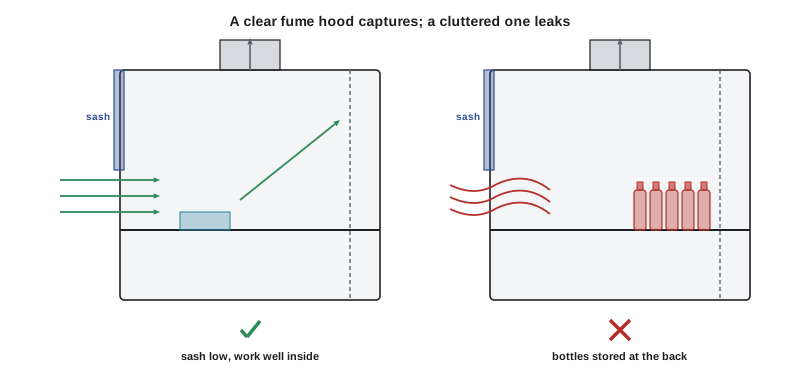
Good hood practice includes: keeping the sash as low as practical, and at or below the marked working height; working at least 15 cm (6 in) inside the hood; keeping the hood free of clutter and stored chemicals, which disrupt airflow; not putting your head inside the hood; checking the airflow monitor before each use; and having hoods tested at least annually and after any change to the ventilation system. A fume hood is not a storage cabinet; bottles left in the hood become fuel if a fire starts there.
# Average a fume hood face velocity traverse and flag uneven readings.
# Nine grid readings in m/s at the working sash height (illustrative).
readings = [0.52, 0.48, 0.55, 0.47, 0.50, 0.58, 0.30, 0.45, 0.51]
avg = sum(readings) / len(readings)
print(f"Average face velocity: {avg:.2f} m/s ({avg * 196.85:.0f} fpm)")
print("Within typical 0.4-0.6 m/s target:", 0.4 <= avg <= 0.6)
for i, v in enumerate(readings, 1):
    dev = (v - avg) / avg * 100
    note = "  <- check: more than 20% below average" if dev < -20 else ""
print(f"point {i}: {v:.2f} m/s ({dev:+5.1f}%){note}")Average face velocity: 0.48 m/s (95 fpm) Within typical 0.4-0.6 m/s target: True point 1: 0.52 m/s ( +7.3%) point 2: 0.48 m/s ( -0.9%) point 3: 0.55 m/s (+13.5%) point 4: 0.47 m/s ( -3.0%) point 5: 0.50 m/s ( +3.2%) point 6: 0.58 m/s (+19.7%) point 7: 0.30 m/s (-38.1%) <- check: more than 20% below average point 8: 0.45 m/s ( -7.1%) point 9: 0.51 m/s ( +5.3%)
The traverse average is within the typical target, but one reading in the lower corner is far below the others. That pattern often means something is blocking the airflow near that point, such as equipment pushed against the baffle, bottles stored at the back, or a damaged baffle slot. The fix is to clear the hood and retest, and if the low reading persists, to ask the ventilation contractor to check the baffles and exhaust. The 20 per cent flag used here is an illustrative screening rule, not a value from a standard.
Laboratory refrigerators and freezers
Ordinary household refrigerators contain light switches, thermostats and defrost heaters inside the storage compartment that can ignite flammable vapours from leaking solvent bottles. Many lab explosions have started this way. Flammable solvents, and samples containing them, must be stored only in refrigerators designed for the purpose: laboratory-safe or flammable-material storage refrigerators have no ignition sources inside the compartment, while explosion-proof units are designed for use in locations where flammable vapour may be present outside the unit too. Label every refrigerator with what it may hold, and never store food or drink in a lab refrigerator.
Inventory and ordering
A good chemical inventory is the foundation of lab storage safety. It lets people find what they need instead of buying more, it supports peroxide dating and expiry checks, it shows emergency responders what is in each room, and it is the basis for checking quantity limits under the fire code and NFPA 45. Many institutions use a barcode-based system that records each container at receipt and removes it when emptied or discarded. An annual physical reconciliation, in which every container is scanned and orphans are removed, keeps the inventory honest.
Ordering policies help as much as storage rules. Encourage users to buy the smallest container that will last the project, to check the inventory and shared stock before ordering, and to avoid bulk discounts that leave years of supply on the shelf. Some institutions run a chemical redistribution program so unopened surplus can be reused rather than discarded.
Research hazards and scale-up
Research labs sometimes work with new or poorly characterized materials. In 2010, a graduate student at Texas Tech University was seriously injured when a compound he was preparing, an energetic material, detonated after he made a much larger batch than his group had previously handled. The US Chemical Safety Board investigated and found weaknesses in hazard evaluation, in the management of physical hazards in research labs, and in learning from earlier near misses. The lessons apply to storage as well as to experiments: new and energetic materials should be stored in small quantities, in labelled containers, in locations approved by the safety office, and scale-up should require a documented hazard review.
Small-quantity users outside labs
Hair salons store oxidizing developers (hydrogen peroxide), ammonia-based dyes, acetone nail polish remover and flammable aerosol sprays. Dental offices use acrylic monomers, disinfectants and small cylinders of nitrous oxide and oxygen. School science prep rooms often hold decades-old stock, including chemicals that should no longer be in schools at all. The same principles apply in all of these places: keep an inventory, buy small, segregate oxidizers from flammables and acids from bases, use a small flammable cabinet for solvents and aerosols, keep cylinders chained, provide an eyewash where corrosives are used, and dispose of old stock properly.
Worked problem
A school science prep room
A high school science teacher inherits a prep room with shelves arranged alphabetically. On one shelf, sodium metal under oil sits next to sodium hydroxide and sodium nitrate, with picric acid and potassium permanganate nearby. Several bottles have no labels. What should happen?
Show solution
- Stop using the room for routine work until it has been assessed; do not open unlabelled bottles or disturb the picric acid.
- Report to the school board's safety office and request a specialist assessment, since dry picric acid can be shock-sensitive.
- Rearrange the remaining stock by compatibility: water-reactive sodium metal isolated, oxidizers such as sodium nitrate and potassium permanganate away from organics, bases in their own tray.
- Remove unlabelled, expired and unneeded chemicals through a hazardous waste contractor.
- Set up an inventory with dates, buy small quantities, and post the segregation plan.
Answer: Pause, get specialist help for the picric acid and unknowns, re-sort by compatibility, clear out old stock and start an inventory.
Closing out a lab
When a researcher leaves, a lab is renovated, or a program ends, chemicals can be abandoned in large numbers. A lab close-out procedure prevents this. Before the departure date, the responsible person reviews the inventory, transfers useful chemicals to a named new owner, labels everything clearly, and arranges disposal of the rest through the waste program. The safety office then inspects the lab, checks fume hoods, refrigerators and cabinets for leftover materials, and signs off before the space is reassigned or handed to contractors. Contractors should never be the first people to open an old lab cabinet, because they may not recognize peroxide formers, reactive metals or unlabelled toxic materials.
Worked problem
Closing out a research lab
A professor is retiring in two months, and her lab holds about 400 containers collected over 25 years. What should the department do?
Show solution
- Assign a coordinator and set a schedule that finishes before the retirement date.
- Reconcile the inventory against the shelves and flag unlabelled, expired and peroxide-forming items for specialist review.
- Offer usable, unopened chemicals to other labs through the redistribution program, with a named new owner for each.
- Arrange disposal of the rest through the waste contractor, with unknowns characterized first.
- Have the safety office inspect and sign off the empty lab before it is reassigned.
Answer: Plan early, reconcile the inventory, redistribute what is useful, dispose of the rest properly and get a final sign-off.
Common mistakes
MistakeArranging all lab chemicals alphabetically.
InsteadGroup by compatibility first, then alphabetically within each group.
MistakeUsing the fume hood as a storage cabinet.
InsteadKeep only chemicals in active use in the hood.
MistakeStoring ether in a household refrigerator.
InsteadUse a laboratory-safe or flammable-material storage refrigerator.
MistakeBuying the large size because it is cheaper per litre.
InsteadBuy the smallest practical quantity and check shared stock first.
MistakeScaling up a reaction without a hazard review.
InsteadRequire a documented hazard review before scale-up.
Summary and key terms
- Labs hold many chemicals in small containers that accumulate and change often.
- In Canada, labs follow general provincial rules, WHMIS, the fire code and standards such as CSA Z316.5 and NFPA 45.
- Fume hoods typically target an average face velocity of about 0.4 to 0.6 m/s (80 to 120 fpm) and must be kept clear and tested.
- Flammable solvents must only be stored in laboratory-safe or flammable-material refrigerators.
- An accurate inventory supports safe ordering, peroxide dating, emergency response and code compliance.
- New and energetic materials need small quantities, approved locations and a hazard review before scale-up.
- Small-quantity users such as salons, dental offices and schools apply the same principles on a smaller scale.
- Chemical hygiene plan
- A written program for protecting lab workers from hazardous chemicals.
- Chemical hygiene officer
- A person designated to help carry out the chemical hygiene plan.
- Fume hood
- A ventilated enclosure that captures vapours and exhausts them outside.
- Face velocity
- The average speed of air entering a fume hood opening.
- Sash
- The movable front window of a fume hood.
- Laboratory-safe refrigerator
- A refrigerator with no ignition sources inside the storage compartment.
- Orphan chemical
- A chemical with no current owner or user.
- Chemical redistribution
- A program that reuses unopened surplus chemicals.
- Particularly hazardous substance
- A carcinogen, reproductive toxin or highly toxic chemical needing extra controls.
- Scale-up
- Increasing the size of a reaction or batch, which can change its hazards.
Practice problems
Work each problem on paper first, then reveal the answer to check.
Why is strict alphabetical storage a problem in labs?
Show answer
It places incompatible chemicals next to each other.
What is a typical average fume hood face velocity target?
Show answer
About 0.4 to 0.6 m/s (80 to 120 fpm).
How far inside a fume hood should work be done?
Show answer
At least 15 cm (6 in).
Why should bottles not be stored in fume hoods?
Show answer
They disrupt airflow and add fuel to any fire.
Why can a household refrigerator cause an explosion?
Show answer
Its internal light switch, thermostat or heater can ignite solvent vapour.
What standard covers fume hoods in Canada?
Show answer
CSA Z316.5, Fume hoods and associated exhaust systems.
Give three benefits of a chemical inventory.
Show answer
Avoids duplicate buying, supports dating and expiry checks, informs emergency responders and code compliance.
What did the Texas Tech 2010 incident show?
Show answer
Scale-up of energetic materials needs hazard review, and near misses must be learned from.
What did the traverse check flag?
Show answer
One low reading, suggesting an airflow obstruction near that point.
Name two chemicals a hair salon might store that must be segregated.
Show answer
Hydrogen peroxide developer (oxidizer) and acetone or flammable aerosols.
Lesson quiz · 5 questions
Score 60% or more to complete this lesson.
Create a free account to save your progress, take quizzes and earn a certificate.