
HSE-312 · Lesson 3 of 12 · 27 min
Hazard classes and the SDS for storage decisions
Before you can decide where a chemical belongs, you need to know what it is and how it behaves. The supplier has already done most of that work: the hazard classes on the label and the information in the safety data sheet (SDS) tell you what the product can do and how the supplier recommends storing it. HSE-102 taught you to read labels and SDSs in general. This lesson focuses on the parts that drive storage decisions, and on how to turn a shelf full of products into a short list of storage groups.
Physical, health and environmental hazards
The Globally Harmonized System sorts hazards into three families. Physical hazards describe what a chemical can do to property and people through fire, explosion or reaction: flammable liquids, gases, aerosols and solids, oxidizers, self-reactive substances, organic peroxides, pyrophorics, self-heating substances, substances that emit flammable gases in contact with water, gases under pressure, explosives and corrosives to metals. Health hazards describe what a chemical can do to the body: acute toxicity, skin corrosion or irritation, serious eye damage, sensitization, germ cell mutagenicity, carcinogenicity, reproductive toxicity and organ toxicity. Environmental hazards describe harm to aquatic life and the ozone layer.
For storage, physical hazards matter most, because they decide what a chemical must be kept away from and what kind of storage space it needs. Health hazards still matter: highly toxic chemicals may need locked storage and extra containment, and corrosives can attack containers, shelving and skin. Environmental hazards matter for spill prevention and waste.
| Hazard class (GHS) | Pictogram | Storage concern |
|---|---|---|
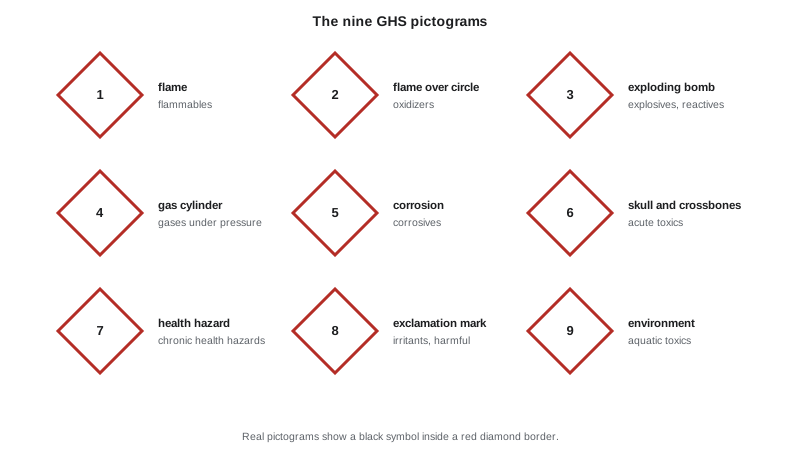
| Flammable liquids, gases, aerosols, solids | Flame | Ignition sources, quantity limits, cabinets and rooms |
| Oxidizers | Flame over circle | Keep away from flammables and combustibles |
| Organic peroxides, self-reactives | Flame, exploding bomb | Temperature control, separation, limited quantities |
| Pyrophorics, self-heating | Flame | Air exclusion, inert storage, small quantities |
| Water-reactives (emit flammable gas) | Flame | Keep dry, away from sprinklers and water lines |
| Gases under pressure | Gas cylinder | Secure cylinders, separate by gas type, protect from heat |
| Corrosive to metals, skin corrosion | Corrosion | Corrosion-resistant shelving, separate acids from bases |
| Acute toxicity (categories 1 to 3) | Skull and crossbones | Secure storage, containment, access control |
| Aquatic toxicity | Environment | Spill containment, keep away from drains |
The SDS sections that matter for storage
An SDS has 16 sections in a fixed order. Four of them are essential for storage decisions, and three more are useful.
Section 2, hazard identification, lists the hazard classes and categories, signal word, hazard statements and pictograms. This tells you the storage groups the product belongs to. Section 7, handling and storage, gives the supplier's specific storage advice: temperature limits, incompatible materials, container types, ventilation and precautions such as keeping the container tightly closed or storing under nitrogen. Section 9, physical and chemical properties, gives the flash point, boiling point, vapour pressure, vapour density, pH and other data used to classify flammable liquids and to judge how readily vapour builds up. Section 10, stability and reactivity, lists conditions to avoid, incompatible materials and hazardous decomposition products. This is the main source for compatibility decisions.
Section 5 (firefighting measures) tells you whether water can be used on the product, which matters for where it sits relative to sprinklers. Section 6 (accidental release measures) tells you what absorbent and neutralizer a spill kit needs. Section 8 (exposure controls and personal protection) tells you which glove material and eye protection to stock near the storage area.
Reading section 10 carefully
Section 10 is where many storage mistakes start, because suppliers often write it in general terms. Phrases such as strong oxidizing agents, strong acids, strong bases and reducing agents describe families of chemicals, not specific products. To use them, you need to know which of your other products fall into those families. Concentrated nitric acid, hydrogen peroxide above about 8 %, calcium hypochlorite, sodium hypochlorite solutions, nitrates, permanganates, chlorates and perchlorates are oxidizers. Hydrochloric, sulfuric, phosphoric and acetic acids are acids. Sodium hydroxide, potassium hydroxide, ammonia solutions and many alkaline cleaners are bases. Metal hydrides, sodium metal and some organometallic reagents are strong reducing agents that also react with water.
If section 10 says incompatible with water or reacts violently with water, the product needs a dry location away from sprinkler heads, sinks and water lines, and the fire department needs to know it is there. If it says avoid heat or store below a stated temperature, it needs temperature control and should not sit near heaters, in direct sunlight or in an unheated shed that bakes in summer.
Worked problem
Pulling storage information from an SDS
An SDS for a parts cleaner gives: section 2, flammable liquid category 2, eye irritation category 2; section 7, keep away from heat, sparks and open flames, store in a well-ventilated place, keep container tightly closed, ground and bond containers; section 9, flash point -4 °C, initial boiling point 56 °C, vapour density 2.0 (air = 1); section 10, incompatible with strong oxidizers, strong acids and bases. What storage decisions follow?
Show solution
- Flammable liquid category 2 means it belongs in the flammable liquids group, in an approved cabinet or flammable storage room within code quantity limits.
- A flash point well below room temperature means it gives off ignitable vapour at all normal temperatures, so ignition control and ventilation are essential.
- A vapour density of 2.0 means vapour is heavier than air and will collect near the floor and in pits, so low-level ventilation and keeping ignition sources off the floor matter.
- Section 10 means it must be segregated from oxidizers, acids and bases.
- Section 7's bonding and grounding note means transfers need a bonding wire and a grounded drum (lesson 9).
Answer: Store it in the flammables group in a cabinet or room, away from oxidizers, acids and bases, with ignition control, low-level ventilation and bonding for transfers.
From hazard classes to storage groups
Most workplaces do not need a separate storage location for every hazard class. They need a small number of storage groups whose members are compatible with each other. A common scheme for small users uses eight to ten groups:
| Storage group | Typical members | Typical location |
|---|---|---|
| Flammable liquids | Solvents, fuels, alcohols, flammable paints | Flammable cabinet or flammable storage room |
| Flammable aerosols | Spray paints, lubricants, cleaners | Flammable cabinet or aerosol cage |
| Oxidizers | Pool chlorine, nitrates, peroxides, permanganates | Separate cabinet or shelf, away from combustibles |
| Inorganic acids | Hydrochloric, sulfuric, phosphoric acid | Corrosive cabinet, acid side |
| Oxidizing acids | Nitric acid, perchloric acid | Separate tray or cabinet from other acids and organics |
| Organic acids | Acetic, formic acid (often flammable too) | Flammable cabinet with secondary tray, or acid cabinet |
| Bases | Sodium hydroxide, ammonia, alkaline cleaners | Corrosive cabinet, base side |
| Water-reactives and pyrophorics | Sodium, calcium carbide, metal hydrides | Dry, isolated cabinet; small quantities |
| Toxics | Cyanides, highly toxic pesticides | Locked cabinet with containment |
| General (low hazard) | Salts, buffers, most solids without hazard classes | General shelving |
Some products belong to two groups. Glacial acetic acid is both flammable (category 3) and corrosive. Ammonium nitrate is an oxidizer and may be an explosive in some forms. For these, follow the most hazardous property and keep them away from the incompatibles of both groups. Lesson 4 shows how to handle these cases with a compatibility table.
# Assign products to storage groups from their GHS classes (simplified rules).
# Order matters: the first rule that matches wins, so the most hazardous comes first.
RULES = [
    ("water-reactive", lambda c: "water-reactive" in c or "pyrophoric" in c),
    ("oxidizers",      lambda c: "oxidizer" in c and "acid" not in c),
    ("oxidizing acids",lambda c: "oxidizer" in c and "acid" in c),
    ("flammables",     lambda c: "flammable" in c),
    ("acids",          lambda c: "acid" in c),
    ("bases",          lambda c: "base" in c),
    ("toxics",         lambda c: "acute tox 1-3" in c),
    ("general",        lambda c: True),
]
products = {
    "acetone": {"flammable"},
    "nitric acid 70%": {"oxidizer", "acid", "corrosive"},
    "pool chlorine": {"oxidizer", "corrosive"},
    "glacial acetic acid": {"flammable", "acid", "corrosive"},
    "sodium hydroxide": {"base", "corrosive"},
    "sodium metal": {"water-reactive"},
    "sodium cyanide": {"acute tox 1-3"},
    "sodium chloride": set(),
}
for name, classes in products.items():
    group = next(g for g, test in RULES if test(classes))
print(f"{name:20s} -> {group}")acetone -> flammables nitric acid 70% -> oxidizing acids pool chlorine -> oxidizers glacial acetic acid -> flammables sodium hydroxide -> bases sodium metal -> water-reactive sodium cyanide -> toxics sodium chloride -> general
The simplified rules show the logic. Glacial acetic acid goes to the flammables group because flammability is checked before acidity; in practice it is stored in a flammable cabinet with its own corrosion-resistant tray, away from oxidizers and bases. Nitric acid goes to its own oxidizing acids group because it is both an acid and a strong oxidizer that reacts dangerously with organic acids and solvents.
Labels as a storage tool
Labels do more than meet the hazard communication rules. They are the main way anyone can tell, at a glance, where a container belongs. Many organizations add a coloured storage-group dot or band to each container when it is received. Some chemical suppliers use their own colour schemes for storage groups; if you adopt one, use it consistently and explain it on a posted chart, because colour schemes differ between suppliers and between organizations. Never rely on colour alone: the written storage group and hazard pictograms should also be visible.
Two dates also belong on every container: the date received and the date opened. These support first-in, first-out use, shelf-life tracking and peroxide-former testing (lesson 7). A permanent marker and a few seconds at the receiving bench are all it takes.
Worked problem
Grouping a mixed shelf
A college maintenance shelf holds: spray lubricant (flammable aerosol), muriatic acid (hydrochloric acid), drain opener (sodium hydroxide), hydrogen peroxide 35 % (oxidizer, corrosive), mineral spirits (flammable liquid category 3) and table salt for de-icing. Assign each to a storage group.
Show solution
- Spray lubricant: flammable aerosols.
- Muriatic acid: inorganic acids.
- Drain opener: bases, stored apart from the acid.
- Hydrogen peroxide 35 %: oxidizers, stored away from the flammables and away from organic materials.
- Mineral spirits: flammable liquids.
- Table salt: general.
Answer: Five separate groups on one shelf means the shelf must be reorganized: flammables to the cabinet, acid and base to opposite sides of a corrosive cabinet, peroxide to an oxidizer location, salt to general shelving.
When the SDS is old or missing
Storage decisions are only as good as the SDS they are based on. An SDS more than a few years old may use an earlier classification, may not reflect a reformulated product, or may come from a different supplier than the product on the shelf. Suppliers must provide a current SDS with hazardous products, and workplaces must keep one available for every hazardous product they use. If an SDS is missing or clearly outdated, ask the supplier for the current version before deciding where to store the product, and keep the product in a conservative location, such as with the most restrictive group it might belong to, until you have it. Never guess a storage group from the product name alone; trade names such as 'Green Clean' or 'Citrus Degreaser' say nothing reliable about flash point or reactivity.
Common mistakes
MistakeReading only the pictograms and ignoring section 10 of the SDS.
InsteadUse section 10 to identify incompatible materials and conditions to avoid.
MistakeTreating "strong oxidizers" in section 10 as a product nobody stocks.
InsteadIdentify which of your own products are oxidizers, acids, bases or reducers.
MistakePutting a dual-hazard product such as glacial acetic acid with only one of its groups.
InsteadFollow the most hazardous property and keep it away from the incompatibles of both groups.
MistakeRelying on colour codes alone to show storage groups.
InsteadWrite the storage group on the container and post a chart explaining any colours.
MistakeSkipping the received and opened dates on containers.
InsteadDate every container to support first-in, first-out use and shelf-life checks.
Summary and key terms
- GHS hazards fall into physical, health and environmental families; physical hazards drive most storage decisions.
- SDS sections 2, 7, 9 and 10 are essential for storage; sections 5, 6 and 8 support it.
- Section 10 lists incompatible families such as oxidizers, acids, bases and reducers, which you must map to your own products.
- Flash point and vapour density from section 9 tell you how readily ignitable vapour forms and where it collects.
- Most small users can manage storage with eight to ten compatible storage groups.
- Dual-hazard products follow the most hazardous property and avoid the incompatibles of both groups.
- Labels showing the storage group and received and opened dates make good storage visible.
- Physical hazard
- A hazard from fire, explosion, reactivity or pressure.
- Health hazard
- A hazard that harms the body, such as toxicity or corrosivity.
- Storage group
- A set of chemicals that are compatible and can be stored together.
- Section 10
- The SDS section on stability and reactivity, including incompatible materials.
- Flash point
- The lowest temperature at which a liquid gives off enough vapour to ignite.
- Vapour density
- The weight of a vapour compared with air; above 1 means it sinks.
- Oxidizer
- A substance that supplies oxygen or accepts electrons and can intensify fires.
- Water-reactive
- Reacting with water to give heat or flammable or toxic gas.
- Dual-hazard product
- A product with two hazard classes that place it in different storage groups.
- First-in, first-out
- Using the oldest stock first so containers do not age on the shelf.
Practice problems
Work each problem on paper first, then reveal the answer to check.
Which three families of hazards does the GHS use?
Show answer
Physical, health and environmental.
Which SDS section gives incompatible materials?
Show answer
Section 10, stability and reactivity.
Which SDS section gives the supplier storage advice?
Show answer
Section 7, handling and storage.
A solvent has a vapour density of 3.1. What does that mean for storage?
Show answer
Its vapour is heavier than air and collects at floor level, so low-level ventilation and ignition control matter.
Name three common oxidizers found in workplaces.
Show answer
Calcium hypochlorite (pool chlorine), hydrogen peroxide solutions, nitrates, nitric acid, permanganates.
Why is nitric acid often stored apart from other acids?
Show answer
It is a strong oxidizing acid that reacts dangerously with organic acids and other organics.
How should a dual-hazard product be stored?
Show answer
According to its most hazardous property, away from the incompatibles of both groups.
What two dates should be written on chemical containers?
Show answer
Date received and date opened.
Why should colour codes not be used alone?
Show answer
Schemes differ between suppliers and organizations, and colour can be misread; the written group must also be visible.
Which SDS section helps you stock the right spill kit?
Show answer
Section 6, accidental release measures.
Lesson quiz · 5 questions
Score 60% or more to complete this lesson.
Create a free account to save your progress, take quizzes and earn a certificate.