
HSE-312 · Lesson 4 of 12 · 26 min
Chemical compatibility and segregation
Segregation is the practice of keeping chemicals that react dangerously with each other far enough apart, or behind enough of a barrier, that a leak, a dropped container or a fire cannot bring them together. It is the most important single idea in chemical storage, and also the one most often done badly. This lesson explains why incompatible reactions happen, how to use a compatibility table, what separation and barriers mean in practice, and how to build a segregation plan for a real storeroom.
What makes chemicals incompatible
Two chemicals are incompatible when mixing them produces something worse than either alone. The bad outcomes fall into a few categories: heat, fire, explosion, toxic gas, flammable gas, violent pressure build-up, or the formation of a dangerously unstable substance. Some reactions are instant and violent. Others are slow, such as an oxidizer gradually charring a cardboard box until it ignites. Some need a trigger such as heat or a spark.
| Combination | What can happen | Workplace example |
|---|---|---|
| Acid + base | Heat, boiling, splattering | Concentrated sulfuric acid spilled into a caustic cleaner |
| Oxidizer + flammable or combustible | Fire or explosion | Pool chlorine with oil, rags or brake fluid |
| Acid + hypochlorite (bleach) | Chlorine gas | Toilet bowl acid cleaner mixed with bleach |
| Ammonia + hypochlorite | Chloramine gases | Glass cleaner mixed with bleach |
| Acid + cyanide or sulfide salts | Hydrogen cyanide or hydrogen sulfide gas | Acid spilled on plating salts or sulfide sludge |
| Water + water-reactive | Flammable gas and heat | Sprinkler water on calcium carbide or sodium metal |
| Oxidizing acid + organic | Violent reaction, fire | Nitric acid with acetone or acetic acid |
| Acid + active metal | Hydrogen gas | Hydrochloric acid on aluminum or zinc shavings |
Concentration matters. Dilute household vinegar and a dilute baking soda solution fizz harmlessly; glacial acetic acid poured into concentrated sodium hydroxide boils and splatters. The compatibility tables used for storage assume concentrated products in the quantities found on shelves, because that is what a leak or a fire will bring together.
Compatibility tables
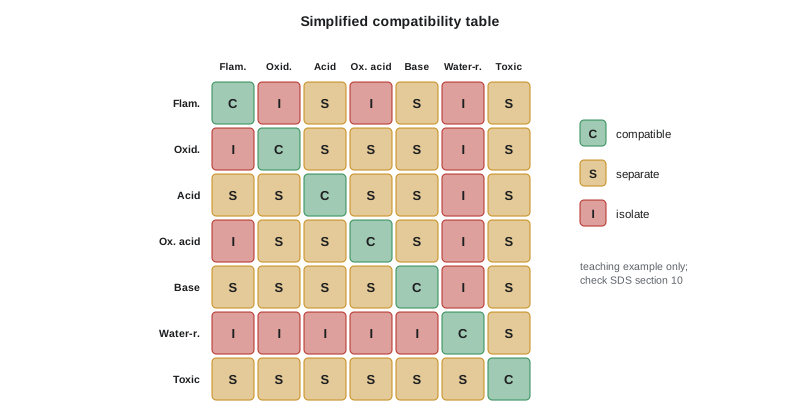
A compatibility table, sometimes called a compatibility chart or matrix, lists storage groups along the top and down the side. Each cell shows whether two groups can be stored together. Most tables use three answers: compatible (can share a shelf or cabinet), separate (keep apart, often with a tray, shelf or distance), and isolate (keep in a separate cabinet, room or fire compartment). Well-known sources include the US Environmental Protection Agency's 1980 chemical compatibility chart, the reactivity worksheet tool developed by the US National Oceanic and Atmospheric Administration (NOAA) for its CAMEO Chemicals database, and guidance from CCOHS and from university safety offices. These sources use different numbers of groups and slightly different rules, so pick one, adapt it to your inventory and use it consistently.
The table below is a simplified version for the storage groups introduced in lesson 3. It is a teaching example. For real decisions, check the specific products against their SDS section 10 and a recognized compatibility source.
| Flam. | Oxid. | Inorg. acid | Oxid. acid | Base | Water-react. | Toxic | |
|---|---|---|---|---|---|---|---|
| Flammables | C | I | S | I | S | I | S |
| Oxidizers | I | C | S | S | S | I | S |
| Inorganic acids | S | S | C | S | S | I | S |
| Oxidizing acids | I | S | S | C | S | I | S |
| Bases | S | S | S | S | C | I | S |
| Water-reactives | I | I | I | I | I | C | S |
| Toxics | S | S | S | S | S | S | C |
What separate and isolate mean in practice
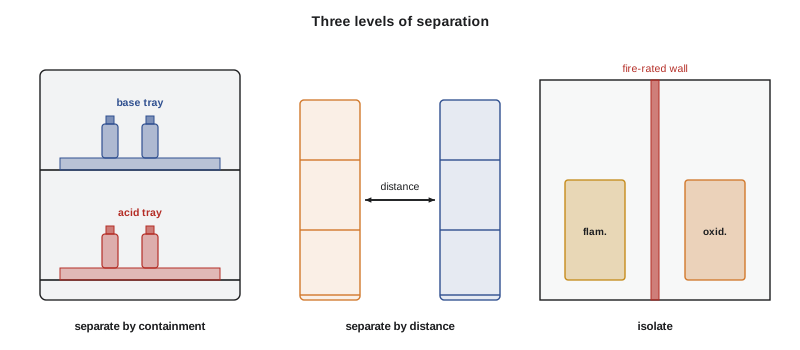
Separate usually means the two groups must not be able to mix if one container leaks. On a small scale, separate secondary containment trays in the same cabinet can achieve this, for example an acid tray and a base tray on different shelves of a corrosive cabinet, with the acids on the lower shelf so a leak cannot drip onto the bases. Distance also counts. Fire codes and guidance often use separations of about 1 m to 6 m (3 ft to 20 ft) between incompatible groups in open storage, depending on the hazard and quantity. Some codes also accept a non-combustible barrier or partition in place of distance.
Isolate means a much stronger barrier: a separate cabinet, a separate room or a separate fire compartment, so that a fire or large leak involving one group cannot reach the other. Flammables and oxidizers should be isolated. Water-reactive and pyrophoric chemicals should be isolated from everything, including the water from fire sprinklers, which may mean a separate cabinet away from sprinkler heads with the fire department informed.
Building a segregation plan
A segregation plan is a simple document that shows where each storage group lives and why. For a small user it can be one page: a floor sketch of the storage area with cabinets and shelves labelled by group, a list of which products belong to which group, and the compatibility rules being followed. The steps are:
- Take a full inventory of the chemicals in the area, with quantities and SDSs.
- Assign each product to a storage group, using SDS sections 2 and 10.
- Remove products that are expired, unidentified or unneeded before deciding on space.
- Allocate locations so that groups that must be isolated are in separate cabinets or rooms, and groups that must be separated have their own trays, shelves or distance.
- Within each group, arrange products alphabetically if that helps people find them.
- Label shelves and cabinets with the group name, and post the plan in the storage area.
- Review the plan whenever new products are introduced.
# Check a storage layout against a simplified compatibility table.
# C = compatible, S = separate (needs own tray/shelf), I = isolate (different cabinet/room).
G = ["flammable", "oxidizer", "acid", "oxid_acid", "base", "water_react", "toxic"]
T = {
 "flammable":   "CISISIS",
 "oxidizer":    "ICSSSIS",
 "acid":        "SSCSSIS",
 "oxid_acid":   "ISSCSIS",
 "base":        "SSSSCIS",
 "water_react": "IIIIICS",
 "toxic":       "SSSSSSC",
}
def rule(a, b):
    return T[a][G.index(b)]

# Each location: (cabinet, tray) -> list of (product, group)
layout = {
    ("cab1", "top"):    [("acetone", "flammable"), ("mineral spirits", "flammable")],
    ("cab1", "bottom"): [("hydrogen peroxide 35%", "oxidizer")],
    ("cab2", "top"):    [("sodium hydroxide", "base")],
    ("cab2", "bottom"): [("hydrochloric acid", "acid"), ("nitric acid", "oxid_acid")],
}
problems = 0
items = [(loc, p, g) for loc, lst in layout.items() for p, g in lst]
for i in range(len(items)):
    for j in range(i + 1, len(items)):
        (c1, t1), p1, g1 = items[i]
        (c2, t2), p2, g2 = items[j]
        r = rule(g1, g2)
        if r == "I" and c1 == c2:
            print(f"ISOLATE: {p1} and {p2} share {c1}"); problems += 1
        elif r == "S" and (c1, t1) == (c2, t2):
            print(f"SEPARATE: {p1} and {p2} share {c1} {t1}"); problems += 1
print(f"{problems} problem(s) found")ISOLATE: acetone and hydrogen peroxide 35% share cab1 ISOLATE: mineral spirits and hydrogen peroxide 35% share cab1 SEPARATE: hydrochloric acid and nitric acid share cab2 bottom 3 problem(s) found
The check finds two problems in this invented layout. The peroxide, an oxidizer, shares a cabinet with flammable solvents, which the table says must be isolated. Hydrochloric acid and nitric acid share a tray, which the table says needs separation, because nitric acid is an oxidizing acid. Moving the peroxide to its own cabinet and giving nitric acid its own tray fixes both.
Special cases
Some chemicals do not fit neatly into groups, and some combinations within a group are still dangerous. Organic acids such as acetic and formic acid are often flammable and should not be stored with oxidizing acids. Perchloric acid is a powerful oxidizer when concentrated or heated and needs its own storage. Hydrofluoric acid attacks glass and requires plastic containers and special first aid (calcium gluconate gel), so it should be stored apart with its first aid supplies nearby. Cyanide and sulfide salts must be kept away from all acids, because a leak of acid onto them releases highly toxic gas. Picric acid and other compounds that become explosive when dry need regular inspection and must not be allowed to dry out.
Within the flammable group, some products are also oxidizers or reactive. Organic peroxides, used as hardeners for fibreglass resins and in some laboratory work, are flammable and can decompose violently when heated or contaminated. They need cool storage away from accelerators such as cobalt solutions, which are often sold in the same kit. Keep the two parts of a two-part product apart until they are mixed for use.
Worked problem
Fixing a pool chemical room
A community pool's chemical room holds: 200 kg of calcium hypochlorite granules, a 200 L drum of muriatic acid for pH control, a 20 L can of gasoline for the lawn mower, and bags of sodium bicarbonate. All are against one wall. What is wrong and what should change?
Show solution
- Calcium hypochlorite and muriatic acid release chlorine gas if they meet. They must be separated, ideally in different rooms or at least with separate containment and distance, so a leak of acid cannot reach the granules.
- Calcium hypochlorite and gasoline are an oxidizer and a flammable liquid. They must be isolated: the gasoline belongs in a flammable cabinet or an outdoor storage shed, not in the chemical room.
- The acid drum needs secondary containment large enough for its contents, and it must not be stored above the hypochlorite.
- Sodium bicarbonate is low hazard and can stay, ideally between the other groups or on its own shelf.
- Post the segregation plan and train staff never to use the same scoop or bucket for acid and hypochlorite.
Answer: Move the gasoline out, separate the acid from the hypochlorite with containment and distance (preferably separate rooms), and post the plan.
Pool chemical incidents are a frequent source of chlorine gas exposures at community facilities, often when a delivery driver or new staff member pours acid into the wrong tank or stores bags of hypochlorite where acid can drip on them. The same risk exists in water treatment plants, food plants and car washes that use hypochlorite for sanitation.
Inspecting segregation
Segregation slips over time. A busy worker puts a bottle back on the nearest shelf. A new product arrives and is put wherever there is room. Inspections should check that each container is in its labelled group location, that trays are clean and not full of leaked product, that containers are closed and not corroded, and that no new products have arrived without being assigned to a group. A monthly walk-through with a short checklist is enough for most small users.
Segregation in vehicles and temporary storage
Segregation does not stop at the storeroom door. Service trucks, maintenance carts and job-site storage boxes often carry fuel, oxidizing pool chemicals, acids and compressed gases together. A minor collision or a pothole can break containers, and the cab may fill with vapour or gas. Keep incompatible products in separate, secured, closed boxes or compartments, carry the smallest practical quantities, and never transport cylinders loose or inside a closed passenger compartment. Dangerous goods transport rules may apply even to small quantities carried for work, so check them before setting up a vehicle. On construction and maintenance sites, temporary storage containers should follow the same segregation plan as a permanent storeroom, with flammables and oxidizers in separate containers placed apart.
Common mistakes
MistakeStoring pool chlorine and muriatic acid side by side because both are pool chemicals.
InsteadSeparate hypochlorite from acids with containment and distance or separate rooms.
MistakeKeeping nitric acid in the same tray as other acids.
InsteadGive oxidizing acids their own tray or cabinet away from organics and other acids.
MistakePlacing acids on a shelf above bases.
InsteadStore the more hazardous or more likely to leak group on the lower shelf, each in its own tray.
MistakeStoring both parts of a two-part resin kit together.
InsteadKeep organic peroxide hardeners away from accelerators until use.
MistakeWriting a segregation plan once and never reviewing it.
InsteadReview the plan when new products arrive and check it during regular inspections.
Summary and key terms
- Incompatible chemicals react to produce heat, fire, explosion, toxic or flammable gas, or pressure.
- Key incompatibilities include acids with bases, oxidizers with flammables, acids with hypochlorite, cyanides or sulfides, and water-reactives with water.
- Compatibility tables classify pairs of storage groups as compatible, separate or isolate.
- Separation can be achieved with separate trays, shelves or distance; isolation needs separate cabinets, rooms or fire compartments.
- A segregation plan maps storage groups to locations and is reviewed when products change.
- Special cases include oxidizing acids, hydrofluoric acid, cyanides, dry picric acid and two-part kits.
- Regular inspections keep segregation from drifting.
- Compatibility table
- A grid showing whether pairs of storage groups can be stored together.
- Separate
- Keep apart with separate containment, shelves or distance.
- Isolate
- Keep in a separate cabinet, room or fire compartment.
- Segregation plan
- A document mapping storage groups to locations in a storage area.
- Oxidizing acid
- An acid that is also a strong oxidizer, such as nitric or perchloric acid.
- Chloramine
- Toxic gases formed when ammonia mixes with hypochlorite.
- Organic peroxide
- A peroxide compound that is flammable and can decompose violently.
- Accelerator
- A chemical that speeds the cure of a resin and reacts with peroxide hardeners.
- Calcium hypochlorite
- A solid oxidizer used for pool and water disinfection.
- Calcium gluconate gel
- First aid treatment for hydrofluoric acid skin exposure.
Practice problems
Work each problem on paper first, then reveal the answer to check.
What gas forms when bleach is mixed with an acid cleaner?
Show answer
Chlorine.
What gas can form when acid leaks onto cyanide salts?
Show answer
Hydrogen cyanide.
What is the difference between separate and isolate?
Show answer
Separate means separate trays, shelves or distance; isolate means separate cabinets, rooms or fire compartments.
Which groups should water-reactive chemicals be isolated from?
Show answer
All other groups, and from water sources such as sprinklers and sinks.
Why should acids be on a lower shelf than bases?
Show answer
So that a leaking acid cannot drip onto the bases.
Name three sources of compatibility guidance.
Show answer
EPA chemical compatibility chart, NOAA CAMEO Chemicals reactivity worksheet, CCOHS or university safety office guidance.
List the steps for building a segregation plan.
Show answer
Inventory, assign groups, remove unneeded stock, allocate locations, arrange within groups, label and post, review.
Why are organic peroxide hardeners stored away from accelerators?
Show answer
The combination can decompose violently.
What two problems did the layout check find?
Show answer
Peroxide sharing a cabinet with flammables, and nitric acid sharing a tray with hydrochloric acid.
What should a monthly segregation inspection check?
Show answer
Containers in their labelled locations, clean trays, closed and intact containers, new products assigned to groups.
Lesson quiz · 5 questions
Score 60% or more to complete this lesson.
Create a free account to save your progress, take quizzes and earn a certificate.