
HSE-310 · Lesson 8 of 12 · 27 min
Plant traffic, material handling and ergonomics
Plants move enormous amounts of material: raw materials in, work in progress between processes, finished goods out, and waste away. That movement involves forklifts, tuggers, pallet jacks, automated guided vehicles, overhead cranes, conveyors, trucks at docks and, still, a great deal of manual lifting and carrying. Two families of injury result. Struck-by and crushing injuries from vehicles and loads are less common but often fatal. Strains and sprains from lifting, pushing, pulling and repetitive work are the single most common type of lost-time injury in manufacturing. This lesson covers both at plant level. HSE-218 covers forklifts in depth, HSE-219 covers cranes, and HSE-342 covers warehouse and backroom work in retail.
Traffic management
A plant traffic plan treats the plant like a small town with its own roads, sidewalks, crossings and rules. The goal is to keep pedestrians and vehicles apart wherever possible and to control the places where they must meet. Physical separation is the strongest control: barriers, guardrails and dedicated pedestrian routes. Where separation is not possible, plants use controlled crossings, one-way routes, speed limits, mirrors, warning lights, proximity detection and clear rules about right of way. The traffic plan should be drawn on a site map, explained at orientation and reviewed whenever the layout changes.
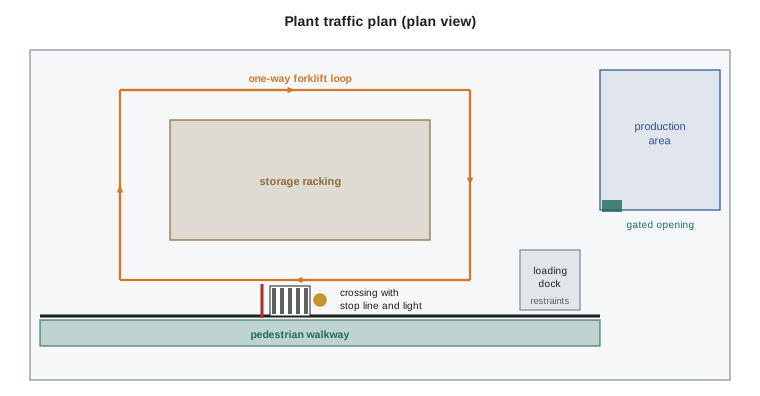
| Control | Strength | Example |
|---|---|---|
| Eliminate the movement | Strongest | Conveyor or automated system instead of forklift trips |
| Physical separation | Strong | Barriers between forklift aisles and walkways |
| Time separation | Strong if enforced | No pedestrians in the warehouse during truck loading hours |
| Controlled crossings | Moderate | Gates, stop lines, mirrors, flashing lights at crossings |
| Speed limits and one-way routes | Moderate | 8 km/h (5 mph) inside buildings, one-way loops |
| Detection and warning technology | Supporting | Blue spotlights, proximity sensors, cameras |
| Rules and training | Supporting | Eye contact before crossing, horn at blind corners |
| High-visibility clothing | Weakest alone | Vests for everyone on the plant floor |
Stopping distance and visibility
A loaded forklift is heavy, often carries its load in front where it blocks the driver's view, and cannot stop instantly. Drivers frequently travel in reverse for visibility, which puts the counterweight, the heaviest part, toward the people they cannot see. Pedestrians tend to assume drivers see them. The combination explains why so many plant fatalities involve a pedestrian struck by a reversing truck. A simple calculation shows how far a truck travels before it stops.
# Stopping distance of a forklift: reaction distance plus braking distance (illustrative).
g = 9.81
reaction_s = 1.0          # perception and reaction time
mu = 0.3                  # effective braking on a smooth concrete floor (illustrative)
for kmh in (5, 8, 12, 16):
    v = kmh / 3.6
    react = v * reaction_s
    brake = v ** 2 / (2 * mu * g)
    total = react + brake
print(f"{kmh:>2} km/h ({kmh / 1.609:4.1f} mph): reaction {react:4.2f} m + braking {brake:4.2f} m = {total:4.2f} m ({total * 3.281:4.1f} ft)")5 km/h ( 3.1 mph): reaction 1.39 m + braking 0.33 m = 1.72 m ( 5.6 ft) 8 km/h ( 5.0 mph): reaction 2.22 m + braking 0.84 m = 3.06 m (10.0 ft) 12 km/h ( 7.5 mph): reaction 3.33 m + braking 1.89 m = 5.22 m (17.1 ft) 16 km/h ( 9.9 mph): reaction 4.44 m + braking 3.36 m = 7.80 m (25.6 ft)
Even at walking-pace speeds the truck needs a few metres to stop, and wet, oily or dusty floors make it worse. That is why crossings need sight lines and why pedestrians must make eye contact and get a clear signal before stepping in front of or behind a vehicle.
Loading docks
Loading docks combine trucks, forklifts, pedestrians and a drop of more than a metre in one small area. The classic dock incidents are trailer creep or early departure, where the trailer moves away while a forklift is entering it and the truck falls; forklifts driving off the dock edge; trailers collapsing under a heavy forklift; and drivers struck in the yard. Controls include vehicle restraints or wheel chocks, a communication system such as lights or a key control that prevents the driver leaving while loading is underway, dock edge barriers, trailer jack stands, inspection of trailer floors, and a defined waiting area for truck drivers away from the dock floor.
Worked problem
A near miss at dock 4
A forklift operator entered a trailer at dock 4 just as the truck driver, who had not been told loading was still in progress, began to pull away. The forklift's rear wheels dropped into the gap but it did not fall. What failed, and what should change?
Show solution
- The trailer was not secured: no restraint or chocks were in place, or they were not used.
- There was no communication system linking the dock and the driver, so the driver did not know loading was underway.
- Change: install or enforce vehicle restraints with a light system (red inside for forklifts when not locked; red outside for drivers when locked).
- Change: a key or glad-hand lock procedure so the driver cannot leave until the dock releases the trailer, and a driver waiting area.
Answer: The trailer was unsecured and there was no dock-to-driver communication. Use restraints with interlocked signals and a driver release procedure.
Storage and racking
Pallet racking holds tonnes of material above people's heads. Racks fail when they are overloaded, damaged by forklift impacts, installed without proper anchoring, or modified without engineering review. A single bent upright can drastically cut a frame's capacity. Plants control racking hazards by posting load capacities on each bay, protecting uprights at aisle ends and corners, inspecting racks regularly and after impacts, unloading damaged bays until they are repaired, and keeping loads within the rack's design. In Ontario, new or modified racking that meets certain criteria needs a pre-start health and safety review under section 7 of Regulation 851.
# Rack bay load check: are the actual loads within the posted capacity? (illustrative)
capacity_per_level = 2000   # kg per pair of beams, from the capacity label
bays = {
    "A-01": [1800, 1900, 1750], "A-02": [2100, 1600, 1500],
    "A-03": [1200, 1300, 1250], "A-04": [1950, 2050, 1900],
}
for bay, levels in bays.items():
    over = [i + 1 for i, kg in enumerate(levels) if kg > capacity_per_level]
    status = "OK" if not over else "OVERLOADED at level(s) " + ", ".join(map(str, over))
print(f"Bay {bay}: loads {levels} kg -> {status}")Bay A-01: loads [1800, 1900, 1750] kg -> OK Bay A-02: loads [2100, 1600, 1500] kg -> OVERLOADED at level(s) 1 Bay A-03: loads [1200, 1300, 1250] kg -> OK Bay A-04: loads [1950, 2050, 1900] kg -> OVERLOADED at level(s) 2
Manual material handling and ergonomics
Despite automation, workers in plants still lift boxes, bags, parts and tools, push carts, pull pallet jacks and perform repetitive tasks on lines. Musculoskeletal disorders (MSDs), such as back injuries, shoulder injuries, tendonitis and carpal tunnel syndrome, are the most common lost-time injuries in many plants. Risk factors include heavy loads, awkward postures such as bending and twisting, repetition, long reaches, forceful exertions, vibration and cold. Controls follow the hierarchy: eliminate lifting with conveyors and lift tables, reduce weights, redesign workstations to the right height, use mechanical aids such as vacuum lifters and hoists, rotate tasks, and train people to recognize and report early symptoms.
The NIOSH lifting equation is a widely used tool for assessing two-handed lifts. It starts from a load constant of 23 kg (51 lb), the weight that most healthy workers can lift under ideal conditions, and reduces it with multipliers for the horizontal distance of the load from the body, the height at which it starts, the distance it travels, twisting, frequency and the quality of the grip. The result is the recommended weight limit (RWL). Dividing the actual weight by the RWL gives a lifting index; values above 1 indicate increasing risk, and values above about 3 are considered high risk for many workers.
# NIOSH lifting equation (metric form) for a box lifted from a low shelf (illustrative task).
LC = 23.0                       # load constant, kg
H, V, D, A = 40, 30, 80, 30     # horizontal cm, vertical start cm, travel cm, twist degrees
HM = 25 / H
VM = 1 - 0.003 * abs(V - 75)
DM = 0.82 + 4.5 / D
AM = 1 - 0.0032 * A
FM = 0.84                       # about 4 lifts per minute for under 1 hour (from the NIOSH table)
CM = 0.95                       # fair grip, low lift (from the NIOSH table)
RWL = LC * HM * VM * DM * AM * FM * CM
weight = 14.0
print(f"HM {HM:.2f} VM {VM:.2f} DM {DM:.2f} AM {AM:.2f} FM {FM:.2f} CM {CM:.2f}")
print(f"Recommended weight limit: {RWL:.1f} kg")
print(f"Lifting index for a {weight:.0f} kg box: {weight / RWL:.2f}")HM 0.62 VM 0.86 DM 0.88 AM 0.90 FM 0.84 CM 0.95 Recommended weight limit: 7.9 kg Lifting index for a 14 kg box: 1.78
Worked problem
Redesigning a lift
The calculation above gives a lifting index of about 1.8 for a 14 kg box lifted from 30 cm off the floor, 40 cm out from the body, with a twist. How could the task be redesigned to bring the index below 1?
Show solution
- Raise the starting height to about waist level with a lift table: V near 75 cm makes VM close to 1.
- Bring the load closer: a shelf edge that lets the worker stand right at the box reduces H to about 25 cm, making HM equal to 1.
- Remove the twist by placing the destination directly in front: AM becomes 1.
- Rerunning the equation with these changes gives a recommended limit well above 14 kg, so the index drops below 1.
Answer: Changing heights, reach and layout usually reduces risk more than training people to lift differently.
Ontario's Ministry of Labour, Immigration, Training and Skills Development treats MSD prevention as part of the employer's general duty, and provinces such as British Columbia have specific ergonomics requirements (in BC, sections 4.46 to 4.53 of the OHS Regulation). Tools such as the NIOSH equation, the Liberty Mutual manual material handling tables (also known as the Snook tables) for pushing, pulling and carrying, and checklists from provincial safety associations help assess tasks.
Overhead cranes in plants
Many plants use overhead bridge cranes and hoists to move heavy parts, dies and coils. The main hazards are dropped loads, people struck by swinging loads, and crane collisions. Controls include inspected rigging, trained operators, never walking or working under a suspended load, and clear zones along the crane path. HSE-219 covers cranes, hoisting and rigging in depth.
Common mistakes
MistakeRelying on high-visibility vests to protect pedestrians from forklifts.
InsteadSeparate pedestrians and vehicles physically wherever possible; vests are a last layer.
MistakeAssuming the driver sees you.
InsteadMake eye contact and get a clear signal before crossing in front of or behind a vehicle.
MistakeLoading a trailer without securing it.
InsteadUse vehicle restraints or chocks and a dock-to-driver communication system.
MistakeLeaving a damaged rack upright in service.
InsteadUnload the bay until it is inspected and repaired.
MistakeSolving lifting injuries with lifting technique training alone.
InsteadRedesign heights, reach, weights and layout first; training supports good design.
Summary and key terms
- Material movement causes fatal struck-by and crushing injuries and very common strains and sprains.
- Traffic plans separate pedestrians and vehicles and control crossings; physical separation is strongest.
- Forklifts need several metres to stop even at low speed, and reversing trucks are a leading cause of pedestrian deaths.
- Loading docks need trailer restraints, communication with drivers, edge protection and driver waiting areas.
- Racking must be within posted capacity, protected from impacts, inspected and repaired promptly.
- Musculoskeletal disorders are the most common lost-time injuries; controls start with redesign.
- The NIOSH lifting equation gives a recommended weight limit and lifting index for two-handed lifts.
- Traffic management plan
- A site plan of vehicle routes, pedestrian routes, crossings and rules.
- Physical separation
- Barriers or dedicated routes that keep pedestrians and vehicles apart.
- Vehicle restraint
- A device at a dock that holds a trailer in place during loading.
- Trailer creep
- Gradual movement of a trailer away from the dock during forklift loading.
- Rack upright
- The vertical frame member of a pallet rack that supports beams.
- Musculoskeletal disorder
- An injury or disorder of muscles, tendons, nerves or joints, often from lifting or repetitive work.
- Recommended weight limit
- The load most healthy workers could lift under the task conditions without increased risk, per NIOSH.
- Lifting index
- The actual load divided by the recommended weight limit.
- Awkward posture
- A body position away from neutral, such as bending, twisting or reaching overhead.
- Mechanical aid
- Equipment such as a lift table, hoist or vacuum lifter that reduces manual effort.
Practice problems
Work each problem on paper first, then reveal the answer to check.
Rank these traffic controls from strongest to weakest: vests, physical barriers, controlled crossings.
Show answer
Physical barriers, controlled crossings, vests.
Why are reversing forklifts especially dangerous to pedestrians?
Show answer
The driver's view is limited and the heavy counterweight leads toward people who may assume they are seen.
Estimate the total stopping distance at 12 km/h with 1 s reaction time and μ = 0.3.
Show answer
About 3.3 m reaction plus 1.9 m braking, roughly 5.2 m.
Name three dock controls.
Show answer
Vehicle restraints or chocks, dock-to-driver light or key systems, edge barriers, jack stands, driver waiting area.
What should happen when a rack upright is bent by a forklift?
Show answer
Unload the bay, report it, and have it inspected and repaired before reuse.
List four risk factors for musculoskeletal disorders.
Show answer
Heavy loads, awkward postures, repetition, long reaches, force, vibration, cold.
What is the NIOSH load constant?
Show answer
23 kg (51 lb).
A 12 kg box has an RWL of 10 kg. What is the lifting index and what does it mean?
Show answer
1.2; some increased risk, so the task should be improved.
Which changes usually reduce lifting risk most?
Show answer
Redesigning heights, reach, weights and layout, rather than relying on training.
What do the Liberty Mutual (Snook) tables assess?
Show answer
Acceptable forces and weights for pushing, pulling, carrying and lifting.
Lesson quiz · 5 questions
Score 60% or more to complete this lesson.
Create a free account to save your progress, take quizzes and earn a certificate.