
HSE-310 · Lesson 4 of 12 · 27 min
Recognizing hazards in a plant
You cannot control a hazard you have not seen. In a plant, hazards hide in plain sight: a guard that has been off so long that nobody notices, a hose stretched across a walkway, a pallet stacked a little too high, a hissing steam trap, a smell that has always been there. HSE-103 covers hazard recognition and risk assessment in general. This lesson applies those ideas to plants, using a method built around energy that works well for industrial equipment and processes.
Hazards are energy
Almost every serious plant injury involves an uncontrolled release or transfer of energy into the body. Thinking in terms of energy helps you find hazards that a checklist might miss, because it makes you ask what energy is present, where it is stored, and what could release it. The energy wheel below groups plant hazards into ten forms of energy. Walking an area and asking about each form in turn is a quick and thorough way to see what is there.
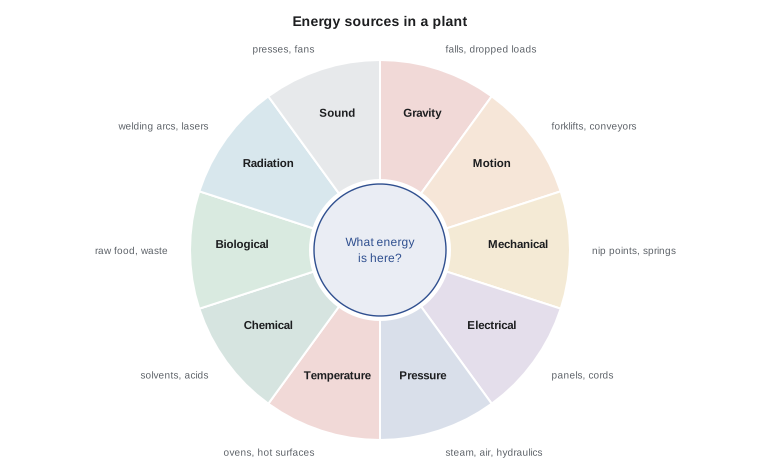
| Energy form | Plant examples | What could release it |
|---|---|---|
| Gravity | Elevated work, stacked pallets, suspended loads, open floor holes | A slip at height, a falling load, a collapsing stack |
| Motion | Forklifts, conveyors carrying product, rolling carts, swinging doors | A vehicle striking a pedestrian, product falling off a belt |
| Mechanical | Rotating shafts, gears, presses, blades, rollers, springs | Contact with moving parts, a released spring |
| Electrical | Panels, motor terminals, extension cords, static | Contact with live parts, arc flash, static spark |
| Pressure | Compressed air, hydraulics, steam, pressure vessels, gas cylinders | A burst hose, an opened line under pressure |
| Temperature | Ovens, fryers, molten metal, steam, cryogenic liquids, freezers | Contact burns, splashes, cold burns |
| Chemical | Cleaning agents, solvents, ammonia refrigerant, combustible dust | Spills, splashes, toxic release, fire or explosion |
| Biological | Raw meat and poultry, wastewater, mould, cooling towers | Infection, allergic reaction |
| Radiation | Welding arcs, lasers, X-ray inspection, nuclear gauges | Eye and skin damage, overexposure |
| Sound | Presses, compressors, grinders, blowers | Hearing loss, missed warnings |
High-energy hazards and direct controls
Research on serious injuries in industry has found that the amount of energy present is one of the best predictors of whether an incident could be fatal. Some studies use rough thresholds, such as a fall of more than about 1.2 m (4 ft), a suspended load over about 225 kg (500 lb), a vehicle moving faster than about 50 km/h (30 mph), or electrical energy above 50 V, to flag high-energy hazards. The exact numbers matter less than the habit: when you see high energy, ask whether there is a direct control that will work even if someone makes a mistake, such as a guard, an interlock, a barrier or isolation. Training, signs and PPE are useful, but they depend on people doing the right thing every time.
# Rough energy estimates for common plant hazards (illustrative values).
g = 9.81
hazards = {
    "200 kg die dropped 1.5 m":            200 * g * 1.5,
    "25 kg box falling 3 m from a rack":   25 * g * 3,
    "4,500 kg forklift at 10 km/h":        0.5 * 4500 * (10 / 3.6) ** 2,
    "80 kg worker falling 4 m":            80 * g * 4,
}
for name, joules in sorted(hazards.items(), key=lambda kv: -kv[1]):
    flag = "HIGH" if joules > 1500 else "lower"
print(f"{name:<36} {joules / 1000:6.2f} kJ {flag}")4,500 kg forklift at 10 km/h 17.36 kJ HIGH 80 kg worker falling 4 m 3.14 kJ HIGH 200 kg die dropped 1.5 m 2.94 kJ HIGH 25 kg box falling 3 m from a rack 0.74 kJ lower
Worked problem
High energy, weak control
In a warehouse area of a plant, finished pallets weighing about 600 kg are stored three high in racking. Aisles are shared by forklifts and pickers on foot. The only control for pedestrians is a sign that says 'Watch for forklifts'. How would you assess this?
Show solution
- Energy present: gravity (600 kg loads at height) and motion (forklifts in shared aisles). Both are high energy.
- Existing control: a sign, which depends entirely on people noticing and reacting.
- Direct controls available: separate pedestrian walkways with barriers, picking from dedicated aisles when trucks are excluded, rack end protection and load backstops.
- Until direct controls are in place, use interim measures such as time separation and blue warning lights, and treat this as a priority.
Answer: High-energy hazards are protected only by a sign. Direct controls such as physical separation and rack protection are needed.
Walking the plant
Formal inspections are covered in lesson 12 and HSE-407, but hazard recognition happens every time someone walks the floor. A few habits make it more effective.
| Habit | Why it helps |
|---|---|
| Walk at different times and shifts | Night and weekend shifts often run with fewer people and different practices |
| Look up, down and behind | Overhead loads, floor openings and equipment backs are easy to miss |
| Watch work being done, not just the area | Many hazards appear only during a task, such as reaching into a machine |
| Ask the operator | Operators know the workarounds, jams and near misses that never get reported |
| Question what has become normal | Long-standing problems stop being seen; fresh eyes help |
| Follow the energy | Trace power, air, steam and product lines to see what could be released |
| Check the non-routine | Ask how cleaning, changeovers and jam clearing are done |
Normalization of deviance
One of the strongest forces working against hazard recognition is normalization of deviance. A small departure from a rule or design, such as running a machine with a guard removed for a quick adjustment, works without incident. It happens again, and again. Over time the deviation becomes the normal way of working, and nobody sees it as a hazard any more. The term comes from Diane Vaughan's study of the 1986 Challenger shuttle loss, but the same pattern appears in plants everywhere. Signs of it include phrases like 'we always do it this way', tools left hanging on machines for bypassing interlocks, and taped-over sensors.
Worked problem
The taped photo-eye
A new supervisor notices that a light curtain on a palletizer has a piece of tape over one sensor. Operators say it trips too often from shrink wrap blowing in, and the tape has been there for months. What should the supervisor do?
Show solution
- Stop the palletizer: with the sensor taped, the light curtain may not protect people entering the cell.
- Remove the tape and test the light curtain; lock out the machine if it does not work correctly.
- Treat the nuisance trips as the real problem: adjust mounting, add a shield or change the wrapping process.
- Talk with the crew about why the workaround was used and how to raise such problems in future.
Answer: A long-standing bypass is a serious hazard. Restore the safeguard, fix the nuisance that caused the bypass, and address the culture that accepted it.
Reporting hazards and near misses
Hazard recognition is useful only if what people see is reported and acted on. Plants make reporting easy with simple cards, phone apps, boards in each area and a standing agenda item at shift meetings. The most important factor, though, is what happens after a report. If workers see their reports fixed, or get an explanation when a fix will take time, they keep reporting. If reports disappear, reporting stops.
# Hazard report follow-up: how fast are reports closed? (illustrative data, days to close)
import statistics
reports = {"guarding": [2, 5, 1, 9, 3], "housekeeping": [1, 1, 2, 1], "traffic": [14, 30, 7],
           "electrical": [3, 4], "ergonomics": [21, 45, 12, 60]}
for cat, days in reports.items():
    over = sum(d > 14 for d in days)
    print(f"{cat:<13} n={len(days)}  median {statistics.median(days):>4} days  over 14 days: {over}")
allds = [d for v in reports.values() for d in v]
print(f"All reports: median {statistics.median(allds)} days, {sum(d > 14 for d in allds)} of {len(allds)} took over two weeks")guarding n=5 median 3 days over 14 days: 0 housekeeping n=4 median 1.0 days over 14 days: 0 traffic n=3 median 14 days over 14 days: 1 electrical n=2 median 3.5 days over 14 days: 0 ergonomics n=4 median 33.0 days over 14 days: 3 All reports: median 4.5 days, 4 of 18 took over two weeks
From hazard to risk
Recognizing a hazard is the first step. The next is judging the risk, which depends on how likely harm is and how severe it would be. HSE-103 and HSE-223 cover risk matrices and other methods in depth. In plants, a simple matrix helps rank the hazards found during a walk so that the most serious get attention first.
# A 5 x 5 risk matrix applied to hazards found on a plant walk (illustrative ratings).
def band(s):
    return "HIGH" if s >= 15 else "MEDIUM" if s >= 8 else "LOW"
found = [  # (hazard, likelihood 1-5, severity 1-5)
    ("pedestrians in forklift aisle", 4, 5),
    ("taped light curtain on palletizer", 3, 5),
    ("hose across walkway", 4, 2),
    ("missing rack end protector", 2, 4),
    ("spray bottle with no label", 3, 2),
]
for h, l, s in sorted(found, key=lambda x: -(x[1] * x[2])):
print(f"{h:<36} L{l} x S{s} = {l * s:>2} {band(l * s)}")pedestrians in forklift aisle L4 x S5 = 20 HIGH taped light curtain on palletizer L3 x S5 = 15 HIGH hose across walkway L4 x S2 = 8 MEDIUM missing rack end protector L2 x S4 = 8 MEDIUM spray bottle with no label L3 x S2 = 6 LOW
Hazard recognition for contractors and visitors
People new to a plant see some hazards more clearly than regulars, because nothing is normal to them yet, but they also miss hazards that are specific to the process, such as a line that carries ammonia or a hopper that can contain combustible dust. A good host shows contractors the plant-specific hazards in their work area before they start, and encourages them to report anything that worries them. Some plants give contractors a quick hazard card listing the energies present in each area.
Job hazard analysis in plants
For tasks that are done regularly, plants record hazards and controls in a job hazard analysis (JHA), sometimes called a job safety analysis. The task is broken into steps, the hazards of each step are listed using the energy wheel as a prompt, and the controls are recorded. JHAs are most useful when they are written with the people who do the job, kept short, posted where the work is done, and reviewed when the task, equipment or materials change. For non-routine tasks such as unusual repairs, many plants use a quick field-level hazard assessment at the start of the job instead, which HSE-230 covers.
| Step | Hazards (energy) | Controls |
|---|---|---|
| Change slicer blade | Mechanical (blade edge), electrical (motor) | Lockout, cut-resistant gloves, blade guard tool |
| Clean slicer | Chemical (sanitizer), mechanical (blade) | Lockout, chemical goggles and gloves, blade cover |
| Reassemble and test | Mechanical (moving parts) | Guards replaced and checked before removing locks |
Common mistakes
MistakeRelying only on a checklist to find hazards.
InsteadUse the energy wheel to ask what energy is present and what could release it.
MistakeAccepting signs, training and PPE as enough for high-energy hazards.
InsteadLook for direct controls that work even when someone makes a mistake.
MistakeInspecting only empty areas between shifts.
InsteadWatch tasks being done, especially non-routine work, on different shifts.
MistakeTreating long-standing workarounds as normal.
InsteadRecognize normalization of deviance and restore the safeguard.
MistakeCollecting hazard reports without feedback.
InsteadFix reported hazards or explain timelines, or reporting will stop.
Summary and key terms
- Most serious plant injuries involve an uncontrolled release of energy.
- The energy wheel prompts you to look for ten forms of energy in an area.
- High-energy hazards need direct controls that work despite human error.
- Walk at different times, watch tasks, ask operators and follow the energy.
- Normalization of deviance turns workarounds into accepted practice.
- Reporting works only when people see action on their reports.
- A simple risk matrix ranks hazards so the most serious are fixed first.
- Hazard
- Something with the potential to cause harm.
- Risk
- The combination of how likely harm is and how severe it would be.
- Energy wheel
- A prompt listing forms of energy to look for when identifying hazards.
- High-energy hazard
- A hazard with enough energy to cause serious injury or death if released.
- Direct control
- A control that works even if a person makes a mistake, such as a guard or barrier.
- Normalization of deviance
- The gradual acceptance of departures from rules or design as normal.
- Workaround
- An informal way of getting a job done that bypasses the intended method or safeguard.
- Near miss
- An event that could have caused harm but did not.
- Hazard report
- A record of a hazard raised by a worker so that it can be fixed.
- Risk matrix
- A grid combining likelihood and severity ratings to rank risks.
Practice problems
Work each problem on paper first, then reveal the answer to check.
Name the ten forms of energy on the energy wheel.
Show answer
Gravity, motion, mechanical, electrical, pressure, temperature, chemical, biological, radiation and sound.
Give a plant example of pressure energy and how it could be released.
Show answer
A hydraulic hose bursting, or a compressed air line opened while pressurized.
Why are direct controls preferred for high-energy hazards?
Show answer
They work even when people make mistakes, unlike signs, training or PPE.
Estimate the potential energy of a 50 kg load at 4 m.
Show answer
50 × 9.81 × 4 ≈ 1,960 J, about 2 kJ.
Why should hazard walks include different shifts?
Show answer
Practices and staffing differ on night and weekend shifts.
What is normalization of deviance?
Show answer
The gradual acceptance of a departure from a rule or design as normal practice.
Give two signs of normalization of deviance in a plant.
Show answer
Taped sensors, bypass tools hanging on machines, "we always do it this way".
What should happen after a hazard report?
Show answer
It should be fixed, or the reporter told the plan and timeline.
A hazard has likelihood 3 and severity 5. What is its score and band on a 5 × 5 matrix?
Show answer
15, high.
What plant-specific hazards should a host show contractors?
Show answer
Process hazards in their work area, such as ammonia lines, dust hoppers or high-pressure systems.
Lesson quiz · 5 questions
Score 60% or more to complete this lesson.
Create a free account to save your progress, take quizzes and earn a certificate.