
HSE-310 · Lesson 7 of 12 · 25 min
Fire prevention, hot work and housekeeping
Fire is one of the oldest and most destructive industrial hazards. A plant fire can kill workers, destroy the business and harm the surrounding community. Most plant fires start in predictable ways: hot work near combustibles, electrical faults, overheated equipment such as bearings and motors, smoking, poor housekeeping that lets dust, oil and waste build up, and flammable liquids handled carelessly. This lesson covers fire prevention at plant level. HSE-216 covers hot work in depth, HSE-222 covers fire wardens and evacuation, HSE-312 covers chemical storage, and HSE-313 covers combustible dust.
How fires start and spread
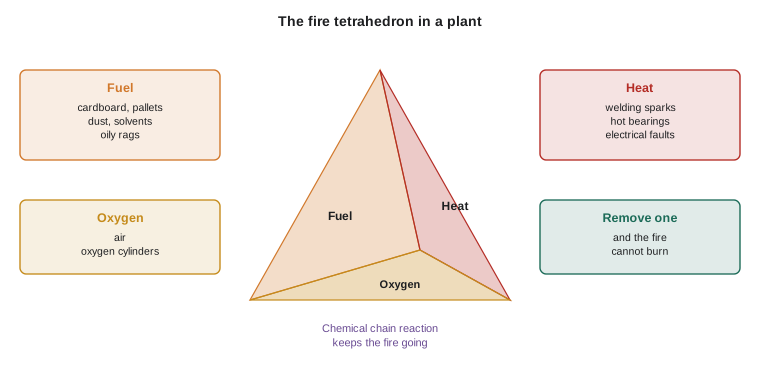
A fire needs fuel, oxygen and heat, and a chain reaction that keeps them going. Remove any one and the fire goes out. In a plant, fuel is everywhere: cardboard, pallets, plastic film, wood dust, flour, oil-soaked rags, hydraulic fluid, solvents and gas cylinders. Oxygen comes from the air, and sometimes from oxygen cylinders or oxidizing chemicals. Heat comes from sparks, hot surfaces, friction, electrical arcs, static discharge and chemical reactions. Prevention means keeping fuel and heat sources apart, and keeping fuel to a minimum.
| Ignition source | Plant examples | Prevention |
|---|---|---|
| Hot work | Welding, cutting, grinding, brazing, torch work | Hot work permits, clearance of combustibles, fire watch |
| Electrical | Overloaded cords, damaged wiring, loose connections, arcing motors | Inspection, thermography, no daisy-chained cords |
| Hot surfaces and friction | Overheated bearings, slipping belts, dryers, ovens | Maintenance, temperature monitoring, clearances |
| Smoking and open flames | Cigarettes, lighters, space heaters | Designated smoking areas, controlled heaters |
| Static electricity | Pouring flammable liquids, pneumatic conveying of powders | Bonding and grounding |
| Chemical reaction | Oily rags self-heating, incompatible chemicals, lithium-ion batteries | Metal rag containers, segregation, charging controls |
Housekeeping is fire prevention
Good housekeeping is one of the cheapest and most effective fire controls. Accumulated dust on beams and ducts, piles of cardboard and pallets, oily rags left on benches, waste bins overflowing beside equipment, and stock blocking sprinklers all give a small ignition the fuel to become a large fire. Housekeeping also matters for exits: a fire that would be survivable becomes deadly if exits and aisles are blocked. In plants that handle combustible dusts, such as flour, sugar, wood, plastics and metals, housekeeping is critical because a thin layer of settled dust can fuel a devastating secondary explosion when disturbed. HSE-313 covers combustible dust in detail.
| Housekeeping item | Standard to aim for |
|---|---|
| Combustible waste | Removed at least every shift; kept in closed metal containers where oily or flammable |
| Pallets and packaging | Stored in designated areas away from buildings or with sprinkler protection; limited quantities indoors |
| Dust on surfaces | Cleaned regularly using safe methods (vacuums rated for the dust, not compressed air) |
| Clearance below sprinklers | Kept clear as required by the fire code, commonly at least about 450 mm (18 in) below deflectors |
| Exits and aisles | Never blocked, even temporarily |
| Fire equipment | Extinguishers, hose cabinets and alarm pull stations visible and unobstructed |
| Flammable liquids | In approved containers and cabinets; only working quantities at workstations |
# Fire load of material left near a work area (illustrative heats of combustion, MJ/kg).
heat = {"cardboard": 16, "wood pallets": 17, "polyethylene film": 44, "hydraulic oil": 42}
stock = {"cardboard": 120, "wood pallets": 200, "polyethylene film": 30, "hydraulic oil": 20}  # kg
total = 0
for item, kg in stock.items():
    mj = kg * heat[item]; total += mj
    print(f"{item:<18} {kg:>4} kg x {heat[item]:>2} MJ/kg = {mj:>6,} MJ")
print(f"Total fire load: {total:,} MJ (about {total / 3.6:,.0f} kWh of heat)")cardboard 120 kg x 16 MJ/kg = 1,920 MJ wood pallets 200 kg x 17 MJ/kg = 3,400 MJ polyethylene film 30 kg x 44 MJ/kg = 1,320 MJ hydraulic oil 20 kg x 42 MJ/kg = 840 MJ Total fire load: 7,480 MJ (about 2,078 kWh of heat)
Hot work in plants
Hot work is any work that produces flames, sparks or enough heat to ignite materials: welding, cutting, brazing, soldering, grinding and torch work. It causes a large share of industrial fires, often hours after the work has finished, when smouldering material bursts into flame after everyone has left. The first question is always whether hot work can be avoided, for example by using cold cutting, mechanical joining or moving the part to a designated welding shop. If it cannot, a hot work permit controls the job.
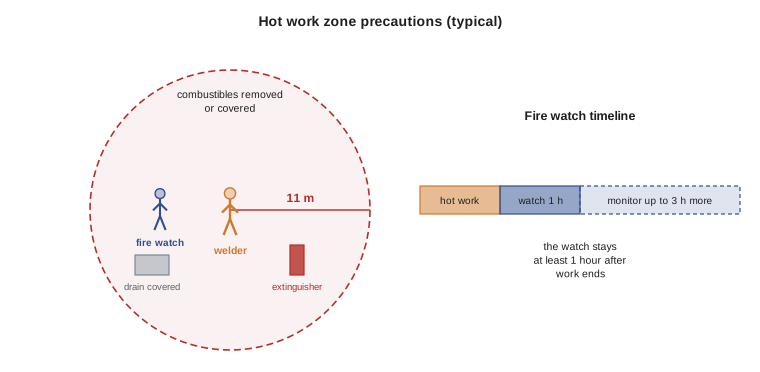
In Canada, hot work is governed by provincial OHS regulations, the National Fire Code of Canada as adopted by each province, and CSA W117.2, Safety in welding, cutting and allied processes. Many plants and insurers also follow NFPA 51B. Common practice is to remove or protect combustibles within 11 m (35 ft) of the work, cover floor and wall openings, wet down or shield combustible floors, provide suitable extinguishers, and post a trained fire watch during the work and for a period afterwards.
NFPA 51B has lengthened the required fire watch over time. Since its 2019 edition it has called for a fire watch of at least one hour after hot work ends, with further monitoring of the area for up to three additional hours as decided by the person who authorizes the permit. Older practice of 30 minutes still appears in some plant procedures and regulations, so check which rule your plant follows, and use the longer period where there is any doubt.
Worked problem
A grinding job near a baler
A maintenance mechanic needs to grind a broken bolt on a frame about 6 m (20 ft) from a cardboard baler surrounded by loose cardboard. The plant wants it done during production. What should happen?
Show solution
- Ask whether hot work can be avoided, for example by drilling out the bolt instead of grinding.
- If grinding is needed, issue a hot work permit; the loose cardboard is inside the combustible clearance distance.
- Remove the loose cardboard, cover the baler opening with a fire blanket and place a screen to contain sparks.
- Post a trained fire watch with a suitable extinguisher during the work and for at least one hour afterwards, then check the area again later.
Answer: Avoid hot work if possible; otherwise clear or protect combustibles within the clearance distance, contain sparks and keep a fire watch during and after the job.
Flammable and combustible liquids
Flammable liquids such as solvents, thinners and some cleaning agents give off vapours that can ignite well away from the liquid itself. Their hazard depends on the flash point: the lowest temperature at which the liquid gives off enough vapour to ignite. A liquid with a flash point below room temperature can form an ignitable mixture at any time. Plants control flammable liquids by limiting quantities at workstations, storing them in approved containers and cabinets, bonding and grounding during transfer, ventilating work areas and keeping ignition sources away. HSE-312 covers storage and handling in detail.
# Classifying liquids by flash point (simplified GHS categories; illustrative values).
liquids = {"acetone": -20, "isopropyl alcohol": 12, "mineral spirits": 40, "diesel": 55, "hydraulic oil": 200}
def ghs(fp):
    if fp < 23: return "Category 1 or 2 flammable (very easily ignited)"
    if fp <= 60: return "Category 3 flammable"
    if fp <= 93: return "Category 4 combustible"
    return "Not classified as flammable (still burns when heated)"
for name, fp in liquids.items():
print(f"{name:<18} flash point {fp:>4} C -> {ghs(fp)}")acetone flash point -20 C -> Category 1 or 2 flammable (very easily ignited) isopropyl alcohol flash point 12 C -> Category 1 or 2 flammable (very easily ignited) mineral spirits flash point 40 C -> Category 3 flammable diesel flash point 55 C -> Category 3 flammable hydraulic oil flash point 200 C -> Not classified as flammable (still burns when heated)
Fire protection systems
Prevention reduces the chance of fire; protection limits the damage when one starts. Plants rely on detection and alarm systems, sprinklers, special suppression systems for hazards such as fryers, paint booths and data rooms, portable extinguishers and hose stations, and fire separations that stop fire spreading between areas. These systems must be inspected, tested and maintained. A sprinkler valve left closed after maintenance, or an extinguisher hidden behind stock, can turn a small fire into a disaster. Impairment procedures, such as tagging a closed valve and arranging a fire watch while protection is out of service, are part of the permit system.
| System | What it does | Typical check |
|---|---|---|
| Fire alarm and detection | Detects smoke or heat and warns occupants | Regular testing of devices and alarm audibility |
| Automatic sprinklers | Controls or extinguishes fire with water | Valves locked open, gauges, flow tests, clearance below heads |
| Special suppression | Protects specific hazards with foam, wet chemical, gas | Service by a qualified contractor |
| Portable extinguishers | Lets trained people attack small fires | Monthly visual check, annual service |
| Fire separations and doors | Stops fire and smoke spreading | Doors close and latch; no wedges |
Portable extinguishers are for small fires only, and only for people trained to use them. If a fire is larger than a wastebasket, spreading, producing heavy smoke, or between you and the exit, leave and raise the alarm. Choose the extinguisher for the fuel: water or foam for ordinary combustibles, dry chemical or carbon dioxide for flammable liquids and electrical equipment, wet chemical for cooking oils, and special agents for combustible metals.
Electrical fires and thermography
Electrical faults are among the leading causes of industrial fires. Loose connections, overloaded circuits, failing insulation and dust inside panels create heat long before they start a fire. Infrared thermography surveys, done while equipment is running under load, find these hot spots so they can be repaired during planned downtime. Many insurers expect an annual survey of switchgear, motor control centres and major panels. Simple daily habits also matter: do not overload power bars, do not run extension cords through doorways or under mats, keep panel doors closed and the area in front of them clear, and report any burning smell, discoloured outlet or warm plug at once.
Lithium-ion batteries
Lithium-ion batteries now power many plant tools, forklifts, automated guided vehicles and scanners. Damaged, overcharged or poorly made batteries can go into thermal runaway, venting flammable gases and burning intensely, and the fires are hard to put out. Plants control the risk with charging areas away from combustibles and exits, chargers approved for the battery, inspection and removal of damaged packs, and storage limits. HSE-322 covers battery hazards in more depth.
Common mistakes
MistakeTreating housekeeping as appearance rather than fire prevention.
InsteadAccumulated dust, packaging and oily waste are fuel; remove them routinely.
MistakeEnding the fire watch as soon as welding stops.
InsteadKeep a fire watch at least one hour afterwards and check again later, per current NFPA 51B practice.
MistakeUsing compressed air to blow down combustible dust.
InsteadUse vacuums rated for the dust; blowing dust can create an explosive cloud.
MistakeStoring stock right up to sprinkler heads.
InsteadKeep the required clearance below sprinkler deflectors.
MistakeFighting any fire with the nearest extinguisher.
InsteadFight only small fires you are trained for, with the right type, and leave if in doubt.
Summary and key terms
- Most plant fires start from hot work, electrical faults, hot surfaces, smoking, static and poor housekeeping.
- Fire needs fuel, oxygen, heat and a chain reaction; prevention keeps fuel and heat apart.
- Housekeeping is a core fire control and critical where combustible dust is present.
- Avoid hot work where possible; otherwise use permits, clear combustibles within 11 m (35 ft) and keep a fire watch.
- Current NFPA 51B practice is a fire watch of at least one hour, with monitoring up to three more hours.
- Flammable liquids are controlled by quantity limits, approved storage, bonding and grounding, and ventilation.
- Fire protection systems must be maintained, and impairments managed through the permit system.
- Fire tetrahedron
- The four elements a fire needs: fuel, oxygen, heat and a chemical chain reaction.
- Hot work
- Work producing flames, sparks or heat able to ignite materials, such as welding and grinding.
- Fire watch
- A trained person who watches for and responds to fires during and after hot work.
- Combustible clearance
- The distance within which combustibles must be removed or protected during hot work.
- Flash point
- The lowest temperature at which a liquid gives off enough vapour to ignite.
- Bonding and grounding
- Connecting containers to each other and to earth to prevent static sparks.
- Fire load
- The total heat that could be released by burning all combustibles in an area.
- Impairment
- A period when a fire protection system is out of service.
- Housekeeping
- Keeping work areas clean, orderly and free of waste and obstructions.
- Secondary dust explosion
- A larger explosion when settled dust is lifted and ignited by a first event.
Practice problems
Work each problem on paper first, then reveal the answer to check.
Name the four elements of the fire tetrahedron.
Show answer
Fuel, oxygen, heat and a chemical chain reaction.
List four common ignition sources in plants.
Show answer
Any four: hot work, electrical faults, hot surfaces and friction, smoking, static, chemical reactions.
Why is housekeeping a fire control?
Show answer
It removes fuel and keeps exits and fire equipment clear.
Why should compressed air not be used to clean combustible dust?
Show answer
It lifts dust into a cloud that can explode.
What is the first question for any hot work job?
Show answer
Whether hot work can be avoided by another method.
Within what distance must combustibles be removed or protected for hot work?
Show answer
Commonly 11 m (35 ft).
How long does current NFPA 51B practice require a fire watch after hot work?
Show answer
At least one hour, with further monitoring up to three additional hours as decided.
What is a flash point?
Show answer
The lowest temperature at which a liquid gives off enough vapour to ignite.
What is a fire protection impairment and how is it managed?
Show answer
A system out of service; tag it, notify, arrange a fire watch and restore it promptly.
When should you not fight a fire with an extinguisher?
Show answer
If it is larger than a wastebasket, spreading, smoky, between you and the exit, or you are not trained.
Lesson quiz · 5 questions
Score 60% or more to complete this lesson.
Create a free account to save your progress, take quizzes and earn a certificate.