
HSE-310 · Lesson 1 of 12 · 27 min
Industrial plants and why people get hurt
A plant is a place where many hazards meet. A food-processing plant has conveyors, slicers, ammonia refrigeration, wet floors, forklifts and sanitation chemicals. A metal fabrication shop has presses, lasers, welding, overhead cranes and heavy plate. A sawmill, a pulp mill, a bakery, a bottling line, an auto parts stamping plant, a chemical blending facility and a recycling depot each bring their own mix. People in these plants are often skilled and experienced, yet serious injuries keep happening, and they tend to happen in a small number of predictable ways.
This course is the entry course of the industrial sites track. It is written for workers, supervisors and contractors who work in or visit manufacturing and processing plants. It pulls together the hazard courses you may already have taken, such as lockout (HSE-210), confined spaces (HSE-211), fall protection (HSE-212), machine guarding (HSE-215), hot work (HSE-216) and forklifts (HSE-218), and shows how a plant manages them as one system: orientation, permits, traffic plans, inspections, shutdowns and emergency plans. It is awareness training. It does not replace the site-specific orientation, equipment training and competency checks your employer must provide under provincial occupational health and safety law.
What makes a plant different
Most plants combine four things that raise risk. First, they concentrate energy: electrical, mechanical, hydraulic, pneumatic, thermal, chemical and gravitational energy are all present in one building, often in large amounts. Second, they run continuously or in long shifts, so maintenance is done under time pressure and sometimes on running equipment. Third, they mix people and moving vehicles in the same aisles. Fourth, they rely on many contractors, especially during shutdowns, who may not know the plant well. Each of these is manageable on its own. The danger comes when they combine: a contractor, unfamiliar with the site, clearing a jam on a conveyor that someone else restarts, in a noisy area where nobody hears a shout.
| Feature | Why it raises risk | Where this course deals with it |
|---|---|---|
| Concentrated energy | Many energy sources can be released at once | Lessons 4, 5 and 11 |
| Continuous production | Pressure to fix problems without stopping the line | Lessons 5 and 11 |
| People and vehicles mixed | Pedestrians struck by forklifts and trucks | Lesson 8 |
| Many contractors | Unfamiliar with plant rules, layout and hazards | Lessons 3 and 11 |
| Chemicals and processes | Fires, explosions and toxic releases | Lessons 7 and 9 |
| Health hazards | Noise, dust, fumes and heat cause long-term illness | Lesson 10 |
The numbers
Manufacturing is one of the larger sources of accepted lost-time claims in Canada. Figures published by the Association of Workers' Compensation Boards of Canada show manufacturing near the top of the list each year, along with health care, construction, retail and transportation. The most common lost-time injuries in plants are strains and sprains from lifting and repetitive work, followed by contact injuries: being struck by objects, caught in or between machinery, and cut by tools or blades. Deaths are rarer but cluster around a few events: machinery entanglement, crushing by mobile equipment, falls from height, falling objects and explosions. Occupational disease from long-term exposure to noise, dust and chemicals adds a large hidden toll that shows up years later.
Measuring injury rates
To compare plants of different sizes, safety professionals turn injury counts into rates. A rate divides the number of cases by the amount of work done, then scales it to a standard number of hours. Two conventions are common, and mixing them up leads to wrong comparisons.
In Canada, workers' compensation boards often report claims per 100 workers covered, and many companies report a lost-time injury frequency per 200,000 hours, the same base used in the United States. International companies and some Canadian firms use 1,000,000 hours instead. The 200,000-hour base represents 100 full-time workers each working about 2,000 hours a year, so a rate of 2.0 per 200,000 hours means roughly two cases per 100 workers a year. Always check which base a figure uses.
# Injury rates for an illustrative plant with 240 workers.
hours = 240 * 1980          # hours worked in the year
recordable = 9              # all recordable injuries and illnesses
lost_time = 3               # cases with days away from work
restricted = 2              # restricted work or job transfer only
def rate(cases, base):
    return cases * base / hours
print(f"Hours worked: {hours:,}")
print(f"Total recordable rate (per 200,000 h): {rate(recordable, 200_000):.2f}")
print(f"DART rate (per 200,000 h):           {rate(lost_time + restricted, 200_000):.2f}")
print(f"Lost-time frequency (per 200,000 h): {rate(lost_time, 200_000):.2f}")
print(f"Lost-time frequency (per 1,000,000 h): {rate(lost_time, 1_000_000):.2f}")Hours worked: 475,200 Total recordable rate (per 200,000 h): 3.79 DART rate (per 200,000 h): 2.10 Lost-time frequency (per 200,000 h): 1.26 Lost-time frequency (per 1,000,000 h): 6.31
Worked problem
Comparing two plants fairly
Plant A had 6 lost-time injuries in 600,000 hours. Plant B had 4 lost-time injuries in 250,000 hours. Plant B's manager says it is safer because it had fewer injuries. Is that right?
Show solution
- Plant A rate: 6 × 200,000 ÷ 600,000 = 2.0 per 200,000 hours.
- Plant B rate: 4 × 200,000 ÷ 250,000 = 3.2 per 200,000 hours.
- Plant B worked far fewer hours, so its smaller count hides a higher rate.
- Small plants should also look at several years together, because one or two cases swing the rate a lot.
Answer: No. Plant B's rate is 60 per cent higher than Plant A's, even though its count is lower.
The injury triangle and its limits
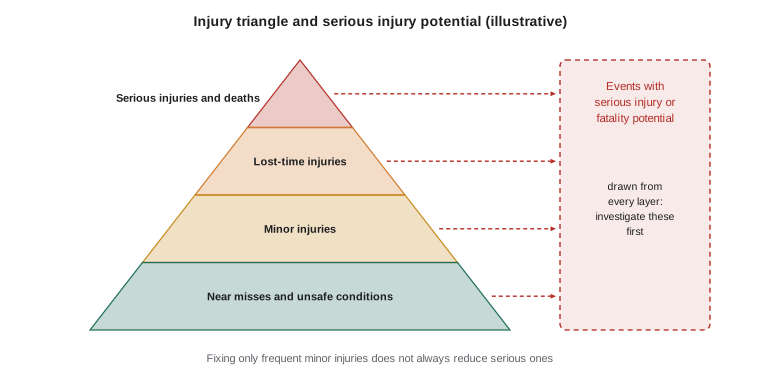
Many people have seen the safety triangle or pyramid: one serious injury at the top, above many minor injuries, and very many near misses and unsafe acts at the base. It comes from early studies by H. W. Heinrich in the 1930s and Frank Bird in the 1960s, who counted incidents in insurance records and companies and found far more minor events than serious ones. The idea that you can prevent serious injuries simply by driving down minor ones turned out to be misleading. Plants that cut their minor injury rate sharply did not always see fewer fatalities, because the events that kill people, such as entanglement, crushing and explosions, often have different causes from cuts and sprains.
Modern practice keeps the useful part of the triangle, which is that near misses and minor events are valuable warnings, and adds a sharper focus on serious injury and fatality (SIF) potential. A slip on a wet floor and a near miss with a reversing forklift are both minor events, but only the second could easily have killed someone. Plants now sort incidents by their potential, not just their outcome, and investigate high-potential events as seriously as actual serious injuries. Lesson 12 and HSE-403 return to this.
# Sorting a month of plant incidents by potential, not just outcome (illustrative).
incidents = [
    ("slip on wet floor, bruised knee", "minor", False),
    ("forklift reversed past pedestrian, no contact", "near miss", True),
    ("hand cut on sheet edge", "minor", False),
    ("guard removed on running conveyor, no injury", "near miss", True),
    ("strain lifting a box", "minor", False),
    ("dropped load from crane missed worker", "near miss", True),
    ("eye irritation from cleaning chemical", "minor", False),
]
sif = [d for d, o, p in incidents if p]
print(f"{len(incidents)} events; {len(sif)} had serious injury or fatality potential:")
for d in sif:
print(" -", d)7 events; 3 had serious injury or fatality potential: - forklift reversed past pedestrian, no contact - guard removed on running conveyor, no injury - dropped load from crane missed worker
How serious plant injuries happen
When serious plant injuries are investigated, the same few patterns appear again and again. Knowing them helps you spot the moment when an ordinary task becomes dangerous.
| Pattern | Typical situation | Main control |
|---|---|---|
| Caught in running machinery | Clearing a jam, cleaning or adjusting with the machine energized | Guarding and lockout (HSE-215, HSE-210) |
| Struck or crushed by mobile equipment | Pedestrian in a forklift aisle or at a loading dock | Traffic separation (lesson 8, HSE-218) |
| Falls from height | Accessing mezzanines, tanks, racking or equipment tops | Fall protection and safe access (HSE-212) |
| Struck by falling or moving objects | Suspended loads, stacked material, ejected parts | Crane and storage controls (HSE-219) |
| Fire and explosion | Hot work near combustibles, dust, flammable liquids | Permits and housekeeping (lessons 6, 7 and 9) |
| Hazardous atmospheres | Entry into tanks, pits or silos | Confined space program (HSE-211) |
| Release of stored energy | Hydraulic, pneumatic, steam or electrical energy during maintenance | Isolation and verification (lesson 11) |
Look at how many of these involve maintenance, cleaning or clearing problems rather than normal production. When a line is running smoothly, guards are on and people are in their usual places. When something goes wrong, people reach in, climb up, open covers and bypass interlocks to get production moving again. That is why so much of this course is about non-routine work.
Worked problem
A night shift jam
On a night shift, a bottle filler jams. The operator, who has cleared the same jam many times, opens a guard door, which stops the filler through an interlock. A second operator, not knowing the first is inside, resets the interlock to restart the line. What went wrong, and what would have prevented it?
Show solution
- The interlock stopped the machine but was never meant to protect a person inside; a reset by someone else can restart it.
- Clearing the jam was treated as routine, so nobody applied a personal lock.
- There was no positive communication between the two operators about who was inside.
- A jam-clearing procedure using lockout, or a designed alternative such as a trapped-key system with the key carried inside, would have prevented a restart.
Answer: Routine jam clearing relied on an interlock instead of energy isolation under the person's own control. Lockout or an equivalent designed method was needed.
Costs beyond the injury
A serious plant injury costs far more than the medical and compensation bills. Production stops while the scene is secured and investigated. Equipment may be damaged. Regulators may issue orders that shut down a line until it is fixed. Prosecutions can follow, with fines for the company and in some cases charges against individuals. Customers may lose confidence, and good workers may leave. Research on injury costs consistently finds that these indirect costs are several times the direct costs, which is one reason why well-run plants treat safety as part of running the business, not as a separate program.
# Direct and indirect costs of one serious caught-in injury (illustrative).
direct = {"medical and compensation": 85_000}
indirect = {
    "lost production (2 shifts down)": 64_000,
    "investigation and management time": 18_000,
    "repairs and guarding upgrades": 22_000,
    "replacement worker and training": 15_000,
    "overtime to catch up": 21_000,
}
d = sum(direct.values()); i = sum(indirect.values())
for k, v in {**direct, **indirect}.items():
    print(f"{k:<36} ${v:>9,}")
print(f"{'total':<36} ${d + i:>9,} (indirect is {i / d:.1f} x direct)")medical and compensation $ 85,000 lost production (2 shifts down) $ 64,000 investigation and management time $ 18,000 repairs and guarding upgrades $ 22,000 replacement worker and training $ 15,000 overtime to catch up $ 21,000 total $ 225,000 (indirect is 1.6 x direct)
Common mistakes
MistakeJudging plant safety by the number of injuries alone.
InsteadCompare rates per hours worked, and look at several years for small plants.
MistakeAssuming fewer minor injuries automatically means fewer fatalities.
InsteadSerious injuries often have different causes; track and investigate events with serious potential.
MistakeTreating jam clearing and cleaning as routine production work.
InsteadNon-routine work on equipment is where many serious injuries happen and needs energy control.
MistakeRelying on an interlock to protect a person inside a machine.
InsteadInterlocks stop machines; lockout or a designed equivalent keeps them stopped under your control.
MistakeTreating this course as the site orientation.
InsteadEach plant must give its own orientation and equipment training; this course is awareness.
Summary and key terms
- Plants concentrate energy, run continuously, mix people and vehicles, and rely on contractors.
- Most injuries are strains and contact injuries; serious ones cluster around a few event types.
- Injury rates per 200,000 hours allow fair comparison; check the base and look at several years.
- The injury triangle is useful for near misses but misleading for serious injury prevention.
- Sort incidents by serious injury and fatality potential, not only by outcome.
- Maintenance, cleaning and clearing problems account for many serious plant injuries.
- Indirect costs of serious injuries are usually several times the direct costs.
- Industrial establishment
- A factory, plant, shop or similar workplace where goods are made, processed or handled.
- Lost-time injury
- An injury that keeps the worker away from work beyond the day of the injury.
- Total recordable case rate
- All recordable injuries and illnesses per 200,000 hours worked.
- DART rate
- Cases with days away, restricted work or job transfer per 200,000 hours worked.
- Frequency rate
- Number of injuries per a standard number of hours, such as 200,000 or 1,000,000.
- Near miss
- An event that could have caused harm but did not.
- SIF potential
- Whether an event could reasonably have caused a serious injury or fatality.
- Non-routine work
- Tasks outside normal production, such as maintenance, cleaning and clearing jams.
- Indirect cost
- A cost of an incident beyond medical and compensation costs, such as lost production.
- Interlock
- A device that stops a machine when a guard is opened.
Practice problems
Work each problem on paper first, then reveal the answer to check.
Name four features of plants that raise risk.
Show answer
Concentrated energy, continuous production, people and vehicles mixed, many contractors (also chemicals and health hazards).
A plant had 5 recordable cases in 400,000 hours. What is its rate per 200,000 hours?
Show answer
5 × 200,000 ÷ 400,000 = 2.5.
Why can a small plant's injury rate swing a lot from year to year?
Show answer
With few hours worked, one or two cases change the rate greatly.
What does the 200,000-hour base represent?
Show answer
About 100 full-time workers each working 2,000 hours a year.
What is the main weakness of the injury triangle?
Show answer
Reducing minor injuries does not reliably reduce serious ones, which often have different causes.
Give two examples of near misses with serious injury potential.
Show answer
A forklift passing close to a pedestrian; a dropped load landing near a worker; a guard removed on running equipment.
Why do so many serious injuries happen during non-routine work?
Show answer
Guards are opened, people reach in or climb up, and time pressure encourages shortcuts.
Why is an interlock not enough when someone enters a machine?
Show answer
Someone else can reset it and restart the machine; lockout keeps control with the person at risk.
List three indirect costs of a serious injury.
Show answer
Lost production, investigation time, repairs, replacement workers, overtime, regulatory orders.
Does this course replace site orientation?
Show answer
No. Each employer must give site-specific orientation and equipment training.
Lesson quiz · 5 questions
Score 60% or more to complete this lesson.
Create a free account to save your progress, take quizzes and earn a certificate.