
HSE-310 · Lesson 3 of 12 · 25 min
Site orientation, plant rules and contractor safety
The first hour someone spends in a plant shapes how they work there. A new employee, a summer student, a delivery driver, a visiting engineer and a contractor's millwright all arrive knowing little about the hazards, the layout, the alarms and the rules. Orientation exists to close that gap before anyone is exposed. A good orientation is short, specific, practical and checked; a poor one is a long video followed by a signature.
Who needs what
Not everyone needs the same orientation. A visitor escorted along a marked walkway to the office needs to know the emergency alarm, where to muster and what PPE to wear. A contractor doing maintenance on production equipment needs much more: the permit system, lockout rules, traffic routes, hazardous areas, who to report to and how to stop work. A new production worker needs the full plant orientation plus training on each task and machine before working alone. Plants often use a tiered approach so that each group gets what it needs without wasting time.
| Group | Minimum orientation | Additional before work |
|---|---|---|
| Escorted visitor | Alarm, muster point, PPE, stay with escort | None |
| Delivery driver | Route to dock, where to wait, vehicle rules, no entry to the floor | Dock procedure (wheel chocks, restraints) |
| Contractor worker | Full plant orientation, permit and lockout rules, hazardous areas | Job-specific briefing and permit |
| New employee | Full plant orientation and rights and duties | Task and equipment training, supervised start |
| Transferred employee | Area-specific hazards and procedures | Equipment training for the new area |
| Returning after long absence | Changes since they left | Refresher on equipment changed |
What a plant orientation covers
Most plant orientations cover the same core topics. The order matters: start with what could kill someone in the first hour, then move to how work is organized, then to how to raise concerns. Wherever possible, show rather than tell. Walk the route to the muster point, show the alarm sounding, point out the forklift aisles and the pedestrian walkways, and demonstrate how a lock and tag are applied.
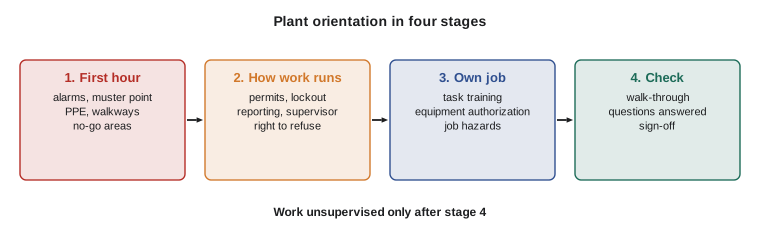
| Topic | What the person must know or do |
|---|---|
| Emergency alarms and muster | Recognize each alarm, know the nearest exits and the muster point, report to the warden |
| PPE rules | Which PPE is required where, how to wear and check it |
| Traffic and walkways | Use marked walkways; never walk behind a reversing truck; make eye contact with drivers |
| No-go and restricted areas | Areas requiring authorization, such as electrical rooms, confined spaces, robot cells |
| Permit-to-work and lockout | No work on equipment without the right permit and personal lock |
| Reporting | How to report hazards, near misses and injuries, and to whom |
| Right to refuse and stop work | How to stop a job that is unsafe without fear of reprisal |
| Hazardous materials | Where labels and safety data sheets are, and the main chemicals present |
| Housekeeping and smoking | Where smoking is allowed, how to keep aisles and exits clear |
| First aid | Location of first aid kits, eyewash stations, AEDs and trained first aiders |
In Ontario, employers must give workers information and instruction about hazards and how to protect themselves, and must provide basic health and safety awareness training to every worker and supervisor (Ontario Regulation 297/13). Under the Workplace Hazardous Materials Information System (WHMIS), workers must receive training on the hazardous products they use. Young and new workers are injured at higher rates in their first months on the job, so many provinces stress orientation for them in particular.
Checking understanding
A signature on an attendance sheet proves only that someone was present. Better plants check understanding before the person works: a short walk-through where the newcomer shows the route to the muster point and names the alarms, a few practical questions at the machine, or a supervised first shift. Language matters. If someone cannot read the orientation material or follow the spoken instructions, they have not been oriented. Plants with multilingual workforces use interpreters, translated materials and pictograms, and pair new workers with experienced colleagues who share their language.
# Orientation sign-off check: who is allowed to start unsupervised work today? (illustrative)
people = [
    {"name": "A. Singh", "type": "employee", "plant": True, "task": True, "walkthrough": True},
    {"name": "B. Lopez", "type": "contractor", "plant": True, "task": False, "walkthrough": True},
    {"name": "C. Nguyen", "type": "employee", "plant": True, "task": True, "walkthrough": False},
    {"name": "D. Kowalski", "type": "contractor", "plant": True, "task": True, "walkthrough": True},
]
for p in people:
    missing = [k for k in ("plant", "task", "walkthrough") if not p[k]]
    status = "cleared" if not missing else "NOT cleared - missing " + ", ".join(missing)
print(f"{p['name']:<12} {p['type']:<10} {status}")A. Singh employee cleared B. Lopez contractor NOT cleared - missing task C. Nguyen employee NOT cleared - missing walkthrough D. Kowalski contractor cleared
Plant rules that save lives
Many plants have adopted a short list of life-saving rules: a handful of absolute rules covering the activities most likely to kill. They are deliberately few, simple and enforced consistently, so that everyone knows them by heart. Breaking one is treated as a serious matter, but the emphasis is on making them easy to follow, for example by providing locks, walkways and permits, rather than on discipline after the fact.
| Life-saving rule | What it means in practice |
|---|---|
| Energy isolation | Never work on equipment without isolating energy and applying your personal lock |
| Line of fire | Never put any part of your body where moving equipment, loads or released energy could strike it |
| Mobile equipment | Stay in pedestrian walkways; never enter an operating area without the driver's acknowledgement |
| Working at height | Use fall protection or approved access above the plant's height threshold |
| Confined space | Never enter without a valid entry permit, testing and a standby attendant |
| Hot work | Never start hot work without a valid permit and fire watch |
| Bypassing safety devices | Never bypass, defeat or remove a guard or interlock without authorization |
| Impairment | Never work under the influence of alcohol, cannabis or drugs that affect safety |
Contractors in the plant
Contractors do some of the most hazardous work in plants: maintenance, repairs, installation, cleaning, demolition and shutdown work. They often work on unfamiliar equipment, at odd hours, under schedule pressure, and alongside plant staff who are running production. Studies of serious incidents in process industries have repeatedly found contractors over-represented among those killed. A contractor safety program manages this risk through the whole life of the contract: before, during and after.
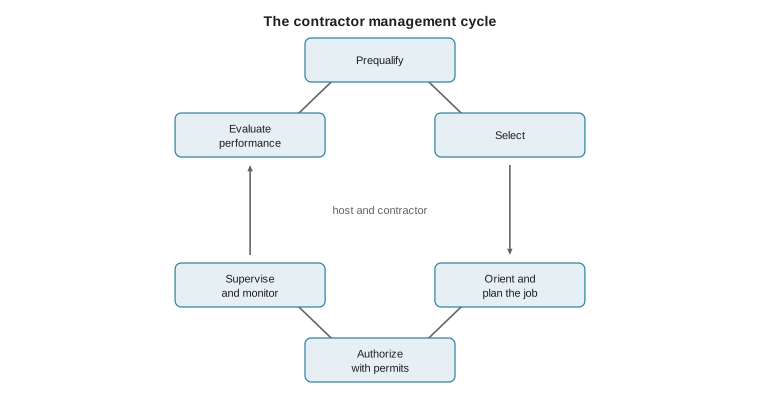
Prequalification looks at a contractor's safety record and systems before it is invited to bid. Common evidence in Canada includes workers' compensation clearance letters and experience rating, a Certificate of Recognition (COR) or equivalent from a provincial safety association, written safety programs, training records and insurance. Many companies use third-party prequalification services. HSE-406 and CON-330 cover prequalification scoring in detail.
# Weighted prequalification score for three contractors (illustrative weights and scores 0-10).
weights = {"injury record": 0.30, "safety program": 0.25, "training records": 0.15,
           "references": 0.15, "regulatory history": 0.15}
contractors = {
    "Northline Mechanical": {"injury record": 8, "safety program": 7, "training records": 9, "references": 8, "regulatory history": 10},
    "Ridge Industrial":     {"injury record": 5, "safety program": 9, "training records": 6, "references": 7, "regulatory history": 6},
    "Bayview Millwrights":  {"injury record": 9, "safety program": 5, "training records": 5, "references": 9, "regulatory history": 9},
}
for name, s in contractors.items():
    score = sum(weights[k] * s[k] for k in weights) * 10
    flag = "acceptable" if score >= 70 else "needs improvement plan"
print(f"{name:<22} {score:5.1f}/100 {flag}")Northline Mechanical 82.0/100 acceptable Ridge Industrial 66.0/100 needs improvement plan Bayview Millwrights 74.0/100 acceptable
Once a contractor is on site, the host plant and the contractor must agree who controls what. The host knows the plant hazards, the permit system and the emergency arrangements. The contractor knows its own work methods, tools and workers. A pre-job meeting brings these together: scope of work, hazards on both sides, permits needed, isolation points, interfaces with production, emergency contacts and who will supervise. Contractor supervisors must be on site and engaged, not just named on paper.
Worked problem
Planning a contractor job
A contractor is hired to replace a gearbox on a conveyor in a busy packaging area during a weekend. What should the pre-job meeting settle?
Show solution
- Scope and sequence: remove guard, isolate, rig out old gearbox, install new one, test.
- Permits: lockout of the conveyor and adjacent equipment; lifting plan for the gearbox; hot work only if cutting or welding is needed.
- Interfaces: which nearby lines will run, barricades between the work area and forklift routes.
- People: names of the contractor supervisor and plant contact, emergency numbers, muster point.
- Handover: who tests the conveyor after work, and how locks are removed and production restarted.
Answer: A short written plan agreed by both supervisors, with permits, barricades, named contacts and a defined handover back to production.
Monitoring and evaluation
Throughout the job, the host monitors contractor work: checking permits, visiting the work area, watching for unsafe acts and conditions, and stopping work if necessary. Problems are discussed with the contractor supervisor, not only with individual workers. At the end, the host evaluates the contractor's safety performance, including incidents, permit compliance and cooperation, and records it so that the next prequalification decision is informed by real performance, not just paperwork.
Young, new and temporary workers
People in their first months at a plant are injured at noticeably higher rates than experienced workers, whatever their age. They do not yet know the hidden hazards, the informal warning signs or the right person to ask, and they may be reluctant to question instructions. Young workers can add inexperience and a wish to impress. Temporary agency workers may move between sites every few weeks and receive the thinnest orientation of all. Good plants give these groups extra attention: a named buddy or mentor, a gradual introduction to more hazardous tasks, frequent check-ins by the supervisor, and clear encouragement to ask questions and to stop when unsure.
In Canada, provincial laws set minimum ages for certain work, such as 15 or 16 for factories in several provinces and higher ages for some hazardous tasks, and Ontario's basic awareness training applies to every worker, including students and temporary workers. Host employers and temporary help agencies share responsibility for agency workers' safety, and in Ontario a host employer's injury record reflects injuries to agency workers placed with it.
Whatever the legal details, a simple test applies: before anyone works without close supervision, would you be comfortable explaining to their family exactly how they were prepared for the job?
Common mistakes
MistakeTreating a signed attendance sheet as proof of orientation.
InsteadCheck understanding with a walk-through, questions or a supervised start.
MistakeGiving every visitor and contractor the same long orientation.
InsteadUse tiers that match orientation to the person's exposure.
MistakeWriting dozens of absolute rules.
InsteadKeep life-saving rules few, simple and consistently applied.
MistakeLeaving contractors to manage themselves once on site.
InsteadAgree controls in a pre-job meeting and monitor the work throughout.
MistakeChoosing contractors only on price.
InsteadPrequalify on safety performance and systems, and record actual performance after each job.
Summary and key terms
- Orientation closes the knowledge gap before anyone is exposed, and should be tiered by exposure.
- Start with life-saving essentials: alarms, muster, PPE, walkways and no-go areas.
- Check understanding; a signature proves only attendance, and language barriers defeat orientation.
- Life-saving rules are a short list of absolute rules for the activities most likely to kill.
- Contractors do much of the riskiest work and need management before, during and after the job.
- Prequalification, pre-job meetings, permits, monitoring and evaluation form the contractor cycle.
- Host and contractor must agree who controls each hazard and interface.
- Orientation
- The introduction a person receives to a workplace's hazards, rules and emergency arrangements before work.
- Tiered orientation
- Orientation content matched to how much a person will be exposed to plant hazards.
- Muster point
- The assembly location where people gather after evacuation to be accounted for.
- Life-saving rule
- An absolute rule covering an activity with a high potential to kill.
- Line of fire
- The path of moving equipment, loads or released energy that could strike a person.
- Contractor
- A company or person hired to do work in the plant who is not the plant's own employee.
- Prequalification
- Assessing a contractor's safety record and systems before awarding work.
- Pre-job meeting
- A meeting between host and contractor to agree scope, hazards, permits and contacts.
- Host employer
- The plant owner or operator that brings contractors onto its site.
- Escort
- A trained person who accompanies a visitor and keeps them safe.
Practice problems
Work each problem on paper first, then reveal the answer to check.
Why should orientation be tiered?
Show answer
Different people face different exposures; tiers give each what they need without wasting time.
Which topics should come first in an orientation?
Show answer
Life-saving essentials: alarms, exits and muster, PPE, walkways and no-go areas.
Give two ways to check that someone understood their orientation.
Show answer
A walk-through to the muster point, practical questions at the machine, a supervised first shift.
What should a plant do for a worker who cannot read the orientation material?
Show answer
Use an interpreter, translated or pictogram materials, and pair them with a colleague who shares their language.
List four typical life-saving rules.
Show answer
Any four: energy isolation, line of fire, mobile equipment, working at height, confined space, hot work, no bypassing safety devices, no impairment.
Why are contractors over-represented in serious incidents?
Show answer
They do high-risk non-routine work on unfamiliar equipment under schedule pressure.
Name the stages of the contractor management cycle.
Show answer
Prequalify, select, orient and plan, authorize, supervise and monitor, evaluate.
What should a pre-job meeting agree?
Show answer
Scope, hazards, permits, isolation points, interfaces with production, contacts and handover.
What evidence might a Canadian contractor provide at prequalification?
Show answer
Compensation clearance and experience rating, COR, safety programs, training records, insurance.
Why record contractor performance after each job?
Show answer
So that future prequalification reflects real performance, not just paperwork.
Lesson quiz · 5 questions
Score 60% or more to complete this lesson.
Create a free account to save your progress, take quizzes and earn a certificate.