
HSE-310 · Lesson 10 of 12 · 25 min
Health hazards in plants: noise, dust, fumes and heat
Injuries from machines and vehicles are sudden and visible. Occupational diseases caused by plant work are slow and hidden: hearing loss from years of noise, lung disease from dust, cancers from fumes and chemicals, skin disease from wet work and solvents, and heat illness on hot days. In both Canada and the United States, occupational disease causes more work-related deaths each year than traumatic injuries, though many cases are never recognized as work-related. This lesson gives a plant-level overview of health hazards and how plants manage them. The hazard courses go deeper: noise (HSE-241), respiratory protection (HSE-240), silica and lead (HSE-242), heat and cold (HSE-243), hydrogen sulfide (HSE-244) and asbestos (HSE-246).
Industrial hygiene in one paragraph
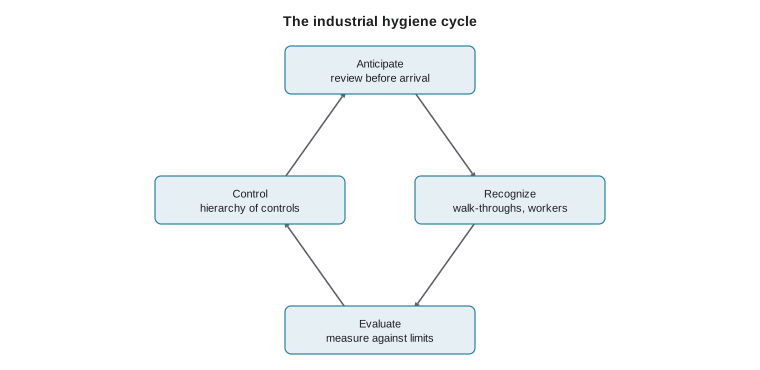
Industrial hygiene, sometimes called occupational hygiene, is the science of anticipating, recognizing, evaluating and controlling health hazards at work. Hygienists ask what agents are present (chemical, physical or biological), how workers are exposed (breathing, skin contact, swallowing, noise and radiation reaching the body), how much exposure occurs compared with an occupational exposure limit, and what controls will reduce it. The answers come from walking the plant, reviewing safety data sheets and processes, measuring exposures with personal sampling pumps, noise dosimeters and direct-reading instruments, and then applying the hierarchy of controls.
Exposure limits
Occupational exposure limits (OELs) set the maximum airborne concentration of a substance, or level of a physical agent such as noise, that most workers can be exposed to day after day without adverse effects. Most Canadian provinces adopt the threshold limit values (TLVs) published by the American Conference of Governmental Industrial Hygienists (ACGIH), sometimes with changes; Ontario lists its limits in Regulation 833. Limits are usually expressed as an 8-hour time-weighted average (TWA), with short-term exposure limits (STEL) for 15-minute peaks and ceiling limits that must never be exceeded. Being below the limit does not mean zero risk, especially for carcinogens and sensitizers, so plants aim to keep exposures as low as reasonably achievable.
# 8-hour time-weighted average from personal sampling over a shift (illustrative values, mg/m3).
samples = [  # (concentration, hours)
    (2.4, 2.0),   # grinding area
    (0.6, 3.0),   # assembly
    (4.1, 1.5),   # cleaning out dust collector
    (0.0, 1.5),   # breaks and office
]
total_h = sum(t for _, t in samples)
twa = sum(c * t for c, t in samples) / 8
print(f"Hours sampled: {total_h}")
print(f"8-hour TWA: {twa:.2f} mg/m3")
limit = 3.0  # an illustrative respirable dust limit
print(f"Ratio to a {limit} mg/m3 limit: {twa / limit:.0%} ->", "above" if twa > limit else "below", "the limit")Hours sampled: 8.0 8-hour TWA: 1.59 mg/m3 Ratio to a 3.0 mg/m3 limit: 53% -> below the limit
Noise
Noise is one of the most common plant health hazards, from presses, compressors, grinders, blowers, conveyors, saws and bottling lines. Noise-induced hearing loss is permanent and builds up slowly, so workers often do not notice it until it is severe. Noise also masks warnings, shouts and alarms, which links it to injuries. HSE-241 covers noise in detail.
In most Canadian provinces the noise exposure limit is 85 dBA as an 8-hour average with a 3 dB exchange rate: every 3 dB increase halves the allowed time, so 88 dBA is allowed for 4 hours and 91 dBA for 2 hours. Federally regulated workplaces use 87 dBA. Ontario's noise regulation (Ontario Regulation 381/15) requires engineering controls first and hearing protection where needed.
# Allowed exposure time at different noise levels (exchange-rate rule).
def hours(level, criterion, exchange):
    return 8 / 2 ** ((level - criterion) / exchange)
print("dBA   85/3 rule   90/5 rule")
for L in (85, 88, 90, 91, 94, 95, 100):
print(f"{L:>3} {hours(L, 85, 3):7.2f} h {hours(L, 90, 5):7.2f} h")dBA 85/3 rule 90/5 rule 85 8.00 h 16.00 h 88 4.00 h 10.56 h 90 2.52 h 8.00 h 91 2.00 h 6.96 h 94 1.00 h 4.59 h 95 0.79 h 4.00 h 100 0.25 h 2.00 h
Dusts, fumes and mists
Airborne particles are a major plant health hazard. Dusts are solid particles produced by grinding, cutting, sanding, crushing and handling powders; fumes are very fine particles formed when hot metal vaporizes and condenses, as in welding; mists are liquid droplets from spraying, machining fluids or plating. The smallest particles, the respirable fraction, reach deep into the lungs. Effects depend on the material: crystalline silica causes silicosis and lung cancer, wood dust causes asthma and nasal cancer, flour dust causes baker's asthma, welding fume causes metal fume fever and is classified as a human carcinogen, and metalworking fluid mists cause dermatitis and lung disease. Some dusts are also combustible (HSE-313).
| Agent | Plant sources | Main health effects | Course |
|---|---|---|---|
| Respirable crystalline silica | Foundries, stone and concrete products, glass, abrasive blasting | Silicosis, lung cancer, kidney disease | HSE-242 |
| Welding fume | Fabrication shops, maintenance | Metal fume fever, lung disease, cancer; manganese nerve effects | HSE-216 |
| Wood dust | Sawmills, furniture and cabinet plants | Asthma, nasal and sinus cancer | HSE-240 |
| Flour and grain dust | Bakeries, mills, food plants | Occupational asthma, allergy | HSE-240 |
| Isocyanates | Spray foam, polyurethane coatings, adhesives | Severe asthma (sensitizer) | HSE-240 |
| Metalworking fluids | Machining and grinding | Dermatitis, hypersensitivity pneumonitis | HSE-240 |
| Lead | Battery recycling, soldering, demolition of painted steel | Nervous system, kidney and reproductive harm | HSE-242 |
Controlling airborne exposures
The hierarchy of controls applies to health hazards just as to safety hazards. The best options are to eliminate or substitute the hazardous material, such as switching from silica sand to a safer blasting medium or from solvent-based to water-based paints. Next come engineering controls, especially local exhaust ventilation, which captures contaminants at the source before they reach the worker's breathing zone: welding fume extractors, hoods on mixers, downdraft tables and ventilated enclosures. General dilution ventilation helps with low-toxicity contaminants but is weak on its own. Administrative controls, such as reducing time in exposed areas and wet cleaning instead of dry sweeping, come next. Respirators are the last line and need a full program with fit testing (HSE-240).
# Capture velocity check for a welding fume hood (simplified Dalla Valle equation, illustrative).
# Q = V * (10 x^2 + A) for a plain opening; V = capture velocity at distance x.
A = 0.06          # hood face area, m2 (e.g. 0.3 m x 0.2 m)
Q = 0.25          # airflow, m3/s
for x_cm in (10, 20, 30, 45):
    x = x_cm / 100
    V = Q / (10 * x ** 2 + A)
    ok = "adequate" if V >= 0.5 else "too low"
print(f"Weld {x_cm:>2} cm from hood: capture velocity {V:4.2f} m/s -> {ok} (target 0.5 m/s)")Weld 10 cm from hood: capture velocity 1.56 m/s -> adequate (target 0.5 m/s) Weld 20 cm from hood: capture velocity 0.54 m/s -> adequate (target 0.5 m/s) Weld 30 cm from hood: capture velocity 0.26 m/s -> too low (target 0.5 m/s) Weld 45 cm from hood: capture velocity 0.12 m/s -> too low (target 0.5 m/s)
The calculation shows a key practical point: capture velocity falls rapidly with distance. A fume extractor that works well at 15 cm from the weld does almost nothing at 45 cm. Workers need training to keep hoods close to the work, and supervisors need to check that they do.
Heat
Plants with furnaces, ovens, dryers, kilns, molten metal, steam and poorly ventilated roofs can be dangerously hot, especially in summer heat waves. Heat stress reduces concentration and increases errors as well as causing heat exhaustion and heat stroke, which can kill. Controls include engineering measures such as insulation, shielding and ventilation, acclimatization schedules for new and returning workers, work-rest cycles based on the wet bulb globe temperature (WBGT), cool water and rest areas, and training to recognize symptoms. HSE-243 covers heat stress in detail.
Other health hazards
Plants have several other health hazards worth knowing about. Hand-arm vibration from grinders and impact tools causes vibration white finger and nerve damage. Wet work and solvents cause dermatitis, one of the most common occupational diseases. Biological hazards appear in meat and poultry plants, wastewater and cooling towers (Legionella). Shift work disrupts sleep and is linked to fatigue-related incidents. Psychosocial hazards, such as high demands with little control, harassment and violence, affect health too. Each needs recognition and control like any other hazard.
Health surveillance
Health surveillance tracks workers' health over time to detect early effects of exposure, so controls can be improved before serious harm occurs. Examples include audiometric testing for workers exposed to noise, lung function tests and chest X-rays for those exposed to silica, blood lead testing, skin checks for dermatitis, and medical evaluation before respirator use. Surveillance results, combined into group statistics with personal privacy protected, show whether controls are working.
Worked problem
A rising trend in hearing tests
Annual hearing tests in a metal stamping plant show that 6 of 40 press operators have a standard threshold shift this year, up from 1 the year before. Noise levels at the presses average about 92 dBA. What should the plant do?
Show solution
- Treat the shifts as a warning that hearing protection is not working well enough or controls have slipped.
- Re-measure noise and check whether press changes, worn dies or missing enclosures have raised levels.
- Look at engineering controls: press enclosures, damping, quieter dies, isolating compressed air exhausts.
- Check hearing protector fit and use: fit-test earplugs, offer better options, and supervise wearing.
- Follow up with affected workers and record actions; review results again after changes.
Answer: Investigate the noise sources and protector effectiveness, improve engineering controls first, and confirm with follow-up testing.
Exposure monitoring in practice
Exposure monitoring is planned, not random. A hygienist first groups workers who do similar tasks with similar exposures, called similar exposure groups, then samples enough people in each group on enough days to describe typical and high exposures. Personal samples are taken in the worker's breathing zone, not from a fixed point on a wall, because exposures depend on how close people work to the source. Results are compared with limits, and if they are close to or above a limit, controls are improved and sampling is repeated. Workers have a right to see results that concern them, and good plants explain what the numbers mean and what is being done.
| Result compared with the limit | Typical response |
|---|---|
| Well below (under about a tenth of the limit) | Maintain controls; resample if the process changes |
| Moderate (a tenth to half of the limit) | Periodic monitoring; look for easy improvements |
| Close to the limit (half the limit or more) | Improve controls; more frequent monitoring |
| Above the limit | Immediate controls, respiratory protection meanwhile, investigate and resample |
Common mistakes
MistakeTreating health hazards as less important because harm is not immediate.
InsteadOccupational disease kills more workers than injuries; manage it like any serious hazard.
MistakeAssuming exposure below the limit means zero risk.
InsteadLimits protect most workers; keep exposures as low as reasonably achievable, especially for carcinogens and sensitizers.
MistakeRelying on respirators and earplugs first.
InsteadUse substitution and engineering controls first; PPE needs a full program and is the last line.
MistakePositioning fume hoods far from the work.
InsteadKeep local exhaust close to the source; capture velocity falls rapidly with distance.
MistakeIgnoring early surveillance results.
InsteadUse hearing, lung and blood tests to spot failing controls early.
Summary and key terms
- Occupational disease from noise, dust, fumes, chemicals and heat is slow, hidden and causes more deaths than injuries.
- Industrial hygiene anticipates, recognizes, evaluates and controls health hazards.
- Exposure limits are usually 8-hour TWAs with short-term and ceiling limits; below the limit is not zero risk.
- Most provinces use 85 dBA with a 3 dB exchange rate for noise.
- Dusts, fumes and mists cause silicosis, asthma, cancers and other diseases depending on the material.
- Control airborne hazards by substitution and local exhaust ventilation first; respirators are the last line.
- Health surveillance detects early effects so controls can be improved.
- Industrial hygiene
- The science of anticipating, recognizing, evaluating and controlling workplace health hazards.
- Occupational exposure limit
- The maximum exposure considered acceptable for most workers over a working lifetime.
- Time-weighted average
- Average exposure over a period, usually 8 hours, weighted by time at each level.
- Short-term exposure limit
- A limit on average exposure over a short period, usually 15 minutes.
- Exchange rate
- The increase in noise level that halves the allowed exposure time.
- Respirable fraction
- Airborne particles small enough to reach the deepest parts of the lungs.
- Local exhaust ventilation
- Ventilation that captures contaminants at the source.
- Capture velocity
- The air speed needed at the source to draw contaminants into a hood.
- Sensitizer
- A substance that can cause an allergic reaction after repeated exposure.
- Health surveillance
- Regular health checks to detect early effects of workplace exposure.
Practice problems
Work each problem on paper first, then reveal the answer to check.
Why are occupational diseases often missed?
Show answer
They develop slowly, appear years later and may not be linked to work.
Name the four steps of the industrial hygiene cycle.
Show answer
Anticipate, recognize, evaluate, control.
A worker is exposed to 5 mg/m³ for 2 h and 1 mg/m³ for 6 h. What is the 8-hour TWA?
Show answer
(5 × 2 + 1 × 6) ÷ 8 = 2 mg/m³.
Under an 85 dBA, 3 dB rule, how long is allowed at 91 dBA?
Show answer
2 hours.
Name three airborne health hazards in plants and their effects.
Show answer
Silica (silicosis), wood dust (asthma, nasal cancer), welding fume (cancer, metal fume fever), isocyanates (asthma).
Why is local exhaust preferred over general ventilation?
Show answer
It captures contaminants at the source before they reach the worker's breathing zone.
What happens to capture velocity as the source moves away from a hood?
Show answer
It falls rapidly, roughly with the square of distance.
Give three controls for heat stress.
Show answer
Shielding and ventilation, acclimatization, work-rest cycles, water and rest areas, training.
Give two examples of health surveillance.
Show answer
Audiometric tests, lung function tests, blood lead tests, skin checks.
What should a plant do when hearing test results worsen?
Show answer
Re-measure noise, improve engineering controls, check protector fit and use, and follow up.
Lesson quiz · 5 questions
Score 60% or more to complete this lesson.
Create a free account to save your progress, take quizzes and earn a certificate.