
HSE-230 · Lesson 8 of 12 · 20 min
Choosing and verifying controls
In February, a crew from another contractor working for Southplains Gas had a close call. Their FLHA listed the hazard 'gas release when cutting the service line,' and the control 'line isolated.' The line was isolated, at one valve. But a second feed, through a bypass the crew did not know about, kept gas flowing into the section. When the crew began to cut, gas came out of the pipe. Nobody was hurt, because the gas detector alarmed and the crew backed off. The investigation found that the form was filled in honestly. The control was real. It just had not been checked.
Leila brought the incident report to Coldwater's monthly safety meeting. 'This is the part of the form where most of the risk is,' she said, pointing to the controls column. 'Finding hazards is hard. Choosing controls that work is harder. And checking that they actually work is the step everybody skips.' This lesson covers all three.
The hierarchy of controls
Controls are not all equally strong. The hierarchy of controls ranks them from most to least effective. You may have met it before; here it is with examples from field work.
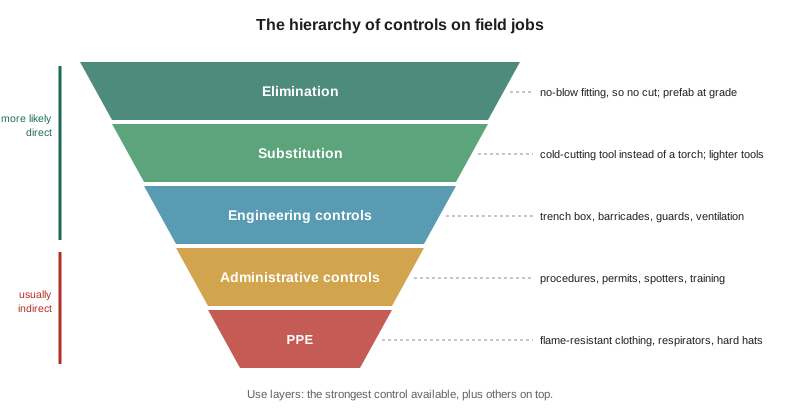
- Elimination removes the hazard completely. If the job can be done without the hazard, that is the strongest control. Examples: doing a tie-in with a fitting that does not require cutting into a live line, prefabricating pipe at ground level so nobody has to weld in the excavation, scheduling work for daylight to avoid working in the dark.
- Substitution replaces something hazardous with something less hazardous. Examples: a cold-cutting tool instead of a torch near gas, a water-based coating instead of a solvent-based one, a lighter tool, a lower-pressure test.
- Engineering controls put a physical barrier or device between people and the hazard. Examples: a trench box, guardrails, machine guards, a physical barricade around a swing radius, ventilation in a vault, a backup camera and proximity sensor on a truck, a ground fault circuit interrupter on a cord.
- Administrative controls change how people work. Examples: procedures, permits, training, signs, spotters, job rotation, limiting time in hot or cold conditions, the FLHA itself.
- Personal protective equipment protects the person wearing it. Examples: flame-resistant clothing, hard hats, safety glasses, hearing protection, respirators, gloves, fall protection harnesses.
Alberta's OHS Code sets this order in law. A hazard must be eliminated if that is reasonably practicable. If not, it must be controlled with engineering controls first, then administrative controls, then personal protective equipment, or with a combination of these that gives a greater level of protection.
Why higher is better
The higher controls work on the hazard itself. They do not depend on people noticing the hazard, remembering the rule or wearing the equipment correctly. A trench box protects the worker whether or not they are paying attention. A sign that says 'stay out of the trench when the walls look unstable' only works if someone reads it, believes it and judges the walls correctly.
That links directly to Lesson 5. Elimination, substitution and engineering controls are much more likely to be direct controls, which are the ones needed for high-energy hazards. Administrative controls and PPE are usually indirect. They still matter, and many jobs need them, but they should not be the only controls for anything that could kill.
Why the lower levels still matter
In real field work, many hazards cannot be eliminated or engineered away completely, especially on short jobs. Almost every FLHA will include administrative controls and PPE. The goal is not to avoid them, but to use them in layers on top of stronger controls wherever possible. The crew that plans 'trench box, plus competent person inspection, plus ladder within 7.5 m (25 ft) of every worker, plus hard hats' has four layers. If one fails, the others are still there.
Choosing controls on an FLHA
When the crew reaches the controls column, Dani asks four questions for every hazard, in order:
- Can we get rid of it? Is there a way to do this step without the hazard at all, such as a different method, a different time or a different location?
- Can we make it smaller? Can we use less energy: lower pressure, a lighter load, a shallower excavation, a slower speed, a smaller tool?
- Can we put something between it and us? Is there a barrier, a guard, a box, a lock, a cover, distance?
- What do we do and wear to manage what is left? Procedures, permits, spotters, training and PPE.
Asking in this order stops the crew from jumping straight to 'wear PPE' and 'be careful,' which are the controls people think of first because they are the easiest. Often, the first two questions produce a better plan that is no slower. On the Hillcrest job in Lesson 1, asking 'can we get rid of it?' about the soft ground led the crew to move the truck, which removed the rollover hazard entirely.
What a good control looks like on paper
A control written on the form should pass three simple tests:
- Specific. It says exactly what will be done. Not 'isolate the line' but 'close and lock valves V-12 and V-14, open bleed at the meter riser, confirm zero pressure on the gauge and with the detector.'
- Owned. It is clear who will do it. Some forms have a column for the person responsible; if yours does not, write the name or role next to the control.
- Checkable. Someone walking up to the site could see whether it is in place. A trench box is checkable. 'Stay alert' is not.
Critical controls
Some controls matter much more than others. For each high-energy hazard, there are usually one or two controls that, if they failed, would leave people directly exposed to serious harm. Many industries call these critical controls. The idea comes from mining and process industries, which developed it after studying what actually stopped major incidents. It is now used by many utilities, pipeline operators and contractors.
For Coldwater's common jobs, the critical controls include:
| High-energy hazard | Critical controls |
|---|---|
| Cave-in of an excavation | Protective system (sloping, benching or trench box) in place before entry; competent person inspection |
| Gas release during cutting or tie-in | Verified isolation of every feed; zero pressure confirmed; continuous gas monitoring |
| Contact with buried facilities | Valid locates; hand or hydrovac exposure inside the zone |
| Contact with overhead lines | Safe limit of approach maintained; line owner controls (cover or de-energize) where needed |
| Struck by or pinned by mobile equipment | Physical separation of people and equipment; exclusion zones |
| Suspended loads | Nobody under the load; rated rigging inspected; lift plan for non-routine lifts |
| Fire or explosion from hot work | Gas-free atmosphere confirmed by test; combustibles removed; fire watch |
The point of naming critical controls is focus. A busy crew cannot check every control on the form every hour. But they can check the critical ones, every time, before anyone is exposed.
Verifying controls
This is the step the other contractor's crew missed. A control that is planned but not verified is only a hope. Verification means someone checks, in the field, that the control is actually in place and working, before people are exposed to the hazard and again when conditions change.
Many companies now use critical control verification, or CCV, for their highest risks. It works like this:
- For each critical control, the company writes a short list of yes-or-no questions that anyone can check in the field. For a gas isolation: 'Are all feeds to the section identified on the drawing? Is each feed valve closed and locked? Is the section bled to zero? Has zero pressure been confirmed on a gauge and with a detector? Is the detector on and in the work area?'
- Before the work starts, the lead hand or a crew member goes through the questions, looking at the control itself, not at the paperwork.
- If any answer is 'no,' the work does not start until it is fixed.
- Supervisors and managers do the same checks on a sample of jobs, and the results are tracked.
'Show me,' not 'tell me'
The heart of verification is seeing, not asking. 'Is the line isolated?' invites the answer 'yes.' 'Show me the locks and the gauge' invites a walk to the valves. Owen, the superintendent, calls this the 'show me' rule. When he visits a crew, he does not ask whether the controls are in place. He asks someone to show him, starting with the critical ones.
Verification for isolations deserves special care, because stored energy can hide. For mechanical and electrical isolations, the standard practice is often described as 'try, test, verify': try to start the equipment after locking it out, test with an appropriate meter that there is no voltage, and verify that stored energy, such as pressure, springs or capacitors, has been released. For gas lines, it means confirming zero pressure at the work point, not just at the valve, and continuing to monitor while the line is open, because a missed feed or a leaking valve can bring pressure back.
Worked problem
Turning a weak control into a verified critical control
Show solution
- The hazard on the original form: gas release when cutting the service line. The original control: 'line isolated.'
- Specific: Dani rewrote it as 'close and lock the service valve at the main (V-1) and the meter valve (V-2); check the drawing and the site for any bypass or second feed; open the bleed at the riser; confirm zero on the gauge at the work point.'
- Owned: Dani does the isolation and holds the keys; Grace confirms zero pressure before she starts cutting.
- Verified: before cutting, Grace and Dani walk to each valve and look at the locks; Grace reads the gauge at the cut point and checks the detector reading at the pipe opening. Both initial the form.
- Layered: the gas detector stays on at the excavation edge with an alarm set at 10 percent of the lower explosive limit; a charged fire extinguisher is at the edge; the muster point is upwind.
- When the cut is made, a cold-cutting tool is used instead of a torch, which is substitution: even if a small amount of gas is present, there is no flame to ignite it.
Answer: The control became specific, owned, checked and layered, with a substitution on top. A missed bypass would now be caught by the zero-pressure check and the detector before anyone cut.
Controls change during the day
A control that was verified at 8 a.m. may not be in place at 2 p.m. Barriers get moved to let a truck through. Spoil piles creep toward the edge. Someone takes off their hearing protection to talk. A valve gets opened by an operator who did not know the crew was there. That is why verification is not a one-time event. Dani's crew re-checks critical controls after every break, every shift change, every change in the work and any time someone new joins. Lesson 9 covers how to handle changes in conditions.
Common mistakes
MistakeJumping straight to PPE and 'be careful' for every hazard.
InsteadAsk in order: get rid of it, make it smaller, put something between, then manage what is left.
MistakeWriting a control that is not specific, such as 'line isolated.'
InsteadSay exactly what will be done, by whom, in a way that can be checked.
MistakeRelying only on administrative controls and PPE for a high-energy hazard.
InsteadLook for an elimination, substitution or engineering control that works as a direct control.
MistakeAsking 'is it done?' instead of looking.
InsteadUse the 'show me' rule and verify critical controls in the field.
MistakeVerifying controls once at the start and never again.
InsteadRe-check critical controls after breaks, changes and new arrivals.
Summary and key terms
- The hierarchy of controls ranks elimination, substitution, engineering, administrative controls and PPE from most to least effective.
- Higher-level controls act on the hazard and are more likely to be direct controls; lower levels still add useful layers.
- On an FLHA, ask in order: can we get rid of it, make it smaller, put something between it and us, and what do we do and wear for what is left?
- Good controls are specific, owned and checkable.
- Critical controls are the one or two controls whose failure would leave people directly exposed to a high-energy hazard.
- Verify critical controls in the field before exposure and after changes, using 'show me' rather than 'tell me.'
- Hierarchy of controls
- A ranking of control types from most to least effective: elimination, substitution, engineering, administrative and PPE.
- Engineering control
- A physical barrier or device that separates people from a hazard.
- Administrative control
- A change in how people work, such as a procedure, permit, training or spotter.
- Critical control
- A control whose failure would leave people directly exposed to a high-energy hazard.
- Critical control verification (CCV)
- A field check, using yes-or-no questions, that a critical control is in place and working.
Practice problems
Work each problem on paper first, then reveal the answer to check.
Put these controls in order from strongest to weakest: hearing protection, a quieter pump, a sound barrier, time limits near the pump.
Show answer
A quieter pump (substitution), a sound barrier (engineering), time limits (administrative), hearing protection (PPE).
Rewrite 'barricade the swing' so it is specific, owned and checkable.
Show answer
For example: 'Rick sets up barricades around the full swing radius of the excavator with one entry gate; nobody enters while the machine is working; Dani checks the barricade at each break.'
What is the difference between a critical control and any other control?
Show answer
If a critical control fails, people are directly exposed to a high-energy hazard.
Why did the other contractor's isolation fail?
Show answer
There was a second feed through a bypass that nobody had identified, and zero pressure at the work point was not verified.
Name two moments when critical controls should be re-checked during the day.
Show answer
Any two: after breaks, at shift change, when the work changes, when someone new joins, after any disturbance to the site.
Lesson quiz · 5 questions
Score 60% or more to complete this lesson.
Create a free account to save your progress, take quizzes and earn a certificate.