
HSE-230 · Lesson 10 of 12 · 21 min
Leading the pre-job talk
In May, Owen asked Dani to take on a new responsibility. Coldwater was adding a second crew for the summer, and Sam, now in his tenth month, would be its acting lead hand for small jobs, with Dani checking in by phone and visiting every few days. Sam was excited and nervous. The part that worried him most was not the technical work. It was standing in front of four people, some older and more experienced than him, and leading the pre-job talk.
Dani told him that the talk is where an FLHA becomes real. 'The form is what we write,' she said. 'The talk is what people actually hear. If the talk is bad, the form doesn't matter, because nobody knows what's on it.' This lesson covers how to lead a pre-job talk that people listen to, remember and act on.
Pre-job talk, tailgate talk, toolbox talk
The words get mixed up, so it helps to separate them. A toolbox talk is usually a short safety training session on a general topic, such as heat stress, ladder safety or hand injuries, often delivered weekly from a prepared script. A pre-job talk, also called a tailgate meeting or tailboard, is a discussion of the specific job about to be done, at the work site, built around the FLHA. Both are useful. This lesson is about the second one.
A good pre-job talk does four things:
- Builds a shared picture of the job: what we are doing, in what order, who does what.
- Focuses attention on the hazards that matter most today, especially the high-energy ones and their critical controls.
- Checks understanding, so the lead hand knows each person actually knows the plan, not just that they heard it.
- Opens the door for anyone to raise concerns now and to stop the job later.
Where and when
Hold the talk at the work site, after the walk and before the work starts. Stand where everyone can see the work area, so you can point to the hazards rather than describe them. Pick a spot away from noise: a running hydrovac or compressor makes a talk almost useless. If the equipment must run, move away from it or shut it down for ten minutes. Face the crew toward the work and keep your back to the sun if you can, so people are not squinting.
Keep it short. For most jobs, ten to fifteen minutes is enough, including the time to sign the form. A talk that runs to thirty minutes on a routine job loses people. A talk that runs to three minutes skips the parts that matter. If the job is complex, it is better to hold a short talk at the start and another before each major step, such as the lift or the tie-in, than one long talk that nobody remembers by the afternoon.
A structure that works
Dani gave Sam a structure she has used for years. It follows the FLHA but is not a reading of it.
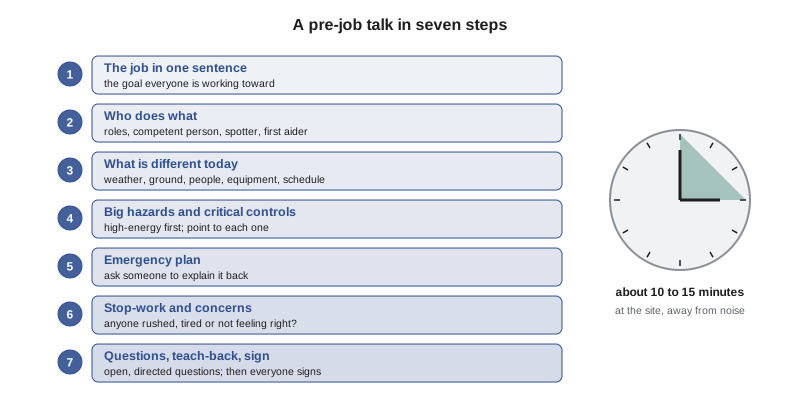
- The job in one sentence. 'Today we're exposing the service line at 412 Birch Street, replacing about 1 m (3 ft) of pipe and backfilling by 3 p.m.' This gives everyone the goal.
- Who does what. Name each person's role for each step, including the competent person, the spotter, the fire watch and the first aider.
- What is different today. Weather, ground, new people, new equipment, the client's operator on site, a tight schedule. Ask the crew if they see anything else that is different.
- The big hazards and their critical controls. Walk through the high-energy hazards first, pointing to each one. For each, say what the critical control is and who verifies it. Lower-energy hazards can be covered briefly or left on the form.
- The emergency plan. Muster point, who calls, the address for emergency services, what to do if we hit the line. Do not just say it; ask someone to tell you.
- Stop-work and concerns. Say out loud that anyone can stop the job, and ask whether anyone is rushed, tired or not feeling right today.
- Questions, teach-back and sign. Ask open questions, check understanding, deal with anything raised, and then everyone signs.
Note what is not on the list: reading every line of the form, going through the standard PPE list, or repeating the company safety policy. Those are on the form and in training. The talk is for what matters on this job, today.
Asking questions that work
The most common question in pre-job talks is 'Any questions?' It is also one of the least useful. Most people answer it with silence, because asking a question in front of the crew can feel like admitting you were not paying attention. Silence does not mean understanding.
Better questions are open, specific and directed:
| Instead of | Try |
|---|---|
| Any questions? | What part of this job worries you most? |
| Everyone know where the muster point is? | Sam, where do we go if the detector alarms? |
| Is the isolation okay? | Grace, walk me through how you will confirm zero pressure before cutting. |
| Everyone clear on the lift? | Rick, where will people be standing when the pipe is in the air? |
| Anything else? | What is one thing we haven't talked about that could hurt someone today? |
Teach-back
Teach-back is a technique borrowed from health care. Instead of asking 'Do you understand?', you ask the person to explain the key point back to you in their own words. 'Tell me what you'll do if you smell gas in the excavation.' If they can explain it, they understand it. If they cannot, you have found a gap before it matters, without making anyone feel tested in a bad way. Dani uses teach-back for the emergency plan and for every critical control, and she rotates who she asks so that nobody is singled out.
Ask the quiet person first
In most crews, the most experienced or most confident person talks first, and everyone else agrees. That means the lead hand hears one view instead of five. Dani's habit, which Sam had noticed from his first day, is to ask the newest or quietest person first: 'Sam, what do you see that could hurt us?' New workers often notice things others have stopped seeing, and once they have spoken first, they are more likely to speak up later.
Keeping people engaged
Pre-job talks can become a routine that people sit through without thinking, especially on crews that do similar work every day. Signs of a disengaged talk: people looking at their phones, the same person answering every question, signatures happening before the talk ends, nobody ever raising a concern. A few habits help:
- Point, don't recite. Walk to the hazard and point at it. People remember what they see.
- Use the people's own words. If the operator calls the swing radius 'the danger zone,' use that.
- Tell a short story. A one-minute account of a real incident or near miss linked to today's hazard is more memorable than a rule. Coldwater's incident summaries are a good source.
- Change who leads parts of the talk. Let the operator explain the lift, the welder explain the hot work controls, the newest person explain the emergency plan.
- Act on what people raise. If someone raises a concern and nothing changes, they will stop raising concerns. If the plan changes because of what they said, they will keep talking.
- End on time. Respecting people's time is part of earning their attention.
Special situations
Language and literacy
On some crews, not everyone reads English easily or speaks it as a first language. Do not assume that a signature means the form was understood. Use plain words and short sentences, point to the hazards, use pictures where you can, such as the energy wheel or the company's high-energy icons, and use teach-back. If a crew member speaks another language, ask a bilingual crew member to help, or use the company's translated materials. Make sure the emergency plan, in particular, is understood by everyone.
Late arrivals and visitors
Anyone who arrives after the talk must get a short version before entering the work area: the job, the big hazards and their controls, the emergency plan and stop-work. Then they sign, with the time. This includes client inspectors, delivery drivers who will be in the work area and crew members who join after lunch. Dani keeps a short card in the truck with the key points so that whoever briefs the latecomer covers the same ground.
Disagreement
Sometimes a crew member disagrees with the plan, often an experienced worker who has done the job a different way for years. Treat it as useful information, not a challenge. Ask them to explain their concern or their method, listen fully, and compare it with the procedure and the FLHA. If their way is better and fits the procedure, use it and update the form. If it does not, explain why. If you cannot resolve it, call the supervisor before starting. Never start a job with a crew member who has not agreed to the plan.
Running a talk as a new lead hand
Sam's specific worry was leading people who were older and more experienced than he was. Dani's advice was practical. 'You don't have to know more than them,' she said. 'You have to run a good process. Ask Rick to explain the lift. Ask Grace to explain the hot work. Your job is to make sure every hazard has a control, every person knows the plan and anyone can stop us.' Experienced workers generally respect a lead hand who asks for their knowledge and then holds everyone, including themselves, to the plan.
Worked problem
Sam's first talk as acting lead hand
Show solution
- The job: replace a meter set and regulator at a small commercial building. Crew: Sam, Rick, a second-year labourer named Ana, and a client inspector arriving at 10 a.m.
- Sam held the talk beside the meter, with the truck engine off. He opened with one sentence: 'We're isolating the service, swapping the meter and regulator, purging, testing and relighting by noon.'
- Roles: Sam would isolate and hold the keys; Rick would do the swap; Ana would set up barricades and run the detector; Sam was first aider.
- What's different: the building's parking lot was busy with customers, and the building manager had not been told about the shut-off. Sam asked the crew if they saw anything else. Ana pointed out a propane tank for a patio heater against the wall 3 m (10 ft) from the meter.
- Big hazards: gas release and ignition. Critical controls: verified isolation, zero pressure at the meter, detector running, no ignition sources within the barricade. The propane tank was moved, with the manager's permission, outside the barricaded area.
- Emergency: Sam asked Ana to tell him the muster point and who would call. She answered correctly. He asked Rick what he would do if the detector alarmed. Rick explained.
- Stop-work: Sam said, 'If anyone sees something that bothers you, stop us. I mean it.' He asked if anyone was rushed or tired. Rick said his back was sore; they agreed Ana would carry the new regulator.
- Questions: 'What part of this job worries you most?' Rick said the customers' cars. They added a second barricade at the lot entrance. Everyone signed. When the inspector arrived, Sam briefed her using the card, and she signed with the time.
Answer: The talk took twelve minutes, found a propane tank and a parking hazard, and every person could explain the plan.
Common mistakes
MistakeHolding the talk next to a running hydrovac or compressor.
InsteadMove away from noise or shut the equipment down for the talk.
MistakeReading the whole form aloud.
InsteadFocus on what is different today and the high-energy hazards with their critical controls.
MistakeAsking 'Any questions?' and taking silence as understanding.
InsteadAsk open, specific, directed questions and use teach-back.
MistakeLetting the most experienced person do all the talking.
InsteadAsk the newest or quietest person first.
MistakeLetting late arrivals start without a briefing.
InsteadBrief every late arrival on the key points and have them sign with the time.
Summary and key terms
- A pre-job talk discusses the specific job at the work site, built around the FLHA; it is different from a general toolbox talk.
- Hold it at the site, away from noise, after the walk and before work starts, usually in 10 to 15 minutes.
- Follow seven steps: the job in one sentence, roles, what is different, big hazards and critical controls, emergency plan, stop-work, then questions and signing.
- Ask open, specific, directed questions, use teach-back, and ask the newest or quietest person first.
- Keep people engaged by pointing, using short stories, sharing the lead and acting on what people raise.
- Plan for language barriers, late arrivals, visitors and disagreement; never start with someone who has not agreed to the plan.
- Pre-job talk
- A discussion of the specific job about to be done, held at the work site and built around the hazard assessment.
- Toolbox talk
- A short training session on a general safety topic, often delivered from a prepared script.
- Teach-back
- Asking a person to explain a key point in their own words to check understanding.
- Open question
- A question that cannot be answered with yes or no, such as "What worries you most?"
- Directed question
- A question asked of a specific person by name.
Practice problems
Work each problem on paper first, then reveal the answer to check.
Rewrite 'Everyone okay with the lift?' as an open, directed question.
Show answer
For example: 'Rick, where will each of us be standing while the pipe is in the air?'
Why is 'Any questions?' a weak question?
Show answer
People often answer with silence because asking can feel like admitting they were not paying attention; silence does not show understanding.
What are the seven steps of the pre-job talk structure in this lesson?
Show answer
The job in one sentence; who does what; what is different today; big hazards and critical controls; emergency plan; stop-work and concerns; questions, teach-back and sign.
What should happen when a client inspector arrives after the talk?
Show answer
They get a short briefing on the job, big hazards and controls, emergency plan and stop-work, and sign with the time before entering the work area.
How should an acting lead hand handle leading more experienced workers?
Show answer
Run a good process and ask the experienced workers to explain their parts, while holding everyone to the plan.
Lesson quiz · 5 questions
Score 60% or more to complete this lesson.
Create a free account to save your progress, take quizzes and earn a certificate.