
HSE-230 · Lesson 2 of 12 · 21 min
Hazard assessment and the law in Alberta
A week after the Hillcrest job, Sam asked Dani a question that many new workers ask. 'Is the FLHA actually the law, or is it just a company rule?' Dani did not answer straight away. She called Leila Haddad, Coldwater Field Services Ltd.'s health and safety advisor, who was in the yard that morning. 'Good question,' Leila said. 'The short answer is that the law requires hazards to be assessed and controlled, and the FLHA is one of the main ways we meet that requirement on site. The long answer takes about twenty minutes.'
This lesson is the long answer. You do not need to become a lawyer to do a good FLHA, but knowing where the duty comes from helps you understand why the form asks what it asks, why supervisors check it, and why a sloppy one can matter a great deal if something goes wrong.
Where the duty comes from in Alberta
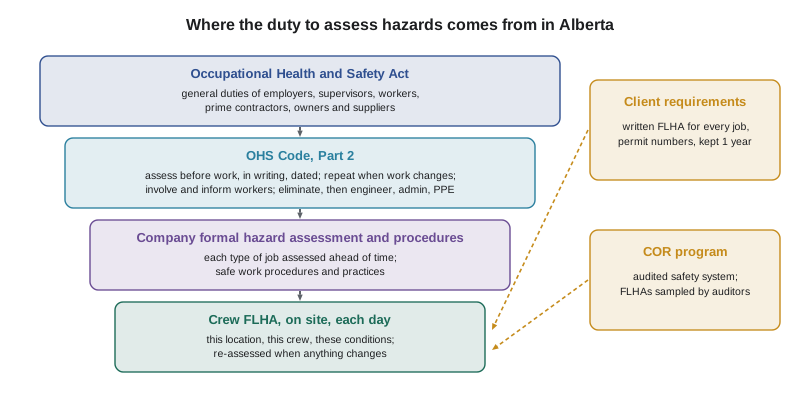
In Alberta, workplace health and safety is mainly governed by three layers of law. The Occupational Health and Safety Act sets out the general duties of employers, supervisors, workers, prime contractors, suppliers and others. The OHS Regulation adds some administrative rules. The OHS Code contains the detailed technical requirements, organized into parts, such as hazard assessment, excavation, confined spaces, hazardous energy control and fall protection. Alberta OHS officers inspect work sites, investigate serious incidents and enforce the law.
The duty to assess hazards is in Part 2 of the OHS Code, titled Hazard Assessment, Elimination and Control. Its key requirements are:
- Assess before work begins. The employer must assess the work site and identify existing and potential hazards before work begins, or before construction of a new work site.
- Write it down and date it. The assessment must be in writing, must include the methods used to control or eliminate the hazards identified, and must be dated.
- Repeat it. The assessment must be repeated at reasonably practicable intervals to prevent unsafe conditions from developing, when a new work process is introduced, when a work process or operation changes, and before significant additions or alterations to a work site.
- Involve workers. The employer must involve affected workers in the assessment and in the control or elimination of the hazards, where reasonably practicable.
- Inform workers. Workers affected by the hazards must be informed of the hazards and the methods used to control them.
- Control in order. Hazards must be eliminated if reasonably practicable. If not, they must be controlled using engineering controls first, then administrative controls, then personal protective equipment, or a combination that gives greater protection.
Those six requirements line up closely with what a good FLHA does. The formal hazard assessment that Coldwater prepares for each type of job covers the 'before work begins' duty for routine work. The FLHA covers the parts that only the crew on site can do: assessing the specific location on the day, re-assessing when the work changes, involving the workers who will do the job, and making sure each of them knows the hazards and controls.
Who carries which duty
The law gives different people different duties. On a field crew, it is worth being clear about who is responsible for what, because the FLHA form brings all of them together on one page.
- Employers must ensure, as far as reasonably practicable, the health and safety of their workers and others at the work site. That includes doing hazard assessments, providing competent supervisors, training workers, and providing the equipment needed to control the hazards. An employer cannot hand this duty to the workers by asking them to sign a form.
- Supervisors, including lead hands who direct the work of others, must take all precautions reasonable in the circumstances to protect the workers they supervise, make sure those workers follow the law and the controls, and advise them of known or reasonably foreseeable hazards. A lead hand who runs the FLHA is acting as a supervisor.
- Workers must take reasonable care to protect themselves and others, cooperate with their supervisor and employer, use the equipment and procedures required, and take part in hazard assessments. Refusing to take part in the FLHA is not an option.
- Prime contractors, required on many sites with more than one employer, must coordinate health and safety across all the employers there. On a client's pipeline project, the prime contractor may require all crews to use its FLHA form or to share theirs.
- Owners and clients must provide information about hazards they know of, such as buried lines, process conditions and isolations, so that the people working on their property can assess them.
Competent people
Alberta's OHS Code uses the term competent, meaning adequately qualified, suitably trained and with sufficient experience to safely perform work without supervision or with only a minimal degree of supervision. Many parts of the Code require a competent person for certain tasks, such as inspecting an excavation, testing a confined space atmosphere or supervising hot work. On an FLHA, the crew should write down who the competent person is for each of those tasks.
Dani is the competent person for excavation on most of her jobs, and Rick is the competent person for the hydrovac truck. Grace is qualified for the welding and the fire watch. Sam is not yet competent for any of those, so the form names who will supervise him on each step.
Due diligence and why the paperwork matters
In Canada, a person charged with an offence under health and safety law can defend themselves by showing due diligence: that they took every precaution reasonable in the circumstances to prevent the harm. Courts look at what was actually done, not just what was written. But a good, specific, signed FLHA is strong evidence that the crew identified the hazard and took steps to control it. A copied, generic form is weak evidence, and it can suggest that the hazard assessment was never really done.
Serious cases can go further. Since 2004, the Criminal Code of Canada has included section 217.1, which says that everyone who undertakes, or has the authority, to direct how another person does work or performs a task is under a legal duty to take reasonable steps to prevent bodily harm to that person, or any other person, arising from that work or task. Supervisors, lead hands and managers have been prosecuted under this section after workplace deaths. That is not a reason to be afraid of being a lead hand. It is a reason to take the FLHA seriously.
Leila put it to Sam this way. 'If something happens on your job and someone asks what you did to prevent it, you want to be able to hand them a form that shows you looked at the real hazards and did something real about them. But the form only counts if it describes what you actually did. Writing down a control you did not use is worse than writing nothing.'
Worked problem
Reading a form the way an investigator would
Show solution
- Leila showed Sam two old forms from a different company, both for a trench repair on a water line. Both were signed by the whole crew.
- Form A listed: 'slips, trips and falls; pinch points; PPE.' The controls column said 'be careful' and 'wear PPE.' The weather box was blank. No competent person was named.
- Form B listed: 'trench 1.8 m (6 ft) deep in wet clay; spoil pile on south edge; water line under pressure; traffic on lane.' Controls: 'trench box placed before entry; spoil 1 m (3 ft) back from edge; line isolated at valves V3 and V4, tagged; flagger on lane.' It named Dani's counterpart as competent person and recorded rain at 10:30 with a re-check of the trench walls.
- Leila asked which form showed that the crew had actually assessed the hazard of a cave-in. Sam pointed to Form B straight away.
- She then asked what an investigator would conclude from Form A if the trench had collapsed. Sam said it would look as if nobody had thought about the trench at all.
Answer: A specific form shows real assessment; a generic form suggests none was done, even if the crew did think about it.
COR and client requirements
Many Alberta employers hold a Certificate of Recognition, or COR. A COR shows that the employer's health and safety management system has been audited against a standard set by a certifying partner, such as Energy Safety Canada or the Alberta Construction Safety Association, under the province's Partnerships in Injury Reduction program. A COR is valid for three years, as long as the employer completes a maintenance audit in each of the two years after the certification audit. Hazard assessment is a core element of every COR audit, and auditors usually pull a sample of FLHAs and interview workers about them. Many oil and gas, utility and municipal clients will only hire contractors who hold a COR.
Clients also set their own rules. Southplains Gas, the gas utility that hires Coldwater for most of its work, requires a written FLHA for every job, signed by every person on site, kept on site during the work and kept by the contractor for at least a year. It also requires the FLHA to reference the utility's own permit numbers for any hot work or confined space entry. Dani keeps a copy of those requirements taped inside the truck.
Your rights while doing an FLHA
The FLHA also connects to workers' rights. Under the OHS Act, Alberta workers have the right to know about hazards, the right to participate in health and safety, including hazard assessment, and the right to refuse dangerous work. An employer cannot take discriminatory action against a worker for using those rights. If the FLHA turns up a hazard that cannot be controlled, a worker can refuse the work and must report the refusal to the employer or supervisor right away. Lesson 9 looks at refusing work and stopping the job in more detail.
What the law means for your form
Leila finished by turning the legal duties into a short checklist that any crew can use when they review their own form before signing it. Each item on the list comes straight from a duty described above:
- Is it dated, with the time and the exact location? The law expects a dated, written assessment, and the client wants to know which site it covers.
- Does it describe today's job and today's conditions? A form that could have been written for any job on any day does not show that this job was assessed.
- Does every hazard have a control that someone will actually use? Controls must be real, specific and in the right order, starting with elimination where it is practicable.
- Is the competent person named for each task that needs one? Excavation, confined space testing, hot work and similar tasks need a named person.
- Did every worker take part and sign? Signatures should come after the discussion, not before it, and late arrivals must be briefed.
- Does it show re-assessment? When the job changed during the day, the form should show what changed, when, and what the crew did about it.
- Is it kept as required? The form stays on site during the work and is filed afterwards so the company, the client and any auditor can see it.
Sam copied the list into the back of his notebook. Dani told him that if he could answer yes to all seven questions, the form would stand up to almost any audit, and more importantly, it would probably mean the crew had done the thinking that keeps people safe.
In practice, most crews never get close to a formal refusal. A good FLHA finds the problem early, the crew and the supervisor fix it, and the job goes ahead. That is the point. The law sets the floor; the FLHA is how the crew gets well above it.
Common mistakes
MistakeThinking that signing the form moves responsibility from the employer to the worker.
InsteadRemember that employers, supervisors and workers each keep their own duties, whatever the form says.
MistakeWriting controls on the form that the crew will not actually use.
InsteadWrite only what you will do, and update the form if the plan changes.
MistakeLeaving the competent person box blank because 'everyone knows who it is.'
InsteadName the competent person for each task that requires one.
MistakeAssuming the client's form covers everything the company requires, or the other way around.
InsteadCheck both sets of requirements and make sure the form you use meets both.
MistakeThrowing out completed forms at the end of the job.
InsteadKeep them as the company and client require, because they are the record of what the crew did.
Summary and key terms
- Part 2 of the Alberta OHS Code requires hazards to be assessed before work begins, in writing, dated, repeated when work changes, with worker involvement, and controlled in a set order.
- An FLHA is how the crew meets those duties for the specific site and day, alongside the company's longer assessments and procedures.
- Employers, supervisors, workers, prime contractors and clients each have their own duties, and signing a form does not transfer them.
- A competent person must be named for tasks that require one, such as inspecting an excavation or testing a confined space.
- A specific, honest FLHA is strong evidence of due diligence; a generic or false one is weak or harmful evidence.
- COR audits and client contracts usually check FLHAs, and workers keep their rights to know, participate and refuse.
- OHS Code
- Alberta's detailed technical health and safety rules, organized into parts.
- Competent
- Adequately qualified, suitably trained and with enough experience to do the work safely with little or no supervision.
- Prime contractor
- The party responsible for coordinating health and safety on a work site with more than one employer.
- Due diligence
- Taking every precaution reasonable in the circumstances to prevent harm; a defence to some charges.
- Certificate of Recognition (COR)
- A certificate showing that an employer's health and safety management system has passed an audit against a recognized standard.
Practice problems
Work each problem on paper first, then reveal the answer to check.
List the six requirements of Part 2 of the Alberta OHS Code that relate to the FLHA.
Show answer
Assess before work begins; write it down and date it; repeat it when work changes and at reasonable intervals; involve workers; inform workers; eliminate or control hazards in the set order.
Why does the FLHA name a competent person for some tasks?
Show answer
Because the law requires a competent person for tasks such as excavation inspection, and the crew needs to know who that is.
Can a worker refuse to take part in the FLHA?
Show answer
No. Workers must take part in hazard assessments under Alberta law.
Why is writing a control you did not use worse than writing nothing?
Show answer
Because the form becomes a false record, which damages trust and can be strong evidence against the crew and company.
How long is an Alberta COR valid, and what keeps it valid?
Show answer
Three years, as long as a maintenance audit is completed in each of the two years after the certification audit.
Lesson quiz · 5 questions
Score 60% or more to complete this lesson.
Create a free account to save your progress, take quizzes and earn a certificate.