
HSE-230 · Lesson 12 of 12 · 27 min
FLHAs with permits and isolations: three capstone jobs
By June, Sam had been with Coldwater for a year. He had a ground disturbance ticket, a confined space entry course, H2S Alive training and his first evaluation as an acting lead hand. To finish his first year, Owen gave him a challenge: lead the FLHA for three of the most demanding jobs in Coldwater's summer schedule, with Dani reviewing each one. All three involved work that also required permits or isolations. This lesson first explains how FLHAs and permits work together, then follows Sam through the three jobs.
Permits and FLHAs: different jobs, one plan
A permit is a formal written authorization to do a specific high-risk task, in a specific place, for a specific time, under specific conditions. It is issued by someone with authority over the area or system, often the client's operator or a designated permit issuer, and accepted by the person in charge of the work. Common permits on Coldwater's jobs include hot work permits, confined space entry permits, ground disturbance or crossing permits from pipeline owners, and isolation or lockout permits for the client's systems.
The permit and an FLHA do different jobs:
| Permit | FLHA | |
|---|---|---|
| Purpose | Authorizes a specific high-risk task under set conditions | Records the crew's plan for the whole job today |
| Who prepares it | Permit issuer, with the person in charge of the work | The crew, led by the lead hand |
| What it covers | One task or area, such as hot work at one tie-in | Every step of the job, including tasks not under the permit |
| Conditions | Set by the issuer: gas tests, isolations, fire watch, time limits | Includes the permit conditions plus the crew's own hazards and controls |
| When it ends | At its expiry time, or when conditions change | When the job ends or must be redone because the plan no longer fits |
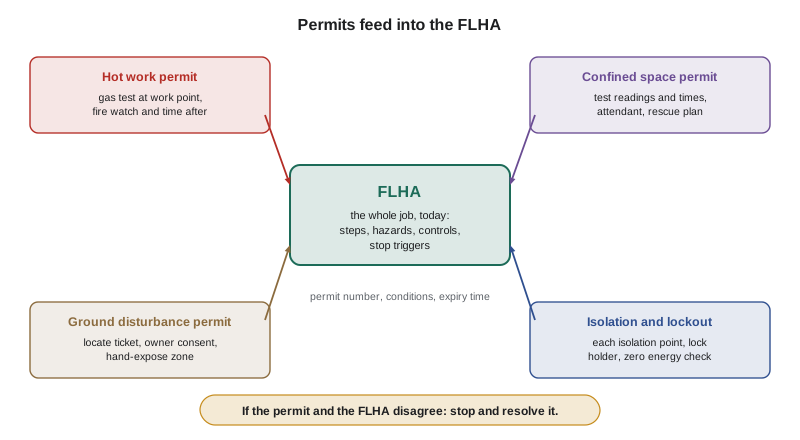
Four rules link them:
- The FLHA records each permit. Its number, its issuer, its expiry time and its key conditions.
- Permit conditions become controls on the FLHA. If the hot work permit requires a fire watch for a set time after the work ends, the FLHA names the fire watch and the time.
- The FLHA covers what the permit does not. A confined space permit covers the entry, but not the drive to the site, the lift of equipment into the vault or the traffic on the road above.
- If they disagree, stop. If the permit says one thing and the crew's plan or the site says another, for example the permit lists one isolation point and the crew finds two feeds, the crew stops and resolves it with the permit issuer before starting.
Isolations, confined spaces and hot work
Three types of high-risk work show up on most permits. Each has its own rules, covered in separate courses. Here is what the FLHA must capture for each.
Isolating hazardous energy
Alberta's OHS Code requires hazardous energy to be controlled before work on machinery, equipment or systems where its unexpected release could injure a worker. The usual method is to isolate the energy at every source, secure each isolation with a personal lock, release or block stored energy, and verify that the system is in a zero-energy state before work starts. For gas lines, isolation means closing and locking every valve that could feed the section, bleeding the section down and confirming zero pressure at the work point. The FLHA should list each isolation point, who holds the lock and how zero energy was verified.
Confined spaces
A confined space is a restricted space that may become hazardous because of its design, construction, location or atmosphere, or the work done in it. Valve vaults, meter pits and large-diameter pipe can all be confined spaces. Alberta's OHS Code requires a hazard assessment, a code of practice, an entry permit system for confined spaces, atmospheric testing before and during entry, trained workers, a competent person outside the space and a rescue plan with the equipment and people to carry it out. The FLHA should record the permit number, the test readings and times, the ventilation, the attendant and the rescue arrangements.
Atmospheric testing for confined spaces is usually done in a set order: oxygen first, then flammable gases, then toxic gases. Many permits require oxygen between about 19.5 and 23 percent, flammable gas below 10 percent of the lower explosive limit, and toxic gases below their exposure limits. The permit sets the exact limits for the job.
Hot work
Hot work is any work that produces flame, sparks or heat that could ignite a flammable material, including welding, cutting, grinding and torch work. On gas work, the main hazard is ignition of gas that remains in or near the pipe. Alberta's OHS Code requires that hot work not be done where a flammable atmosphere may be present unless the atmosphere has been tested and confirmed safe, and most clients require a hot work permit with gas testing, removal or protection of combustibles, a fire extinguisher and a fire watch. The FLHA should record the permit, the gas test results at the work point, the fire watch and how long the fire watch will stay after the work.
Capstone job 1: regulator replacement in a valve vault
Sam's first job was replacing a pressure regulator inside a concrete vault under a parking lot. The vault was about 2.4 m (8 ft) deep, entered through a 750 mm (30 in) hatch with a fixed ladder. The work required a confined space entry permit from Southplains Gas and an isolation of the gas feeding the regulator.
Worked problem
Job 1: the FLHA for the vault
Show solution
- Steps: set up traffic control in the lot; open the hatch; test the atmosphere from outside; ventilate; isolate and bleed the regulator run; enter; remove the old regulator; lift it out with the tripod hoist; lower and install the new one; leak test; restore gas; exit and close the hatch.
- High-energy hazards: toxic or flammable atmosphere in the vault; gas release during the swap; fall through the open hatch; a falling regulator, about 40 kg (90 lb), during the lift; vehicles in the lot.
- Critical controls: continuous four-gas monitoring by the entrant and at the hatch; isolation of the inlet and outlet valves locked by Sam, with zero pressure confirmed at the regulator; hatch guarded by a removable barrier when open; nobody below the load during the lift, with the entrant out of the vault or in the far corner; barricades and a flagger for the lot.
- Permit interface: permit number on the form; permit conditions for oxygen and flammable gas copied into the controls; Ana named as attendant, Rick as entrant, Sam as entry supervisor; rescue by tripod and retrieval line, with the fire department's non-emergency line called in advance to confirm response time.
- Stop triggers agreed in the talk: any alarm on either detector; the attendant losing contact with the entrant; rain filling the vault; anyone feeling dizzy or unwell.
- What happened: at the first test, the oxygen reading was normal but flammable gas read 4 percent of the lower explosive limit, from a weeping fitting. The crew ventilated for 15 minutes and re-tested. The reading dropped to zero, and the crew added a note to tighten and leak test that fitting as part of the job.
Answer: The test caught a small leak before entry, the crew controlled it, and the permit and the form matched at every step.
Capstone job 2: tie-in weld on a steel main
The second job was welding a new section of 150 mm (6 in) steel main into an existing main beside a row of houses. The section would be isolated and purged, then cut with a cold-cutting tool, and the new section welded in. The work required a hot work permit, an isolation agreed with Southplains Gas's operator, and an excavation that the competent person had inspected that morning.
Worked problem
Job 2: the FLHA for the tie-in
Show solution
- Steps: confirm the excavation inspection; confirm the operator's isolation and add Coldwater's locks; purge the section with nitrogen as the utility's procedure requires; gas test at the cut points; cold cut the old pipe; prepare the ends; lower the new section; weld; inspect the welds; coat; restore gas with the operator; backfill.
- High-energy hazards: gas release or ignition at the cut and during welding; cave-in; the new pipe section, about 140 kg (300 lb), during lowering; fire spreading to the dry hedge beside the excavation; heat stress for the welder in the excavation in the afternoon sun.
- Critical controls: isolation verified at both valves with Coldwater's locks added to the operator's; zero pressure at the cut points; continuous gas monitoring at the excavation, with hot work stopping at any reading above zero; trench box in place and inspected; nobody in the excavation while the pipe is lifted; the hedge wetted and covered with a fire blanket; fire watch with an extinguisher at the edge.
- Permit interface: the hot work permit number, its expiry at 4 p.m., the requirement for zero gas at the work point and the fire watch period after welding all written onto the form.
- Stop triggers: any gas reading; the permit expiring before the work is done; a change in wind toward the houses; the welder showing signs of heat stress.
- What happened: at 2:30 p.m., Sam saw that welding would not finish before the permit expired at 4 p.m. Instead of rushing, he called the operator, who extended the permit after re-testing. Sam recorded the extension and the new test result in the re-assessment log, and moved the welder's breaks to every 45 minutes because of the heat.
Answer: Sam treated the permit expiry as a stop trigger, not a deadline to rush, and handled the change through the permit issuer and the form.
Capstone job 3: hydrovac crossing near a high-pressure pipeline
The third job was the most complex. Coldwater had to expose a Southplains Gas distribution line where it crossed under a rural road, about 20 m from a high-pressure transmission pipeline owned by another company, and under a three-phase power line. The work required locates through Utility Safety Partners, written consent from the pipeline licensee for ground disturbance in the controlled area, a road-use and traffic plan from the county, and a power line clearance check with the electrical utility.
Worked problem
Job 3: the FLHA for the crossing
Show solution
- Steps: set up traffic control on the road; meet the pipeline company's representative and confirm their marks; position the hydrovac truck; hydrovac expose the distribution line on both sides of the road; confirm its depth and location; complete the inspection the client needed; backfill and compact; restore the road shoulder; remove traffic control.
- High-energy hazards: contact with the transmission pipeline; contact with the overhead power line by the hydrovac boom; traffic on the road; the high-pressure water wand; a backing hydrovac truck; an open excavation at the road shoulder.
- Critical controls: transmission line located and marked by its owner, with its representative on site, and no excavation within the area the owner set except under the representative's direction; hydrovac boom height limit set and a dedicated observer whenever the boom moves, with the power line's voltage and safe distance confirmed by the electrical utility; traffic control per the county plan with a lane closure and flaggers; exclusion zone around the hydrovac wand; truck positioned once, with a barricade between it and the work area; excavation edges barricaded and covered when unattended.
- SIMOPS: the pipeline representative, the county road crew mowing nearby, and farm traffic. Sam held a joint talk with the pipeline representative and the county foreman, and all three signed one another's forms.
- Stop triggers: any unexpected line or object; any contact with the transmission line marks; the observer losing sight of the boom; the pipeline representative leaving the site; a vehicle entering the closed lane.
- What happened: while exposing the second side, Rick uncovered a small yellow plastic line that was not on any locate. Sam stopped the work. The pipeline representative confirmed it was not theirs, and Southplains Gas identified it as an old service to a farm that had been abandoned but not removed. The crew protected it, recorded it and continued after re-assessing.
Answer: Sam's form brought together three outside parties' requirements, and the crew stopped for an unmarked line exactly as planned.
Dani's review
After the three jobs, Dani sat down with Sam and the three forms. She had only small comments. On the vault job, she suggested writing the actual gas readings and times instead of 'OK.' On the tie-in, she pointed out that the fire watch period after welding was on the permit but had been left off the form. On the crossing, she praised the joint talk, and said it was the best SIMOPS planning she had seen from a first-year worker.
Then she asked him what he had learned in a year. Sam thought about it. 'The form isn't the point,' he said. 'The point is that we all look at the job before we do it, we say out loud what could kill us and what's stopping it, and we stop when something changes. The form is just how we remember that we did.'
That is a good summary of this course. An FLHA done well is short, specific and honest. It is built from the steps of the job and a scan of the site. It uses the energy wheel to find hazards, focuses on high-energy hazards and their direct controls, rates risk as a conversation rather than a calculation, verifies the controls that matter most, gives everyone the authority to stop, is shared through a pre-job talk that people listen to, and fits together with permits and isolations. Above all, it is done by people who care about getting everyone home.
Common mistakes
MistakeTreating the permit as a replacement for the FLHA.
InsteadRecord the permit on the form and plan the whole job, including steps the permit does not cover.
MistakeLeaving permit conditions off the form.
InsteadCopy key conditions, such as gas test limits and fire watch time, into the controls.
MistakeStarting work when the permit and the site disagree.
InsteadStop and resolve the difference with the permit issuer first.
MistakeRushing to finish before a permit expires.
InsteadTreat expiry as a stop trigger and get the permit extended or reissued after re-testing.
MistakeWriting 'OK' instead of actual test readings.
InsteadRecord the readings and the times they were taken.
Summary and key terms
- A permit authorizes a specific high-risk task under set conditions; an FLHA records the crew's plan for the whole job.
- The FLHA records each permit, turns its conditions into controls, covers what the permit does not, and stops the work if the two disagree.
- Isolations need every energy source locked and zero energy verified; confined spaces need permits, testing, an attendant and rescue; hot work needs gas testing, combustible control and a fire watch.
- The capstone jobs show the same pattern: steps, high-energy hazards, critical controls, permit conditions, agreed stop triggers, and re-assessment when things change.
- SIMOPS with outside parties, such as pipeline owners and road crews, are best handled with a joint talk and shared plans.
- An FLHA done well is short, specific and honest, and it is done by people who want everyone to go home safe.
- Permit
- A formal written authorization to do a specific high-risk task under specific conditions for a set time.
- Permit issuer
- The person with authority over an area or system who issues and can extend or cancel a permit.
- Zero energy state
- The condition of equipment or a system after all energy sources are isolated and stored energy is released.
- Attendant
- The trained person who stays outside a confined space to monitor entrants and summon rescue.
- Fire watch
- A person assigned to watch for and put out fires during hot work and for a set time afterwards.
Practice problems
Work each problem on paper first, then reveal the answer to check.
Name the four rules that link permits and FLHAs.
Show answer
Record each permit on the form; turn permit conditions into controls; cover what the permit does not; stop if they disagree.
In what order is a confined space atmosphere usually tested?
Show answer
Oxygen first, then flammable gases, then toxic gases.
In Job 2, why did Sam not rush to finish before the permit expired?
Show answer
Because expiry was a stop trigger; rushing would have created new risk, so he had the permit extended after a re-test and recorded the change.
What controls protected the crew from the overhead power line in Job 3?
Show answer
A boom height limit, a dedicated observer whenever the boom moved, and the voltage and safe distance confirmed by the electrical utility.
What two small improvements did Dani suggest on Sam's forms?
Show answer
Write actual gas readings and times instead of 'OK,' and record the fire watch period after welding.
Lesson quiz · 5 questions
Score 60% or more to complete this lesson.
Create a free account to save your progress, take quizzes and earn a certificate.