
HSE-230 · Lesson 5 of 12 · 21 min
Energy sources and high-energy hazards
One evening in November, Leila Haddad ran a training session for all of Coldwater's field crews in the shop. She started by putting a photo on the screen: a hard hat with a deep dent in the top, sitting next to a 1 kg (2 lb) wrench. The wrench had fallen about 6 m (20 ft) from a pipe rack at a client site. The worker wearing the hard hat walked away with a headache. 'Now,' Leila said, 'imagine that was a 10 kg (22 lb) valve handwheel instead of a wrench. Would the hard hat have saved him?' Nobody answered.
The point Leila wanted to make was that hazards differ hugely in how much harm they can do, and that the difference comes down to energy. This lesson introduces a way of looking at hazards that many utilities, contractors and researchers have adopted over the last decade: energy-based hazard recognition. It is one of the most useful tools you can bring to an FLHA.
Hazards are energy
Almost every injury happens when some form of energy reaches a person's body faster or in a larger amount than the body can handle. A fall is gravity energy. Being struck by a truck is motion energy. A burn is temperature energy. An electrical shock is electrical energy. Hydrogen sulphide poisoning is chemical energy. Thinking of hazards as energy has two advantages. First, it gives the crew a complete list of places to look, so fewer hazards are missed. Second, it lets the crew compare hazards by size, so they spend the most effort on the ones that could kill.
The energy wheel
The tool most crews use to look for energy is called the energy wheel. It divides energy into ten types, arranged around a circle. Each type has examples that are common on field jobs:
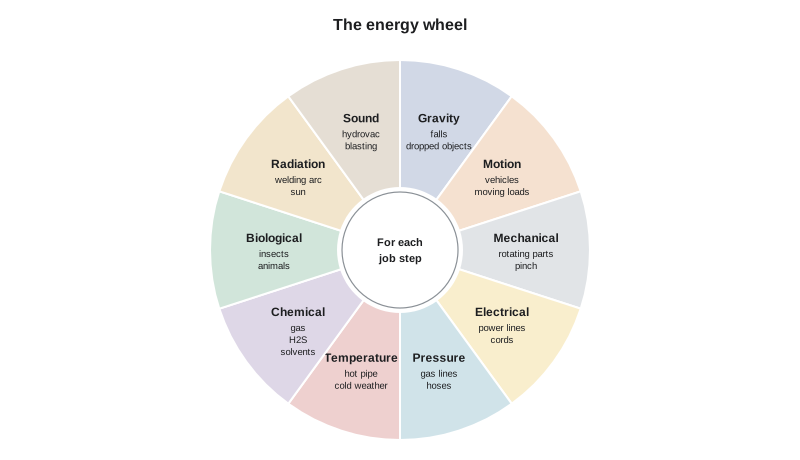
- Gravity. Anything that can fall or that someone can fall from: ladders, excavations, elevated work, suspended loads, stacked materials, tools on a pipe rack.
- Motion. Anything moving, or that could start moving: vehicles, trucks backing up, moving loads, swinging booms, rolling pipe, flowing water.
- Mechanical. Rotating and reciprocating machine parts, pinch points between parts, compressed springs, tensioned cables and chains.
- Electrical. Overhead and buried power lines, generators, extension cords, batteries, static electricity, welding machines, lightning.
- Pressure. Gas in pipes and cylinders, compressed air in hoses, hydraulic lines, pressure trapped behind a closed valve, blasting equipment, hydrovac water at high pressure.
- Temperature. Hot pipe and equipment, welding and cutting, flame, steam, very cold metal, extreme weather.
- Chemical. Natural gas, hydrogen sulphide, fuels, solvents, coatings, welding fumes, silica dust, carbon monoxide from engines.
- Biological. Insects, wasps, snakes, rodents and their droppings, dogs, livestock, plants, mould, sewage.
- Radiation. Ultraviolet from the welding arc and the sun, radiography sources used to inspect welds, lasers.
- Sound. Noise from hydrovac trucks, compressors, blasting, saws and grinders.
Using the wheel is simple. For each step of the job, the crew goes around the wheel and asks: is there any of this type of energy in this step, or near it? Research led by the University of Colorado's Construction Safety Research Alliance and others has found that crews who use the wheel during a pre-job brief recognize noticeably more hazards than crews who do not, with improvements of roughly a third reported in field studies. The wheel works because it gives people a structured prompt instead of relying on memory.
Not all energy is equal
Once the crew has found the energy, the next question is how much of it there is. A dropped pencil and a dropped pipe section are both gravity hazards, but they are not the same problem. Researchers who study serious injuries and fatalities have found that the hazards most likely to kill are high-energy ones, and they have tried to put a number on where 'high' begins.
A common rule of thumb in this research is about 1,500 joules. A joule is a unit of energy; 1,500 joules is roughly the energy of an 80 kg (175 lb) person falling about 2 m (6.5 ft), or of a small car rolling at walking pace. Above that level, the chance of a serious injury or fatality rises sharply. Below it, injuries are usually less severe, though not always. The number is a guide, not a law of nature, and you do not need to calculate joules on every job. But the idea is powerful: some hazards carry enough energy to kill, and those deserve the strongest controls.
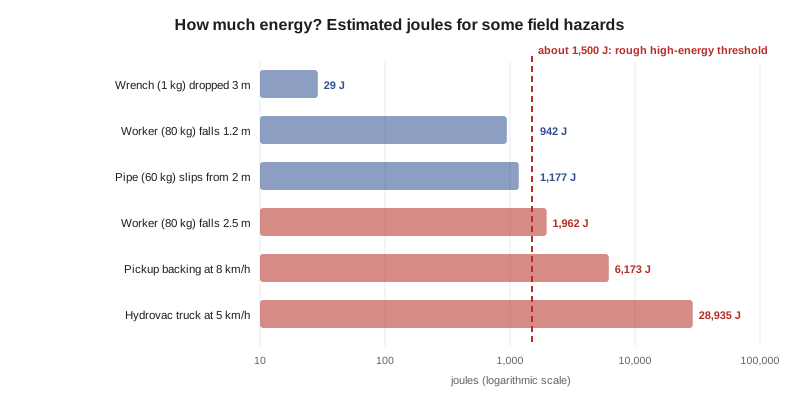
Leila showed the crews a short program that estimates the energy in some common hazards on their jobs. You can run it and change the numbers.
# Estimate the energy in some everyday field hazards, in joules (J)
g = 9.81  # gravity, m/s^2

def falling(mass_kg, height_m):
    return mass_kg * g * height_m          # potential energy = m g h

def moving(mass_kg, speed_kmh):
    v = speed_kmh / 3.6                    # km/h to m/s
    return 0.5 * mass_kg * v ** 2          # kinetic energy = 1/2 m v^2

THRESHOLD = 1500  # rough level above which serious injury becomes likely

hazards = [
    ("Wrench (1 kg) dropped 3 m into the excavation", falling(1.0, 3.0)),
    ("Worker (80 kg) falls 1.2 m from valve supports", falling(80, 1.2)),
    ("Worker (80 kg) falls 2.5 m into the excavation", falling(80, 2.5)),
    ("Pipe section (60 kg) slips from 2 m on the picker", falling(60, 2.0)),
    ("Pickup truck (2,500 kg) backing at 8 km/h", moving(2500, 8)),
    ("Hydrovac truck (30,000 kg) moving at 5 km/h", moving(30000, 5)),
]

for name, joules in hazards:
    level = "HIGH ENERGY" if joules >= THRESHOLD else "lower energy"
print(f"{name:52} {joules:>9,.0f} J {level}")Wrench (1 kg) dropped 3 m into the excavation 29 J lower energy Worker (80 kg) falls 1.2 m from valve supports 942 J lower energy Worker (80 kg) falls 2.5 m into the excavation 1,962 J HIGH ENERGY Pipe section (60 kg) slips from 2 m on the picker 1,177 J lower energy Pickup truck (2,500 kg) backing at 8 km/h 6,173 J HIGH ENERGY Hydrovac truck (30,000 kg) moving at 5 km/h 28,935 J HIGH ENERGY
The results surprised several people in the room. A pickup truck backing at walking speed carries several times the energy of a worker falling into an excavation. A hydrovac truck creeping forward carries many times more. That is why backing incidents, struck-by incidents with mobile equipment and pinning between a vehicle and a fixed object cause so many deaths in field work, even at low speeds.
High-energy hazards to watch for
Industry groups that study serious injuries, including the Edison Electric Institute, which represents many US electric utilities, have published sets of simple pictures or icons for the high-energy hazards that cause most serious injuries and fatalities in their work. The details vary, but most lists include:
- Suspended loads and anything lifted overhead.
- Falls from height, including into excavations.
- Mobile equipment and traffic, including backing trucks and equipment working near people.
- Motor vehicle incidents at highway speeds.
- Heavy rotating equipment.
- High temperatures, steam and fire with fuel to keep burning.
- Explosions, including gas ignition.
- Electrical contact with high-voltage lines and arc flash.
- Excavations and trenches deep enough for a cave-in to bury someone.
- High doses of toxic chemicals, such as hydrogen sulphide, or of radiation.
When the crew finds one of these on an FLHA, it should be marked clearly, for example with a star or a box, and given extra attention in the controls column.
Direct controls
Finding a high-energy hazard is only half the job. The other half is making sure it has a control strong enough to protect people even when someone makes a mistake. Researchers call this a direct control. A control counts as direct when it meets three tests:
- It targets the high-energy hazard itself. It acts on the energy, by removing it, blocking it or keeping it away from people.
- It is in place, verified and used properly. It is not just planned. Someone has checked that it is installed and working.
- It works even if someone makes an unintentional mistake. It does not depend on everyone being careful all the time.
Examples of direct controls on Coldwater's jobs include a trench box or proper sloping in an excavation, a verified isolation with locks on the valves and zero pressure confirmed at the bleed point, guardrails around an opening, a physical barrier between people and moving equipment, and a gas line purged and tested before cutting.
Some controls are useful but are not direct. These are sometimes called indirect controls, because they depend on people doing the right thing every time: training, warning signs, a spotter, an observer, a rule such as 'stay out of the swing radius,' a toolbox talk, and most personal protective equipment. Indirect controls matter, and many jobs need them. But for a high-energy hazard, the question on the FLHA should be: what is our direct control? If the honest answer is 'we don't have one,' that is a reason to stop and talk to the supervisor.
Some companies measure this by checking a sample of jobs and counting, for each high-energy hazard found, whether a direct control was in place. The share of high-energy hazards with a direct control is a useful measure of how well the most serious risks are actually being managed, much more useful than the number of forms filled in.
Worked problem
Applying the energy wheel to one step
Show solution
- Step: lower a 6 m (20 ft) section of 100 mm (4 in) steel pipe into the excavation with the picker truck.
- Gravity: the pipe is a suspended load, about 100 kg (220 lb), lifted about 3 m (10 ft). Workers in the excavation could be under it. High energy. Direct control: nobody in the excavation or under the load while it is lifted; workers enter only after the pipe is landed and blocked.
- Motion: the boom swings and the truck may need to move. High energy if a person is pinned. Direct control: barricade the swing area; outriggers set on pads on firm ground.
- Electrical: the overhead power line is 12 m (40 ft) from the excavation. The boom could reach it. Direct control: boom limit set and a physical stop or range limiter on the crane; the line owner contacted about a cover if the boom must work closer than the safe limit.
- Mechanical: hands near the rigging when landing the pipe. Indirect controls: tag lines, no hands on the load; keep fingers out of pinch points.
- Sound and chemical: the truck engine. Lower energy; hearing protection and keep exhaust away from the excavation.
Answer: Going around the wheel found five types of energy, three of them high energy, each with a direct control.
Using the wheel on a busy morning
Sam's worry, after Leila's session, was time. Going around ten types of energy for every step of an eleven-step job sounded like an hour of paperwork. Dani showed him how her crew actually does it. They do not write ten lines for every step. Instead, one person reads the energy types out loud while the crew looks at the step, and anyone who sees that type of energy says so. Most steps have only two or three types that matter. The rest get a quick 'no' and the crew moves on.
The crew then circles anything that could be high energy and asks the direct control question for each circled item. On a typical job, that leaves three to six high-energy hazards that get most of the discussion. The whole process takes about the same time as a normal walk and talk, but it is far more thorough. After a few weeks, Sam found that he had memorized the wheel and was going around it in his head whenever he walked onto a site.
Leila also keeps a laminated copy of the wheel clipped to every form board in Coldwater's trucks, so nobody has to rely on memory on a cold morning.
Common mistakes
MistakeTreating every hazard as equally important.
InsteadUse energy to find the hazards that could kill and give them the strongest controls.
MistakeRelying on memory to list hazards.
InsteadGo around the energy wheel for each step.
MistakeUnderestimating slow-moving vehicles.
InsteadRemember that even a slow truck carries far more energy than a fall.
MistakeListing training or a spotter as the only control for a high-energy hazard.
InsteadLook for a direct control that works even if someone makes a mistake.
MistakeWriting a direct control that is planned but not checked.
InsteadVerify that it is in place and working before anyone is exposed.
Summary and key terms
- Most injuries happen when energy reaches the body faster or in larger amounts than it can handle.
- The energy wheel lists ten types: gravity, motion, mechanical, electrical, pressure, temperature, chemical, biological, radiation and sound.
- Using the wheel during a pre-job brief helps crews find more hazards than relying on memory.
- High-energy hazards, often described as above about 1,500 joules, are the ones most likely to cause serious injuries and fatalities.
- A direct control targets the high-energy hazard, is in place and verified, and works even if someone makes a mistake.
- Training, signs, spotters and most PPE are indirect controls; useful, but not enough on their own for a high-energy hazard.
- Energy wheel
- A tool that divides hazards into ten types of energy to prompt hazard recognition.
- Joule
- A unit of energy; 1,500 joules is about the energy of an 80 kg (175 lb) person falling about 2 m (6.5 ft).
- High-energy hazard
- A hazard with enough energy to cause a serious injury or fatality.
- Direct control
- A control that targets a high-energy hazard, is verified in place and works even if someone makes an unintentional mistake.
- Indirect control
- A control that depends on people doing the right thing, such as training, signs or a spotter.
Practice problems
Work each problem on paper first, then reveal the answer to check.
Name the ten types of energy on the energy wheel.
Show answer
Gravity, motion, mechanical, electrical, pressure, temperature, chemical, biological, radiation and sound.
What three tests must a control pass to be a direct control?
Show answer
It targets the high-energy hazard, it is in place and verified, and it works even if someone makes an unintentional mistake.
Is a spotter a direct control for a backing truck? Why or why not?
Show answer
No. A spotter depends on people doing the right thing every time; a physical barrier or keeping people out of the backing area is a direct control.
Using the program, which hazard carries the most energy?
Show answer
The moving hydrovac truck, by a wide margin.
What should the crew do if a high-energy hazard has no direct control?
Show answer
Stop and talk to the supervisor before anyone is exposed.
Lesson quiz · 5 questions
Score 60% or more to complete this lesson.
Create a free account to save your progress, take quizzes and earn a certificate.