
HSE-230 · Lesson 11 of 12 · 23 min
Pencil-whipping, common failures and quality checks
At the end of May, Leila asked Sam to help her with a task he had not expected: sorting through a box of completed FLHAs from the previous month. There were about two hundred forms from six crews. 'Look for patterns,' she said. 'Good ones, bad ones, and anything that makes you wonder what really happened on that job.'
It took Sam an afternoon. He found forms that told a clear story of a real job, with sketches, re-assessments and notes in the margins. He also found four forms from one crew, on four different days at four different sites, with identical hazard lists in identical handwriting. He found a form signed by six people at 7:15 a.m. for a job that, according to the timesheet, two of them did not join until after lunch. He found a form for a hot work job with nothing in the fire hazard section. And he found a dozen forms that listed 'slips, trips and falls' and 'pinch points' as the only hazards for excavation work.
'Now you know why we do this,' Leila said. This lesson is about why FLHAs fail, how to recognize a form that has been filled in without thought, and how supervisors and companies can check quality in a way that improves the forms instead of just collecting them.
What pencil-whipping is
Lesson 1 introduced pencil-whipping: filling in a safety form to satisfy a requirement rather than to think about the work. It is one of the most common problems in field safety, and almost every safety professional has a story about it. Pencil-whipped forms are dangerous in two ways. They miss hazards, because nobody actually looked. And they create a false picture, because the company, the client and any investigator will believe the hazards were assessed when they were not.
Pencil-whipping is rarely about bad people. It usually grows out of the conditions that crews work in. Understanding those conditions is the first step to fixing it.
Why it happens
- Too many forms. When a crew has to complete an FLHA, a vehicle inspection, an equipment checklist, a permit, a client form and a toolbox talk sign-in every morning, the paperwork crowds out the thinking.
- Forms that are too long or not relevant. A six-page form with a hundred tick boxes, most of which do not apply to most jobs, teaches people to tick without reading.
- No feedback. If forms go into a box and nobody ever reads them or talks about them, crews learn that the form does not matter.
- Production pressure. When the crew is behind and the client is waiting, the form becomes something to get out of the way.
- Forms used for blame. If the form is mainly used after incidents to find out who signed what, crews learn to protect themselves with generic wording rather than describe the real job.
- Familiarity. On routine jobs done many times, people stop believing the form will tell them anything new.
- No training. Workers who were never taught what the form is for, as Sam was not at first, fill it in by copying others.
Signs of a pencil-whipped form
Sam made a list of what he had found in the box. Leila added a few items from her own experience. Together, they make a useful checklist for anyone reviewing forms:
- Identical forms on different days. Same hazards, same controls, same order, same words, on jobs that were not identical.
- Generic hazards only. 'Slips, trips and falls,' 'pinch points,' 'PPE' with no specific hazards from the site.
- Missing obvious hazards. No fire hazard on a hot work job, no cave-in on an excavation, no overhead line on a job next to a power line.
- Controls that are not controls. 'Be careful,' 'stay alert,' 'use common sense,' 'follow procedures.'
- All signatures at the same time. Including people who arrived later, or the signatures were written before the job even started.
- Same handwriting throughout. One person filled in the whole form, including other people's names.
- Blank re-assessment log on a long or complex job. A full day of excavation with weather changes and no recorded changes.
- Risk scores that are always low. Every residual risk green, every time.
- Mismatch with other records. The form says one thing; the timesheet, the permit, the photos or the incident report says another.
One sign on its own does not prove a form was pencil-whipped. A routine job really might have very similar hazards on two days. But several signs together are a strong indicator that the crew filled in the form without doing the assessment.
The cost of a bad form
Leila keeps a short file of incident reports from across the industry where the FLHA was a factor. The pattern is consistent. In many serious incidents, the form had been completed and signed. The hazard that hurt someone was either missing from the form, written in generic words, or listed with a control that was not actually in place. The form gave everyone a sense that the hazards had been handled, when they had not. A form that is not used is not just useless; it can make people less careful by making them feel safe.
Quality checks by supervisors
The answer to pencil-whipping is not more paperwork or stricter rules about signing. It is regular, respectful attention from supervisors and managers to the quality of the thinking behind the forms. Coldwater uses three kinds of quality checks.
1. Field reviews of a live FLHA
The most valuable check is for a supervisor to be on site while the crew does its FLHA and pre-job talk, and then to look at the work. Owen does at least two of these every week. He watches the walk, listens to the talk, then compares the form to the site: Are the hazards he can see on the form? Are the critical controls in place? Can a crew member explain the emergency plan? He gives feedback on the spot, starting with what was done well.
2. Form reviews
Each month, Leila pulls a random sample of completed forms from each crew and scores them against a short checklist. Random sampling matters. If lead hands choose which forms to hand in, the sample will show their best work, not their typical work. The checklist Coldwater uses has ten items, each scored as met or not met:
| # | Checklist item |
|---|---|
| 1 | Specific location and time |
| 2 | Job steps written as actions |
| 3 | Site-specific hazards, not only generic ones |
| 4 | High-energy hazards marked |
| 5 | Direct control for each high-energy hazard |
| 6 | Controls specific, owned and checkable |
| 7 | Emergency plan complete |
| 8 | All workers signed with times |
| 9 | Re-assessment recorded when the job changed |
| 10 | Close-out completed |
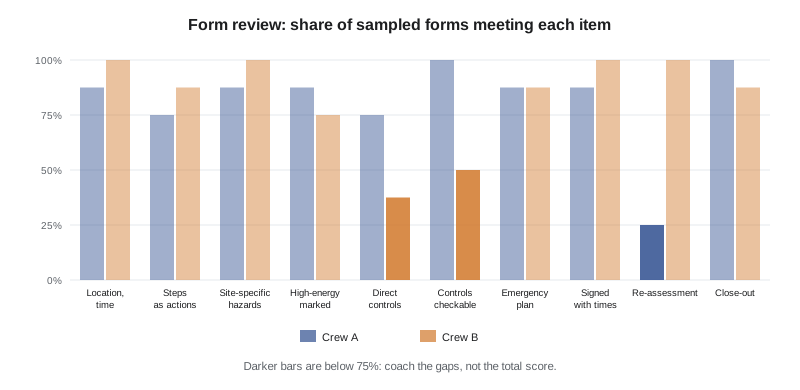
The short program below shows how scoring a sample works. It uses invented results for forty forms from two crews and a random sample of eight forms from each.
# Score a sample of hazard assessment forms against a 10-point quality checklist.
# Each form gets 1 point for each item it meets.
import random
random.seed(7)  # fixed so the example gives the same "random" sample each time

CHECKLIST = [
    "Specific location and time",
    "Job steps written as actions",
    "Site-specific hazards (not only generic)",
    "High-energy hazards marked",
    "Direct control for each high-energy hazard",
    "Controls specific, owned and checkable",
    "Emergency plan complete",
    "All workers signed with times",
    "Re-assessment recorded when the job changed",
    "Close-out completed",
]

# Results for 40 forms collected in May (1 = item met, 0 = not met).
# Crew A tends to miss re-assessment; Crew B tends to miss direct controls.
def make_form(crew):
    weak = {"A": [8], "B": [4, 5]}[crew]
    return [0 if (i in weak and random.random() < 0.6) or random.random() < 0.08 else 1
            for i in range(len(CHECKLIST))]

forms = [("A", make_form("A")) for _ in range(20)] + [("B", make_form("B")) for _ in range(20)]

# Supervisors review a random sample of 8 forms per crew
for crew in ("A", "B"):
    pool = [f for c, f in forms if c == crew]
    sample = random.sample(pool, 8)
    avg = sum(sum(f) for f in sample) / len(sample)
    print(f"Crew {crew}: average score {avg:.1f} / 10 on {len(sample)} forms")
    for i, item in enumerate(CHECKLIST):
        met = sum(f[i] for f in sample)
        if met < 6:
print(f" needs coaching: {item} ({met}/8 forms)")Crew A: average score 8.1 / 10 on 8 forms needs coaching: Re-assessment recorded when the job changed (2/8 forms) Crew B: average score 8.2 / 10 on 8 forms needs coaching: Direct control for each high-energy hazard (3/8 forms) needs coaching: Controls specific, owned and checkable (4/8 forms)
The output shows each crew's average and the items that most forms in the sample missed. That is the useful part. A score of 8 out of 10 tells you little on its own. Knowing that Crew B often marks high-energy hazards but often has no direct control for them tells Owen exactly what to coach.
3. Interviews
The third check is the simplest: asking crew members about the form. 'What was the biggest hazard on yesterday's job, and what did you do about it?' 'What would you have done if the detector had alarmed?' If people can answer from memory, the FLHA did its job. If they cannot remember what was on it, the form was probably not the centre of the conversation it was supposed to be. COR auditors in Canada and client auditors in both countries often use the same approach.
Coaching, not punishment
How supervisors respond to a weak form decides whether forms get better or just get more defensive. If a lead hand is disciplined every time a form is weak, the next forms will be longer and more generic, written to protect the crew rather than describe the job. If the lead hand gets specific, respectful coaching, the next forms will improve.
Owen's approach with a weak form has four parts:
- Start with what was good. There is almost always something.
- Ask before telling. 'Walk me through how you decided the controls for the excavation.' The answer often shows that the crew did think about it but did not write it down well, or that something really was missed.
- Be specific. 'The overhead line isn't on here, and the boom was under it at 10 a.m.' is useful. 'Your forms need to be better' is not.
- Fix the system as well as the form. If every crew misses the same item, the problem may be the form, the training or the schedule, not the crews.
Discipline still has a place for deliberate falsification, such as signing for someone else or writing that a control was in place when it was not. But that is rare, and it should be treated very differently from a form that is simply weak.
Fixing the system
When Leila and Owen reviewed the box of forms with the lead hands, they found several system problems, not just crew problems:
- The form was too long. Coldwater's old form had three pages and 90 tick boxes. They redesigned it to two sides, with a short prompt list and more space for site-specific hazards.
- The prompt list did not include the high-energy hazards. They added the company's high-energy icons and a box for the direct control.
- Crews were doing duplicate forms. On Southplains Gas jobs, crews filled in both the client's form and Coldwater's. Leila worked with the client to accept one combined form.
- There was no feedback. Now each crew gets a short monthly summary of its form review, with one thing to keep doing and one thing to improve.
- Training was inconsistent. New workers now get a two-hour session on the FLHA, using the material in this course, before their first field job.
Paper and digital forms
Many companies are moving to digital forms on phones and tablets. They have real advantages: no lost forms, automatic time stamps, GPS locations, photos, required fields and easier review. They also have risks: drop-down lists and default values make it even easier to tick without thinking, signatures can be done in a moment on someone else's device, and screens are hard to read outdoors in sunlight or with gloves on. Whatever the format, the same rules apply: walk the site, talk as a crew, write specific hazards and controls, and sign only when you understand.
Worked problem
Reviewing a weak form with a lead hand
Show solution
- Owen pulled a form from another lead hand, Marcus, for a valve replacement in a vault. It listed: 'confined space,' 'pinch points,' 'slips, trips and falls.' Controls: 'follow procedures,' 'PPE.' The re-assessment log was blank, and the job had lasted nine hours.
- He started with what was good: the header and emergency box were complete, and the confined space permit number was recorded.
- He asked Marcus to walk him through the job. Marcus described testing the vault atmosphere, setting up the tripod and retrieval line, isolating the valve, and a change after lunch when water began to seep into the vault and they had to pump it out.
- Owen pointed out that almost none of that was on the form. The direct controls for the confined space were real but not written. The water and the pump, with its exhaust, were a change that should have been re-assessed, because exhaust near the vault opening can contaminate the air inside.
- Marcus agreed. Together they rewrote the hazards and controls as a model for his crew. Owen also noticed that the confined space section of the form had no room for gas test readings, so he raised it with Leila as a form problem.
Answer: The crew had done much of the thinking but had not recorded it, and had missed one real change. The coaching improved the next forms and the form itself.
Common mistakes
MistakeAssuming a completed, signed form means the hazards were assessed.
InsteadLook for signs of pencil-whipping and check the form against the site.
MistakeLetting lead hands choose which forms to submit for review.
InsteadReview a random sample so the results show typical work.
MistakeFocusing on the total score.
InsteadLook at which checklist items are missed and coach those.
MistakeDisciplining crews for weak forms.
InsteadCoach specifically and respectfully, and reserve discipline for deliberate falsification.
MistakeBlaming crews when every crew misses the same item.
InsteadLook for a system problem in the form, training or schedule.
Summary and key terms
- Pencil-whipping misses hazards and creates a false picture that hazards were controlled.
- It grows out of too many or too long forms, no feedback, production pressure, use of forms for blame, familiarity and lack of training.
- Signs include identical forms, generic hazards, missing obvious hazards, non-controls, same-time signatures, blank re-assessment logs, always-low scores and mismatches with other records.
- Quality checks include field reviews of a live assessment, scoring a random sample of forms against a checklist, and interviewing crew members.
- Coaching that starts with what was good, asks first and is specific improves forms; discipline is for deliberate falsification.
- When many crews make the same mistake, fix the system: the form, training, duplication and feedback.
- Pencil-whipping
- Filling in a safety form to satisfy a requirement without actually thinking about the work.
- Field review
- A supervisor observing a crew complete its hazard assessment and comparing the form to the site.
- Random sample
- A selection of forms chosen by chance, so the results show typical rather than best work.
- Quality checklist
- A short list of items used to score whether a form shows real assessment.
- Falsification
- Deliberately recording something untrue, such as signing for someone else or claiming a control was in place.
Practice problems
Work each problem on paper first, then reveal the answer to check.
Name four signs of a pencil-whipped form.
Show answer
Any four: identical forms on different days, generic hazards only, missing obvious hazards, controls that are not controls, all signatures at the same time, same handwriting, blank re-assessment log on a complex job, always-low risk scores, mismatch with other records.
Why should forms for review be chosen at random?
Show answer
If lead hands choose, the sample shows their best work rather than their typical work.
In the program, what does Crew B need coaching on?
Show answer
Having a direct control for each high-energy hazard, and writing controls that are specific, owned and checkable.
What are the four parts of Owen's coaching approach?
Show answer
Start with what was good, ask before telling, be specific, and fix the system as well as the form.
Give one risk of digital forms.
Show answer
Any one: drop-downs and defaults make ticking without thinking easier; signatures can be done quickly on someone else's device; screens are hard to read outdoors or with gloves.
Lesson quiz · 5 questions
Score 60% or more to complete this lesson.
Create a free account to save your progress, take quizzes and earn a certificate.