
HSE-217 · Lesson 4 of 12 · 27 min
Safe digging near buried facilities and strike response
Marks on the ground tell you roughly where a facility is. They do not tell you exactly where it is, how deep it is, whether there is a second line beside it, or whether the record it came from was wrong. Safe digging closes that gap. This lesson covers the zone around the marks where machines must give way to careful exposure, the methods used to expose facilities, special rules near pipelines, and what to do when something is hit anyway.
The tolerance zone
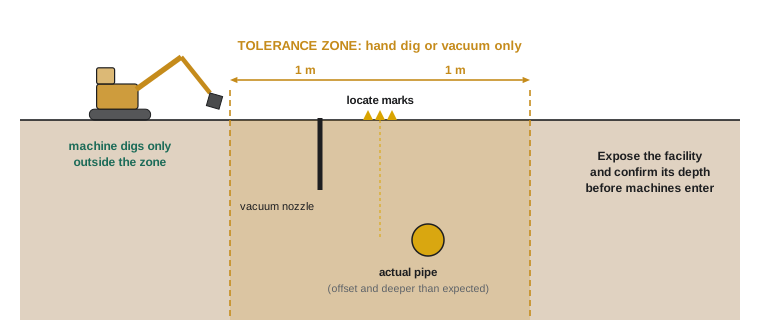
The tolerance zone, called the hand expose zone in Alberta, is the strip of ground on each side of the locate marks within which the facility could actually be. Within it, mechanical excavation is not allowed until the facility has been exposed by hand digging or by a method the owner accepts, such as vacuum excavation. Alberta's OHS Code defines the hand expose zone as 1 m on each side of the locate marks for most underground facilities and 5 m on each side for high-pressure pipelines, and prohibits mechanical excavation within the zone until the facility is exposed. Elsewhere in Canada, best practices from the regional Common Ground Alliances and the requirements of most owners set a zone of 1 m on each side of the marks. Owners can set a wider zone on the locate sheet, and some do for high-pressure gas mains and transmission cables.
Worked problem
How wide is the zone?
A 200 mm gas main is marked with a single line of yellow paint. The owner's sheet sets a hand expose zone of 1 m on each side of the marks. How wide a strip must be treated as a hand-dig area, and where may an excavator bucket work freely?
Show solution
- The zone extends 1 m each side of the line of marks, giving a strip 2 m wide.
- The pipe may be anywhere within that strip, at an unknown depth.
- A bucket may dig outside the strip, but should approach the edge carefully and stay shallow until the pipe is located.
- Within the strip, use hand tools or vacuum excavation until the pipe is exposed and its depth confirmed.
Answer: A 2 m wide strip centred on the marks; machines work only outside it until the main is exposed.
Methods of exposing facilities
Hand digging is the traditional method. It should be done with care: use blunt-edged or insulated shovels, avoid picks, bars and spades with sharp points that can puncture a pipe or cut a cable, and dig alongside the expected location rather than straight down on top of it. Pry soil gently away from the facility rather than stabbing at it. Hand digging is slow and physically hard in frozen or compacted ground, which is exactly when crews are tempted to bring the machine closer.
Vacuum excavation, often called hydrovac or daylighting, uses high-pressure water or air to loosen the soil and a powerful vacuum to lift the spoil into a debris tank on a truck. It is fast, precise and much less likely to damage a facility than any mechanical method, and it works in frozen ground when heated water is used. It has its own hazards:
- High-pressure water jets can cut skin and damage the coating of a pipe if held too close or too long in one spot. Operators follow the owner's limits on pressure, nozzle type and distance.
- The vacuum hose can trap a hand or limb. Keep body parts away from the nozzle.
- Holes created by vacuum excavation are deep and narrow. Cover or barricade them, and remember that a deep keyhole is still an excavation.
- Spoil in the debris tank is a liquid slurry that must be disposed of according to municipal and environmental rules.
Other methods include air excavation tools, which use a supersonic air jet to break soil without damaging pipes, and test holes, also called potholes or keyholes, dug at intervals along a route to confirm the location and depth of a facility before a long trench or a directional drill crosses it.
| Method | Strengths | Limits and hazards |
|---|---|---|
| Hand digging | No equipment needed; good control | Slow; hard in frozen or compacted soil; pointed tools can damage facilities |
| Hydrovac (water) | Fast, precise, works in frozen ground with heated water | Coating damage if misused; slurry disposal; deep narrow holes |
| Air vacuum | Dry spoil can be reused as backfill; gentle on facilities | Slower in clay; dust; noise |
| Test holes at intervals | Confirms location and depth along a long route | Only shows the facility where a hole is dug |
| Mechanical with spotter | Fast outside the tolerance zone | Not acceptable inside the zone until the facility is exposed |
Once the facility is exposed
Exposing the facility is the beginning, not the end. Once it is visible:
- Confirm it is the facility you expected. Check the material, size and depth against the locate sheet.
- Look for other lines alongside. Gas and electrical services often share a trench, and communications lines are frequently laid above them.
- Support the facility if the excavation will undermine it. Long spans of unsupported pipe or cable can sag, crack or pull apart at joints. Owners specify support methods.
- Protect it from the bucket. Mark the location clearly with stakes or flags, and keep a spotter watching when machines work nearby.
- Report any damage, however small. A scrape on a coated steel pipe or a nick in a cable jacket can lead to corrosion or failure months later. The owner must inspect it before backfill.
- Backfill correctly, with the bedding material and compaction the owner requires, and replace any warning tape.
Pipelines
High-pressure oil and gas pipelines carry enormous stored energy, and a rupture can produce a fireball hundreds of metres across. For federally regulated pipelines, the Canadian Energy Regulator's damage prevention regulations create a prescribed area extending 30 m on each side of the centreline of the pipe. Ground disturbance of 30 cm or deeper within the prescribed area requires the pipeline company's written consent and a locate, and companies must mark their pipe within 3 working days or at a mutually agreed time. Driving vehicles or mobile equipment across the right-of-way outside the travelled portion of a road also needs consent, with exceptions for agricultural activity. Alberta's Pipeline Rules for provincially regulated lines set a 30 m controlled area, require the pipeline to be located and hand exposed before mechanical excavation within 5 m, and forbid mechanical excavation within 60 cm of the pipe without the licensee's direct supervision.
Worked problem
Does the prescribed area apply?
A farmer wants to install a fence along a federally regulated gas pipeline right-of-way. The posts will be augered 1 m deep, 12 m from the pipeline centreline. Separately, a landscaper wants to level a garden 20 m from the centreline, removing 20 cm of topsoil. Which activities need the pipeline company's consent?
Show solution
- Both activities are within 30 m of the centreline, so both are inside the prescribed area.
- The fence posts disturb the ground to 1 m, deeper than 30 cm, so a locate and the company's written consent are required.
- The garden levelling disturbs only 20 cm, less than 30 cm, so consent is not required for depth reasons, provided cover over the pipe is not reduced.
- Both parties should still contact the one-call centre, and the landscaper should confirm no mobile equipment crossing of the right-of-way needs consent.
Answer: The fence posts need consent and a locate; the 20 cm levelling does not need consent but still needs a one-call request.
When a facility is hit
Despite every precaution, strikes happen. What the crew does in the next minute can decide whether a strike becomes a disaster.
Gas lines. If a gas line is damaged, even if there is no audible leak:
- Stop work and shut off equipment only if it can be done without creating a spark; otherwise leave it and get away.
- Move everyone away from the area, upwind, and keep the public back. Do not use phones, lighters, vehicle ignitions or anything else that could ignite gas near the leak.
- Call 911 and the gas utility's emergency number from a safe distance.
- Do not try to stop the leak, crimp the pipe, cover it or backfill. Do not restart equipment until the utility says it is safe.
- Even a scratch or a dent with no leak must be reported; the utility will inspect and repair it.
Electrical cables. If a bucket contacts an energized cable, the machine and the ground around it may be energized. The operator should stay in the cab unless there is a fire, warn others to stay away, and call the electrical utility. If the operator must leave, they should jump clear with feet together, without touching the machine and the ground at the same time, and shuffle away in small steps. HSE-214 and HSE-224 cover electrical hazards in more depth.
Fibre optic and communications lines. A cut fibre cable is not an immediate physical hazard to the crew, but the invisible laser light in some fibres can damage eyes, so never look into the cut end. Cuts can disable emergency phone service, so report them immediately.
Water and sewer lines. A broken water main can flood a trench in minutes and undermine the walls. Get everyone out of the excavation first, then call the owner. A broken sewer releases sewage and can release hydrogen sulphide and other gases into the trench.
Pressure to dig without exposing
Exposing every facility in the tolerance zone takes time, and the pressure to skip it is constant. A vacuum truck is not available until tomorrow; the ground is frozen; the owner's representative is late; the marks look accurate. Damage prevention data consistently show that a large share of strikes happen because the excavator did not use enough care in the tolerance zone, not because the locate was wrong. The cost of a strike, in repairs, outage penalties, evacuations and possibly lives, is almost always greater than the cost of waiting a few hours. Supervisors should plan vacuum excavation into the schedule from the start, and treat a missing locate, an unexposed facility or a missing owner's representative as a reason to stop rather than an obstacle to work around.
Common mistakes
MistakeUsing a pick or pointed spade to dig inside the tolerance zone.
InsteadUse blunt or insulated tools, or vacuum excavation, and dig alongside rather than on top of the facility.
MistakeBackfilling over a scraped pipe because it is not leaking.
InsteadReport all damage and let the owner inspect and repair before backfill.
MistakeTrying to stop a gas leak by crimping or covering the pipe.
InsteadEvacuate upwind, eliminate ignition sources and call 911 and the utility.
MistakeClimbing down from an excavator that has contacted a power cable.
InsteadStay in the cab unless there is a fire; if you must leave, jump clear and shuffle away.
MistakeAssuming a pipeline marker shows the exact location of the pipe.
InsteadMarkers only show the line is nearby; locate and expose it before digging.
Summary and key terms
- The tolerance or hand expose zone is typically 1 m each side of the marks, and 5 m for high-pressure pipelines in Alberta.
- Machines stay out of the zone until the facility is exposed by hand or vacuum excavation.
- Hydrovac is precise but has its own hazards: water jets, suction and deep narrow holes.
- Once exposed, confirm, support, protect and report any damage before backfill.
- Federally regulated pipelines have a 30 m prescribed area where disturbance of 30 cm or more needs consent.
- After a gas strike, evacuate upwind, avoid ignition and call 911 and the utility.
- After an electrical strike, stay in the machine and keep others away.
- Tolerance zone
- The strip each side of locate marks where a facility may lie and machines may not dig until it is exposed.
- Hand expose zone
- Alberta's term for the tolerance zone around locate marks.
- Vacuum excavation
- Excavation using water or air to loosen soil and a vacuum to remove it, also called hydrovac or daylighting.
- Daylighting
- Exposing a buried facility so it can be seen, usually by vacuum excavation.
- Test hole
- A small excavation dug to confirm the location and depth of a facility, also called a pothole or keyhole.
- Right-of-way
- The strip of land in which a pipeline company holds rights to build and maintain its line; federally regulated lines also have a 30 m prescribed area on each side.
- Coating damage
- Damage to the protective layer on a steel pipe that can lead to corrosion.
- Step potential
- The voltage between a person's feet when standing on energized ground.
- Spotter
- A worker who watches the bucket and the facility and signals the operator.
Practice problems
Work each problem on paper first, then reveal the answer to check.
What is the purpose of the tolerance zone?
Show answer
To allow for locate error by requiring careful exposure near the marks.
What is Alberta's hand expose zone for a high-pressure pipeline?
Show answer
5 m on each side of the locate marks.
Name two hazards of hydrovac excavation.
Show answer
Water jet injuries and coating damage, suction hazards, deep narrow holes, slurry disposal.
Why should a minor scrape on a pipe be reported?
Show answer
It can lead to corrosion or failure later, so the owner must inspect it.
What is the first priority after a gas line strike?
Show answer
Move people away upwind and eliminate ignition sources, then call 911 and the utility.
Why should the operator stay in an excavator that has hit a power cable?
Show answer
The machine and ground may be energized; stepping down can complete a path through the body.
When is pipeline company consent needed in the CER prescribed area?
Show answer
For ground disturbance 30 cm or deeper, and for vehicle crossings outside roads.
Why dig alongside a facility rather than on top of it?
Show answer
It reduces the chance of striking it with the tool.
Why must exposed facilities sometimes be supported?
Show answer
Long unsupported spans can sag, crack or pull apart.
Why should you never look into a cut fibre end?
Show answer
Invisible laser light can damage the eye.
Lesson quiz · 5 questions
Score 60% or more to complete this lesson.
Create a free account to save your progress, take quizzes and earn a certificate.