
HSE-217 · Lesson 9 of 12 · 29 min
Water, atmospheres and confined spaces
Two invisible or easily underestimated hazards share this lesson. Water undermines walls, adds pressure to supports, hides the trench floor and can flood a trench faster than workers can climb out. Gases and vapours can collect in a trench just as they do in a tank or manhole, and a trench can become a confined space. Both are controlled the same way: anticipate them in planning, monitor them during the work, and stop when conditions change.
Where the water comes from
Water reaches excavations from several sources:
- Groundwater, when the excavation extends below the water table or through a water-bearing layer of sand or gravel.
- Surface water from rain, snowmelt, irrigation or runoff from paved areas uphill of the trench.
- Broken or leaking water mains, sewers and services, sometimes damaged by the excavation itself.
- Nearby watercourses, ponds and ditches that feed water through permeable soil.
- Frost thaw in spring, which releases water held in frozen ground.
Water weakens soil walls by adding weight, reducing friction between grains and washing out fine particles. Granular soils below the water table can flow into the trench, a condition sometimes called running sand or quick conditions. In the floor of the trench, upward-flowing water can cause boiling or piping, where the floor loses all strength. Water in a trench also hides tripping hazards, makes footing slippery, increases the risk of electrical shock from tools and pumps, and causes hypothermia in cold weather.
Rules for water in excavations
Ontario's O. Reg. 213/91, section 230, requires an excavation in which a worker may be required to enter to be kept reasonably free of water. Section 235 permits timbering and shoring from the regulation's table only where there is no hydrostatic pressure; where groundwater pressure exists, an engineered system is needed. Alberta's soil categories treat soil that is wet, granular below the water table, or that exerts hydraulic pressure on supports as soft, sandy or loose, the weakest class.
Controlling water
- Divert surface water before it reaches the excavation, with berms, ditches, sandbags and grading. Do not let roof drains, pavement runoff or pump discharge flow back towards the trench.
- Pump accumulated water from sumps at the low end of the trench, with pumps sized for the inflow and someone responsible for keeping them running.
- For excavations below the water table, use dewatering systems such as well points or deep wells designed by an engineer, which lower the water table before digging rather than chasing water after it arrives.
- Use sheeting or engineered shoring that can resist water pressure where dewatering is not practical.
- Stop work and get out if water starts to rise faster than pumps can remove it, if the floor starts to boil, or if fine soil is being pumped out with the water, which shows that soil is being removed from behind the walls.
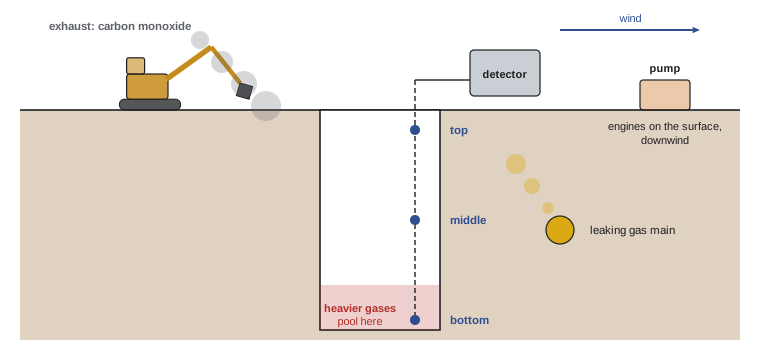
- Locate gasoline and diesel pumps on the surface, downwind and away from the trench, so that exhaust does not flow into it. Electric pumps need ground fault protection.
Pumped water can carry sediment and contaminants, and its discharge is regulated. In Ontario, construction dewatering above certain daily volumes must be registered on the Environmental Activity and Sector Registry or covered by a Permit to Take Water, and discharge to sewers is subject to municipal sewer-use bylaws. Check current thresholds and conditions with the Ministry of the Environment, Conservation and Parks and the municipality.
Worked problem
Will the pump keep up?
Groundwater seeps into a 20 m long, 1.0 m wide trench at an estimated 80 L/min. A submersible pump rated at 150 L/min at the required lift is available. If the pump fails, how long until water reaches 0.3 m deep, about knee height on a crouching worker?
Show solution
- The pump capacity, 150 L/min, exceeds the inflow, 80 L/min, with a margin of about 1.9 times.
- Volume to 0.3 m deep: \( 20 \times 1.0 \times 0.3 = 6 \) m³, or 6,000 L.
- Time at 80 L/min with the pump off: \( 6{,}000 / 80 = 75 \) min.
- That is enough time to get out and restore pumping, but inflow can increase suddenly, so a standby pump and a clear rule for getting out are needed.
Answer: The pump keeps up with a margin; water would reach 0.3 m in about 75 minutes if it failed.
Hazardous atmospheres in excavations
An open trench feels like the outdoors, so workers rarely think of its air as a hazard. But a trench is a long, narrow pit with limited air movement, and gases heavier than air settle in it. Sources include:
- Leaking natural gas from damaged mains or services. Natural gas is lighter than air but can still collect under plates, in pockets and in soil before it disperses.
- Propane, gasoline vapour and other fuels from leaking tanks, contaminated soil or spills. These are heavier than air and pool in the bottom of a trench.
- Carbon monoxide from engine exhaust: excavators, compactors, generators, cut-off saws and gasoline pumps operating in or near the trench.
- Hydrogen sulphide from sewers, septic systems, organic soils and some industrial sites. It is heavier than air, toxic and deadens the sense of smell at higher concentrations. HSE-244 covers it in detail.
- Methane and carbon dioxide from landfills, organic soils, peat and decaying vegetation.
- Oxygen deficiency from displacement by other gases, or from oxidation of iron-bearing soils and decaying matter.
- Toxic vapours from contaminated soil at former industrial sites, gas stations and dry cleaners.
| Gas or vapour | Density compared with air | Typical source in excavations | Main hazard |
|---|---|---|---|
| Methane (natural gas) | Lighter (about 0.55) | Gas main leaks, landfills, organic soil | Fire and explosion; displaces oxygen |
| Propane | Heavier (about 1.5) | Tank and line leaks | Fire and explosion; pools in low spots |
| Carbon monoxide | About the same (0.97) | Engine exhaust | Toxic; no warning odour |
| Hydrogen sulphide | Heavier (about 1.2) | Sewers, septic systems, organic soil | Highly toxic; flammable |
| Carbon dioxide | Heavier (about 1.5) | Decay, landfills, dry ice, exhaust | Displaces oxygen; toxic at high levels |
| Gasoline vapour | Much heavier (3 to 4) | Contaminated soil, leaking tanks | Fire and explosion; toxic |
Testing the atmosphere
Atmospheric testing is required wherever a hazardous atmosphere exists or could reasonably be expected, such as near landfills, sewers, gas mains, fuel storage, contaminated sites, or where fuel-powered equipment runs in or near the excavation. Testing uses a calibrated multi-gas detector, typically measuring oxygen, flammable gases as a percentage of the lower explosive limit (LEL), carbon monoxide and hydrogen sulphide. The detector should be bump tested each day before use, and readings taken from outside the excavation by lowering a sampling probe or the detector itself before anyone enters. Test at the top, middle and bottom, because gases stratify. Where the excavation meets the definition of a confined space, the full confined space requirements apply, including an assessment, a plan, an entry permit and continuous monitoring.
Worked problem
Reading the LEL scale
A detector reads 12 percent LEL for methane in the bottom of a trench beside a gas main. The LEL of methane is 5 percent by volume in air. What is the concentration of methane by volume and in parts per million, and what should the crew do?
Show solution
- 12 percent of the LEL is \( 0.12 \times 5\% = 0.6\% \) methane by volume.
- 1 percent by volume is 10,000 ppm, so 0.6 percent is 6,000 ppm.
- Many employers set the first alarm at 10 percent LEL, so this reading is above a typical alarm threshold. It indicates a leak.
- Get everyone out, eliminate ignition sources, call the gas utility and do not re-enter until the source is controlled and readings are back to zero.
Answer: 0.6 percent, or 6,000 ppm. Evacuate and call the utility; a reading near a gas main means a leak.
Ventilation
Where a hazardous atmosphere is possible but can be controlled, forced ventilation with an air mover or blower can keep the air in an excavation fresh. The blower intake must be in clean air, upwind and away from engine exhausts, and the air should be delivered to the bottom of the excavation where heavier gases collect. Ventilation does not replace testing; it is checked by continuous monitoring. It is not a fix for an active gas leak, which must be stopped by the owner.
Worked problem
Air changes in a trench box
A blower delivers 20 m³/min of fresh air into the working space of a trench box that is 1.2 m wide, 3.0 m deep and 6.0 m long. How many air changes per minute is this, and how long does one air change take?
Show solution
- Volume of the working space: \( 1.2 \times 3.0 \times 6.0 = 21.6 \) m³.
- Air changes per minute: \( 20 / 21.6 \approx 0.93 \).
- One air change takes about \( 21.6 / 20 \approx 1.1 \) min.
- Mixing is never perfect, so several air changes are needed before testing again, and monitoring continues while work goes on.
Answer: Just under one air change per minute; ventilate for several minutes, retest, and keep monitoring.
When an excavation becomes a confined space
Most open trenches are not confined spaces, but some excavations meet the definition. In Ontario, the confined space provisions for construction projects in O. Reg. 213/91 define a confined space as a fully or partially enclosed space that is not both designed and constructed for continuous human occupancy and in which atmospheric hazards may occur because of its construction, location or contents or because of work done in it. A deep, narrow excavation near a sewer, a pit with a vault or chamber, a shaft or a tunnel can qualify. Alberta's OHS Code, Part 5, regulates confined spaces and restricted spaces, and other provinces have similar rules. When a space qualifies, the employer needs a written program, a hazard assessment, a plan, entry permits, testing, ventilation, attendants and a rescue plan. HSE-211 covers confined spaces in detail.
Even when an excavation does not meet the definition, the same thinking applies: anticipate the atmospheric hazard, test, ventilate, keep someone at the top, and have a plan for getting a worker out without sending someone else into the same air.
Contaminated sites deserve particular planning. Where historical use suggests fuel, solvents or other chemicals in the soil, the employer should obtain environmental site information before digging, plan for monitoring and personal protective equipment, and arrange disposal of contaminated spoil and water.
Common mistakes
MistakeRunning a gasoline pump or generator at the edge of the trench.
InsteadPlace engines downwind and away from the excavation, and monitor for carbon monoxide.
MistakeTesting the air only at the top of the trench.
InsteadTest at top, middle and bottom, because heavier gases settle at the floor.
MistakeContinuing to work while water rises faster than the pump can remove it.
InsteadGet out, increase pumping or dewatering, and let the competent person reassess.
MistakePumping out cloudy water full of fine soil without concern.
InsteadFines in the discharge mean soil is being removed from behind the walls; stop and reassess.
MistakeAssuming no excavation can ever be a confined space.
InsteadAssess deep or enclosed excavations against the confined space definition.
Summary and key terms
- Water weakens walls, adds pressure, causes boiling floors and can flood trenches quickly.
- Ontario requires excavations to be kept reasonably free of water and engineered support where hydrostatic pressure exists.
- Divert surface water, pump from sumps, and dewater deep excavations before digging.
- Gas, fuel vapours, carbon monoxide, hydrogen sulphide and low oxygen can collect in trenches.
- Test with a calibrated detector at several levels before entry and as conditions change.
- Ventilate with clean air delivered to the bottom, and keep monitoring.
- Some excavations are confined spaces and need the full confined space program.
- Dewatering
- Lowering the groundwater level around an excavation with pumps, well points or wells.
- Sump
- A low point where water collects so it can be pumped out.
- Boiling
- Upward flow of groundwater through the floor of an excavation that destroys the soil's strength.
- Hydrostatic pressure
- Water pressure that increases with depth and pushes on walls and supports.
- Lower explosive limit (LEL)
- The lowest concentration of a gas in air that can ignite.
- Bump test
- A brief exposure of a gas detector to a known gas to confirm its sensors and alarms respond.
- Stratification
- Layering of gases by density, with heavier gases settling lower.
- Confined space
- A space not designed for continuous occupancy in which atmospheric or other serious hazards may occur.
- Well point
- A small-diameter well connected to a pump to lower groundwater near an excavation.
Practice problems
Work each problem on paper first, then reveal the answer to check.
Name four sources of water in excavations.
Show answer
Groundwater, rain and runoff, broken mains or sewers, nearby watercourses, frost thaw.
What does fine soil in pump discharge indicate?
Show answer
Soil is being washed from behind the walls, weakening them.
Which is heavier than air: methane or propane?
Show answer
Propane.
Why should engines be kept away from trenches?
Show answer
Their exhaust carries carbon monoxide that can collect in the trench.
At what levels should the air in a trench be tested?
Show answer
Top, middle and bottom.
Convert 20 percent LEL of methane to percent by volume.
Show answer
1 percent by volume, or 10,000 ppm.
What does s. 230 of O. Reg. 213/91 require?
Show answer
Excavations a worker may enter must be kept reasonably free of water.
Where should a ventilation blower intake be located?
Show answer
In clean air, upwind and away from engine exhaust.
What is a bump test?
Show answer
A check that the detector responds to a known gas before use.
Give an example of an excavation that might be a confined space.
Show answer
A deep narrow pit near a sewer, a shaft or a vault.
Lesson quiz · 5 questions
Score 60% or more to complete this lesson.
Create a free account to save your progress, take quizzes and earn a certificate.