
HSE-217 · Lesson 11 of 12 · 27 min
Emergency response and trench rescue
Everything in the previous lessons is aimed at making sure this lesson is never needed. But collapses, gas strikes, medical emergencies and injuries still happen, and the first few minutes decide how many people go home. The instinct to jump into a collapsed trench and dig out a co-worker by hand is powerful and understandable. It is also one of the main reasons trench collapses kill more than one person. This lesson covers planning for emergencies, what to do in the first minutes, how technical rescue works, and the reporting and investigation that follow.
Why untrained rescue kills
A trench that has collapsed once is likely to collapse again. The first failure removes the soil that was supporting the remaining walls, and the walls above and beside the slide are now steeper and more stressed than before. Spoil, workers and equipment rushing to the edge add load just where it does the most harm. Secondary collapses commonly occur within minutes of the first.
A buried worker cannot simply be pulled out. Soil packs around the body and grips it; pulling on arms can dislocate joints without freeing the victim. Soil pressing on the chest prevents breathing. Rescuers digging with shovels risk striking the victim, and an excavator digging near a buried person is likely to injure or kill them.
Worked problem
Why you cannot pull a victim out
A worker is buried to the armpits. Estimate the mass of soil resting on a strip 0.4 m wide and 0.5 m deep over the chest along 0.5 m of the body, at 1,800 kg/m³. Then consider the soil packed around the legs.
Show solution
- Volume over the chest: \( 0.4 \times 0.5 \times 0.5 = 0.1 \) m³.
- Mass: \( 0.1 \times 1{,}800 = 180 \) kg pressing on the chest.
- The soil around the legs and hips adds much more, packed tightly and gripping the body by friction.
- No group of co-workers can pull against that without causing injury, and every second spent at the edge risks a second collapse.
Answer: About 180 kg on the chest alone; the victim needs trained rescuers with shoring, not a tug-of-war.
Planning before the work starts
Ontario's O. Reg. 213/91 requires the constructor to establish written emergency procedures for the project, and every employer must plan for the emergencies its work could cause. For excavation work, the emergency plan should answer specific questions before the first bucket of soil is removed:
- Who calls for help, how, and what will they say? Cell coverage, the site's address and access route, and the nearest cross street should be written down.
- Does the local fire service have a trench rescue team, and how long will it take to arrive? Rural areas may wait an hour or more for a technical rescue team from a larger centre.
- What first aid supplies, trained first aiders and equipment are on site, and where?
- How will the gas, electrical and water utilities be contacted to isolate their facilities?
- Who will meet the emergency services at the road and guide them in?
- How will equipment and traffic near the trench be stopped?
- What rescue equipment is on site for hazardous atmosphere incidents, such as a retrieval line and harness for a worker in a trench, where entry rescue is not needed?
The plan should be reviewed with the crew at the start of the job and at tailgate meetings, so everyone knows their role without having to think about it.
The first minutes after a collapse
When a trench collapses with someone inside, the first actions are:
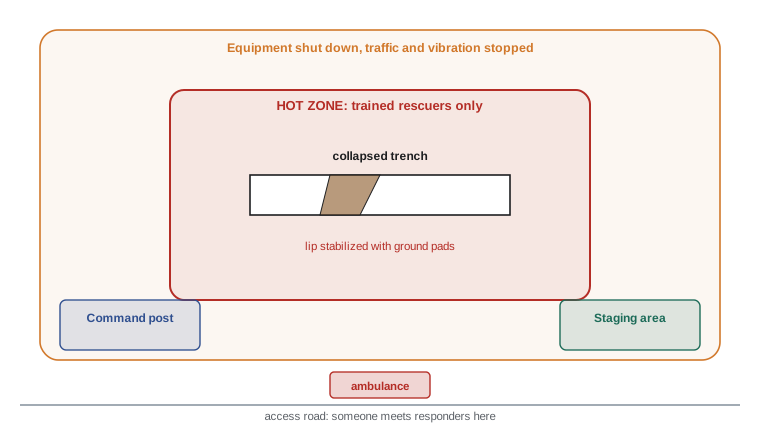
- Call 911 immediately. Say clearly that there has been a trench collapse with a worker buried, so that dispatch sends a technical rescue team as well as paramedics. Give the address, access route and the number of people trapped.
- Keep everyone out of the trench and back from the edge. Do not let co-workers enter to dig. This is the hardest instruction to enforce, and the most important.
- Shut down equipment near the trench and stop traffic, compactors and any other source of vibration, but do not move the excavator if moving it could load the edge or the victim.
- Do not remove spoil from around the edge or try to dig the victim out with a machine.
- If a worker trapped only partially and fully conscious can be helped out safely from within a protected area, for example inside an intact trench box, that may be done; otherwise wait for trained rescuers.
- Keep track of where the victim was last seen, and whether anyone else might be missing. Count heads.
- Call the utilities if any facility has been damaged, and keep ignition sources away from any gas.
- Send someone to the road to meet and guide the emergency services.
- Gather information for the incident commander: depth and dimensions of the trench, soil type, time of collapse, the victim's position, utilities in the area, and any hazards such as gas or water.
How technical rescue works
Fire services that provide trench rescue train their technical rescuers to recognized standards, such as NFPA 1006 for rescuer qualifications and NFPA 2500 for the operational capability of rescue teams. A trench rescue typically follows a sequence: size up the scene, control hazards such as utilities and traffic, stabilize the lip of the trench with ground pads or plywood to spread the weight of rescuers, install panels and struts to shore the walls around the victim, and only then enter to uncover the victim, often by hand and with small tools. Air may be supplied to the victim while this happens. The process can take hours. Rescuers will not enter until the walls are shored, because they know that an unshored trench is likely to collapse again.
The crew's job is to make that process faster and safer: clear access for the rescue vehicles, a clear briefing, equipment stopped, utilities isolated, and nobody adding to the problem. Contractors can also offer resources the fire service may lack, such as trench boxes, plywood, timber or a vacuum truck, under the direction of the incident commander.
Worked problem
How long will help take?
A contractor is digging a 3 m deep sewer connection in a rural township. The local volunteer fire department can arrive in 15 minutes but has no trench rescue capability. The nearest technical rescue team is 60 km away. Estimate the time until a buried worker could be reached, and what this means for planning.
Show solution
- Travel for the technical team: at an average of 80 km/h, 60 km takes about 45 minutes, plus perhaps 10 minutes to be dispatched.
- Setup and shoring: a typical rescue needs at least 30 to 60 minutes before rescuers can safely reach the victim.
- Total: roughly 1.5 to 2 hours before a fully buried worker could be uncovered.
- A fully buried person cannot survive that long without air, so prevention is the only realistic protection, and the plan must make sure no one is ever in an unprotected trench.
Answer: Around 1.5 to 2 hours. Rescue cannot be relied on; the protective system is the only real protection.
Other emergencies in excavations
- Gas strike: follow lesson 4. Evacuate upwind, eliminate ignition sources and call 911 and the gas utility. Account for everyone, including workers who were in the trench.
- Hazardous atmosphere: if a worker collapses in a trench, assume the air may be the cause. Do not enter without testing and appropriate respiratory protection. Use a retrieval line if one is attached. Ventilate and call for help.
- Flooding: get workers out by the nearest ladder immediately; do not wait to save tools or equipment.
- Electrical contact: keep everyone away from the machine and any energized ground, call the utility, and do not touch a victim who may still be in contact with the source.
- Medical emergencies: a worker who has a heart attack, heat stroke or injury in a trench still needs to be brought out safely. Plan how a stretcher could be lifted out, and remember that the trench must still be protected for responders.
First aid for trench victims
Trench victims may have crush injuries, suffocation, spinal injuries, fractures, hypothermia and shock. First aiders should follow their training and the instructions of the 911 dispatcher until paramedics arrive. Crush syndrome is a particular concern: when pressure on a large muscle mass is released after a long time, toxins and potassium released from damaged muscle can cause heart rhythm problems and kidney failure. That is why technical rescuers and paramedics coordinate the moment of release, and why victims who seem fine after being freed still need hospital assessment.
Reporting and investigation
After a fatality or critical injury in Ontario, the employer and constructor must notify the Ministry of Labour, Immigration, Training and Skills Development, the joint health and safety committee or health and safety representative, and the union, if any, immediately by telephone or other direct means, and provide a written report within 48 hours under section 51 of the OHSA. The scene must not be disturbed except to save life, relieve suffering, maintain an essential public utility or prevent unnecessary damage, until an inspector gives permission. Other provinces have similar requirements. Damage to buried facilities must be reported to the owner, and the regional one-call or damage prevention body collects reports to identify trends.
An investigation should look past the immediate cause, such as no trench box, to the reasons behind it: was a box on site, was the competent person present, was the schedule realistic, did the crew feel able to refuse, and had similar shortcuts happened before without consequence? Fixing those underlying causes prevents the next incident; blaming the victim does not.
| Emergency | First actions | Do not |
|---|---|---|
| Trench collapse with burial | Call 911 for trench rescue; keep everyone out; stop equipment and traffic; meet responders | Enter the trench; dig with a machine; pull on the victim |
| Gas strike | Evacuate upwind; remove ignition sources; call 911 and utility | Try to stop the leak; start engines |
| Worker collapses in trench | Assume bad air; test; ventilate; call 911 | Enter without testing and protection |
| Rapid flooding | Get out by the nearest ladder | Stay to save equipment |
| Power line or cable contact | Keep away; call the utility and 911 | Touch the machine or victim |
Supporting the crew afterwards matters as well. Workers who witness a collapse or a co-worker's death can suffer serious psychological effects; employers should arrange access to critical incident support and employee assistance programs and should not pressure the crew to return to the trench immediately.
Common mistakes
MistakeJumping into a collapsed trench to dig out a co-worker.
InsteadCall 911 for trench rescue and keep everyone out of the unprotected trench.
MistakeUsing the excavator to dig towards a buried worker.
InsteadShut it down; machines near a victim can kill them and load the walls.
MistakeTelling 911 only that a worker is injured.
InsteadSay trench collapse with a worker buried so a technical rescue team is sent.
MistakeAssuming the fire department can always perform a trench rescue quickly.
InsteadFind out before work starts who has trench rescue capability and how long they take.
MistakeCleaning up the scene before investigators arrive.
InsteadPreserve the scene except as needed to save life or prevent further harm.
Summary and key terms
- Secondary collapses kill untrained rescuers; keep everyone out of a collapsed trench.
- Buried victims cannot be pulled free; soil weight and friction hold them.
- Plan emergencies before digging: calls, access, rescue capability, utilities.
- Call 911 and say trench collapse so technical rescue is dispatched.
- Technical rescuers shore the walls before entering; rescue takes hours.
- Gas, air, flooding and electrical emergencies need their own first actions.
- Report fatalities and critical injuries immediately and preserve the scene.
- Secondary collapse
- A further cave-in after the first, often triggered by rescuers or loads at the edge.
- Technical rescue team
- Rescuers trained and equipped for specialized rescues such as trench collapse.
- Incident commander
- The person in overall charge of an emergency response.
- Lip
- The edge of a trench, which rescuers stabilize before approaching.
- Ground pad
- A panel laid at the edge to spread the weight of rescuers.
- Crush syndrome
- Shock and organ damage that can follow release of crushed muscle.
- Hot zone
- The area of highest hazard at an incident, entered only by trained responders.
- Retrieval line
- A line attached to a worker's harness so they can be pulled out without entry.
- Critical injury
- An injury of a serious nature defined in Ontario regulations, which must be reported immediately.
Practice problems
Work each problem on paper first, then reveal the answer to check.
Why do untrained rescuers often become victims?
Show answer
They enter an unprotected trench that collapses again.
What should be said when calling 911 for a trench collapse?
Show answer
That there is a trench collapse with a worker buried, plus location, access and number trapped.
Why should the excavator not be used to dig out a victim?
Show answer
It can strike the victim and its weight can trigger a second collapse.
What do technical rescuers do before entering a collapsed trench?
Show answer
Stabilize the lip and shore the walls.
What is crush syndrome?
Show answer
Heart and kidney problems caused by toxins released when crushed muscle is freed.
A worker collapses in a trench with no visible injury. What should you suspect?
Show answer
A hazardous atmosphere; test before anyone enters.
Name three items to include in an excavation emergency plan.
Show answer
Who calls and what to say, rescue capability and response time, first aid, utility contacts, meeting responders.
Within what time must a written report follow a critical injury in Ontario?
Show answer
48 hours.
What resources might a contractor offer rescuers?
Show answer
Trench boxes, plywood, timber, a vacuum truck, under the incident commander's direction.
What should an investigation look for beyond the immediate cause?
Show answer
Underlying causes such as schedule, equipment availability, supervision and culture.
Lesson quiz · 5 questions
Score 60% or more to complete this lesson.
Create a free account to save your progress, take quizzes and earn a certificate.