
HSE-210 · Lesson 9 of 12 · 28 min
Restoring equipment and removing locks safely
Removing locks and restarting equipment is the most dangerous moment of the lockout cycle after the work itself. People are tired and eager to get production running. Guards may still be off, tools may be left inside, a coworker may be crawling out from under the machine, and the controls may be in the run position from testing. This lesson covers the release sequence, temporary re-energization for testing or positioning, and the strict rules for removing a lock when the person who applied it is not there.
The release sequence
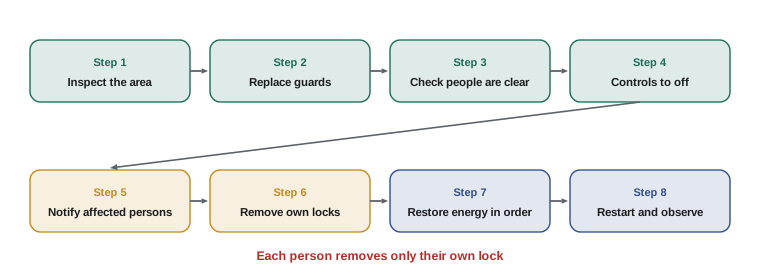
Release follows its own fixed sequence, mirroring the lockout steps in reverse:
- inspect the work area: make sure the work is complete, non-essential items such as tools, parts, rags and test equipment have been removed, and machine components are intact and operational;
- replace guards and safety devices, and reconnect anything that was disconnected for the work;
- check that all workers are safely positioned or removed from the machine and its danger zones, and do a head count in group jobs;
- make sure controls are in the off or neutral position;
- notify affected persons that locks are being removed and the equipment is about to be restarted;
- remove locks and tags, each person removing only their own;
- restore energy at the isolating devices in the order the procedure specifies, for example air before electrical or the reverse depending on the machine;
- start the equipment using normal controls and confirm it operates correctly, staying alert for unexpected behaviour.
CSA Z460 and Canadian regulations require that equipment not be restarted until it is safe to do so and workers have been notified, and that each lock be removed only by the person who applied it, except under the defined removal procedures discussed below.
Inspecting the area and accounting for tools
A forgotten wrench inside a gearbox or a rag in a fan can cause serious damage or become a projectile when the machine starts. Many sites use tool accountability methods for large or critical equipment: tools are logged in and out, foam shadow boards show missing tools at a glance, or a final walk-down is done by a second person. For confined spaces and large machines, a head count of everyone who entered is essential; group lock boxes help here, because each person removes their lock only when they have left the equipment.
Worked problem
Tool accountability check
Before restarting a large mixer after a gearbox repair, the crew checks its tool log. 23 tools were signed out at the start of the job and 22 have been returned to the shadow board. What should happen next?
Show solution
- Tools out: 23. Tools returned: 22. Missing: \( 23 - 22 = 1 \).
- The equipment must not be restarted until the missing tool is found or it is confirmed that it is not inside the equipment.
- Search the gearbox, mixer bowl and surrounding area; if necessary reopen inspection covers before any lock is removed.
Answer: Stop: one tool is unaccounted for. Locks stay on until it is found.
Removing your lock
Each person removes only their own lock, and only when they are clear of the equipment and finished with their part of the job. In a group lockout, workers remove their personal locks from the group box as they finish. When all personal locks are off, the person in charge confirms everyone is clear, opens the box, takes the job lock keys and removes the job locks in the order the procedure specifies. If the job is incomplete and the equipment must remain out of service, the person in charge may leave the job locks in place under a hold or out-of-service procedure, with clear tags.
Temporary re-energization for testing or positioning
Some jobs need the equipment energized partway through: to test a repair, to jog a machine to a new position, to set up a die, or to troubleshoot a fault. This is a recognized situation, but it must follow a controlled sequence:
- clear the machine of tools and materials;
- remove all workers from the machine and its danger zones;
- remove the lockout devices, following the normal release steps;
- energize and carry out the test or positioning;
- de-energize all systems and reapply energy control, including verification, before work resumes.
Each test cycle repeats the full lockout before anyone is exposed again. If troubleshooting must be done with the equipment energized, for example electrical testing on live circuits, that is a different kind of work that requires specific procedures, qualified workers and protective measures, not lockout.
CSA Z460 allows temporary removal for testing and positioning under a defined procedure and calls for alternative methods where live work is unavoidable.
Worked problem
The cost of test cycles
A technician troubleshooting a filler expects to need four test runs. Each re-lockout takes 12 minutes including verification, and each release and test takes 6 minutes. How much time does the controlled sequence add, and is that a reason to skip re-lockout?
Show solution
- Per cycle: \( 12 + 6 = 18 \) minutes.
- Four cycles: \( 4 \times 18 = 72 \) minutes.
- That is significant, but skipping re-lockout means working on equipment that has just been energized and could be again. The answer is to plan the troubleshooting to minimize cycles, not to skip lockout.
Answer: About 72 minutes; not a reason to skip lockout, but a reason to plan the work carefully.
When the person who applied a lock is not there
Sooner or later, a lock is left on after its owner has gone home, gone on vacation or left the company. It is tempting to cut it off and get the machine running. That is exactly how people get killed: the owner might still be inside the equipment, or might return the next day expecting the equipment to be locked out. Every program needs a strict procedure for removing a lock in the owner's absence, and every jurisdiction regulates it.
Canadian regulations generally allow removal by someone other than the person who applied the lock only under defined conditions. In British Columbia, a supervisor may remove a lock after trying to contact the worker and confirming that the equipment can be operated safely, and the worker must be told at the start of their next shift. Quebec allows the employer to authorize removal of a forgotten lock or one with a lost key with the installer's agreement, or after an inspection of the equipment, and every removal must be logged. Most other provinces require the person removing the lock to be competent and designated, to make reasonable efforts to contact the owner, and to confirm no one is endangered.
A sound abandoned lock procedure typically requires:
- confirming that the owner is not on site, including a physical search of the equipment and checking with gate or sign-in records;
- reasonable efforts to contact the owner by phone or message, documented with times;
- authorization by a designated manager, not just any supervisor;
- an inspection of the equipment to confirm no one is in it and it is safe to operate, often by two people;
- removal by a designated competent person, with the removal logged;
- informing the owner before they return to work, often by a note at the time clock or a call, and a discussion afterward about why the lock was left.
Worked problem
An abandoned lock timeline
At 23:10 the night shift finds a day-shift electrician's lock still on a pump. The procedure requires (1) a site search, about 20 minutes; (2) two phone calls 15 minutes apart, with a message; (3) manager authorization, about 10 minutes after the second call; (4) a two-person equipment inspection, about 15 minutes. If each step starts when the previous one ends, when is the earliest time the lock could be removed?
Show solution
- Site search: 23:10 to 23:30.
- First call at 23:30, second call at 23:45.
- Manager authorization by 23:55.
- Inspection from 23:55 to 00:10.
- Earliest removal: 00:10, logged, with the electrician informed before their next shift.
Answer: About 00:10, an hour after discovery. The delay is deliberate: it protects anyone who might still be inside.
Emergencies
Occasionally equipment must be restarted urgently, for example to rescue someone or to prevent a greater hazard such as a runaway process. Emergency procedures should still require the area to be checked and the people involved to be accounted for before any lock is removed by someone else. Rescuing a person trapped in a machine often requires keeping energy isolated, not restoring it, so emergency plans should be worked out in advance with the people who know the equipment.
Restart and the first minutes of operation
Even when every step has been followed, watch the equipment closely when it restarts. Stand clear of pinch points and line of fire. Listen for unusual sounds, watch for leaks or vibration, and be ready to stop it. Tell the operator what was done and anything unusual to watch for. Close out the work order, return devices to the lockout station and report any problems with the procedure so it can be improved.
Restoring energy in the right order
The order in which energy is restored can matter as much as the order in which it was isolated. Restoring air to a machine before its control power is on may allow cylinders to move to unpredictable positions; restoring hydraulic pressure before guards are in place can move parts suddenly. The machine-specific procedure should state the restoration order and any checks between steps, such as confirming that a raised part is supported before air is restored, or that valves are in the correct position before a pump is started. Restore one source at a time and observe the machine as each comes back.
Preventing locks from being left on
Abandoned locks are usually a symptom of something else: jobs that run past the end of a shift without a proper transfer, workers called away to another emergency, or confusion about who was still working. Good shift handover procedures, end-of-shift checks of group boxes and lockout boards, and a culture of following up on every abandoned lock all reduce how often the removal procedure has to be used.
Common mistakes
MistakeRemoving locks before checking that everyone is clear.
InsteadDo a head count and visual check before any lock comes off.
MistakeLeaving controls in the run position after testing.
InsteadReturn controls to off or neutral before removing locks.
MistakeTesting a repair and then going back in without re-locking.
InsteadReapply lockout and verify after every test or positioning cycle.
MistakeCutting off a lock left by someone who went home.
InsteadFollow the formal abandoned lock procedure: search, contact, authorize, inspect, log and inform.
MistakeRestarting without telling the operator what was done.
InsteadNotify affected persons and brief them on anything unusual.
Summary and key terms
- Release has its own sequence: inspect, replace guards, clear people, controls off, notify, remove own locks, restore energy, restart.
- Tool accountability and head counts prevent restart injuries and damage.
- Each person removes only their own lock.
- Testing or positioning requires clearing, releasing, testing and then full re-lockout and verification.
- Removal of another person's lock is allowed only under a strict procedure set by regulation and the program.
- Abandoned lock procedures include search, contact, authorization, inspection, logging and informing the owner.
- Watch closely during restart and report any procedure problems.
- Release sequence
- The steps for removing locks and restoring energy safely.
- Tool accountability
- A system for confirming that every tool taken into equipment is removed.
- Shadow board
- A board with outlines showing where each tool belongs, making missing tools obvious.
- Head count
- Confirming everyone who entered equipment has left.
- Testing and positioning
- Temporary re-energization of equipment to test it or move it.
- Abandoned lock
- A lock left on equipment when its owner is not available.
- Designated person
- A person formally appointed to carry out a task such as lock removal.
- Out-of-service lockout
- Locks and tags keeping equipment unavailable until work resumes.
- Line of fire
- The path of moving equipment, released energy or ejected material.
- Removal log
- A record of locks removed by someone other than the owner.
Practice problems
Work each problem on paper first, then reveal the answer to check.
What should you check before removing locks?
Show answer
The work is complete, tools removed, guards replaced, people clear and controls off.
Who removes a personal lock?
Show answer
Only the person who applied it, except under the abandoned lock procedure.
What is the sequence for testing during a job?
Show answer
Clear tools, clear people, remove devices, energize and test, then de-energize and re-lock.
A crew signs out 15 tools and returns 15. Can they proceed?
Show answer
Yes, as far as tools are concerned, after the other release checks.
Name three elements of an abandoned lock procedure.
Show answer
Confirm the owner is off site, attempt contact, authorize, inspect, log and inform the owner.
Why must the owner be told before returning to work?
Show answer
So they do not assume the equipment is still locked out.
Three test cycles take 20 minutes each. Total?
Show answer
60 minutes.
What should happen when equipment restarts?
Show answer
Stand clear, watch and listen for problems, and brief the operator.
Why might a rescue require keeping energy isolated?
Show answer
Restoring energy could move parts onto the trapped person.
What happens to job locks when all personal locks are off a group box?
Show answer
The person in charge confirms everyone is clear and removes them in the specified order.
Lesson quiz · 5 questions
Score 60% or more to complete this lesson.
Create a free account to save your progress, take quizzes and earn a certificate.