
HSE-210 · Lesson 11 of 12 · 28 min
Machine-specific procedures, placards, inspections and audits
A lockout program lives or dies by its procedures. When a millwright arrives at an unfamiliar machine at three in the morning, the procedure posted beside it is what tells them where every isolation point is, what device to use, how to release the stored energy and how to verify. If the procedure is missing, out of date or vague, the worker is left to guess. This lesson covers how good machine-specific procedures are written and maintained, how placards and labels support them, and how periodic inspections and audits keep the whole system honest.
What a machine-specific procedure contains
Formats vary, but good procedures share a common structure:
- a header with the machine name and unique identifier, location, procedure number, revision number and date, author and approver;
- the scope: which tasks the procedure covers, and any tasks that need a different procedure or an approved alternative method;
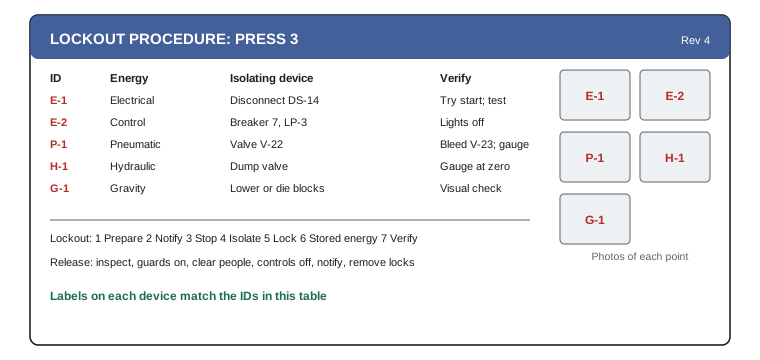
- an energy source table listing each source with its identifier, type, magnitude, location, isolating device, lockout device, stored energy control and verification method;
- the shutdown, isolation, lockout, stored energy and verification steps in order;
- the release and restart steps, including the order in which energy is restored;
- photographs or diagrams showing each isolation point, with the identifier visible on a label;
- special notes: hazards such as hot surfaces or chemicals, other permits required, group lockout arrangements and contacts.
| ID | Energy | Magnitude | Isolating device and location | Stored energy and verification |
|---|---|---|---|---|
| E-1 | Electrical | 600 V, 3-phase | Main disconnect DS-14, east wall | Try start; qualified person tests for absence of voltage |
| E-2 | Electrical (control) | 120 V | Breaker 7, panel LP-3 | Try start; control lights off |
| P-1 | Pneumatic | 620 kPa | Ball valve V-22 at drop, lock handle | Open bleed V-23; gauge at zero |
| H-1 | Hydraulic | 14 MPa | Pump isolated by E-1 | Open accumulator dump valve; gauge at zero |
| G-1 | Gravity | 450 kg platen | Lower to rest or insert die blocks | Visual check of blocks |
Writing a procedure
Procedures are best written by a small team that includes an authorized person who works on the machine, an operator, and someone who knows the program requirements. A typical process:
- gather manuals, drawings and existing procedures;
- walk down the machine, tracing every energy source to its isolating device and noting stored energy;
- label each isolation point with its identifier if it is not already labelled;
- take photographs of each isolation point, showing the device and label;
- draft the procedure in plain language, using short numbered steps;
- field-test it: have an authorized person who did not write it perform the lockout from the draft alone, while the team watches for gaps or confusing steps;
- correct the draft, get it approved and post it;
- add it to the procedure register with a review date.
Plain language matters. Steps such as 'Isolate all sources' tell an experienced person nothing they did not know and tell a new person nothing they can use. 'Turn disconnect DS-14 on the east wall to OFF and apply lock' is clear.
Placards and labels
Many workplaces post a one-page placard at each machine, with photographs and the energy table, so the procedure is available at the point of use. Each isolating device should carry a durable label with its identifier and what it isolates, such as 'DS-14: Press 3 main power'. Labels and placards must match: if the procedure says V-22, the valve must say V-22. Mismatched or missing labels are a common inspection finding and a common cause of the wrong device being isolated.
Keeping procedures current
Equipment changes: a new air cylinder is added, a disconnect is moved, a heater is installed with its own supply. Each change can make the procedure wrong. Good programs link procedure review to management of change, so that any modification to equipment or energy sources triggers a review before the equipment returns to service. Procedures are also reviewed when an incident or near miss reveals a problem, when workers report a mismatch, and on a fixed schedule.
Periodic inspections
CSA Z460 calls for periodic review of the hazardous energy control program and procedures, including observation of authorized persons performing lockout, to confirm that procedures are accurate and followed. Quebec requires written procedures to be reviewed periodically, and other provinces expect employers to show that their procedures are maintained. Many Canadian employers adopt an annual inspection of each procedure as good practice.
A good periodic inspection is more than a paperwork check. The inspector watches an authorized person perform the lockout on the actual equipment, compares what they do with the written procedure, checks that the procedure still matches the equipment, and talks with the worker about their responsibilities. Findings are recorded and corrected.
Worked problem
Scheduling annual inspections
A site has 58 machine-specific procedures, each to be inspected at least once a year. Inspections are spread over 48 working weeks and shared by 3 trained inspectors. Each inspection takes about 45 minutes. (a) How many inspections are needed per week? (b) How many per inspector per week? (c) How many inspector hours per year?
Show solution
- (a) \( 58 \div 48 \approx 1.2 \) inspections a week.
- (b) \( 1.2 \div 3 \approx 0.4 \): about one inspection every two to three weeks per inspector.
- (c) \( 58 \times 0.75 = 43.5 \) hours a year.
Answer: About 1.2 inspections a week, 0.4 per inspector, and 43.5 inspector hours a year.
Audits of the program
Beyond inspecting individual procedures, the program as a whole should be audited, often annually, by someone independent of day-to-day lockout. An audit checks whether the program document is current, whether every machine that needs a procedure has one, whether training records are complete, whether periodic inspections were done and their findings closed, whether lock removal logs show problems, whether contractors were managed properly, and whether workers at all levels understand the rules. Audit checklists produce a score that can be tracked over time, but the most useful output is a list of specific improvements.
Worked problem
Scoring an audit
An audit checklist has 24 items. The auditor finds 19 fully compliant, 3 partly compliant (scored as half) and 2 non-compliant. What is the audit score as a percentage? Which items should be fixed first?
Show solution
- Points: \( 19 \times 1 + 3 \times 0.5 + 2 \times 0 = 20.5 \).
- Score: \( 20.5 \div 24 \approx 0.854 \), about 85 per cent.
- The two non-compliant items come first, especially if they affect worker protection directly, such as missing procedures or uncertified training.
Answer: About 85 per cent; fix the non-compliant items first, starting with those that expose workers.
Worked problem
Leading indicators
Over a quarter, a site records 410 lockouts, 6 failed verifications (energy found during the try step or testing), 2 abandoned lock removals and 9 procedure mismatches reported by workers. Calculate the failed verification rate per 100 lockouts, and say what the numbers suggest.
Show solution
- Failed verification rate: \( 6 \div 410 \times 100 \approx 1.5 \) per 100 lockouts.
- Each failed verification was a near miss caught by the system: verification is working, but isolation errors are happening.
- Nine reported mismatches show workers are engaged, and point to procedures that need updating; the two abandoned lock removals should be reviewed for causes.
Answer: About 1.5 failed verifications per 100 lockouts. Investigate the causes, update the mismatched procedures and review the abandoned locks.
Using findings to improve
Inspections and audits are only useful if their findings lead to changes. Typical improvements include rewriting unclear steps, adding missing photographs, relabelling isolating devices, adding lockout stations, buying the right devices, retraining individuals or groups, redesigning equipment to make isolation easier, and engineering out frequent exposures. Sharing results with workers and the health and safety committee builds trust and shows that reports of problems lead to action.
Procedures for similar machines
Large sites may have dozens of identical machines. It can be efficient to write one procedure covering a group of machines with the same type and magnitude of energy, the same isolating devices in the same relative locations and the same stored energy controls. The risk is that the machines drift apart over time through modifications. A group procedure must list each machine it covers, and each machine must still be labelled and checked. When one machine in the group is modified, the procedure must be updated or that machine given its own procedure.
Electronic procedures and records
Many organizations now keep procedures, inspection records and training records in electronic systems, sometimes with tablets or QR codes at each machine that link to the current procedure and photographs. These systems make it easier to control revisions, schedule inspections and analyse trends. They also create new risks: a worker without connectivity cannot see the procedure, and an electronic version may differ from an old paper placard left on the machine. Programs using electronic procedures should keep a reliable posted copy at the point of use and remove outdated paper versions whenever a procedure is revised.
The annual review of the program
Once a year, many employers review the whole program with management and the health and safety committee. The review looks at inspection and audit findings, incidents and near misses, leading indicators, changes to regulations and standards (such as new editions of consensus standards), changes in equipment and staffing, and feedback from workers. It ends with a short action plan with owners and dates. This closes the loop shown in lesson 4: the program is not a binder on a shelf but a system that learns.
Learning from other sites
Organizations with several sites can share procedures, inspection findings and incident lessons between them. A failed verification at one plant often reveals a weakness that exists on similar equipment elsewhere. Regular sharing, through safety bulletins, cross-site audits or a central procedure library, spreads improvements quickly and prevents each site from having to discover the same problem the hard way.
Finally, keep procedures readable. A procedure that runs to many pages will not be read at three in the morning. Put the essential steps and photographs on the placard, and keep background information, such as the risk assessment for an alternative method, in the full procedure file.
Common mistakes
MistakeWriting procedures at a desk from drawings alone.
InsteadWalk down the equipment and field-test the draft with an authorized person.
MistakeUsing vague steps such as "isolate all energy".
InsteadName each device, its location and the action, in plain language.
MistakeLabels that do not match the procedure identifiers.
InsteadLabel every isolating device with the same identifier used in the procedure.
MistakeTreating periodic inspection as a paperwork review.
InsteadObserve an authorized person performing the lockout and compare it with the procedure.
MistakeModifying equipment without reviewing the procedure.
InsteadLink procedure review to management of change.
Summary and key terms
- Machine-specific procedures include a header, scope, energy source table, lockout and release steps, photographs and special notes.
- Procedures are written from a walk-down and field-tested by an authorized person who did not write them.
- Placards and labels put the procedure at the point of use and must match its identifiers.
- Management of change, incidents, worker reports and fixed schedules trigger procedure reviews.
- CSA Z460 calls for periodic review including observation; annual inspection is common good practice.
- Program audits check procedures, training, inspections, logs and contractor management.
- Leading indicators such as failed verifications and reported mismatches show where to improve.
- Energy source table
- The part of a procedure listing each energy source with its isolation and verification details.
- Placard
- A one-page posted procedure with photographs at the machine.
- Isolation point label
- A durable label identifying an isolating device and what it isolates.
- Field test
- Performing a draft procedure on the equipment to find gaps before approval.
- Procedure register
- A list of all procedures with revision and review dates.
- Management of change
- A process for reviewing hazards and procedures before changes are made.
- Periodic inspection
- A regular check that a procedure is accurate and followed.
- Certification
- A record confirming an inspection or training was done, with names and dates.
- Program audit
- An independent review of the whole energy control program.
- Leading indicator
- A measure of activity or near misses that predicts future performance.
Practice problems
Work each problem on paper first, then reveal the answer to check.
What columns belong in an energy source table?
Show answer
Identifier, type, magnitude, location, isolating device, lockout device, stored energy control and verification.
Who should field-test a draft procedure?
Show answer
An authorized person who did not write it.
Why must labels match procedure identifiers?
Show answer
So the right device is isolated without guesswork.
Name two triggers for procedure review.
Show answer
Equipment changes, incidents or near misses, worker reports of mismatches, or the scheduled review date.
What does a good periodic inspection include?
Show answer
Observing an authorized person perform lockout, comparing with the procedure, and reviewing responsibilities.
A site has 36 procedures and 2 inspectors over 48 weeks. Inspections per inspector per week?
Show answer
36 ÷ 48 ÷ 2 ≈ 0.375.
An audit scores 18 of 20 items compliant. Percentage?
Show answer
90 per cent.
Calculate failed verifications per 100 lockouts for 4 in 250.
Show answer
1.6 per 100.
Why are worker-reported mismatches a good sign?
Show answer
They show workers are engaged and catching problems before injuries.
What is management of change?
Show answer
A process that reviews hazards and procedures before equipment or processes are changed.
Lesson quiz · 5 questions
Score 60% or more to complete this lesson.
Create a free account to save your progress, take quizzes and earn a certificate.