
HSE-210 · Lesson 2 of 12 · 31 min
Types and sources of hazardous energy
You cannot control energy you have not identified. The most common technical failure in lockout is a missed energy source: the main electrical disconnect is locked, but the machine also has a pneumatic cylinder fed from the plant air system, a hydraulic accumulator, a counterweight or a second power feed for its heaters. This lesson goes through the main types of hazardous energy, explains the difference between energy supplied from outside and energy stored inside the equipment, and shows with simple calculations why stored energy deserves respect.
Energy that is supplied and energy that is stored
It helps to sort energy into two groups. Supplied energy comes into the equipment from an outside source: electricity from a panel, compressed air from the plant system, steam or hot water from a boiler, process fluids from a pipe. You control supplied energy mainly by isolating it at an energy-isolating device such as a disconnect switch or line valve.
Stored energy stays inside the equipment after the supply is isolated. Examples include a raised press ram, a compressed spring, air trapped in a cylinder between a closed valve and the piston, oil pressure held in a hydraulic accumulator, a charged capacitor in a motor drive, a heavy flywheel still spinning, or a hot surface that takes hours to cool. Residual energy is another term for the same idea: what remains after isolation. Stored energy must be released, restrained, blocked or allowed to dissipate, and then verified, before work starts. Lesson 7 covers how.
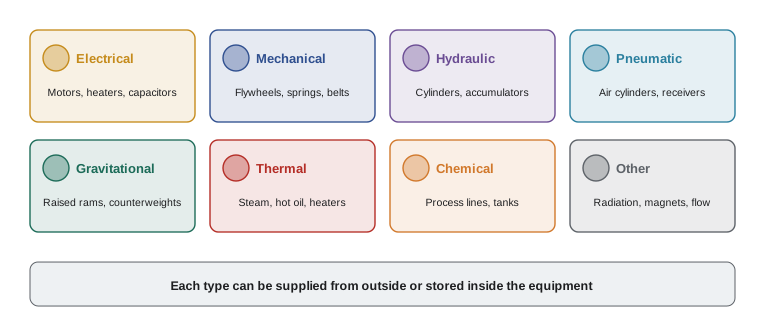
Electrical energy
Electrical energy powers motors, heaters, controls, lights, magnets and welding equipment. The hazards are electric shock, burns and arc flash, and the unexpected movement of anything the electricity drives. Electrical energy is usually isolated at a disconnect switch, a circuit breaker or by unplugging cord-and-plug equipment. Watch for:
- more than one feed, such as a separate supply for heaters, controls, lighting or a heat trace;
- control power from a separate transformer or panel that keeps relays and controllers live after the main disconnect is open;
- uninterruptible power supplies, batteries and backup generators;
- capacitors in motor drives, power supplies and power factor correction banks, which can hold a dangerous charge after isolation;
- induced voltage from nearby lines and back-feed from other equipment.
Verifying that electrical equipment is de-energized requires an appropriate voltage tester used by a qualified person. This course explains the idea in lesson 7. Detailed electrical safety, including arc flash, is covered in HSE-214.
Mechanical energy
Mechanical energy is the energy of moving or tensioned parts: rotating shafts, flywheels, belts, chains, gears, blades, rollers and springs. Even after the motor is isolated, a heavy flywheel or rotor can keep turning for minutes, and a spring under compression or tension can release suddenly when a part is loosened. Tensioned conveyor belts, coiled wire, banding under tension and torsion bars all store mechanical energy. Mechanical energy is controlled by letting moving parts come to a complete stop, by braking, by blocking, and by releasing spring tension in a controlled way.
Hydraulic and pneumatic energy
Hydraulic systems use pressurized liquid, usually oil, to move cylinders, presses, lifts and clamps. Pneumatic systems use compressed air or another gas. Both can hold pressure in lines, cylinders and accumulators after the pump or supply is isolated. A hydraulic line under pressure can inject oil through skin, a fluid injection injury that needs urgent surgical care. A pneumatic cylinder with trapped air can move suddenly when a fitting is loosened. Hydraulic and pneumatic energy is isolated by closing and locking supply valves, then bleeding or venting the trapped pressure through bleed valves, and verifying with gauges.
Gravitational energy
Anything that can fall or move downhill has gravitational energy: a raised press ram or platen, a lift table, a dump body, a hopper of material, a suspended load, a counterweight, a door or a mast. Isolating the hydraulic or electrical power to a lifting system does not remove the gravitational energy; in fact, isolating hydraulic power without blocking may allow the load to drift down as pressure leaks away. Gravitational energy is controlled by lowering the part to its rest position, or by mechanical blocking with pins, blocks, safety props or die blocks rated for the load.
Thermal and chemical energy
Thermal energy includes hot and cold surfaces, steam, hot water, hot oil, molten material and cryogenic liquids. It can cause burns and, through expansion, create pressure. Thermal energy is controlled by isolating the heat source and allowing time to cool, and by isolating and draining hot or cold process lines. Chemical energy includes reactive, flammable, toxic or corrosive substances in pipes, tanks and vessels. It is controlled by isolating lines, often with double block and bleed arrangements or blanks, and by draining, purging and cleaning. Work inside tanks and vessels also brings in confined space requirements, which are covered in HSE-211.
Other forms
Some workplaces also have radiation sources, such as industrial radiography or nuclear gauges, lasers, magnetic fields from lifting magnets, and process energy such as material flow in chutes and silos. Engulfment in flowing granular material, such as grain or sand, is a form of hazardous energy. These are controlled by isolation methods specific to the hazard, such as shuttering a radiation source, and by procedures written by qualified people.
| Energy type | Examples of sources | Typical control |
|---|---|---|
| Electrical | Motors, heaters, controls, capacitors, batteries | Lockable disconnect or breaker; discharge and test |
| Mechanical | Flywheels, springs, belts, rotating shafts | Wait for stop, brake, block, release tension |
| Hydraulic | Cylinders, presses, accumulators, lines | Close and lock valves; bleed; check gauges |
| Pneumatic | Air cylinders, receivers, air lines | Close and lock valves; vent; check gauges |
| Gravitational | Raised rams, lifts, counterweights, hoppers | Lower to rest or block mechanically |
| Thermal | Steam, hot oil, heaters, cryogenic liquids | Isolate, drain, allow to cool or warm |
| Chemical | Process pipes, tanks, reactive substances | Isolate, blank, drain, purge, test atmosphere |
How much energy is stored? Some calculations
Numbers help explain why stored energy is dangerous. The unit of energy is the joule (J). As a reference point, dropping a 1 kg object from a height of 1 m releases about 10 J, which might bruise a foot. The examples below show stored energies in the hundreds of thousands of joules.
Here \( k \) is the spring stiffness, \( x \) the compression or extension, \( m \) the mass, \( g \) the acceleration due to gravity (9.81 m/s²), \( h \) the height, \( C \) the capacitance, \( V \) the voltage, \( I \) the moment of inertia and \( \omega \) the rotational speed in radians per second.
Worked problem
Energy in a compressed spring
A guard counterbalance spring has a stiffness of 20 kN/m and is compressed 0.15 m. How much energy is stored?
Show solution
- Use \( E = \tfrac{1}{2} k x^{2} \).
- \( E = 0.5 \times 20\,000 \times 0.15^{2} = 0.5 \times 20\,000 \times 0.0225 = 225 \) J.
- That is more than 20 times the energy of the dropped 1 kg object, released in a fraction of a second if the spring retainer is removed.
Answer: About 225 J.
Worked problem
Energy in a raised press platen
A press platen with a mass of 500 kg is held 0.6 m above the bed by hydraulic pressure. What gravitational energy is stored, and what force would a falling platen exert at rest on a block?
Show solution
- Use \( E = m g h \).
- \( E = 500 \times 9.81 \times 0.6 \approx 2\,943 \) J, or about 2.9 kJ.
- The weight is \( m g = 500 \times 9.81 \approx 4\,905 \) N, so a support block must be rated well above 4.9 kN, with a safety factor set by the manufacturer or an engineer.
Answer: About 2.9 kJ; a block rated well above 4.9 kN.
Worked problem
Energy in a compressed air receiver
A plant air receiver holds 500 L at a gauge pressure of 700 kPa. Estimate the order of magnitude of the stored energy using pressure times volume.
Show solution
- Convert: 500 L = 0.5 m³ and 700 kPa = 700 000 Pa.
- \( pV = 700\,000 \times 0.5 = 350\,000 \) J, or about 350 kJ.
- A full thermodynamic calculation gives a somewhat different number, but the order of magnitude is hundreds of kilojoules: enough to drive a cylinder or blow a fitting apart.
Answer: Roughly 350 kJ, an order-of-magnitude estimate.
Worked problem
Energy in a motor drive capacitor and a flywheel
(a) A variable frequency drive has a DC bus capacitance of 2,000 µF charged to 650 V. How much energy is stored? (b) A flywheel with a moment of inertia of 12 kg·m² spins at 1,200 rpm. How much energy does it store, and if friction provides a braking torque of 5 N·m, roughly how long will it take to coast to a stop?
Show solution
- (a) \( E = \tfrac{1}{2} C V^{2} = 0.5 \times 0.002 \times 650^{2} = 0.5 \times 0.002 \times 422\,500 \approx 423 \) J.
- (b) Convert speed: \( \omega = 1\,200 \times 2\pi / 60 \approx 125.7 \) rad/s.
- \( E = \tfrac{1}{2} I \omega^{2} = 0.5 \times 12 \times 125.7^{2} \approx 94\,800 \) J, or about 95 kJ.
- Coast-down time \( t = I \omega / \tau = 12 \times 125.7 / 5 \approx 302 \) s, about 5 minutes.
Answer: About 423 J in the capacitor, enough to kill; about 95 kJ in the flywheel, which could take around 5 minutes to stop.
Two lessons follow from these numbers. First, isolation of the supply is only half the job: the stored energy can be as dangerous as the supplied energy. Second, time matters. Drives warn users to wait a stated number of minutes before opening them, and flywheels need time or a brake to stop. A procedure must say how stored energy is released and how long to wait.
Finding every source
How do you make sure nothing is missed? Good practice combines several sources of information:
- the manufacturer's manual and drawings, including electrical schematics, piping and instrumentation diagrams and hydraulic and pneumatic circuit diagrams;
- a physical walk-down of the equipment, tracing cables, pipes and hoses back to their sources;
- labels on disconnects, breakers and valves, checked against the drawings;
- the people who operate and maintain the equipment, who often know about the second feed or the valve no one labelled;
- previous procedures, incident reports and near miss reports;
- a check of what is upstream and downstream: process lines from other equipment, shared air headers, conveyors that feed or are fed by this one.
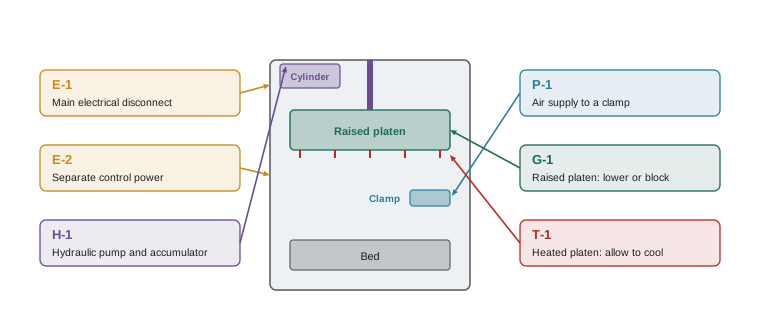
The result is an energy source inventory for the machine, which becomes part of its machine-specific procedure (lesson 11). Each source gets an identifier, such as E-1 for the main electrical disconnect, P-1 for the main air valve and H-1 for the hydraulic accumulator dump valve, and each identifier matches a label on the equipment.
Common mistakes
MistakeLocking out the main electrical disconnect and assuming the machine is safe.
InsteadList every energy source, including air, hydraulic, gravity, springs, heat and separate control power.
MistakeIsolating hydraulic power to a raised part without blocking it.
InsteadLower the part or block it mechanically, because pressure can leak and let it drift down.
MistakeOpening a motor drive immediately after switching it off.
InsteadWait the time stated by the manufacturer and verify that capacitors are discharged.
MistakeStarting work while a flywheel or rotor is still coasting.
InsteadWait for a complete stop, or use a brake, and verify that motion has stopped.
MistakeRelying only on labels when identifying sources.
InsteadCheck labels against drawings and a physical walk-down, and ask operators and maintainers.
Summary and key terms
- Hazardous energy can be electrical, mechanical, hydraulic, pneumatic, gravitational, thermal, chemical or another form such as radiation.
- Supplied energy comes from outside; stored or residual energy remains after isolation.
- Stored energy must be released, restrained, blocked or dissipated and then verified.
- Simple formulas show that springs, raised loads, air receivers, capacitors and flywheels can store hundreds of thousands of joules.
- Capacitors and flywheels need time, discharge or braking before work.
- A complete energy source inventory uses drawings, a walk-down, labels and the knowledge of operators and maintainers.
- Each source gets an identifier that matches a label and a step in the procedure.
- Supplied energy
- Energy delivered to equipment from an outside source, such as electricity or plant air.
- Residual energy
- Energy that remains in equipment after the supply is isolated; also called stored energy.
- Accumulator
- A vessel that stores hydraulic fluid under pressure, often with a gas charge.
- Bleed valve
- A valve used to release trapped pressure from a line or component.
- Mechanical block
- A device such as a pin, prop or block that prevents a part from moving or falling.
- Flywheel
- A heavy rotating wheel that stores rotational energy.
- DC bus
- The internal direct-current circuit of a motor drive, which includes large capacitors.
- Fluid injection injury
- An injury in which pressurized fluid is forced through the skin.
- Energy source inventory
- A list of every hazardous energy source on a machine, with identifiers and controls.
- Joule
- The SI unit of energy; about the energy released by a 1 kg object falling 10 cm.
Practice problems
Work each problem on paper first, then reveal the answer to check.
What is the difference between supplied and stored energy?
Show answer
Supplied energy comes from an outside source; stored energy remains in the equipment after isolation.
Give two examples of gravitational energy in a plant.
Show answer
A raised press ram, lift table, counterweight, hopper or suspended load.
Why can a hydraulically raised part drift down after the pump is isolated?
Show answer
Pressure leaks past seals and valves, so the part is no longer supported.
Calculate the energy in a spring with k = 10 kN/m compressed 0.2 m.
Show answer
0.5 × 10,000 × 0.04 = 200 J.
Calculate the energy in a 200 kg part raised 1.5 m.
Show answer
200 × 9.81 × 1.5 ≈ 2,943 J.
A 1,000 µF capacitor is charged to 400 V. How much energy is stored?
Show answer
0.5 × 0.001 × 160,000 = 80 J.
Why must you wait before opening a motor drive?
Show answer
Its capacitors can hold a dangerous charge for several minutes after isolation.
Name three sources of information for an energy source inventory.
Show answer
Manuals and drawings, a physical walk-down, labels, operators and maintainers, and past procedures or incidents.
Why is control power a common missed source?
Show answer
It may come from a separate transformer or panel and stay live after the main disconnect is open.
What extra hazard arises when working inside a tank after isolating its lines?
Show answer
Confined space hazards, such as hazardous atmospheres, covered in HSE-211.
Lesson quiz · 5 questions
Score 60% or more to complete this lesson.
Create a free account to save your progress, take quizzes and earn a certificate.