
HSE-210 · Lesson 5 of 12 · 26 min
Locks, tags and lockout devices
A lockout is only as good as the hardware that holds it. A lock that can be pried off with a screwdriver, a breaker lockout that slips off the handle, a valve cover that does not fit, or a tag that fades in the rain can all leave a worker exposed while believing they are protected. This lesson describes the main types of lockout hardware, the requirements they must meet, and the limits of tags.
Requirements for lockout hardware
CSA Z460 and Canadian regulations expect lockout devices to be suitable for the conditions, to hold the isolating device in the safe position, and to identify the person who applied them. Personal locks must be individually keyed, with the key kept by the person who applied the lock, and several provinces add specific rules: British Columbia, for example, prohibits combination locks and requires each personal lock to be marked or tagged to identify the worker.
In practice, good hardware is:
- dedicated: used only for lockout, never for tool boxes, lockers or gates;
- individually keyed, with one key per lock held by the person who applied it;
- identified, with the worker's name, photo or number on the lock or an attached tag;
- standardized, so that everyone recognizes a lockout lock at a glance, often by a distinctive colour;
- suitable for the environment: non-conductive bodies for electrical work, corrosion-resistant materials for wet or chemical areas, high-temperature rating near hot equipment;
- matched to the isolating device, so it holds the device firmly in the off or closed position.
Personal locks and keys
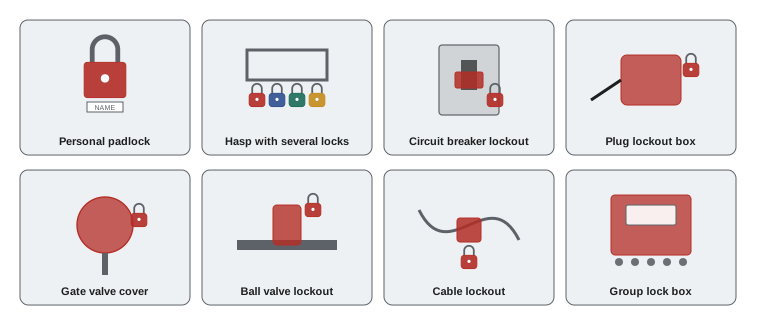
The personal lock is the core of the system. Most programs issue each authorized person a set of locks, all keyed alike for that person but different from everyone else's, so one key opens all of that person's locks and no one else's. Some programs use a different colour for each department or trade, or a special colour for supervisors' or contractors' locks. Duplicate or master keys are a weak point. If they exist at all, they must be strictly controlled, logged and used only under the formal lock removal procedure in lesson 9.
Locks should have the person's name and photo or another clear identifier. A lock that says only 'Danger' does not tell anyone whom to find if the lock is still on at the end of a shift.
Devices for electrical isolation
Electrical disconnect switches designed for lockout have a hasp or a hole in the handle that accepts a padlock when the switch is in the off position. Circuit breakers need an add-on device: clamp-on breaker lockouts that grip the toggle, pin-in or pin-out devices that fit into holes in the breaker, or panel-mounted devices for large moulded case breakers. Plug lockouts are boxes or covers that enclose the plug of cord-and-plug equipment so it cannot be reconnected. Fuses that are removed should be kept by the authorized person, and the fuse holder may need a lockout device. Lockout devices on electrical equipment are often made of non-conductive materials.
Lockout must be applied at the energy-isolating device, not at a control. Locking a start button cover or a control panel door does not isolate the energy.
Devices for valves and fluid systems
Valves are locked with devices that fit over or around the handle. Gate valve covers enclose the handwheel so it cannot be turned. Ball valve lockouts clamp around the lever so it cannot move from the closed position. Butterfly valve lockouts and universal valve lockouts with adjustable arms fit other designs. Cable lockouts, which thread a steel cable through several handles and lock its ends, are useful where several valves or awkward handles must be secured together.
For hazardous chemicals, steam and high-pressure lines, closing a single valve may not be enough, because valves leak. Stronger isolation methods include double block and bleed (two closed valves with an open vent between them), physically disconnecting and capping the line, or inserting a blank or blind flange. Pneumatic lines can be isolated with lockable quick-disconnect devices that prevent the hose from being reconnected.
Blocks, pins and restraints
Gravity and mechanical energy are often controlled with physical restraints rather than locks on isolating devices. Examples are die blocks placed between the platens of a press, safety props under a raised dump body, pins inserted through holes in a lift mast, and chains or straps that hold a part in place. These must be rated for the load, positioned according to the procedure, and themselves locked or tagged where possible so no one removes them while people are exposed.
Hasps and group lock boxes
When several people work on the same equipment, each must be able to apply their own lock. A hasp is a hinged steel loop with several holes. It is placed on the isolating device, and each worker puts their lock through a hole. The isolating device cannot be operated until every lock is removed and the hasp is opened. Hasps typically hold four to six locks, and hasps can be linked for more.
For larger jobs, a group lock box is more practical. The isolating devices are locked with a set of locks whose keys are placed in the box; each worker then puts their personal lock on the box. Lesson 8 explains group lockout in detail.
Worked problem
How many hasps are needed?
Fourteen workers must each apply a personal lock to one disconnect. Each hasp has 6 holes. When hasps are chained, each additional hasp uses one hole of the previous hasp. How many hasps are needed? Would a group lock box be better?
Show solution
- One hasp gives 6 lock positions.
- Each additional hasp adds 6 positions but uses 1, a net gain of 5.
- With \( n \) hasps: positions \( = 6 + 5(n - 1) = 5n + 1 \).
- Solve \( 5n + 1 \geq 14 \): \( n \geq 2.6 \), so 3 hasps, giving 16 positions.
- A chain of three hasps hanging from one disconnect is awkward, and if there are several isolating devices the problem multiplies, so a group lock box is better for a crew of this size.
Answer: Three chained hasps (16 positions), but a group lock box is the better choice.
Worked problem
Sizing a lock issue
A site has 18 authorized persons. The most complex machine that one person locks out individually has 4 isolation points. The site wants each person to have enough locks for that machine, plus a 10 per cent spare stock for replacements. How many personal locks should be ordered?
Show solution
- Locks per person: 4.
- Locks for all persons: \( 18 \times 4 = 72 \).
- Spares: \( 72 \times 0.10 = 7.2 \), round up to 8.
- Total: \( 72 + 8 = 80 \) locks, each set keyed to its owner.
Answer: 80 locks: 72 issued in keyed-alike sets of four, plus 8 spares.
Tags: what they do and what they cannot do
A tag is a warning device. It identifies who applied the lockout and why, and it warns others not to operate the equipment. Tags are attached to locks in almost every program, because a lock alone may not say who applied it or why. A good tag:
- carries a clear warning such as 'Danger: Do not operate';
- shows the name of the person, the date, the reason and a contact number;
- is durable enough for the environment, including moisture, chemicals and sunlight;
- is attached securely so it cannot come off by accident.
CSA Z460 and Canadian regulations treat tags as supplementary to locks. Tag-only systems are not an acceptable substitute for lockout under most provincial regulations, except where an alternative method has been justified by a risk assessment and gives equivalent protection.
Whatever the rules, everyone must understand the limitations of tags:
- a tag is a warning, not a physical barrier, and does not stop anyone from operating the device;
- tags must be legible and understandable by everyone, including workers who read a different language or have limited literacy;
- tags can be torn off, fall off or become illegible;
- tags can give a false sense of security;
- a tag must never be removed or ignored by anyone other than the person who applied it, or bypassed in any way.
| Feature | Lock | Tag alone |
|---|---|---|
| Prevents operation | Yes, physically | No, warning only |
| Identifies who applied it | If marked or tagged | Yes |
| Can be removed by others | Only with force or a controlled key | Easily |
| Affected by weather and wear | Usually durable | Can fade, tear or fall off |
| Acceptable as the main control | Yes | Only as an approved alternative method |
Inspecting and caring for hardware
Lockout hardware wears out. Locks corrode, shackles bend, breaker lockouts lose their grip, valve covers crack and cable lockouts fray. Authorized persons should inspect their devices before use and remove damaged items from service. Hardware should be stored at lockout stations near the equipment so it is available when needed; a common reason for skipping lockout is that the right device was not at hand. A well-stocked lockout station with labelled devices for the machines in that area makes the correct choice the easy choice.
Lockout for equipment that cannot accept a lock
Older equipment may have isolating devices that were never designed for a lock: a disconnect without a hasp, a valve with a removable handle, a breaker without lockout holes. The right long-term fix is to modify or replace the isolating device so it can be locked. In the meantime, programs use adaptable devices such as universal breaker lockouts, cable lockouts or valve covers, or remove a handle or circuit element and secure it, combined with additional measures. Any interim method must be written into the machine procedure so that every authorized person applies it the same way.
Common mistakes
MistakeUsing a personal lock for a locker or tool box as well as for lockout.
InsteadLockout locks are dedicated to lockout and never used for anything else.
MistakeLocking the control panel door or the start button cover.
InsteadLock the energy-isolating device itself, such as the disconnect or valve.
MistakeRelying on one closed valve on a hazardous chemical or steam line.
InsteadUse double block and bleed, disconnection or a blank where the procedure requires stronger isolation.
MistakeTreating a tag as if it physically prevents operation.
InsteadA tag is a warning only; use a lock wherever possible.
MistakeKeeping a spare key on a hook in the maintenance shop.
InsteadControl any duplicate key strictly and use it only under the formal removal procedure.
Summary and key terms
- Lockout hardware must be dedicated, durable, standardized, substantial and identifiable.
- Personal locks are individually keyed, with the only key held by the person who applied them.
- Breaker lockouts, plug lockouts, valve covers, cable lockouts and quick-disconnect lockouts suit different isolating devices.
- Blocks, pins and props restrain gravity and mechanical energy and must be rated for the load.
- Hasps and group lock boxes let several workers each apply a personal lock.
- Tags identify and warn but do not physically prevent operation.
- Inspect hardware before use and keep it at lockout stations near the equipment.
- Personal lock
- A lockout lock assigned to one worker, keyed so only that worker's key opens it.
- Keyed alike
- A set of locks opened by the same key, usually all belonging to one worker.
- Hasp
- A hinged device with several holes that lets multiple workers lock one isolating device.
- Breaker lockout
- A device that holds a circuit breaker in the off position and accepts a lock.
- Plug lockout
- A cover or box that encloses a plug so it cannot be reconnected.
- Gate valve cover
- A device that encloses a valve handwheel so it cannot be turned.
- Cable lockout
- A steel cable threaded through handles and locked to secure several devices.
- Blank
- A solid plate inserted in a pipeline to block flow; also called a blind.
- Double block and bleed
- Two closed valves with an open vent between them.
- Lockout station
- A board or cabinet near equipment holding locks, tags and devices.
Practice problems
Work each problem on paper first, then reveal the answer to check.
Name four qualities of good lockout hardware.
Show answer
Dedicated, durable, standardized, substantial, identifiable and suited to the environment.
Why should personal locks not be used for lockers?
Show answer
They must be dedicated to lockout so they are always recognized and available.
What device locks a ball valve?
Show answer
A ball valve lockout that clamps around the lever.
When might a blank be used instead of a closed valve?
Show answer
On hazardous chemical, steam or high-pressure lines where valves may leak.
How many lock positions do two chained six-hole hasps give?
Show answer
11 (5 × 2 + 1).
What should a tag show?
Show answer
A warning, the person's name, date, reason and contact information.
Give two limitations of tags.
Show answer
They do not physically prevent operation; they can fall off, become illegible or give a false sense of security.
Why are non-conductive locks used on electrical equipment?
Show answer
To reduce the risk of conducting electricity.
What is the risk of an uncontrolled duplicate key?
Show answer
Someone could remove a lock while the worker is still exposed.
Why keep lockout stations near equipment?
Show answer
So the right devices are available and workers are not tempted to skip lockout.
Lesson quiz · 5 questions
Score 60% or more to complete this lesson.
Create a free account to save your progress, take quizzes and earn a certificate.