
HSE-210 · Lesson 10 of 12 · 28 min
Alternative methods, minor servicing and exceptions
Lockout is the default, but it is not always practical. An operator who clears a jam from a labelling machine 30 times a shift cannot spend 10 minutes locking it out each time; a technician setting up a robot may need power to the robot to teach it positions; some processes cannot be fully de-energized without creating a greater hazard. Standards in both countries recognize these situations and allow alternatives, but only under strict conditions. This lesson explains the exceptions and alternative methods, and why they must never become a loophole.
Why alternatives exist
There are three common reasons lockout may not fit a task:
- frequency: tasks such as clearing jams, adjusting guides or changing small tools happen so often during production that full lockout every time would stop production and, in practice, would simply be skipped;
- necessity of energy: some tasks, such as troubleshooting, teaching a robot or fine adjustment, need power to some parts of the equipment;
- process constraints: shutting down a continuous process, a furnace or a chemical reaction may create greater hazards than controlling exposure in another way.
The honest answer to these problems is not to tolerate unprotected work, but to design protection that works for the task. That might mean redesigning the machine so the task is not needed, moving the adjustment point outside the guard, or using engineered safeguards that reliably prevent hazardous motion while a person is exposed.
The hierarchy of control for hazardous energy
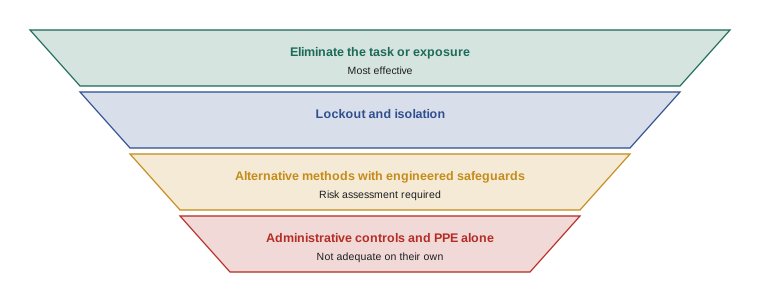
Both CSA Z460 and ANSI/ASSP Z244.1 apply the hierarchy of controls. In order of preference:
- eliminate the need for the task or the exposure, for example by redesigning the jam-prone part or providing remote adjustment;
- lockout or other energy isolation;
- alternative methods based on a documented risk assessment, using engineering controls such as safety-rated interlocks, trapped key systems and safety-rated monitored stops;
- administrative controls and PPE, which on their own are never adequate protection against hazardous energy.
Alternative methods under CSA Z460
CSA Z460 allows other methods of hazardous energy control when lockout is not practicable, provided a documented risk assessment shows that the alternative gives effective protection for the specific task. The risk assessment identifies the task, the hazards, who is exposed and how often, evaluates the risk, selects controls using the hierarchy, and verifies that the residual risk is acceptable. Workers and the health and safety committee should be involved. The alternative method is then written into a procedure, workers are trained on it, and it is reviewed regularly.
Provincial regulations take a similar line. Quebec's regulation allows a method other than lockout where it ensures equivalent safety and the employer documents it; Alberta, British Columbia and other provinces allow safe work procedures or equivalent protection where lockout is not practicable. In every case, the employer must be able to show why lockout is not practicable and how the alternative protects workers as well.
Examples of alternative methods
Common engineered alternatives include safety-rated interlocked guards with control circuits designed to recognized performance levels, trapped key interlock systems that make it physically impossible to open a guard until power is isolated, two-hand controls for some setup tasks, safety-rated reduced speed with enabling devices for robot teaching under CSA Z434, and safety-rated monitored standstill. Each must be designed to an appropriate level of reliability, assessed under standards such as ISO 13849-1 or IEC 62061, and checked regularly.
| Method | How it protects | Key condition |
|---|---|---|
| Safety-rated interlocked guard | Opening the guard stops hazardous motion and prevents restart | Designed to the required performance level and tested regularly |
| Trapped key interlock | The guard key is released only when the isolator is off and locked | Keys controlled; system maintained |
| Enabling device at reduced speed | Motion only while the device is held, at limited speed | For setup and teaching; trained users only |
| Safety-rated monitored standstill | The drive is monitored and stopped if motion is detected | Rated safety function; used for short tasks |
| Local disconnect under exclusive control | The worker isolates and controls the energy at the point of work | Isolation is real, not a control signal |
Cord-and-plug equipment
Equipment powered only through a cord and plug, with no other energy sources, can be controlled by unplugging it, provided the plug is under the exclusive control of the person doing the work. Exclusive control means the plug is physically in the worker's possession or in sight and within reach, so no one else can plug it back in. If the plug is out of sight, for example behind a machine or in another room, a plug lockout device should be used. Equipment with other energy sources, such as compressed air or stored energy, still needs those controlled.
Hot tapping and live work
Hot tapping is welding a connection onto a pressurized pipeline while it remains in service, used on gas, steam and water lines where shutdown would be impractical or would cause a greater hazard. It is a specialized operation with its own procedures and qualified personnel. Similarly, energized electrical work, when it is justified, falls under electrical safety rules rather than lockout. These are not ways around lockout; they are separate disciplines with their own strict controls.
Worked problem
Why frequent tasks need engineered solutions
Operators clear jams on a labeller about 30 times per shift, on two shifts, 250 days a year. Full lockout would take about 10 minutes each time. (a) How many jam clearances happen per year? (b) How many hours would full lockout take? (c) What does this suggest?
Show solution
- (a) \( 30 \times 2 \times 250 = 15\,000 \) clearances per year.
- (b) \( 15\,000 \times 10 = 150\,000 \) minutes, or \( 150\,000 / 60 = 2\,500 \) hours.
- (c) With this many exposures, workers will be tempted to skip lockout, and each exposure carries risk. The right response is to reduce jams at the source and provide an engineered alternative, such as an interlocked access door that safely stops and holds the machine, backed by a risk assessment.
Answer: 15,000 clearances and about 2,500 hours a year; fix the jams and engineer the access, rather than relying on workers to choose between lockout and production.
Worked problem
How reliable is a safety function?
An interlocked guard circuit is designed to a performance level with an average probability of a dangerous failure of about \( 1 \times 10^{-7} \) per hour. The machine operates 4,000 hours a year. Roughly how many dangerous failures would be expected per year? What maintains that reliability?
Show solution
- Expected failures per year \( \approx 1 \times 10^{-7} \times 4\,000 = 4 \times 10^{-4} \).
- That is about one dangerous failure in 2,500 years of operation.
- The figure assumes correct design, installation and regular proof testing; bypassed or poorly maintained interlocks can fail far more often.
Answer: About 0.0004 per year, provided the system is properly designed, maintained and tested.
Worked problem
Does an exception apply?
Decide whether lockout is needed: (a) an operator clears a label jam through an interlocked, safety-rated door that stops and holds the machine, as part of normal production, as described in a documented risk assessment; (b) a mechanic replaces a conveyor drive chain; (c) a technician unplugs a bench grinder, keeps the plug in hand and changes a wheel; (d) a cleaner sprays down a slicer after unplugging it, with the plug lying behind the machine out of sight.
Show solution
- (a) An alternative method may apply: routine, repetitive, integral, with an engineered safeguard backed by a risk assessment.
- (b) Lockout: this is maintenance involving disassembly, not minor servicing.
- (c) The cord-and-plug exception applies: single energy source and exclusive control of the plug.
- (d) Lockout or a plug lockout is needed: the plug is not under exclusive control.
Answer: (a) Alternative method; (b) lockout; (c) cord-and-plug exception; (d) plug lockout needed.
Guarding against misuse
Alternatives and exceptions are often misused. Signs of misuse include a task described as minor that involves reaching deep into a machine, removing several guards or taking more than a few minutes; reliance on stop buttons or e-stops rather than safety-rated systems; interlocks that are routinely bypassed; and 'alternative methods' that exist only as a sentence in a procedure without a risk assessment. Periodic inspections (lesson 11) should check alternative methods as carefully as lockout procedures, including whether the safeguards still work and whether workers are using them as intended.
Mobile equipment and special cases
Mobile equipment, such as forklifts, loaders and trucks, also needs hazardous energy control during maintenance: removing the key, setting brakes, chocking wheels, lowering or blocking raised attachments, disconnecting batteries and releasing hydraulic pressure. Robots and automated cells use a combination of lockout for maintenance and safety-rated modes for teaching and troubleshooting, under robot safety standards. Programmable controllers and remote access create new risks: a network command could restart equipment, which is why newer standards discuss cybersecurity in energy control.
Documenting an alternative method
A documented alternative method usually includes the task description and how often it is done, the hazards and energy sources involved, the people exposed, the risk estimate before and after controls, the engineered safeguards relied on and their required performance, the step-by-step method workers follow, the training required, how the safeguards are tested and how often, and who approved it and when it will be reviewed. Keeping this information together makes it possible for inspectors, auditors and new employees to understand why lockout is not used for that task and what protects the worker instead.
Workers have an important role in alternative methods. They are often the first to notice that an interlock has become unreliable, that a task now takes longer than the risk assessment assumed, or that a workaround has crept in. Programs should invite workers to report these problems and should review the alternative method promptly when they do.
Common mistakes
MistakeCalling any quick task "minor servicing" to avoid lockout.
InsteadThe task must be routine, repetitive and integral to production, with effective engineered protection.
MistakeUsing a stop button or e-stop as the alternative method.
InsteadAlternatives must use safety-rated engineered controls backed by a documented risk assessment.
MistakeUnplugging equipment but leaving the plug out of sight.
InsteadKeep the plug under exclusive control or use a plug lockout device.
MistakeWriting an alternative method into a procedure without a risk assessment.
InsteadDocument the risk assessment, involve workers, train and review regularly.
MistakeTolerating frequent jams because operators have an alternative method.
InsteadReduce the need for exposure at the source as the first step in the hierarchy.
Summary and key terms
- Lockout is the default; alternatives exist for frequent tasks, tasks needing energy and process constraints.
- The hierarchy prefers eliminating the exposure, then lockout, then engineered alternatives; administrative controls alone are not enough.
- CSA Z460 and provincial regulations allow other methods only where lockout is not practicable and a risk assessment shows effective protection.
- Engineered alternatives include safety-rated interlocks, trapped key systems, enabling devices and monitored standstill.
- Cord-and-plug equipment can be controlled by unplugging if the plug is under exclusive control.
- Hot tapping and energized electrical work are separate disciplines with their own controls.
- Inspections should check alternative methods as carefully as lockout procedures.
- Alternative method
- A non-lockout energy control justified by risk assessment for a specific task.
- Minor servicing
- Routine, repetitive tasks integral to production, such as small adjustments or jam clearing.
- Risk assessment
- A documented process to identify hazards, evaluate risk and select controls.
- Trapped key interlock
- A system of keys that enforces a safe sequence, such as isolating before opening a guard.
- Enabling device
- A hand-held switch that permits motion only while held in its middle position.
- Safety-rated monitored standstill
- A safety function that monitors a stopped drive and trips if motion occurs.
- Performance level
- A measure of the reliability of a safety function under ISO 13849-1.
- Exclusive control
- Having a plug in your possession or within sight and reach so no one else can reconnect it.
- Hot tap
- Connecting to a pressurized pipeline while it remains in service.
- Control-reliable
- A safety circuit designed so a single failure does not prevent it from stopping the machine.
Practice problems
Work each problem on paper first, then reveal the answer to check.
Give three reasons lockout might not fit a task.
Show answer
Very frequent tasks, tasks that need energy, and processes that cannot be safely shut down.
What is first in the hierarchy?
Show answer
Eliminating the need for the task or the exposure.
What must support an alternative method?
Show answer
A documented risk assessment showing effective protection, plus procedures, training and review.
What three words describe tasks eligible as minor servicing?
Show answer
Routine, repetitive and integral to production.
When is unplugging enough?
Show answer
When the plug is the only energy source and under the worker's exclusive control.
A task occurs 20 times per shift on 3 shifts for 300 days. How many times a year?
Show answer
18,000.
Why is an e-stop not an alternative method?
Show answer
It is a control device, not a safety-rated system designed and verified for the task.
What is a trapped key interlock?
Show answer
A key system that releases the guard key only when the energy is isolated.
Name two steps for controlling energy on a forklift.
Show answer
Remove the key, set brakes, chock wheels, lower or block attachments, disconnect the battery.
Why do newer standards mention cybersecurity?
Show answer
Network commands could restart equipment during servicing.
Lesson quiz · 5 questions
Score 60% or more to complete this lesson.
Create a free account to save your progress, take quizzes and earn a certificate.